
Cutting Monthly Work Hours With AI
How Philippine businesses use AI to reduce monthly hours and lower costs, with the tasks that give back the most time.


AI Engineer · 36+ years in IT · Japanese, based in Manila for 13+ years

Summary
- Repetitive tasks such as invoice processing, customer inquiries, and report generation often consume the largest share of monthly work hours in Philippine SMEs.
- AI tools combined with proper workflow design can reduce manual hours on routine work, freeing staff for higher-value activities.
- Successful AI adoption in the Philippines is phased. One task, one team, one month, with the result written down before the next step.
The Hidden Cost of Manual Work in Philippine SMEs
| Business Area | Common Manual Task | Typical Time Drain |
|---|---|---|
| Accounting | Manual invoice entry and reconciliation | Daily, hours per staff |
| Customer Service | Answering repeated inquiries | Continuous interruption |
| HR & Payroll | Timesheet collection and validation | Weekly batch work |
| Marketing | Social media posting and reporting | Daily and weekly tasks |
| Operations | Status reports and meeting minutes | Weekly recurring load |
Philippine SMEs operate under tight margins. Many business owners in Metro Manila, Cebu, and Davao tell similar stories: skilled staff spend most of their day on repetitive paperwork rather than client work or growth activities. A bookkeeper who should focus on financial analysis instead types receipts into spreadsheets. A customer service agent answers the same five questions a hundred times a week.
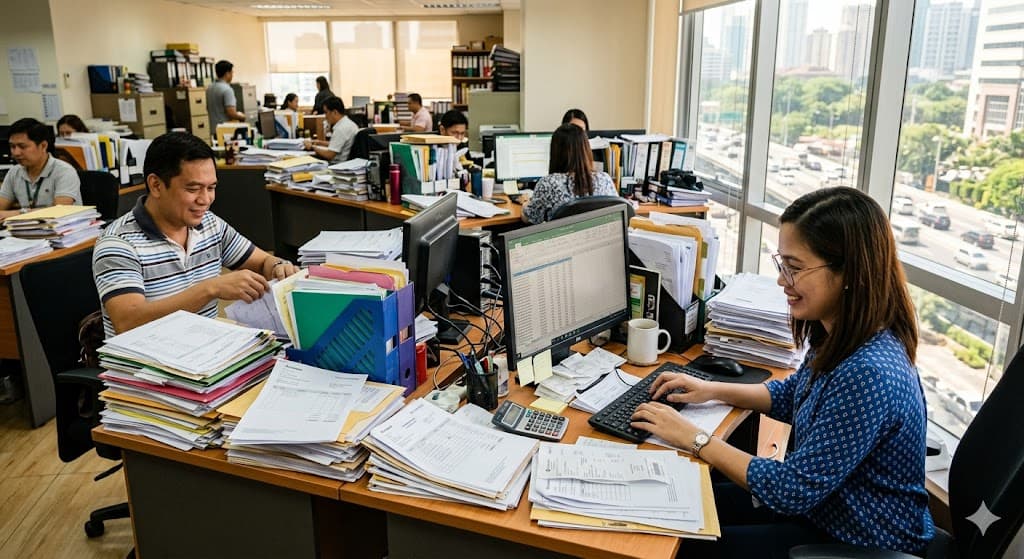 Manual paperwork consumes a large share of monthly work hours in many Philippine SMEs.
This problem is not unique to small companies. Even mid-sized firms with 50 to 200 employees lose substantial monthly hours to manual processes. The cost is not only the peso value of those hours but also the opportunity cost of work not done, customers not served, and improvements not made.
Local context matters here. Internet stability, peso-based pricing of software, and BIR-compliant documentation requirements all shape what solutions are realistic. A tool that works perfectly in a Silicon Valley startup may not fit a Quezon City logistics firm with mixed connectivity.
Related: Automating Routine Business Tasks in the Philippines explains this in detail.
Why Traditional Solutions Fall Short
| Traditional Approach | Main Limitation | Practical Impact |
|---|---|---|
| Hiring more staff | Rising labor cost and training time | Linear cost growth |
| Generic SaaS templates | Poor fit for local processes | Workarounds reappear |
| Custom-built systems only | High upfront cost and long timeline | Cash flow strain |
| Manual process improvement | Depends on staff discipline | Reverts under pressure |
Hiring more people is the default Philippine response to workload pressure. It works up to a point, but every new hire brings recruitment cost, training time, and management overhead. Adding three people to handle invoices does not solve the underlying issue that invoice processing itself is repetitive.
Generic SaaS templates promise quick wins. A Philippine retail business with multiple branches, mixed payment methods, and BIR requirements rarely fits a one-size template designed for US e-commerce, and the gap becomes monthly manual work.
Custom-built systems sit at the other extreme. They fit the business well but cost millions of pesos and take months to deliver. For an SME with limited cash flow, this gap between cheap-but-wrong and expensive-but-right has historically blocked progress.
Pure process improvement, such as Lean or Kaizen, helps but depends on staff discipline. When deadlines pressure the team, shortcuts return and the old habits come back.
How AI Reshapes the Time Equation
| AI Capability | Business Application | Hours Saved Pattern |
|---|---|---|
| Document understanding | Invoice and receipt extraction | Daily accounting tasks |
| Natural language responses | Customer FAQ automation | Continuous support load |
| Text generation | Reports, emails, summaries | Weekly admin work |
| Data classification | Lead scoring, ticket routing | Sales and support triage |
| Workflow orchestration | Connecting multiple tools | Cross-department handoffs |
AI technology is well-suited for the exact kind of work that consumes Philippine SME hours: tasks that follow patterns but require some judgment. Modern large language models can read an invoice image, extract the vendor, amount, and date, and post the entry into accounting software with reasonable accuracy. A human still reviews edge cases, but the volume of routine entries drops sharply.
 AI tools reduce repetitive tasks like invoice extraction and FAQ responses.
For customer service, AI assistants trained on a company's own FAQ and product information can handle common questions in English, Tagalog, or mixed Taglish. Complex or sensitive inquiries still go to human agents, but the first filter removes a large portion of repeated questions.
Report generation is another strong fit. AI can take raw sales data, weekly meeting notes, or support tickets and produce draft summaries that a manager edits rather than writes from scratch. The time difference between editing and writing from blank is considerable.
The key shift is that AI does not replace the staff; it removes the dull repetitive layer from their work. A customer service agent becomes a problem-solver for difficult cases. A bookkeeper becomes a financial advisor to the owner.
Related: AI Tools That Streamline Daily Operations explains this in detail.
Step-by-Step Implementation for Philippine SMEs
| Step | Action | Typical Duration |
|---|---|---|
| 1 | Audit current monthly work hours | 1 to 2 weeks |
| 2 | Identify high-volume repetitive tasks | 1 week |
| 3 | Pilot one task with AI tooling | 2 to 4 weeks |
| 4 | Measure results and adjust | 2 weeks |
| 5 | Scale to next process | Rolling |
The first step is honest measurement. Without knowing how many hours go where, claims of AI savings are guesswork. Ask each team to log their work for two weeks in simple categories. The result usually surprises owners; 80 percent of hours often go to 20 percent of task types.
 Phased implementation with weekly progress reviews is key to successful AI adoption.
The second step is identifying which of those tasks are AI-suitable. Good candidates are high-volume, pattern-based, and tolerant of occasional review. Poor candidates involve high-stakes decisions, sensitive judgment, or unique one-off situations.
The third step is a pilot, not a full rollout. Pick one task, one team, and run it for a month. Set the review date when you start the pilot, not when it goes wrong. A month is long enough for a bad assumption to reach every record you own.
The fourth step is measurement against the baseline from step one. Hours saved, error rates, and staff feedback all matter. If the pilot fails, the cost is contained to one process.
The fifth step is scaling only after the pilot succeeds. Rushing to AI-enable five processes at once usually fails because the team cannot absorb that much change at the same pace.
Related: AI Adoption for Philippine SMEs in 2026 explains this in detail.
Realistic Results and Return on Investment
| ROI Factor | What to Expect | Notes |
|---|---|---|
| Hours saved per process | Meaningful reduction on repetitive tasks | Varies by task fit |
| Software cost | Subscription in pesos or USD | Budget for fluctuations |
| Implementation cost | One-time setup and training | Higher for custom work |
| Payback period | Months, not years for fit cases | Pilot first to confirm |
| Indirect benefits | Better staff retention and morale | Hard to quantify but real |
The honest answer about ROI is that it varies. A perfect-fit case, such as automating invoice data entry for a high-volume retailer, can pay back within months. A poor-fit case, such as forcing AI into a process that needs human judgment, may never pay back.
Software costs are predictable. Most AI tools charge monthly subscriptions ranging from a few hundred to several thousand pesos per user. The bigger variable is implementation: connecting the AI to existing systems, training staff, and refining prompts or rules. SMEs should budget for both.
Indirect benefits are harder to measure but often matter more than direct savings. Staff who escape repetitive work tend to stay longer with the company. Customer response times improve. Owners gain time to focus on strategy rather than firefighting.
A common mistake is expecting AI to deliver savings without process redesign. The hours saved are real only if the freed-up staff time is redirected to higher-value work. Otherwise, the savings exist on paper but not on the income statement.
FAQ
Q: Do I need a large IT team to adopt AI in my Philippine SME?
A: No. Many practical AI tools are designed for non-technical users and integrate with common platforms like Google Workspace, Microsoft 365, and local accounting software. A small business can start with one tool and one process without hiring a full IT team.
Q: Will AI work with Tagalog or Taglish customer messages?
A: Yes, modern AI models handle Tagalog and mixed Taglish reasonably well for common business contexts. Accuracy is highest for written messages and improves further when the AI is given examples specific to your business and industry.
Q: How do I handle data privacy under the Philippine Data Privacy Act?
A: Choose AI vendors that allow you to control where data is stored and processed. Document what personal data flows into AI tools, update your privacy notices, and limit AI access to only the data needed for each task. The National Privacy Commission provides guidance for businesses.
Q: What is a realistic starting budget for AI in an SME?
A: A small pilot can start with subscription costs of a few thousand pesos per month plus internal staff time. More ambitious projects with custom integration can run into hundreds of thousands of pesos. Starting small and scaling based on results is the safer path.
Q: Can AI replace my staff entirely?
A: For most Philippine SMEs, the realistic outcome is AI removing repetitive work from existing staff rather than full replacement. Customer trust, judgment on edge cases, and local relationships still require people. The goal is to free staff for work that AI cannot do well.
Moving Forward With AI in Your Business
Cutting monthly work hours through AI is achievable for Philippine SMEs, but it requires a measured approach: audit current hours, pilot one task, measure results, and scale only what works. Skipping the audit or jumping straight to a full rollout is the most common reason these projects fail.
The next practical step is simple. Pick one repetitive task that consumes the most monthly hours in your business and explore whether an AI tool can handle even part of it. A small successful pilot teaches more than a large failed deployment. PH AI Works can help Philippine businesses identify the right starting point and design a phased implementation that fits local realities.
Sources & References
- National Privacy Commission Philippines — Official guidance on Data Privacy Act compliance for Philippine businesses, including data handling and consent rules relevant to AI deployment.
- Department of Information and Communications Technology (DICT) — Philippine government agency overseeing ICT policy, digital transformation initiatives, and SME digital adoption programs.
- Department of Trade and Industry (DTI) Philippines — Resources and programs supporting Philippine MSMEs, including digitalization assistance and business modernization.
- Bangko Sentral ng Pilipinas (BSP) — Central bank publications on digital payments, financial technology, and SME finance relevant to AI-enabled business operations.
- Philippine Statistics Authority — Official statistics on SME demographics, labor, and business activity in the Philippines.
About the author
Founder / AI Engineer (36+ years in IT)
- ●From Tokyo · based in Manila for 13+ years
- ●36+ years in IT (development, SEO, AI)
- ●Google Certified AI Professional
- ●IBM Certified Generative AI Engineer
- ●AI chatbots, RAG & AI agent development
A Japanese AI engineer with 36+ years in IT and 13+ years on the ground in the Philippines. I write from hands-on experience to help Japanese companies adopt AI that actually delivers results — chatbots, workflow automation, AI agents, and AI-driven marketing. Feel free to reach out in Japanese or English.
Your Competitors Are Already Using AI!
Is your business keeping up?
Related Articles

Research, Analysis, and Writing in One Workflow
Three separate jobs whose handoffs now cost more than the work itself. How to run them as a single workflow.
8/18/2026

Shipping Small Internal Tools in Two Weeks
No-code AI development lets Philippine teams build the small internal tools that never justify a full project.
8/13/2026

AI for Accounting, HR, and Inventory
Why these three back-office functions should be automated separately, and the order that keeps mistakes cheap.
8/8/2026

No-Code AI Chatbots for 24/7 Support in the Philippines
How Philippine SMEs answer customer inquiries around the clock with a no-code AI chatbot — six steps to launch and costs in pesos.
7/14/2026

AI Automation in the Philippines: Beat the Labor Shortage
How Philippine SMEs use AI and automation to absorb rising workload without hiring more staff — where to start and what it costs.
7/13/2026

Linear for Philippine Startups: Ship Projects Faster
A practical guide to Linear, the AI-native project management tool, for Philippine startups that want to organise work and ship.
6/22/2026