
AI Adoption Interviews

Businesses we've actually helped, in their owners' own words. Different industries and scales — with costs, timelines and results out in the open.
* Names are initials and some details are blurred for privacy. Amounts are from the time of each case and approximate. Technology and market conditions can change, so please confirm the latest for your own situation.
* Alongside the Japanese companies in the Philippines we focus on today, these cases include individual clients and small local businesses. Amounts are what was charged at the time and, depending on the scale and scope of the project, differ from our current rates. See Services & Pricing for what we charge today. The figures shown also exclude the third-party services (n8n, Supabase, and similar) each project runs on.
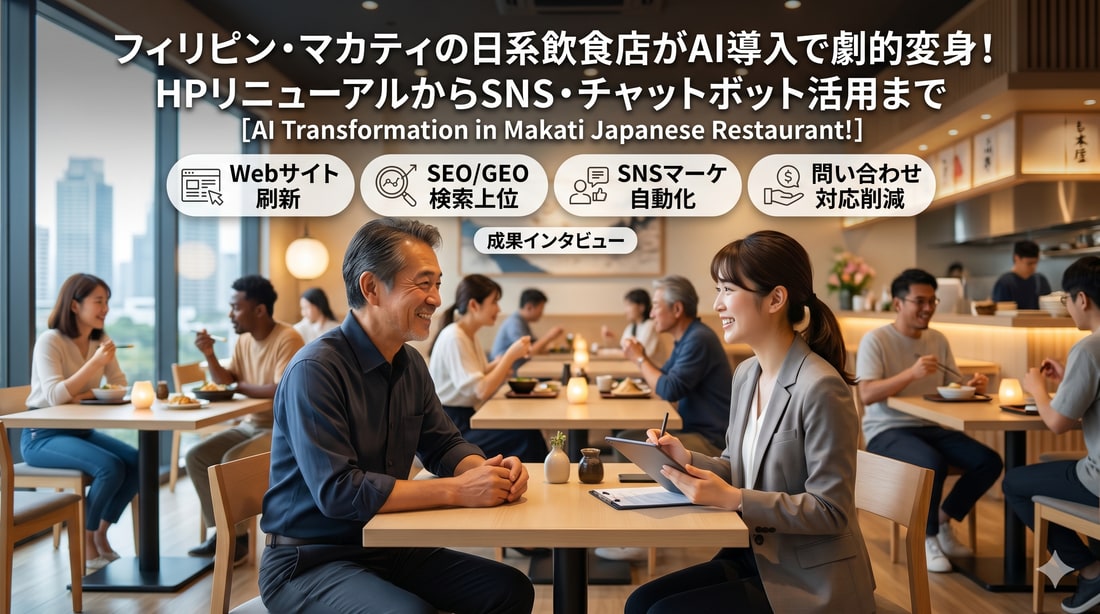
Case 1. AI for a Japanese Restaurant: New Site, SEO/GEO & Chatbot
Client: Mr. M, Japanese restaurant owner (near Little Tokyo, Makati / ~80 seats)
- Client
- Mr. M, Japanese restaurant owner (near Little Tokyo, Makati / ~80 seats)
- When
- 2026
- What we did
- Website rebuild (WordPress) / SEO & GEO / AI-assisted social (Facebook) marketing / AI chatbot / easy menu updates
- Timeline
- ~1 week consult + 1–2 months build + go-live ~2 weeks after staff training (≈2–3 months total)
- Cost
- Not disclosed (owner calls the ROI excellent)
- Results
- Top 1–5 on small keywords / almost no staff time on routine inquiries / more customers
Q.What were the challenges before AI?
A.The website was far too old, social media wasn't bringing in customers, and phone handling was a hassle. The menu was handwritten, so every change took effort.
Q.Why PH AI Works?
A.First, I could consult entirely in Japanese. And the office is right near Little Tokyo in Makati — I was amazed to find an AI specialist with this track record in the neighborhood; someone you'd struggle to meet even in Japan. Given the cost of acquiring customers and of labor, AI was actually quite affordable.
Q.What exactly did you put in?
A.First a WordPress rebuild, then SEO/GEO aimed at small keywords — and we started ranking near the top. We use AI for Facebook-centered social marketing too: analytics, posts, and automation. We added an AI chatbot so it handles simple inquiries, and made the menu easy to update from a PC. Down the line I'd like to use AI to analyze rival shops and sharpen our own strategy.
Q.Timeline?
A.About a week of consultation, one to two months to build. We set a training period for staff and went into full operation about two weeks later.
Q.Results?
A.We've held a top 1–5 ranking on small keywords. Staff almost never handle simple inquiries now. SEO/GEO and social marketing worked, customers increased — we hired more (so labor cost rose), but sales rose more, so it's a net win. Honestly I was skeptical at first, but the return on investment has been excellent.
Q.Any difficulties, and a word for others?
A.Almost none — they took my direction and advice as-is. If anything, AI moves fast, so I hesitated over 'which one to adopt,' but deciding that with an expert was a big help. Businesses and shops that don't adopt AI will fall behind.
Founder's note
For restaurants, AI works on two fronts: 'getting found by new customers' (SEO/GEO/social) and 'cutting daily work' (AI chatbot, menu updates, automation). This shop had location and taste as strengths, so all that was left was building the 'get-found' path with the latest methods. Social ROI is admittedly harder to measure than SEO/GEO, but the ranking and the jump in customers are clear.
Case 2. AI & Automation for a Manila Hair Salon
Client: Mr. H, salon owner (male, 40s, 20 years as a stylist)
- Client
- Mr. H, salon owner (male, 40s, 20 years as a stylist, married)
- When
- 2026
- What we did
- WordPress site / AI-run SEO & GEO (automated Google Analytics & Search Console analysis and improvement) / AI chatbot / AI customer management / AI marketing management
- Cost
- ~¥600,000 (design-focused)
- Timeline
- ~1.5 months from build to launch
- Results
- Inquiry & booking handling cut to almost zero labor
Q.Opening a salon in the Philippines is a big decision.
A.I spent about 20 years as a stylist in Japan. Seeing the energy of the Philippines on a trip, I decided to open here. I'd like to think this much experience is hard to find even in Japan.
Q.Why PH AI Works?
A.I'd been a customer of the operator before, so I went to them. We could talk in Japanese, and the AI track record was more than enough — no hesitation.
Q.What did you adopt?
A.A WordPress rebuild, with SEO/GEO left to AI. In particular, they automated the Google Analytics and Search Console analysis and improvement. We also added an AI chatbot, AI customer management, and AI marketing management.
Q.Results?
A.The biggest thing is that the labor for inquiries and bookings dropped to almost zero. Before, every time the phone rang mid-cut I'd keep the customer waiting to answer. Now I don't have to. If anything I keep marketing modest — push it and too many people come. The Philippines' population growth helps a lot, too.
Q.A word for those considering AI?
A.It's a world apart from Japan's declining beauty industry. Honestly, I can't imagine running a salon without AI anymore.
Founder's note
For salons, AI's 'automate bookings and inquiries' cuts labor dramatically. Automating the GA / Search Console analysis for SEO/GEO keeps improvement cycling. Mr. H had skill as his strength, so all that remained was the get-found path and automating responses.

Case 3. AI Marketing & Automation for a Personal Gym
Client: Two men in their 30s, personal-training gym co-owners (Manila)
- Client
- Two men in their 30s, personal-training gym co-owners
- When
- 2026
- Trigger
- Noticed there was no Japanese-speaking personal gym, so they opened one
- What we did
- WordPress site / SEO & GEO / AI for Google Maps acquisition / AI chatbot for inquiries
- Cost
- ~¥300,000
- Timeline
- ~1–1.5 months from build to launch
- Next
- Plan to use AI for training & meal-plan efficiency
Q.What sparked the opening?
A.There was no personal gym in Manila where you could really communicate in Japanese. So we thought, we'll do it ourselves. When we learned the operator is a Nippon Sport Science University graduate, we hit it off completely.
Q.What did you adopt?
A.We built a WordPress site and use AI for SEO/GEO and Google Maps acquisition. Inquiries are handled by an AI chatbot, so the time we spend on them went to zero.
Q.Results?
A.People find us via Google Maps now, and inquiry handling is off our plate — so the trainers can focus on coaching.
Q.What's next?
A.We'd like to use AI to streamline our clients' training and meal plans.
Q.A word?
A.Even a small gym can make acquisition and operations this much easier with AI.
Founder's note
Local + booking businesses like gyms and schools benefit from Google Maps (MEO) + an AI chatbot. Just taking inquiry-handling time to zero lets trainers focus on coaching. Streamlining plan creation is a natural next step that pairs well with AI.
Case 4. A Large-Scale AI System for an Online English School
Client: Ms. C, online English school operator (female, 30s)
- Client
- Ms. C, online English school operator (female, 30s)
- When
- 2026
- Trigger
- Knew the operator from another business (video production)
- Build
- A large-scale Next.js system (booking, instructors, materials, evaluation, marketing, semi-automated blog)
- Budget
- Over ¥10 million
- Timeline
- ~3–5 months
- Results
- Steady customer growth (a new launch, so no before/after comparison)
Q.What led to the request?
A.We'd already worked together on another business (video production), and it grew from there.
Q.What kind of system did you build?
A.A fairly large one in Next.js: email send/receive, schedule management, customer management, managing the site admin and multiple instructors, class schedules, evaluation management, instructor evaluations, marketing management, creating and managing teaching materials, linking materials to bookings, even semi-automated blog generation — essentially everything the school's operations need, in one.
Q.Budget and timeline?
A.Over ¥10 million, with development around 3–5 months. Given the scale, we took the time to do it right.
Q.Results?
A.It's a new launch, so there's no 'before vs after,' but customers are coming steadily. Having an efficient operating system from day one is huge.
Q.A word for those considering AI?
A.AI is essential technology for online English going forward. Schools that don't adopt it will, I think, decline.
Founder's note
Online English ties together booking, instructors, materials, evaluation and acquisition. Pulling that into one end-to-end Next.js system and semi-automating materials and blog generation slashes the manual workload. Putting the optimal setup in from a new launch is what drove the fast start.

Case 5. AI Service, Multilingual Support & Social Automation for a Phone Shop
Client: A Filipino-owned phone shop (near Little Tokyo, Makati) — introduced via a Japanese acquaintance
- Client
- A Filipino-owned small phone shop
- When
- 2026
- How it started
- A Japanese acquaintance referred them to the operator
- Business
- Load (prepaid) sales, repairs, used handsets, accessories
- What we did
- Auto/semi-auto replies to routine Messenger inquiries / Tagalog–English–Japanese switching / handset recommendations from budget & use / AI-mass-produced Facebook posts (new arrivals, price drops, repair notices) with thumbnails
- Cost
- ~₱60,000
- Timeline
- ~2–4 weeks
- Next
- AI smart glasses to smooth in-person service for Japanese customers
Q.Tell us about the shop.
A.It's a small phone shop run by a Filipino owner — load (prepaid) sales, repairs, used handsets, accessories; several revenue streams. We're near Little Tokyo in Makati, so we occasionally need to serve Japanese customers who don't speak English.
Q.The challenge?
A.A lot of routine questions come in on Messenger — 'How much is this model?' 'In stock?' — and handling them was quietly draining.
Q.What did you adopt?
A.First, auto/semi-auto replies to routine Messenger inquiries, able to switch among Tagalog, English and Japanese, plus a recommendation feature that asks budget and use to suggest a handset. We also mass-produce Facebook posts — new arrivals, price drops, repair notices — with AI-generated copy and thumbnails.
Q.Results?
A.Inquiry handling got much easier, and we can keep posting on social without it stalling. We can serve Japanese customers without worrying about language.
Q.What's next?
A.Eventually I'd like to use AI smart glasses to smooth in-person service for Japanese customers, too.
Founder's note
Small shops in particular benefit from auto-replies to routine inquiries and mass-produced social posts. Multilingual (Tagalog / English / Japanese) switching is a real edge in Manila's Japanese districts. A great example of solving 'service workload' and 'consistent posting' at once — and in a short time.
Case 6. Analytics & Content Improvement for a YouTube Channel
Client: Mr. H, YouTube channel owner (30s, entertainment/hobby niche, based near Manila)
- Client
- Mr. H, 30s (runs an entertainment/hobby YouTube channel, based near Manila)
- When
- Early 2026–present (ongoing)
- What we did
- Once a week: Claude Code auto-collects the analytics data → auto-generates an improvement report → we refine the content together with the owner
- Cost
- Not disclosed (ongoing support)
- Timeline
- ~6 months and ongoing
- Results
- ~2× views / ~1.2× subscribers
- Next
- Extend the automated analysis and reporting to TikTok, Instagram and X data too
Q.What was it like before you used AI?
A.I was running a YouTube channel, but I didn't really understand how to read the analytics numbers or turn them into the next move. Honestly, I was posting videos mostly on instinct.
Q.What exactly did you put in?
A.A setup where, once a week, Claude Code automatically gathers the channel's analytics data and produces an improvement report. From there, we go through it together and fix the content based on what it shows.
Q.Results?
A.In about six months, views roughly doubled and subscribers grew about 1.2×. I was already confident in the content — it was a pretty solid channel to begin with — so the growth rate might look modest. Even so, it's climbing steadily.
Q.What struck you most?
A.Honestly, I wish I'd put this in from the very start of the channel. If I'd been watching the numbers and improving from launch, I could have grown faster and bigger — so I do regret that a little.
Q.What's next?
A.Right now it's just YouTube, but I'd like to analyze the data from TikTok, Instagram and X the same way — auto-reported — and improve the content on each.
Q.A word for those considering it?
A.In the end, this is basically marketing automation. Thanks to it, I no longer need a marketing consultant or a dedicated analytics person. Even a solo creator can keep running data-driven improvements with AI, without hiring specialist staff.
Founder's note
Running YouTube — or any social channel — is a constant loop of 'read the numbers, decide the next move.' Hand that to a weekly automated report from AI (Claude Code) and improvement that used to rely on gut feel becomes a system. Mr. H's channel had strong content to begin with, so all that was left was stacking up data-driven fine-tuning. The growth rate looks modest only because the starting point was already good — and I agree with him that putting this in from launch would have driven even more. Once the system works on YouTube, extending it to TikTok, Instagram and X is straightforward. In short, it's 'marketing automation': the biggest win is being able to keep improvement cycling without a dedicated consultant or analytics staff.
Case 7. Adding PayPal Payments and AI Analytics to a Website
Client: Mr. K, Japanese restaurant owner (40s, based near Manila)
- Client
- Mr. K, Japanese restaurant owner (40s, based near Manila)
- When
- Early 2026–present (ongoing)
- Trigger
- Wanted PayPal payments on the site, but couldn't log into an old PayPal account and was stuck
- What we did
- Sorted out the old account (linked to a BDO bank account) together with PayPal support / opened a new PayPal account on the site's already-registered .com domain and re-linked the freed BDO account / added PayPal payment buttons and links to the site / introduced an AI tool to analyze sales and marketing
- Cost
- Not disclosed (ongoing support)
- Timeline
- ~2–3 weeks from account recovery to payment setup + ongoing AI analysis
- Results
- Customers can now pay directly via PayPal on the site / sales & marketing data analyzed with AI for continuous improvement
Q.What problem brought you in?
A.I wanted to accept PayPal payments on my site, but I could no longer log into the PayPal account I'd set up earlier, and that's where I was stuck. That account had a Philippine BDO bank account linked to it, but the email domain I'd registered it with had expired. There was nothing I could do on my own — I was completely stuck.
Q.How did you solve it?
A.First, they contacted PayPal support and sorted out the old account that still had the BDO bank account tied to it. Then, using an email on the .com domain I'd already obtained for the site, they created a fresh PayPal account and re-linked the BDO account that had been freed from the old one.
Q.What about the site itself?
A.Once the new PayPal account was usable, they installed a full set of PayPal payment buttons and links on the site. Now customers can pay directly from the site.
Q.What's the AI analytics part?
A.Along with payments, we introduced an AI tool that analyzes the site's sales and marketing. We can look at the numbers together and talk through what to fix and how, which is a big help. That part is still ongoing.
Q.Why PH AI Works?
A.Honestly, the PayPal–BDO linking — with English correspondence involved — was completely beyond me alone. Being able to consult entirely in Japanese, and to hand over everything from the payment recovery to the site setup and the AI analysis beyond that, made a huge difference.
Q.A word for others considering it?
A.When you run into a payment problem abroad, you can really grind to a halt. Having someone you can hand that to makes all the difference — I felt it firsthand.
Founder's note
Online payments abroad often stumble on linking a PayPal account to a local bank (here, BDO). In particular, once the registration email's domain expires, both logging in and recovering the account get much harder all at once. Here we untangled it by working with PayPal support to sort out the old account, creating a new account on the site's .com domain, and re-linking the freed bank account. Once the payment buttons are in, customers can pay directly from the site. Adding AI analysis of sales and marketing alongside means you can see not just 'did it sell' but 'what to fix next' in the numbers. Getting payments and data in place together is becoming a real edge for small shops.
Case 8. A Real-Time AI Meeting Assistant for an Online-Shop Owner's English Calls
Client: Ms. A, online-shop owner (woman, 30s, based near Manila)
- Client
- Ms. A, online-shop owner (woman, 30s, based near Manila)
- When
- 2026
- Trigger
- Struggled with English on video calls with overseas suppliers (B1 level); first considered translation smart glasses costing over ¥100,000
- What we did
- A Next.js real-time meeting assistant / reads Zoom & Google Meet English captions → translates to Japanese → auto-suggests 3 optimal replies / pre-loads her background, English level, the other party's profile and the agenda / choose between ChatGPT, Claude and Gemini / saves meetings and analyzes them with AI
- Cost
- About ₱60,000
- Timeline
- About 2 weeks
- Results
- Anxiety about English meetings gone / a tool matched to her own work, which off-the-shelf translation hardware could not deliver
- Next
- SEO/GEO and traffic analysis for the online shop
Q.First, tell us about your business.
A.I run an online shop by myself near Manila. As I started sourcing new products, I ended up dealing with overseas suppliers more and more. Email and chat I can manage with a dictionary, but the real problem was video calls.
Q.Where exactly were you struggling?
A.My English is around B1. If someone speaks slowly, I understand. But in a meeting the other side talks at normal speed, and I have to listen while also thinking about how to reply. My head would fill up, and I'd end up only saying 'Yes' or 'OK' the whole time. During an important price negotiation, I couldn't say even half of what I wanted to — it really hurt, because that conversation directly affects my business.
Q.What solution did you first consider?
A.Honestly, my first idea was to buy smart glasses with a translation feature. But looking into them, they all stop at generic translation - none of them frame a reply around my background or what is at stake in the negotiation. When I talked to PH AI Works, they said, 'With just your PC and Zoom, we can go further than that.' That was a real eye-opener.
Q.How do you use the tool they built?
A.I split my screen in two — the tool on the left, Zoom or Google Meet on the right. Before the meeting I enter my background, my English level, the other person's profile and that day's agenda. When they speak, the tool reads the English captions Zoom shows and translates them into Japanese. On top of that, it automatically suggests three English replies that fit the moment, so I just pick the closest one or tweak it a little into my own words.
Q.Whose AI does it use?
A.I can choose between ChatGPT, Claude and Gemini depending on the situation. For negotiations I use the one that thinks things through carefully, and for chattier meetings the one that responds quickly. I'm not locked into a single option, which is reassuring.
Q.What's the biggest change since you started using it?
A.I'm no longer afraid of meetings in English. Before, just having a meeting on the calendar weighed on me; now I can tell myself, 'It'll suggest replies for me, so I'll be fine.' I stopped missing what the other side says, so I can ask my own questions and negotiate terms too. In the end I did not need dedicated hardware like smart glasses — adding this tool to the PC and Zoom I already had was enough.
Q.We hear there's also a feature for after the meeting.
A.Yes. They added a feature that saves the meeting and lets me organize and analyze it with AI afterward. I can look back at what we discussed with a supplier last time and what I need to prepare for next time, which cuts down on he-said-she-said misunderstandings. When you run a business alone, records like this quietly make a big difference.
Q.What would you like to ask for next?
A.My anxiety about meetings is gone, so now I want to grow the shop itself. I'd love to ask them for SEO and GEO work so my shop gets found through search and AI, plus traffic analysis to see where my customers are coming from.
Founder's note
A great example of how something you assumed required expensive dedicated hardware can be solved with the PC you already own and a bit of development. Off-the-shelf translation smart glasses stop at generic translation; here we delivered a tool tailored to how Ms. A actually works. The mechanism is simple: read the English captions Zoom or Google Meet produces, and — using the background, counterpart and agenda entered in advance — surface three fitting reply options. Because the AI can be ChatGPT, Claude or Gemini, she switches based on the nature of the meeting. Saving meetings for AI analysis then feeds straight into the next round of prep and negotiation. What matters isn't owning the latest gadget; it's shaping just the right system around the actual problem.
Case 9. A Local LLM (Ollama) That Writes, Checks and Publishes English Blog Posts
Client: Mr. T, 50s, based in Manila (runs English-language affiliate sites)
- Client
- Mr. T, 50s, based in Manila (runs English-language affiliate sites)
- When
- Around May 2026–present
- Business
- English-language sites he built himself with Next.js and Python, earning affiliate income mainly through ClickBank
- Trigger
- Wanted AI for blog content, but worried about sending drafts to outside services — and about API costs that grow with every article
- Options considered
- A Raspberry Pi–based external local LLM box (tens of thousands of yen) / a vendor-built external local LLM machine (hundreds of thousands of yen) / LLM services on AWS
- What we did
- Installed Ollama on his existing Windows laptop / selected several models and matched each to a job / set up cross-checking of each article by multiple models / automated the pipeline from writing to checking to publishing on his Next.js site
- Cost
- ~₱60,000
- Timeline
- ~2 weeks
- Results
- Writing, checking and publishing fully automated / drafts never leave his machine / no API charges no matter how many articles he writes
Q.First, tell us about your business.
A.I run websites out of Manila. They're in English, and I earn affiliate income mainly through ClickBank. I built the sites myself with Next.js and Python. I'm in my 50s, but this is the sort of thing I'd rather do myself than hand off.
Q.What made you want to use AI?
A.Writing blog content. I want to publish more, but I work alone and there's only so much I can do. The trouble was that pasting half-finished drafts and my site structure into a paid AI service felt risky — that's my material going somewhere I don't control. And the more articles I write, the more API usage I pay for. Not knowing what the monthly bill would be bothered me too.
Q.What came out of talking to PH AI Works?
A.They suggested a local LLM. The AI runs entirely on my own machine, so nothing I write goes out, and there's no extra charge no matter how much I generate. Honestly, I didn't even know that was an option.
Q.What setups did you look at?
A.We lined up a few and compared them. A small Raspberry Pi–based box for tens of thousands of yen, a vendor-built external local LLM machine for hundreds of thousands, and LLM services on AWS. After talking it through, I went with the simplest one: installing Ollama straight onto the computer I already use. Nothing special — an ordinary Windows laptop.
Q.How does it actually perform?
A.Compared with the latest paid versions of Claude, ChatGPT or Gemini, the quality is lower. I'll be straight about that. But for writing English blog posts, it's more than good enough. The trick I use is having several models check the same article. One model catches what another missed, and that alone lifted the quality a lot.
Q.How does an article get published?
A.They set it up so an article written in Ollama gets published straight to my Next.js blog. Writing, checking, publishing — the whole loop runs on its own now. In the morning I just look over what came out.
Q.Cost and timeline?
A.About ₱60,000, and roughly two weeks. There's no monthly bill, so the more I write, the more it pays for itself.
Q.A word for anyone considering it?
A.I think local LLMs are going to become the mainstream choice. Machines keep getting faster, storage keeps growing, memory keeps increasing while prices come down. Once that happens, there's less and less reason to hand your drafts to an outside service and pay for the privilege. Nothing leaks, nobody limits what you can write, and the cost is predictable — for someone running sites on their own, those three matter a great deal.
Founder's note
A local LLM answers two problems directly: 'I don't want my drafts leaving my machine' and 'I want to stop the charges that pile up the more I use it.' We compared buying dedicated hardware (a Raspberry Pi–style box for tens of thousands of yen, a vendor machine for hundreds of thousands) and cloud LLM services, but for what Mr. T needs — writing English blog posts — installing Ollama on the Windows laptop he already owns is enough. It won't match the latest paid AI on quality, so we made up the difference by having several models read each article and catch each other's misses. Running as many models as you like at no extra charge is exactly where local shines. Connect writing, checking and publishing to the Next.js site, and you can step away from it. As hardware gets faster and cheaper, more people will pick this approach.
Case 10. A Membership Site for an AI Influencer Business — the Hard Part Wasn't the Code
Client: Mr. K, 50s, based near Manila (AI influencer business)
- Client
- Mr. K, 50s, based near Manila (not a PC or IT person; his only machine is a ~¥100,000 Windows laptop)
- When
- February 2026–present (maintenance ongoing)
- Trigger
- Read a magazine feature on the 'AI beauty' business and asked whether he could do it himself
- Business
- Posts AI-generated character images on social media — labeled as AI from the start — and monetizes through a membership site. Imagery goes no further than swimwear and lingerie
- What we did
- Next.js membership site / member auth and age verification / plan-tiered paywall plus single-item purchases / images kept out of any public path and served via short-lived signed URLs / blurred low-resolution previews served in place of the full version / watermarking / guidance on social operations and platform policy
- Payments
- Method and provider not disclosed (we secured a route that clears adult-content screening)
- Cost
- ~₱800,000 (build)
- Maintenance
- ~₱30,000/month (maintenance + advisory, ongoing)
- Timeline
- ~3 months
- Results
- Live and under ongoing maintenance
- Hard part
- Not the build itself — securing a payment route and keeping the social accounts alive
Q.What made you want to start this business in the first place?
A.I read about it in a magazine. The idea was to post AI-generated images of a person on social media and charge for access on a fan site. I'm in my 50s and I know nothing about PCs or IT. The only machine I own is a Windows laptop that cost around ¥100,000. I wanted to find out whether that was even enough to do it.
Q.What came out of the consultation?
A.The first thing they told me was, 'Building the system isn't the hard part. Payments and social media are.' Honestly, I'd assumed the opposite — that writing the program would be the ordeal and taking money would just mean hooking up a bank account. Finding out it was completely the other way around was the biggest surprise.
Q.What kind of site did they build?
A.A membership site in Next.js. Sign-up, age verification, what each plan can see, and the option to buy items one at a time. The images aren't kept anywhere the public can reach — as I understand it, the system checks whether you're a member and then hands out a link that only works for a short window. Non-members only see a lower-resolution, blurred version.
Q.Do you disclose that the person is AI-generated?
A.Yes, from the very beginning. That was something they pushed for strongly. Apparently there's a way of doing this where you hide it and let people believe it's a real person, but I was told, 'That's the most dangerous part of this business, both under the platform rules and legally. Say it's AI and build your fanbase on that — it lasts longer.' So far, being upfront about it hasn't cost me anything.
Q.What was the hardest part?
A.Payments. The images go as far as swimwear or lingerie, so I didn't think of it as adult content. But from the screening side, it gets treated as adult content. The ordinary payment services can't handle it at all under their own terms, so it was a repeated cycle of finding a route that might work and submitting it for review. I'm not disclosing the method or the provider, but that's where the time went.
Q.And social media?
A.Just as hard. All my traffic comes from social, so if an account gets suspended it goes to zero in a day. They taught me that it's less about the images themselves and more about the path that sends people to a paid site — that's what trips the rules — so I'm constantly adjusting how that's presented. And labeling content so it's clear it was made with AI. The platforms tighten this every year, so it's the topic we spend most of our monthly calls on.
Q.Cost and timeline?
A.The build was around ₱800,000 over three months. Now I pay ₱30,000 a month for maintenance and an advisory arrangement. I can't keep up with the rule changes on my own, so those monthly conversations are effectively what keeps the business running.
Q.How do you see it going forward?
A.I do have concerns. Payments and social media are both outside my control, so I don't know whether I can keep this business going indefinitely. Even so, I'm glad I did it. Not many people have taken a business that combines AI with attractive-persona content all the way through — payment screening, platform rules, all of it. Learning firsthand where the line is in a field people view as a bit dubious — what gets through and what gets stopped — was worth a lot. When I launch something similar next time, that experience will count.
Q.A word for anyone considering it?
A.Settle payments and social media before you build anything. I had the order backwards, so being told that at the start saved me. You can have the site finished and still have no business if you can't take the money.
Founder's note
In this kind of business, the technical difficulty and the business difficulty sit in different places. The membership site itself — auth, plan management, a paywall, signed-URL delivery — is the same build as any ordinary creator subscription site, and it came together in three months. Where it jams is payments and social media. Even at the swimwear-and-lingerie level, card brands and payment processors may class it as adult content, and mainstream payment services can't touch it under their own terms. The first thing that catches people out is that this is decided by a standard separate from whether the business is legal. So take your samples and landing page through pre-screening, secure a route that clears, and build after that. Do it in the other order and you end up with a finished site you can't take money on. On social media, it's less the images than the act of funneling people toward paid content that breaches the rules — so don't leave your acquisition parked on one platform; owning your own contact list is the real asset. And the thing working most in Mr. K's favor is that he labeled the character as AI-generated from day one. Charging people while letting them believe they're dealing with a real person is precarious both under platform rules and legally, and the damage when it stops is severe. Disclose it and build a fanbase on that basis, and the work compounds — brand deals included. Decide payments, platform rules and disclosure before you decide anything technical.
Case 11. An AI Dashboard That Reads Prediction Markets for US Stock Decisions
Client: Mr. M, 60s, based near Manila (individual US-equities trader)
- Client
- Mr. M, 60s, based near Manila (not a PC or IT person; his only machine is a ~¥100,000 Windows laptop)
- When
- April 2026–present (maintenance ongoing)
- Trigger
- Heard about prediction markets from an acquaintance and asked whether they could inform his US stock decisions
- Trading style
- Trades roughly once every two or three days to once a week (day and swing trading; no scalping)
- What we did
- A read-only dashboard in Next.js + Python + several AI APIs / collects and visualizes prediction-market data (Polymarket, Kalshi and others) / uses AI to structure each market's question text and map it to tickers and sectors / all probability math handled deterministically in code, not by the AI / confidence weighted by volume and spread, with thin markets excluded / builds its own point-in-time history
- Scope
- Display and analysis only. Orders are placed by hand in his broker's own screen (no automated order routing)
- Cost
- ~₱120,000 (build)
- Maintenance
- ~₱15,000/month (maintenance + advisory, ongoing)
- Timeline
- ~1.5 months
- Results
- Live and under ongoing maintenance
- Hard part
- Mapping market question text to tickers / preprocessing so thin-book prices aren't taken at face value as probabilities / accumulating point-in-time data that can't be fetched retroactively
Q.What made you want this tool built?
A.An acquaintance told me prediction markets existed. His point was that during an election, the market where participants stake their own money called it better than the opinion polls did. I'm in my 60s and I know nothing about PCs or IT. The only machine I own is a Windows laptop that cost about ¥100,000. But the idea of using those numbers as an input to my US stock decisions struck me as interesting.
Q.What does the tool actually do?
A.It collects prediction-market information and puts it on screen where I can read it. They built it with Next.js, Python and the APIs from several AI companies. All I do is look at it — I place the actual trades by hand in my broker's screen. We deliberately left out any automated order function.
Q.Why no automated ordering?
A.When we talked it through, they told me, 'A tool that displays and a tool that places orders are an order of magnitude apart in how much has to be built.' Handling dropped connections, reconciling whether an order actually filled — the list of things to worry about grows enormously. My trading runs at maybe once every two or three days to once a week, mostly day and swing trades. I'm no good at scalping by the second, so I don't do it. At that frequency, we concluded placing orders by hand is plenty.
Q.What was the hardest part of building it, as you understand it?
A.Connecting what the prediction markets are asking to actual stock tickers. What's listed on a prediction market is a question in plain language — 'Will there be a rate cut in September?' — with no structural connection to a ticker symbol. As I understand it, they have the AI read that and work out which companies or which sectors the question bears on. But if you let the AI do the arithmetic as well, the same input can give you a different answer, so the probability calculations are pinned down in the program code instead.
Q.Can you take prediction-market prices at face value as probabilities?
A.They warned me about that at the start too. In a market with little trading, the buy and sell prices sit far apart, so the number on display barely means anything as a probability. So they built in weighting based on volume and the size of the spread, and markets that are too thin get filtered out from the beginning. There's quite a lot in there whose whole job is to stop me from taking the on-screen number at face value.
Q.Cost and timeline?
A.The build was around ₱120,000 over a month and a half. Now I pay ₱15,000 a month for maintenance and an advisory arrangement.
Q.How do you use the monthly advisory arrangement?
A.It's proved more useful than I expected. They traded FX for many years, so they know charts and how to draw lines on them very well. Beyond reporting bugs in the tool, being able to talk through 'how would you read this setup?' once a month is valuable to me. I'm glad it wasn't a case of handing over the tool and that being that.
Q.What's changed most since you started using it?
A.I have one more input to work with. Before, it was my instinct and the chart, and nothing else. Now I can set alongside that a number showing how people are reading things when their own money is on the line. It doesn't mean I'm right every time — but I'm certainly thinking with more to go on.
Q.A word for anyone considering it?
A.Don't set out to build automated trading straight away. That's what I pictured at first too, but the advice was to build something you only look at, and see whether it fits the way you actually trade. That order turned out to be exactly right. And with something like this, whether you have someone to consult after it's built makes a real difference.
Founder's note
Using prediction-market data as an input to equity decisions is a sound idea in itself: where participants stake their own money, a wrong forecast carries the penalty of a loss, so prices tend to work as estimates of probability. But the build jams in three specific places. First, mapping a market's question text to a ticker. A sentence like 'Will there be a rate cut in September?' has no structural connection to a symbol like AAPL. That requires a step where the AI extracts company names, policies, indicators and dates from the question, structures them, and matches them against a ticker master. The critical rule is to keep numeric reasoning away from the AI: pin all probability math and normalization down in code. Otherwise the same input yields different answers and neither validation nor backtesting holds up. Second, don't treat thin-book prices as probabilities. Where the buy and sell prices sit far apart, the number means very little, so you need preprocessing that weights confidence by volume and spread and excludes markets below a threshold. Third, point-in-time data like book depth can't be fetched retroactively, so start accumulating your own history on day one. Beyond that, the best call Mr. M made was leaving automated ordering out. A tool that displays and a tool that submits orders are an order of magnitude apart in the robustness they demand, and at a frequency of once every few days to once a week, placing orders by hand is the rational choice. Build the read-only version first and see whether it fits how you trade — that's the order we recommend.
* This case study describes the AI and software development work we provided. It is not a recommendation of any security or trading method, and it does not constitute investment advice. No market forecast is certain, and no method or tool guarantees a profit. Investment decisions and their outcomes rest with you.
Try AI for your business — the first consultation is free
“Could this work for us?” — absolutely. Your first consultation is free.