
AI Marketing Agency in the Philippines: Growing on a Budget
How Philippine small businesses use AI marketing to grow without agency budgets — the tools, the workflow, and what it costs.


AI Engineer · 36+ years in IT · Japanese, based in Manila for 13+ years
Summary
- Small businesses in the Philippines can run AI-powered marketing for a few thousand pesos per month using free and low-cost tools.
- Manual marketing by owner-operators creates bottlenecks that limit sales growth, and AI tools remove most of these bottlenecks without replacing staff.
- A working AI marketing setup for a Philippine SME can be built in about 30 days through a phased rollout focused on content, social posts, and customer replies.
Marketing Struggles Every Philippine Small Business Knows Too Well
| Common Problem | Business Impact |
|---|---|
| Limited marketing budget | Cannot compete with big brands on ads |
| Owner handles everything | No time for consistent posting |
| No clear data on customers | Guesswork replaces real strategy |
| Slow reply to inquiries | Lost sales on Messenger and Viber |
Running a sari-sari store, a milk tea shop, a small printing business, or a bookkeeping service in Metro Manila or the provinces usually means the owner is also the marketing team. A typical day looks like answering Messenger messages, posting on Facebook, updating the Shopee or Lazada store, and maybe running a Boost Post for PHP 300. There is rarely time for planning.
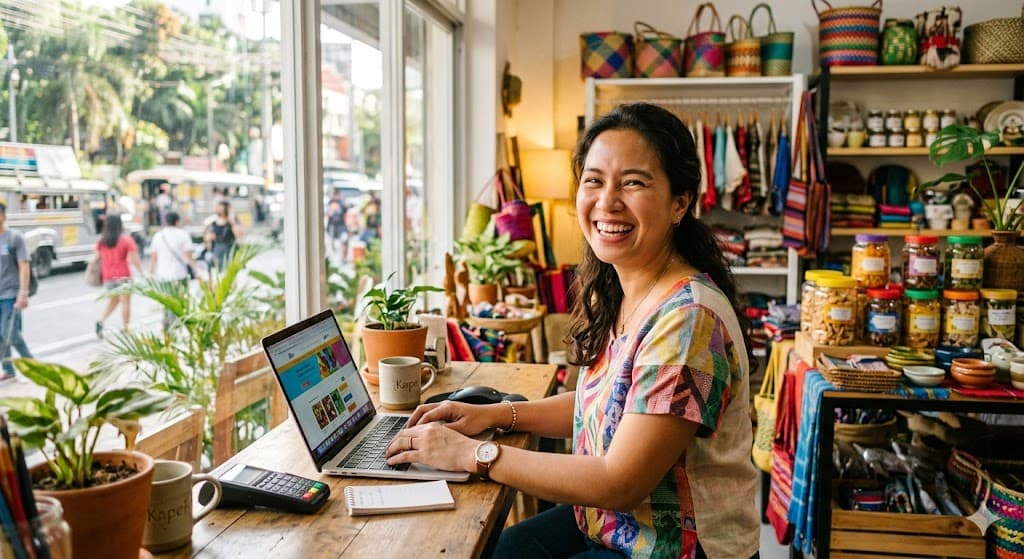
 A typical Philippine SME owner juggling operations and marketing at the same time
The budget gap is the first wall. Big brands in the Philippines spend millions of pesos a year on agencies, while a small business may only have PHP 3,000 to PHP 10,000 per month for all marketing. With such a gap, small businesses often feel they cannot win online.
The owner-as-marketer bottleneck is the second wall. When the owner is busy with operations, marketing stops. Posts become irregular, replies to customers get delayed, and campaigns are not measured. Sales drop not because the product is bad, but because the marketing engine is not running.
Many SMEs also lack customer data. They know sales numbers but not which posts brought buyers, which product pages get clicks, or which messages convert. Without data, every new campaign is a guess, and guesses are expensive.
Why the Old Manual Marketing Playbook Stops Working
| Manual Approach | Why It Falls Short |
|---|---|
| Posting only when free | Inconsistent reach on Facebook |
| Writing every caption by hand | Takes hours per week |
| Replying one-by-one on chat | Slow response, lost buyers |
| Copying competitor posts | No clear brand voice |
| Boosting posts randomly | Budget wasted on wrong audience |
Small businesses in the Philippines often copy what larger businesses did five or ten years ago. The old playbook was simple: post on Facebook a few times a week, boost the best-performing post, reply to DMs, and hope for sales. This worked in 2015. In 2026, it does not.
Organic reach on Facebook has dropped over the years as the platform favors paid content and Reels. A page with 5,000 followers may now reach only a few hundred people per post without paid boost. Posting only when the owner is free makes the reach even smaller because the algorithm rewards consistency.
Writing every caption by hand also takes hours. A small coffee shop owner in Quezon City once told me that she spent one full day every weekend just preparing captions and photos for the following week. That is one lost operational day, every week.
Replying one-by-one on Messenger, Viber, and Instagram is another hidden cost. Customers in the Philippines expect replies within minutes. If the owner is closing the shop at 9 PM, a 10 PM inquiry often gets answered at 8 AM the next morning, and by then the buyer has moved to a competitor.
Copying competitor posts looks safe but creates a bigger problem: no clear brand voice. Customers remember brands with a consistent personality, not businesses that sound like everyone else.
How AI Tools Change the Marketing Game for SMEs
| AI Use Case | What It Does for Your Business |
|---|---|
| AI content writing | Creates captions, blog drafts, and product descriptions in minutes |
| AI image generation | Produces product mockups and social graphics without a designer |
| AI chatbots | Handles FAQs on Messenger 24/7 |
| AI analytics | Shows which posts and products actually sell |
| AI ad optimization | Improves Meta Ads performance on small budgets |
AI marketing is not about replacing the owner. It is about giving the owner a small, affordable team that works 24 hours a day. For a Philippine SME, the practical stack is built from tools already available, most with free tiers or low monthly costs in pesos.
 AI tools give small business owners an affordable virtual marketing team
AI content writing tools such as ChatGPT, Claude, and Gemini can produce Facebook captions, Lazada product descriptions, and blog drafts in Filipino, English, or Taglish. A task that used to take 3 hours now takes 20 minutes of editing. The key is that the owner still reviews and adjusts the tone, but no longer writes from a blank page.
AI image generation with tools like Canva's AI features, Midjourney, or free options like Microsoft Designer can create product mockups, sale announcements, and menu graphics. A milk tea shop owner can generate a full week of post images in one afternoon instead of hiring a freelance designer for every campaign.
AI chatbots through Meta Business Suite's automated replies, ManyChat, or custom-built bots handle the most common questions: store hours, prices, delivery, branch locations. This keeps customers engaged even at midnight. Human takeover remains for complex questions.
AI analytics tools can read Shopify, Shopee, or Meta Ads reports and explain them in plain language. Instead of staring at a dashboard, the owner gets a summary: which product sold best, which ad wasted budget, and what to do next week.
AI ad optimization inside Meta Ads Manager itself, through the Advantage+ campaigns, uses machine learning to find buyers automatically. With a daily budget as small as PHP 100 to PHP 300, small businesses can now test audiences that used to require an agency.
Related: Generative AI Digital Marketing for Philippine SMEs explains this in detail.
A 30-Day Plan to Launch AI Marketing in Your Business
| Week | Focus | Main Tools |
|---|---|---|
| Week 1 | Setup and audit | ChatGPT or Claude, Google Sheets |
| Week 2 | Content production | AI writing tools, Canva |
| Week 3 | Automation on chat | Meta Business Suite, ManyChat |
| Week 4 | Ads and measurement | Meta Ads Manager, Google Analytics |
Adopting AI marketing without a plan leads to tool overload. A phased rollout over 30 days keeps things manageable for a small business that cannot pause operations.
 A phased 30-day rollout keeps AI marketing adoption manageable for busy SME owners
Week 1 is setup and audit. List current marketing activities, monthly cost, and time spent. Open free accounts for one AI writing tool and one design tool. Write down the top 20 questions customers ask on Messenger. This list becomes training material for later automation. Expected time: 5 to 8 hours across the week.
Week 2 is content production. Use AI to draft one month of social media captions, 4 blog posts, and 20 product descriptions. The owner edits for local tone, Filipino expressions, and brand voice. Schedule posts in Meta Business Suite so they publish automatically. A small business can produce a full month of content in 2 to 3 focused days.
Week 3 is chat automation. Set up automated replies in Meta Business Suite for the top 20 FAQs listed in Week 1. Add a welcome message, business hours reply, and away message. Optionally, connect a tool like ManyChat for more advanced flows. Test by sending messages from a personal account to check for mistakes.
Week 4 is ads and measurement. Launch one small Meta Ads campaign using Advantage+ with a budget of PHP 200 to PHP 500 per day. Connect Google Analytics 4 to the website if available. At the end of the week, review what worked and plan Month 2.
Keep a simple Google Sheet with what you changed each week. When something works, you will know which change caused it — and when something stops working, you will know what to undo.
Related: AI and Data Analytics for Marketing Teams explains this in detail.
Real Results and ROI You Can Expect in Pesos
| Area | Before AI | After AI (Typical) |
|---|---|---|
| Time on content | 15 hours per week | 3 to 5 hours per week |
| Monthly marketing cost | PHP 8,000 to 15,000 | PHP 3,000 to 8,000 |
| Response time on chat | Several hours | Under 1 minute for FAQs |
| Posting frequency | 2 to 3 times per week | Daily |
The return on AI marketing for a Philippine SME comes from three places: time saved, cost reduced, and sales improved. The exact numbers depend on the business, but the pattern is consistent across restaurants, online sellers, service providers, and retail shops.
Time savings are the easiest to measure. If an owner spends 15 hours a week on marketing and AI reduces that to 4 hours, the 11 hours saved can go to operations, product development, or rest. In peso terms, if the owner's time is valued at PHP 300 per hour, that is PHP 13,200 saved per month.
Cost reduction comes from replacing some freelance work with AI. A business that used to pay PHP 5,000 per month to a freelance social media manager for basic posting can handle that work internally with AI, while keeping the freelancer for higher-value strategy work. Significant cost savings can be expected, especially in the first six months.
Sales improvement is harder to guarantee but common. Faster chat replies reduce lost inquiries. More consistent posting keeps the brand visible. Better-targeted ads stretch the same PHP 3,000 monthly ad budget further. Many SMEs report noticeable sales growth within 2 to 3 months after a proper AI rollout, though results vary by industry and execution.
The main cost of AI marketing for a small business in the Philippines is usually between PHP 0 and PHP 2,500 per month for tools, depending on whether free tiers are enough. Even the paid versions are affordable compared to hiring an agency, which typically starts at PHP 20,000 per month in Metro Manila.
Related: AI Content Marketing for Philippine Teams: Scale and ROI explains this in detail.
FAQ
Q: Do I need to know coding to use AI marketing tools?
A: No. Tools like ChatGPT, Claude, Canva, and Meta Business Suite work through simple chat or click interfaces. If you can use Facebook and Gmail, you can use these tools. Coding only becomes useful if you want to build custom automations, which is optional.
Q: Will AI content sound robotic to Filipino customers?
A: Only if you use raw AI output without editing. The correct workflow is: AI drafts, you edit for Taglish, local references, and brand voice. A 2-minute edit turns a generic caption into something that feels written by a Pinoy business owner.
Q: Is AI marketing legal in the Philippines for small businesses?
A: Yes. There is no law against using AI tools for marketing. However, the Data Privacy Act of 2012 still applies, so be careful when feeding customer personal data into AI tools. Use anonymized or aggregated data when testing.
Q: How much should a small business budget for AI marketing per month?
A: A starter budget of PHP 500 to PHP 2,500 per month covers most essential tools. Add PHP 3,000 to PHP 10,000 for ads depending on business size. Many SMEs start fully free and upgrade only when they see clear ROI.
Q: What if my business is offline, like a carinderia or barbershop?
A: Offline businesses benefit the most because they usually have weak online presence. Start with Google Business Profile, automated Messenger replies, and one AI-generated post per day. Even basic AI marketing can bring in more walk-in customers.
Q: Should I hire someone or do it myself?
A: For the first 30 to 60 days, do it yourself to learn what works for your business. After that, consider hiring a local IT virtual assistant at Philippine rates to maintain the system. You stay in charge of strategy, while the VA handles daily execution.
Starting Small Beats Waiting for Perfect
AI marketing is not a future trend for Philippine small businesses. The tools are here, the prices are low, and the learning curve is gentle. Waiting for the perfect moment or the perfect budget usually means watching competitors get ahead.
The practical next step is to pick one task this week, for example automated Messenger replies or AI-assisted captions, and run it for 14 days. Measure the time saved and the customer response. If it works, expand to the next task. A small business that adopts AI one step at a time will be far ahead of those still writing every caption by hand a year from now.
If the rollout feels too technical, working with a local IT consultant or developer who understands both AI and the Philippine SME market can shorten the learning time considerably. The goal is not to use every tool, but to make marketing sustainable for a business owner who already has a full plate.
Sources & References
- National Privacy Commission — Data Privacy Act of 2012 (Republic Act No. 10173)
- Department of Trade and Industry — MSME Statistics
- Google Business Profile — Help Center
- Meta for Business — Messenger for Business
- Canva — Magic Studio AI Features
- OpenAI API — Documentation and Pricing
- Statista — Digital Advertising Market in the Philippines
About the author
Founder / AI Engineer (36+ years in IT)
- ●From Tokyo · based in Manila for 13+ years
- ●36+ years in IT (development, SEO, AI)
- ●IBM Certified Generative AI Engineer
- ●AI chatbots, RAG & AI agent development
A Japanese AI engineer with 36+ years in IT and 13+ years on the ground in the Philippines. I write from hands-on experience to help Japanese companies adopt AI that actually delivers results — chatbots, workflow automation, AI agents, and AI-driven marketing. Feel free to reach out in Japanese or English.
Your Competitors Are Already Using AI!
Is your business keeping up?
Related Articles

Personalised Marketing: Four Segments First
Personalisation for a Philippine SME starts with four behavioural segments and language matching, not with a platform.
8/11/2026

Generative AI for Social Media in the Philippines
Five techniques Philippine businesses use to run social media with generative AI — one idea into a week of posts, and more.
7/24/2026

Content Marketing: Dividing Work Between Human and AI
Let AI handle research, drafts, and repurposing; keep judgement, experience, and the final read with people.
7/23/2026

AI-Powered SEO Tactics for Philippine Businesses
Five practical tactics: keyword clustering, AI-assisted drafting, on-page work, internal links, and measurement.
7/22/2026

What Is GEO? Customer Acquisition After SEO
GEO is how Philippine businesses get cited in ChatGPT, Claude, and Gemini answers. What it is and how it differs from SEO.
7/21/2026

Generative AI Content Workflow for Philippine SMEs
A generative AI content workflow that lets a Philippine SME publish more without losing quality — tools, steps, and review checks.
7/20/2026