Indonesia's Copyright Rewrite and AI Regulation: What Japanese Companies in the Philippines Need to Know About Southeast Asia
Indonesia's copyright rewrite has set AI regulation in motion across Southeast Asia. We break down the bill's provisions on generative AI copyright and compensation, then walk Japanese companies in the Philippines through auditing their AI use and writing internal rules.

AI Engineer · 36+ years in IT · Japanese, based in Manila for 13+ years
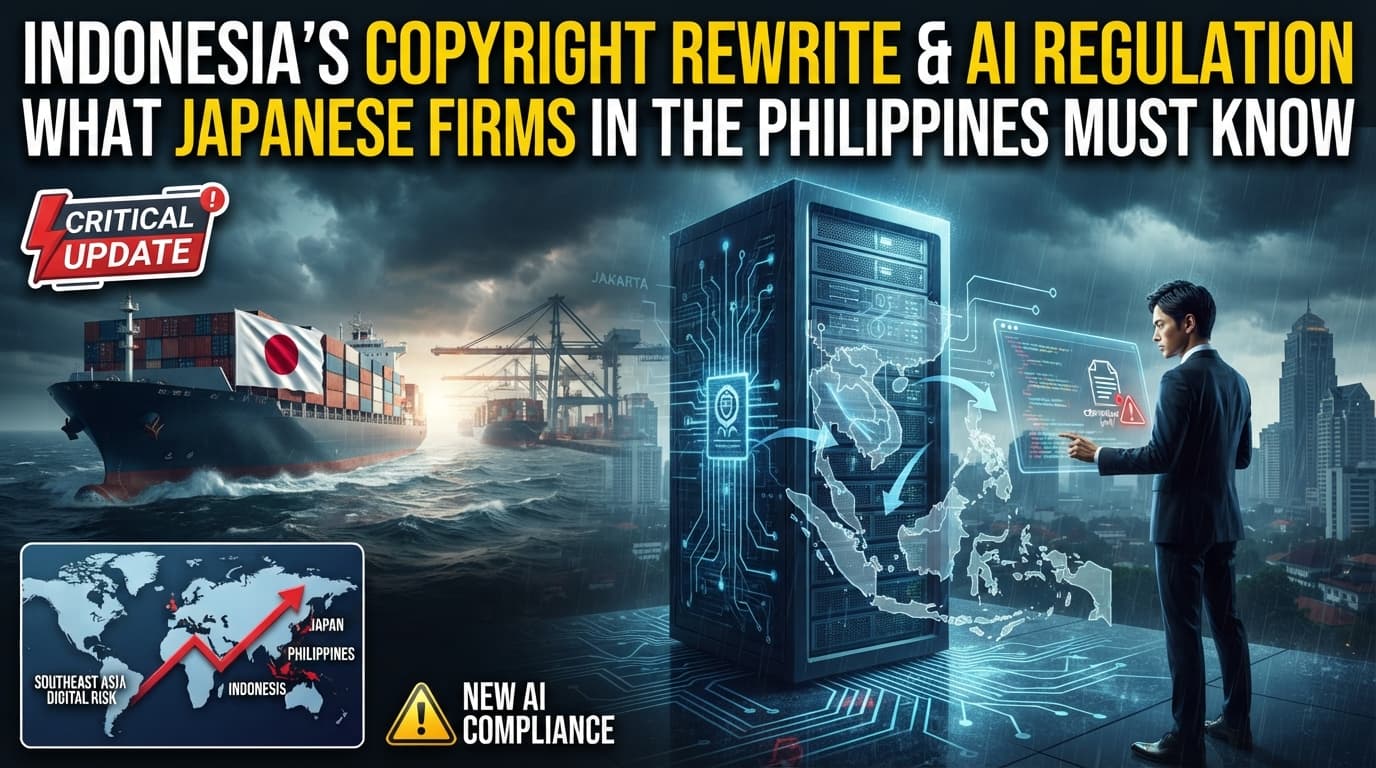
What Indonesia's Copyright Rewrite Demands of Google and AI Platforms — An Introduction to AI and Copyright for Japanese Companies in Southeast Asia
We break down Indonesia's bill to write AI into its copyright law, and explain — in practical terms — the AI audit and internal rules Japanese companies in the Philippines should put in place now.
Part 1: Why This Matters
Step 1: The Philippine Business Context (3 min)
For Japanese companies operating in Southeast Asia, the way each country is moving to regulate AI and copyright has become harder to overlook than ever. Our subject here is a report that Indonesia, the largest economy in Southeast Asia, is moving to write AI explicitly into its copyright law. If it passes, Indonesia could become the first country in Southeast Asia to bring AI into copyright legislation.
Why does news about neighboring Indonesia matter to Japanese professionals working in the Philippines? There are two reasons. First, the use of generative AI — AI that automatically produces text and images — is spreading rapidly in the Philippines across call centers, shared accounting service centers, and IT help desks. Second, regulations in Southeast Asia tend to influence one another: when one country steps forward first, neighboring countries tend to start considering similar rules. If you review how your company uses AI now, you will not be caught scrambling whenever rules tighten in any given country.
Head office in Japan tends to carry questions like "does material made with AI have copyright?" and "is there a problem with training AI on another company's text?" When those of you on the ground can break down what is actually happening in Southeast Asia and pass it on, you make head office's decisions far easier.
In a Manila office, coffee in hand, a Japanese manager opens with this to the local staff: "Apparently a bill came up in Indonesia yesterday that recognizes copyright for content created with AI. We've started making sales materials with AI too, so let's get our internal practices sorted out before rules start moving across Southeast Asia. Shall we start by listing out which tools we're putting what into?"
Step 2: The Key Facts from the Source Article (5 min)
We have pulled out only the facts reported in the source article and organized them into a table for easier study.
| Item | Details |
|---|---|
| What is happening | Indonesia is preparing a major rewrite of its copyright law. It includes recognizing copyright for people who produce works using AI |
| Global significance | If passed, it could become the first country in Southeast Asia to write AI into its copyright law |
| Origin of the bill | The bill was led by parliament and passed to the government for comment. When it might become law is not clear at this point |
| The authorities' view | Hermansyah Siregar, a Ministry of Law official responsible for intellectual property, confirmed the authenticity of the draft and said it would be the first copyright law to address AI explicitly |
| AI-specific provisions | It bans using AI to imitate a creator's "distinctive style" and requires disclosure of AI use in content |
| Platform payment obligations | It requires compensation for aggregating and republishing news, displaying link previews, and using content to train AI |
| How compensation flows | Compensation goes to a state-supervised collective management organisation, which then distributes it to news publishers |
| What it covers | Video games, photographs, computer programs, news reporting, and films, among others |
| Treatment of AI works | Works are protected by copyright only where human creative involvement meets the bar; works generated entirely by AI are excluded. The draft does not specify how much involvement is required |
| Penalties | Platforms that fail to comply face sanctions and could have their local operating licenses revoked |
| Google's response | Google issued a statement last month criticizing the bill, arguing that rigid and overly broad obligations would harm local creators, slow innovation, and drive investment away |
| The global trend | The EU's AI Act requires disclosure of AI use on output that qualifies as a deepfake, and copyright authorities in the United States and Singapore have taken the position that protection requires human contribution |
Source: Reuters — "Indonesia's copyright rewrite puts Google, AI platforms on notice" (July 17, 2026)
This table was compiled from publicly reported facts for study purposes. Please see the original article linked above for details.
Related: How AI Helps Philippine Businesses Compete in the Southeast Asian Market explains this in detail.
Step 3: Comprehension Check (5 min)
Use these five questions to confirm you have read the source article correctly.
Q1. If Indonesia's copyright bill passes, where is it reported to stand within Southeast Asia?
Hint: The word "first" is the key.
Q2. Under this bill, are works created entirely by AI protected by copyright? What was the condition for protection?
Hint: Focus on how much "human involvement" is required.
Q3. When tech platforms handle news, what actions would require them to pay compensation? Try to name at least three.
Hint: Aggregation, republication, and a format that displays content in miniature on screen are all involved.
Q4. What concerns did Google raise about the bill? And what sanctions are said to be possible for failing to comply?
Hint: Consider the content of the statement separately from the question of permission to keep operating locally.
Q5. The article states that mechanisms similar to Indonesia's AI disclosure rule exist in other countries and regions. Which specific examples were given?
Hint: Recall the region that requires labeling of deepfakes.
Related: The Law That Makes Your Chatbot Say 'I'm an AI': The EU AI Act Goes Live August 2, 2026 — What It Means for Japanese Companies in the Philippines explains this in detail.
Part 2: Putting It Into Practice
Step 4: Rollout Steps in the Philippines (10 min)
What this subject teaches is the importance of putting internal controls in place around content created with AI and around the act of training AI on someone else's work. Here is an approach Japanese companies operating in the Philippines can start on tomorrow, broken into five stages.
| Stage | What to do | Philippine-specific notes |
|---|---|---|
| Stage 1 | Inventory your AI tools | List which AI tools are in use internally and what information goes into each one. Do not overlook the free tools local staff use on their own |
| Stage 2 | Review your input data | Check whether you are feeding AI someone else's copyrighted work or personal information, such as customer lists and contracts. Data privacy in the Philippines falls under the National Privacy Commission (NPC), so this requires care |
| Stage 3 | Document your usage rules | Put into an internal document how much human work is added to AI-produced material and how AI use is recorded. Because a culture of settling things verbally runs deep, deliberately putting rules in writing builds trust |
| Stage 4 | Secure a budget | Estimate the cost of paid business-grade AI tools and legal consultation in advance. Even an investment of a few thousand pesos a month is easier for teams to use once approval is already in place |
| Stage 5 | Train and review | Hold briefings for local staff and review the rules quarterly. Preparing materials in both English and Tagalog deepens understanding |
At each stage, prioritize making the current state visible over aiming for perfection. Only after you see the results of the inventory will the rules your company actually needs become clear. In the Philippines, workplace AI use tends to run ahead on the initiative of the people doing the work, so rather than banning it uniformly from above, an approach that listens to the front line and decides safe usage together will last longer.
Related: How AI Is Rewriting the Economics of Philippine BPO: Japanese Firms Rethink Outsourcing and AI explains this in detail.
Step 5: Common Mistakes and How to Avoid Them (5 min)
Here are three situations where Japanese companies tend to stumble when tackling AI and copyright in the Philippines, along with what to do instead.
Mistake 1: Assuming "it was made by AI, so copyright doesn't matter"
If you assume that anything made with AI raises no rights issues, you risk feeding another company's text and images into AI without permission and using the output as your own deliverable. As Indonesia's draft shows, rules on AI and copyright are starting to move in Southeast Asia too.
Wrong: A sales team in Manila feeds a competitor's brochure straight into AI and mass-produces its own promotional materials.
Right: Feed AI only material your company holds the rights to, or material you are permitted to use, and always have a person review and revise the finished document.
Mistake 2: Leaving local staff's tool use unmonitored
When the front line freely uses free AI tools the company does not manage, customer information risks flowing outside. The Philippines has a strong appetite for improving how work gets done, an environment where convenient tools spread naturally.
Wrong: Someone in accounting, trying to work more efficiently, pastes customer payment data into a free outside AI tool.
Right: Have the company select safe business-grade tools and provide them officially, and put in writing — and communicate — a rule against entering confidential information into free tools.
Mistake 3: Imposing head office's rules on the local operation as-is
Running rules written in Japan through nothing more than translation tends to produce rules the front line cannot follow, because they do not fit Philippine business customs or the language difference.
Wrong: Translating a thick Japanese rulebook into English, distributing it, and considering the explanation done.
Right: Work with the head of the Manila office to build a version that fits the local workflow. Use concrete examples in the briefing, and always leave time for questions at the end.
Part 3: Going Deeper
Step 6: Related Technical Terms (5 min)
Here are five important terms from the source article, explained simply.
Generative AI is AI that, given an instruction, produces new text, images, programs, and more. In Philippine call centers, a common use is having generative AI draft reply emails to customers, which the staff member then reviews before sending.
Fair use is the idea that you may use someone else's copyrighted work under certain conditions without the rights holder's permission. The source article notes that this concept, or an individual licensing agreement, comes into play when copyrighted work is used to train AI. It is a concept worth keeping in mind in the Philippines when compiling market research and judging how far quotation may go.
A collective management organisation collects usage fees on behalf of many creators and distributes them to rights holders. Indonesia's draft envisions a mechanism in which compensation from platforms passes through such an organisation to news publishers. In the Philippines too, licensing through these organisations can come into play when music or articles are used for business purposes.
A deepfake is fake video or audio, created with AI, that looks and sounds convincingly like a real person speaking. The source article notes that the EU's AI Act requires disclosure of AI use on such output. When producing video advertising in the Philippines, any use of AI to construct a person calls for careful thought about how to disclose it.
Open-source AI refers to AI whose inner workings are published so that anyone can see and use them. The source article reports that one country described a plan to share this technology with developing nations. For small and medium-sized businesses in the Philippines, it can be an option for putting together AI tailored to the company at lower cost.
Step 7: Thinking Through How This Applies to Your Company (10 min)
Here are three themes for team discussion, each with a prompt to guide your thinking.
Inventory your company's AI use and make it visible
Prompt: Try writing out, department by department, which AI tools are used and for what purpose. You will start to see how much usage the company is not aware of.
Decide how much human work goes into AI-produced output
Prompt: Indonesia's draft makes human involvement a condition of protection. Discuss concretely who reviews and revises AI drafts, and at which stage, in your own company.
Hold a policy for the differences in regulation across Southeast Asia
Prompt: The Philippines, Indonesia, and head office in Japan all start from different assumptions. Think now about a common internal standard that would hold up wherever the rules change.
Next action: Take just 15 minutes at next week's regular meeting and write out, on a single sheet, the names and purposes of the AI tools each department uses. That list becomes the starting point for the rules you build from here.
Part 4: FAQ
Q1. Does Indonesia's bill directly affect our business in the Philippines?
This bill is a domestic Indonesian measure and does not automatically apply to your Philippine operations. Still, it is worth taking in as a landmark sign that regulation is now moving in Southeast Asia. If you organize your company's AI use in the Philippines now, you will be able to respond calmly whenever rules tighten in any given country.
Q2. Is it safe to enter customer data into AI in the Philippines?
Handling customers' personal information calls for care. Data privacy in the Philippines falls under the National Privacy Commission (NPC), so how information is handled requires attention. We recommend using safe business-grade tools your company has formally contracted for, and setting a rule against entering confidential information into free outside tools. When a judgment call is difficult, consult your internal legal team or a specialist.
Q3. Will our company's copyright be recognized in material produced with AI?
Under Indonesia's draft in the source article, protection applies only where there is human creative involvement, and it does not specify how much involvement is required. Views differ by country, but if you operate so that AI output is not used as-is and a person reviews and revises it, you will find it easier to explain your position later.
Q4. Can we use head office's rules in the Philippines as they are?
Rules that have only been translated often do not fit local business customs or the language difference, which makes them hard for the front line to follow. In the Philippines there are situations where verbal exchange carries weight, so it matters to create occasions to explain written rules carefully. We recommend working with the local head to rebuild them into a version that follows the actual workflow.
Q5. Should even a small office start building AI rules now?
Starting while you are small is a lighter load than putting things right later. It is enough to begin with an inventory of the tools in use and a minimum rule against entering confidential information. Rather than trying to write perfect rules in one pass, start by making the current state visible.
Practical Tips (3 Tips)
Start by finding out what data you are putting in
AI copyright and information problems mostly begin with what was entered. Before managing the output, list which departments are putting what information into AI. Once that is visible, the points you need to protect first surface naturally.
Build a human review step into the workflow
Just as Indonesia's draft puts weight on human involvement, do not use AI output as-is — fix into your workflow a step where someone always reviews it. Decide the owner and the stage in advance, and quality holds up while your explanation later gets easier.
Hold a common rule that works across Southeast Asia
So that shifting regulations country by country do not throw you, settle on one minimum standard for your company. With common rules — no confidential information in free tools, keep a record of AI use — you can hold the same posture in the Philippines and in Indonesia alike.
Bonus: How to Work With PH AI Works
PH AI Works supports companies that want to make use of AI and technology in the Philippines. We are set up to consult in Japanese on designing safe ways to use generative AI, building rules that fit local operations, and approaching adoption with Philippine business customs in mind.
As a next step, here are examples of what you can consult us on.
- How to inventory the AI tools in use internally and review the risks
- Documenting AI usage rules that fit Philippine operations, and designing briefings for local staff
- Organizing your company's response policy in light of regulatory movement across Southeast Asia
Please feel free to get in touch. Initial consultations are free.
References and Sources
About the author
Founder / AI Engineer (36+ years in IT)
- ●From Tokyo · based in Manila for 13+ years
- ●36+ years in IT (development, SEO, AI)
- ●IBM Certified Generative AI Engineer
- ●AI chatbots, RAG & AI agent development
A Japanese AI engineer with 36+ years in IT and 13+ years on the ground in the Philippines. I write from hands-on experience to help Japanese companies adopt AI that actually delivers results — chatbots, workflow automation, AI agents, and AI-driven marketing. Feel free to reach out in Japanese or English.
Your Competitors Are Already Using AI!
Is your business keeping up?
Related Articles

Lessons from the Claude Cowork Sandbox Vulnerability: Deciding How Much Your AI Agent Can Touch | Case Study for Japanese Companies in the Philippines
The published sandbox-escape techniques for Claude Cowork are a chance to rethink the assumption that "it's isolated, so it's safe." A free case-study module for Japanese companies in the Philippines covering permission design for AI agents: keeping agents away from credentials, gatekeeping what they read, and auditing vendor advisories.
7/24/2026
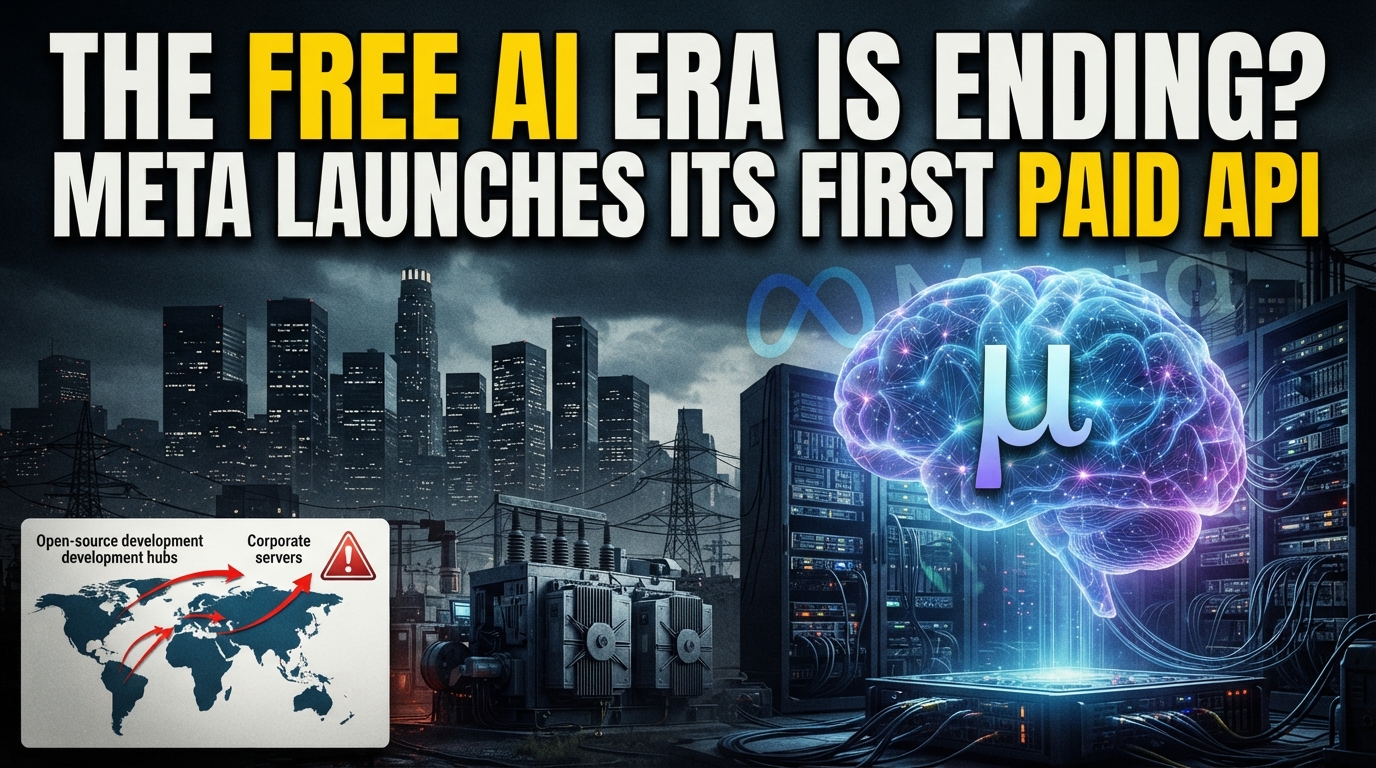
What Meta's Muse Spark 1.1 Teaches Us: The End of the "Free Open Model" Era and Diversifying Your AI Procurement
Meta announced Muse Spark 1.1 together with its first paid developer API, forcing a rethink of plans built on free open models. This free case-study material teaches Japanese companies in the Philippines how to diversify AI procurement — backup models, model-neutral procedures, and checking regional availability — to avoid vendor lock-in.
7/23/2026

What Claude Sonnet 5 Teaches Us: Designing Your AI Budget in the Era of "Near-Flagship Performance at Half the Cost"
Anthropic's Claude Sonnet 5 delivers performance approaching its flagship model at a much lower cost, changing the assumptions behind AI model selection. This free case-study material teaches Japanese companies in the Philippines how to redesign AI costs through use-case-based model tiering and billing-based verification.
7/22/2026

What Claude Cowork's Web and Mobile Expansion Teaches Us: Preparing for a Workday Where You Hand Work to AI and Walk Away
Anthropic has expanded its AI agent Claude Cowork to web and mobile, with cloud execution that keeps working even after you close your device. This free case-study material walks Japanese companies in the Philippines through taking inventory of the work they could hand off to AI, documenting procedures, and setting the operating rules to be ready.
7/21/2026

What Square's ChatGPT and Claude Integrations Teach Us: Preparing for the Day AI Chat Becomes a New Ordering Channel
Square has announced integrations that let customers find restaurants, browse menus, and complete orders and payment inside ChatGPT and Claude conversations. This free learning material walks through the no-extra-fee, zero-setup design and what Japanese food-service and retail companies in the Philippines should do now to prepare for agentic commerce — from AI visibility to their own ordering channels.
7/20/2026

Businesses Are Switching to Cheaper Chinese AI Models — How Japanese Firms in the Philippines Can Balance Cost and Security
As companies move to cheaper Chinese-built AI models, this guide explains how Japanese firms operating in the Philippines can cut AI costs while protecting customer data — covering NPC rules, peso-denominated budgeting, and how to mix models by task.
7/18/2026