
How AI Agents Help Philippine Customer Support Teams Achieve Full Automation
AI agents for customer support automation in the Philippines. Learn how Philippine SMEs can reduce costs and improve service with AI-powered support systems.


AI Engineer · 36+ years in IT · Japanese, based in Manila for 13+ years

Customer support in the Philippines looks different from most markets. A single small seller might handle questions on Facebook Messenger, Viber, Instagram DMs, TikTok comments, and email — all at the same time, and often in Taglish. Delivering fast, consistent service across every channel with a human team alone gets expensive fast. AI agents powered by large language models now make this far more manageable, even on SME budgets.
This article walks through why human teams and basic chatbots hit a ceiling. It also covers how an AI agent handles Taglish and multi-step requests, with a six-step rollout plan and realistic cost numbers. I also share what I learned building AI-driven web applications about why the messy real-world input from Filipino customers is the hard part — not the AI model itself.
Summary
- Philippine businesses struggle with customer support scalability due to multi-channel demands (Facebook Messenger, Viber, Instagram) and high staffing costs, especially during peak shopping seasons
- AI agents powered by large language models offer a superior alternative to basic chatbots by understanding natural language, handling Taglish, and managing complex multi-step tasks 24/7
- Implementation starts with support data auditing and platform selection (PHP 1,500-5,000/month). Hybrid human-AI escalation then cuts costs while improving response times and consistency
Why Philippine Businesses Struggle with Customer Support at Scale
| Challenge | Impact |
|---|---|
| Multi-channel inquiries (FB Messenger, Viber, Instagram, TikTok) | Scattered support resources and coverage gaps |
| High staffing costs and turnover | Unsustainable budgets for SMEs |
| Peak season demands (11.11, Christmas) | Strained capacity during critical sales periods |
Support is one of the biggest operational headaches for a growing Philippine business. An online seller on Lazada and Shopee, a fintech startup in BGC, a regional logistics firm — they all face the same pattern. Customers want fast, accurate answers, any hour of the day. Human teams alone cannot deliver that at SME prices.
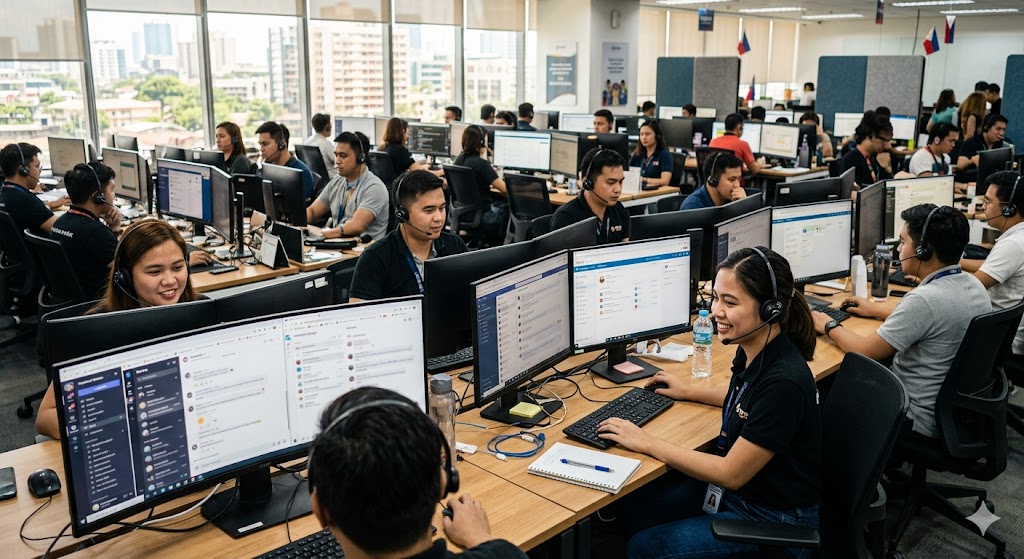 Philippine support teams juggle inquiries across multiple channels during peak shopping seasons
The Philippines has its own twist. Filipino consumers spend more time on social media than users in almost any other country, so questions come in through many channels at once. Facebook Messenger, Viber, Instagram DMs, TikTok comments, and sometimes a plain email. A single small seller routinely covers five or more channels in parallel.
On SME margins, hiring enough agents to cover every channel 24/7 drains the budget quickly — especially during peak events like 11.11, 12.12, or the pre-Christmas rush. Labour cost goes up, training new agents takes weeks, and turnover in the Philippine service industry keeps draining that investment. Many owners end up caught between a weak customer experience and a payroll they cannot sustain.
Related: How Autonomous AI Agents Help Philippine Customer Support Teams Scale Service Quality explains this in detail.
The Limits of Live Chat Teams and Basic Chatbots
| Limitation | Problem | Result |
|---|---|---|
| Rule-based chatbots | Follow scripted decision trees only | Break down with complex or varied questions |
| Live agent scaling | High training costs and turnover | Inconsistent coverage and quality |
| Coverage gaps | Weekend/holiday/late-night limitations | Poor customer experience during off-hours |
Most Philippine businesses already run a small team on Messenger plus a free chatbot that handles greetings and FAQ. That setup reaches its limit quickly.
A rule-based chatbot follows a scripted decision tree. It answers "What are your hours?" fine. It breaks on "Can I pick up my order in your Cebu branch na lang?" because the tree never anticipated that wording. The customer hits a dead end and gives up — or escalates angrily on a public review.
Adding more live agents helps quality but brings new problems. Training a new agent on the product catalogue, return policy, and the dozen edge cases takes two to three weeks. Turnover wipes out that investment every few months. And coverage gaps on weekends, holidays, and late nights are almost inevitable on small teams.
The result is a support experience that feels uneven. Some customers get quick, useful replies. Others wait hours or receive copy-pasted answers that miss the real question. In the Philippine market, where word-of-mouth and public reviews on Shopee and Lazada can swing sales significantly, that unevenness translates directly into lost revenue.
Related: How AI Agents Help Philippine Businesses Automate Complex Tasks explains this in detail.
How AI Agents Transform Customer Support Operations
| Capability | Traditional Chatbot | AI Agent |
|---|---|---|
| Language handling | Keyword matching | Natural Taglish understanding |
| Response type | Fixed scripts | Dynamic, context-aware responses |
| Task complexity | Simple FAQ | Multi-step processes, escalations |
AI agents are a different kind of tool. A rule-based bot follows a fixed tree. An AI agent powered by a large language model reads the message, figures out the intent, and writes an answer on the fly.
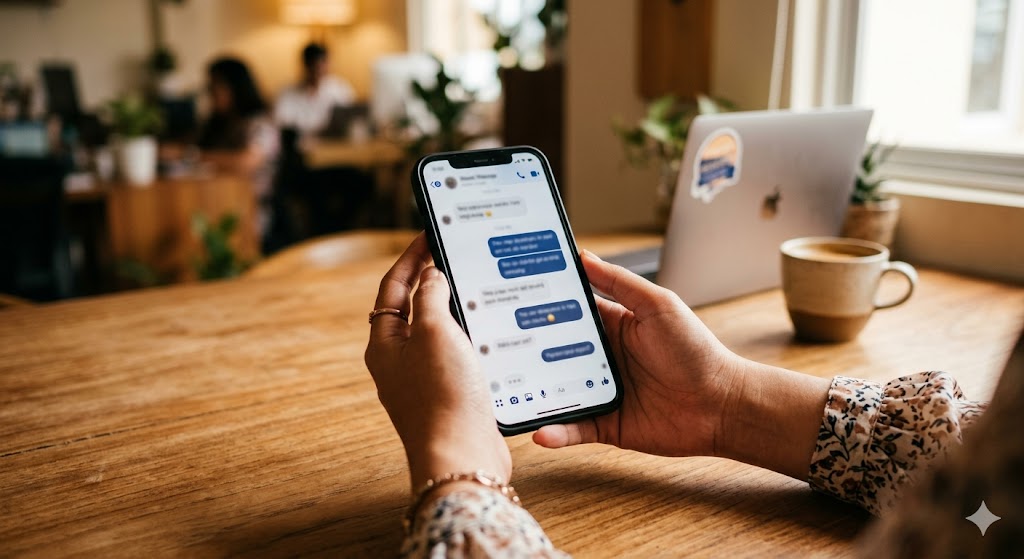 AI agents can respond to Taglish inquiries instantly, even late at night when human agents are off duty
Here is how it looks in practice. A customer messages your Shopee store at 11pm: "Yung order ko last week, hindi pa dumadating. Pwede bang i-check?" The agent detects the Taglish and understands the intent — an order status check. It pulls the record from your order system and replies with the courier, tracking number, and updated delivery time. No human touches it.
Modern agents go well beyond FAQ. They process refund requests, update delivery addresses, book appointments, and hand off hard cases to a human with a clean summary of the conversation already written. The key difference is intent understanding, not keyword matching.
Several capabilities make AI agents a good fit for Philippine support. They read Taglish and English-Bisaya mixing naturally, because the underlying models were trained on multilingual data. They run across Messenger, Viber, email, and a website widget at the same time through API connections. They deliver the same quality on the first message of the day and on the ten-thousandth. For a broader view of the workflow logic behind this, see our piece on AI workflows that automate sales, analytics, and support for Philippine businesses.
In my own work building AI-driven web applications with Next.js — including Philippine projects in the multi-million peso range — the hardest part was never the AI model. It was the knowledge base and the messy real-world input. Customers send misspellings, code-switched Taglish, vague complaints, and emoji-heavy messages. Handling that reliably needs careful prompt design and thorough testing against real past conversations from your own inbox. Budget two to four weeks for that work, not two days.
Step-by-Step: Implementing AI Agents for Your Support Team
| Phase | Action | Key Focus |
|---|---|---|
| Preparation | Audit support data and categorize inquiries | Identify common question patterns |
| Setup | Choose platform (PHP 1,500-5,000/month) and connect knowledge base | Ensure quality information access |
| Integration | Connect channels and set escalation rules | Maintain human backup for complex cases |
| Optimization | Test, monitor, and refine over 2-4 weeks | Tune based on real interactions |
You do not replace the team overnight. A phased rollout keeps cost and risk in check.
 A phased rollout with careful monitoring helps SMEs implement AI support without disrupting existing operations
Step 1: Audit your current support data. Pull the last three to six months of customer messages from Messenger, Shopee chat, Viber, and email. Sort them by type — order tracking, product question, return, billing issue, complaint. Most SMEs find that 10 to 15 question types cover more than 80% of inquiries.
Step 2: Choose your AI platform. Options range widely. Cloud platforms like Dialogflow CX (Google), Amazon Lex, or vendor tools like Tidio and Intercom offer AI-agent features on monthly subscriptions. Entry-level plans for Philippine SMEs typically start from PHP 1,500 to PHP 5,000 per month, though pricing varies. Custom-built agents on the OpenAI or Anthropic API give more flexibility but need a developer. The companion article on GPT integration for Philippine business systems covers the custom route in more detail.
Step 3: Connect your knowledge base. The agent is only as good as the information it can reach. Load your product catalogue, shipping policies, pricing, store addresses, and FAQ. Most platforms accept PDFs, docs, or a direct database connection. Clean content in, clean answers out.
Step 4: Integrate with your channels. Connect the agent to your busiest customer touchpoints. For most Philippine businesses, that means Messenger first, then the website widget, then email, and then Viber. Shopee and Lazada chat usually need a separate integration.
Step 5: Set up human escalation rules. Define clear triggers for handoff: frustrated-customer language, refunds above a threshold (say PHP 3,000), or low AI confidence on the answer. This hybrid setup keeps human help available for the cases that need it.
Step 6: Test and refine. Start with a soft launch. Route 20–30% of inquiries to the agent while keeping the human team on standby. Read the conversation logs daily for the first two weeks, then twice a week. Expect active tuning for four weeks before the agent reaches a steady state.
Related: How Autonomous AI Agents Help Philippine Businesses Scale Beyond Human Limits explains this in detail.
What to Expect: Results and Return on Investment
| Metric | Before AI Agents | After Implementation |
|---|---|---|
| Monthly staffing costs | PHP 80,000-150,000 (3-5 agents) | Significant reduction in routine inquiry handling |
| Response time | Minutes to hours | Seconds for routine questions |
| Setup investment | N/A | PHP 50,000-200,000 (recoverable in months) |
| Availability | Business hours only | 24/7 coverage |
The financial case is straightforward. The main saving comes from cutting the staff hours spent on routine questions, freeing the human team for the complex, high-value cases.
Picture a typical Philippine SME paying roughly PHP 80,000 to 150,000 a month on a small support team — three to five full-time agents including benefits. That SME tends to see meaningful cost reduction once the agent handles the bulk of repetitive questions. The exact saving depends on inquiry volume, mix, and setup quality. AI agents are generally capable of handling a large share of routine inquiries without human involvement, though the actual rate depends on how well the knowledge base is tuned.
Beyond payroll, the operational wins compound. Response times drop from minutes or hours to seconds for routine questions. Support runs 24/7 without overtime. Quality becomes consistent — the answer at 3am matches the answer at 3pm.
There is a revenue upside too. Faster replies on Messenger during a Shopee flash sale correlate with higher conversion. A customer who gets an instant size or shipping answer is more likely to complete the checkout before the cart cools off.
Initial setup usually runs PHP 50,000 to 200,000 for an SME implementation — platform subscription, integration work, and knowledge base preparation. Most businesses recover this within a few months through lower labour cost and better conversion.
FAQ
Q: Can AI agents handle Taglish and Filipino dialects?
A: Yes, with caveats. Modern large language models handle Taglish well in most business contexts. Bisaya, Ilocano, and Hiligaynon are weaker because there is less training data in those languages. Before going live, feed the agent 50 to 100 real past messages from your own inbox and check the replies. Keep a human fallback when the agent's confidence is low.
Q: Will I need to fire my support team?
A: No. The more practical move is to let the agent handle routine questions. Your human team then takes complex cases, VIP relationships, quality monitoring, and oversight of the AI system itself. Most businesses I have worked with kept the same headcount and grew capacity two or three times within six months.
Q: What happens when the AI agent gives a wrong answer?
A: Every AI system will sometimes produce a wrong or unhelpful answer. That is why escalation paths and conversation monitoring matter. Set alerts for low-confidence responses, review the logs weekly, and update the knowledge base whenever you spot a repeated mistake. Most platforms also let you flag a bad reply so the agent learns from the correction.
Q: Is my customer data safe with AI platforms?
A: Data privacy is a legitimate concern, especially under the Philippine Data Privacy Act (RA 10173). Pick platforms that meet international data protection standards and have clear Data Processing Agreements. For health, finance, or other sensitive industries, consider a private cloud or on-premise setup where the data stays inside your control. Name a Data Protection Officer before going live if you process personal data at scale.
Q: How long does implementation take?
A: A basic setup — the agent on Messenger and your website, using a solid FAQ knowledge base — runs two to four weeks. A more complex rollout with CRM integration, order-management hooks, and several channels usually takes six to twelve weeks including active tuning.
Your Next Move Toward Smarter Support
| Action Item | Timeline | Expected Outcome |
|---|---|---|
| Audit current support data | 1-2 weeks | Clear understanding of inquiry patterns |
| Research and select AI platform | 1-2 weeks | Platform aligned with budget and needs |
| Pilot implementation | 4-6 weeks | Functional AI agent handling routine inquiries |
AI-powered support is now within reach for Philippine businesses of almost any size. The agent takes on the high-volume, repetitive work that drains human teams, while your best people stay on the cases that need empathy, judgment, and creative problem-solving.
The practical starting point is simple. Open your support inbox, sort the last thousand messages by type, and pick the two or three question types that show up most often. Those are the cases your first agent should handle well. Build for those, measure the results, and expand from there.
Sources & References
- National Privacy Commission — Republic Act 10173 (Data Privacy Act of 2012)
- Google Cloud Dialogflow CX — Platform Documentation and Pricing
- OpenAI API — Platform Documentation and Pricing
- Tidio — AI Chatbot Platform Pricing
- Intercom — Customer Support Platform Pricing
- We Are Social / Meltwater — Global Digital Reports
About the author
Founder / AI Engineer (36+ years in IT)
- ●From Tokyo · based in Manila for 13+ years
- ●36+ years in IT (development, SEO, AI)
- ●IBM Certified Generative AI Engineer
- ●AI chatbots, RAG & AI agent development
A Japanese AI engineer with 36+ years in IT and 13+ years on the ground in the Philippines. I write from hands-on experience to help Japanese companies adopt AI that actually delivers results — chatbots, workflow automation, AI agents, and AI-driven marketing. Feel free to reach out in Japanese or English.
Your Competitors Are Already Using AI!
Is your business keeping up?
Related Articles

How AI Agent Development Helps Philippine Businesses Automate Beyond Prompt Engineering
A practical guide for Philippine SMEs on moving from AI chat tools and prompt engineering to full-stack AI agent development that connects to real business systems.
6/6/2026

How OpenAI and Anthropic APIs Help Philippine Businesses Build Custom AI Agents
A practical guide for Philippine SMEs on building custom AI agents using OpenAI and Anthropic APIs, covering challenges, solutions, implementation steps, and expected ROI.
5/26/2026

How Multi-Agent AI Systems Help Philippine Businesses Handle Complex Operations
Multi-agent AI systems let several specialised AI models work together to handle complex business workflows. A practical look at what they are, why Philippine SMEs should care, and how to start adopting this technology.
5/24/2026

How Autonomous AI Agents Help Philippine Customer Support Teams Scale Service Quality
Discover how autonomous AI agents transform customer support for Philippine SMEs. Practical guide to AI implementation, ROI, and success strategies for local businesses.
5/23/2026

How AI Agents Help Philippine SMEs Build a Digital Workforce
AI agents are becoming the next digital workforce for Philippine SMEs. Learn how AI agent technology solves staffing gaps, the implementation steps, and realistic ROI for local businesses.
5/17/2026

How AI Agents Help Philippine Businesses Automate Internal Operations
AI agents for Philippine businesses - benefits, risks, and practical steps to automate internal operations with in-house AI solutions
3/29/2026