
DX or AI? Telling the Two Apart
The real difference between digital transformation and AI for Philippine SMEs, and which one you actually need first.


AI Engineer · 36+ years in IT · Japanese, based in Manila for 13+ years
Summary
- DX is the broad business transformation strategy, while AI is one specific technology used inside that strategy.
- Philippine SMEs that confuse the two often overspend on AI tools without fixing the underlying processes.
- A phased approach starting with digitization, then automation, then AI delivers stronger ROI than buying AI tools first.
The Confusion Costing Philippine SMEs Real Money
| Common Misunderstanding | Real Business Impact |
|---|---|
| Treating DX and AI as the same thing | Wasted budget on tools that do not fit the workflow |
| Buying AI before digitizing data | AI cannot run on paper records or scattered spreadsheets |
| Expecting AI alone to transform a company | Process gaps remain, and staff resist the change |
Many business owners in Metro Manila, Cebu, and Davao now hear the words DX (Digital Transformation) and AI (Artificial Intelligence) used as if they mean the same thing. They do not. This confusion is not just a vocabulary problem. It leads to real spending mistakes, often in the range of hundreds of thousands of pesos for small and medium enterprises.
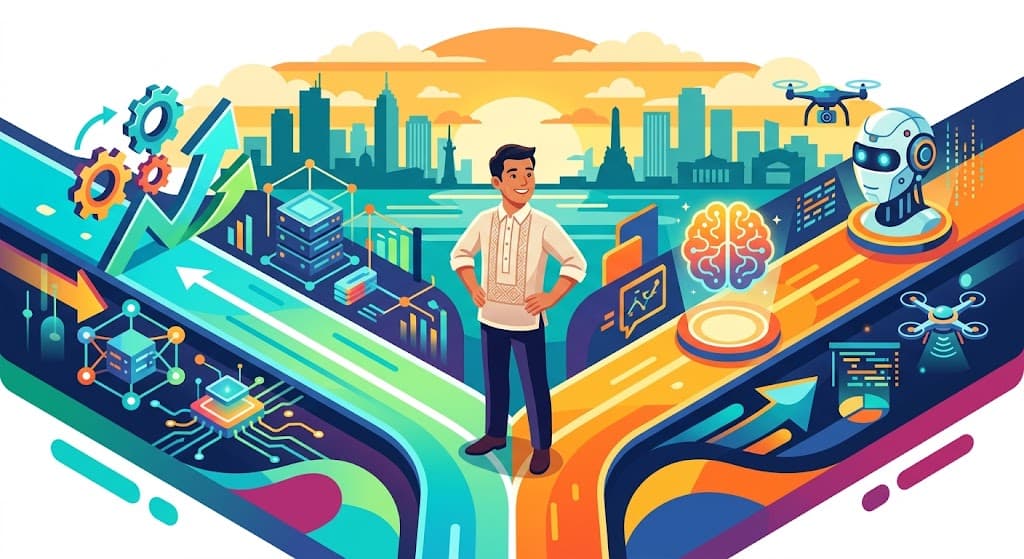
 Many Philippine SMEs confuse DX with AI, leading to costly tool purchases.
A common scenario looks like this. A retail owner in Quezon City attends a seminar, hears that AI will save the business, and signs up for an AI chatbot subscription at around ₱8,000 per month. Six months later, the chatbot still gives wrong answers because the product catalog lives in a printed binder, the inventory is tracked in three separate Excel files, and the staff still write orders by hand. The AI tool was real. The transformation was not.
The gap between the two terms matters because they sit at different levels. DX is the strategy of rethinking how a business operates using digital tools. AI is one of those tools. Confusing the level of strategy with the level of tooling is similar to confusing "renovating a house" with "buying a hammer". Both are useful, but only one is a plan.
Why Buying AI Tools First Usually Fails
| Limitation of the Tool-First Approach | Why It Falls Short |
|---|---|
| Skips the data foundation | AI needs clean, digital, structured data to work |
| Ignores process redesign | Old workflows simply move from paper to screen |
| Treats AI as a finished product | AI requires continuous tuning and human review |
| Underestimates staff training | Adoption fails when employees do not trust the system |
The most common path Philippine SMEs take is to read about ChatGPT, Gemini, or a vendor's AI dashboard, then buy a subscription before any process work is done. This tool-first approach has predictable weaknesses.
The first weakness is the data foundation. AI models learn patterns from data. If sales records are kept on receipts in a shoebox, or if customer information lives only inside the head of one long-time employee, there is nothing for the AI to learn from. A generative AI assistant can write a polite email, but it cannot tell you which products to reorder if your inventory data does not exist in digital form.
The second weakness is process redesign. Many companies in the Philippines simply digitize a paper form, which means they now have a PDF version of the same inefficient process. True DX asks a harder question: should this process exist at all, and if yes, how should it be reshaped now that digital tools are available?
The third weakness is the assumption that AI is a finished product. In practice, AI outputs need review, especially in regulated areas such as BIR tax filings, SEC reporting, or DTI consumer protection rules. A model that hallucinates a non-existent BIR form number can create a real compliance problem.
The fourth weakness is human. Staff who do not understand why a new system was installed often quietly go back to the old way. From experience managing large-budget web system projects, continuous improvement proposals were a clear marker of success: projects where the vendor and the team kept suggesting refinements after delivery succeeded, while projects that stalled the moment the system went live almost always failed to deliver value.
How AI Fits Inside a Proper DX Strategy
| Layer | Purpose | Example for PH SMEs |
|---|---|---|
| Digitization | Move information from paper to digital | Scan receipts, move ledgers to spreadsheets |
| Digitalization | Connect digital data into workflows | Use a POS connected to inventory and accounting |
| AI Integration | Add prediction and automation on top | Forecast demand, automate customer replies |
| Continuous Improvement | Refine based on real results | Adjust pricing, improve chatbot responses |
Once the layers are separated clearly, the role of AI becomes much easier to plan. AI is not the foundation. It is the upper floor that sits on a properly built ground floor of digitized data and connected systems.
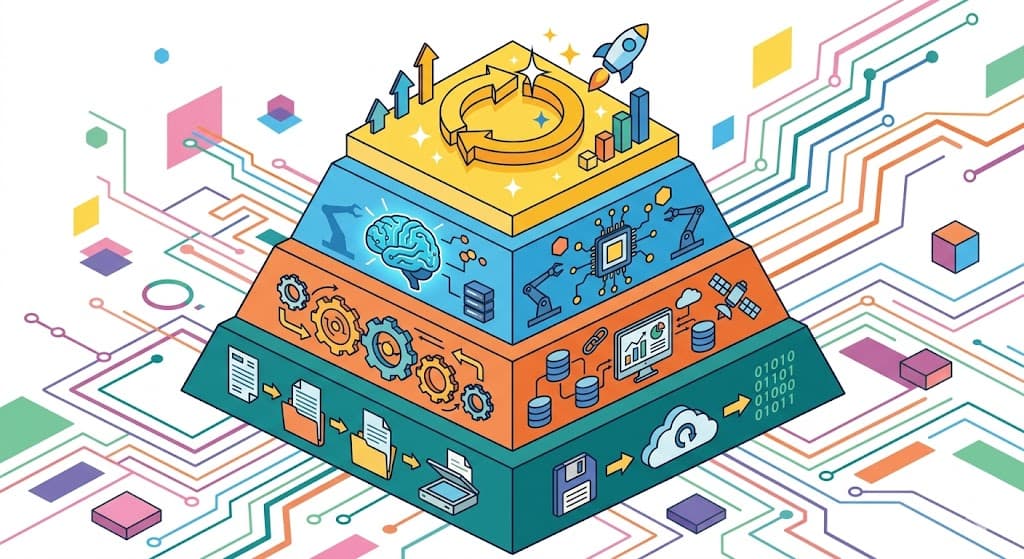 AI works best when built on a foundation of clean data and connected systems.
For a Philippine SME, a sensible structure looks like this. The first layer is digitization, which simply means turning paper, handwritten notes, and verbal knowledge into digital records. A sari-sari store moving from a notebook to a free POS app on a tablet is doing digitization, not AI.
The second layer is digitalization. Here, the digital records start talking to each other. The POS connects to an inventory system, which connects to a simple accounting tool such as QuickBooks or a local cloud service. Orders update stock automatically. Sales reports generate without manual encoding.
The third layer is where AI enters. With clean, connected data, AI can now do useful work. A demand forecast can suggest which sari-sari store items to restock before the 15th and 30th payday rush. A customer service AI can handle Tagalog and English inquiries on Facebook Messenger because it has access to the actual product catalog. A finance AI can flag unusual expense patterns for the owner to review.
The fourth layer, often forgotten, is continuous improvement. AI outputs drift over time as customer behavior, supplier prices, and regulations change. A DX strategy plans for ongoing tuning, not a one-time installation.
Related: AI Strategy for Outperforming Local Competitors explains this in detail.
A Practical Implementation Path for PH SMEs
| Step | Focus | Typical Timeframe |
|---|---|---|
| 1. Process Audit | Map current workflows and pain points | 2–4 weeks |
| 2. Data Cleanup | Digitize and organize existing records | 1–3 months |
| 3. System Integration | Connect tools into a working flow | 2–4 months |
| 4. Targeted AI Pilot | Apply AI to one specific problem | 1–2 months |
| 5. Review and Scale | Measure results, then expand | Ongoing |
A workable path for a Philippine SME does not start with buying AI software. It starts with looking honestly at how work currently flows.
Step 1: Process Audit. List every recurring task in the business. Mark which ones are paper-based, which are digital but isolated, and which already involve some automation. This exercise alone often reveals that 40 to 60 percent of staff time goes to data re-entry between disconnected systems.
Step 2: Data Cleanup. Pick the most painful data source first, usually customer records or inventory. Move it to a clean digital format. For many SMEs, Google Workspace or Microsoft 365 at around ₱350 to ₱600 per user per month is enough at this stage. No AI is needed yet.
Step 3: System Integration. Connect the cleaned data into a flow. POS to inventory. Inventory to accounting. CRM to email marketing. Tools such as Zapier, Make, or n8n can link applications without heavy custom development. Local development partners can also build lightweight integrations using Next.js or similar frameworks when off-the-shelf connectors are not enough.
Step 4: Targeted AI Pilot. Choose one specific, measurable problem. Not "use AI in the business", but "reduce the time spent answering repeat customer questions on Messenger by half". A narrow pilot is far easier to evaluate than a broad rollout.
Step 5: Review and Scale. Measure honestly. If the pilot worked, expand to the next process. If it did not, find out why before adding more AI. From experience commissioning large web development projects, weekly progress meetings and mandatory documentation of specification changes were the two practices that minimized rework. The same discipline applies to AI rollouts.
Related: Avoiding Failed AI Projects: 3 Points That Decide It explains this in detail.
Realistic Results and ROI for Philippine Businesses
| Area of Improvement | Typical Outcome |
|---|---|
| Staff time on repetitive tasks | Noticeable reduction once automation stabilizes |
| Customer response speed | Faster replies during off-hours |
| Forecasting accuracy | Considerable improvement when data is clean |
| Compliance and audit prep | Easier document retrieval for BIR and SEC |
| Total cost of ownership | Lower over 2–3 years vs. all-manual workflows |
Realistic ROI for a Philippine SME comes mostly from staff time savings and faster customer response, not from headline-grabbing automation stories. A small business that frees up two staff members from data re-entry can redirect that time toward sales, customer service, or product development. At an average loaded cost of ₱25,000 to ₱40,000 per employee per month in Metro Manila, the payback period for a well-scoped DX project is often between 12 and 24 months.
 Realistic ROI comes from staff time savings and faster customer response.
Customer response speed improves quickly. AI-assisted reply drafts and FAQ chatbots can handle common questions outside business hours, which matters for businesses serving OFW remitters or e-commerce buyers in different time zones.
Forecasting and reporting see considerable improvement once data is clean and connected. Owners stop guessing inventory based on memory and start ordering based on real patterns. Compliance becomes easier as well: when BIR or SEC documentation is needed, files are searchable instead of buried in folders.
The total cost picture matters most. Subscription costs for cloud tools and AI services are real, often ₱5,000 to ₱30,000 per month for an SME stack. But over two to three years, the cost of not modernizing, including lost sales, slower service, and staff burnout, usually exceeds the investment. Template-based quick fixes look cheap on day one but rarely handle real business complexity. Successful custom designs, in contrast, require detailed upfront business analysis, phased implementation, and continuous adjustment.
Related: AI Adoption in 2026: 5 Gaps Philippine Small Businesses Face explains this in detail.
FAQ
Q: Is DX only for big companies in the Philippines?
A: No. Sari-sari stores, small clinics, and family-run restaurants can all benefit from DX. The scope is smaller, but the principle of moving from paper to connected digital tools is the same.
Q: Do I need to hire an AI specialist to start?
A: Not at the beginning. Most SMEs should start with a generalist IT consultant or local development partner who can audit processes and recommend tools. AI specialists become useful once a specific AI problem has been identified.
Q: How much should a Philippine SME budget for a first DX project?
A: Budgets vary widely, but a focused first project often falls between ₱150,000 and ₱800,000, including consulting, tool subscriptions for the first year, and basic staff training. Larger integrations naturally cost more.
Q: Will AI replace my staff?
A: AI typically removes repetitive parts of jobs rather than entire roles. Staff who learn to work with AI tools usually become more valuable, not less. Plan for retraining, not retrenchment.
Q: What about data privacy under the Data Privacy Act of 2012?
A: Any DX or AI project handling personal data must comply with NPC rules. Choose vendors that document their data handling, keep customer data on reputable cloud providers with clear policies, and register as a Personal Information Controller if required.
Q: Can I use ChatGPT or Gemini for my business right away?
A: You can use them for general tasks like drafting emails or summarizing documents. For business-specific tasks involving customer data, products, or pricing, integration with your own systems is needed first to get reliable results.
Moving Forward With a Clear Plan
DX and AI are not interchangeable terms. DX is the strategy that reshapes how a business operates digitally. AI is one of the most powerful tools available inside that strategy, but only when the foundation of clean data and connected systems is already in place.
For Philippine SMEs, the practical takeaway is simple. Resist the pressure to buy the newest AI tool first. Start with a process audit, clean up the data, connect the systems, and only then add AI where it solves a specific, measurable problem. A phased approach takes longer than a single subscription purchase, but it is the path that actually produces returns.
The next step for most business owners is a short, honest conversation with a trusted IT partner: which one process, if improved, would create the most value this year? That single question is where real transformation begins.
Sources & References
- National Privacy Commission, Data Privacy Act of 2012 (RA 10173)
- Department of Trade and Industry, MSME Statistics
- Department of Information and Communications Technology, Department of Information and Communications Technology — National ICT Ecosystem Framework (NICTEF)
About the author
Founder / AI Engineer (36+ years in IT)
- ●From Tokyo · based in Manila for 13+ years
- ●36+ years in IT (development, SEO, AI)
- ●IBM Certified Generative AI Engineer
- ●AI chatbots, RAG & AI agent development
A Japanese AI engineer with 36+ years in IT and 13+ years on the ground in the Philippines. I write from hands-on experience to help Japanese companies adopt AI that actually delivers results — chatbots, workflow automation, AI agents, and AI-driven marketing. Feel free to reach out in Japanese or English.
Your Competitors Are Already Using AI!
Is your business keeping up?
Related Articles

Competitor Research With AI in One Hour a Week
A four-step weekly routine that collects and compares competitor information, so pricing decisions rest on current data.
8/10/2026

When Not to Use AI: Tasks to Keep Human
An honest look at the five tasks Philippine businesses should keep human — consequential decisions among them.
8/9/2026

Turning Full-Stack Developers Into Agent Specialists
Hiring an AI agent specialist in the Philippines is slow and costly. Retraining the developers you have is usually faster.
8/7/2026

What to Put in an AI Vendor Contract
AI vendor contracts in the Philippines often skip what matters: data return, audit logs, model changes, and exit protection.
8/6/2026

Keeping AI Running Through Brownouts and Typhoons
Cloud AI does not stop when the office loses power — your access does. A continuity plan for Philippine operations.
8/5/2026

Your AI Vendor's Legal Form Changes the Deal
SEC-registered corporation or DTI sole proprietor — in the Philippines the difference changes contracts, banking, and recourse.
8/3/2026