
One-Stop AI Adoption for Philippine SMEs
What a single-partner approach to AI adoption covers, what it costs, and when splitting the work makes more sense.


AI Engineer · 36+ years in IT · Japanese, based in Manila for 13+ years

Summary
- Working with a single partner for AI strategy, development, and support reduces vendor coordination overhead and shortens project timelines for Philippine SMEs.
- Fragmented vendor stacks (separate web, AI, hosting, and support providers) create integration gaps that often cost more than the original development budget.
- A phased rollout starting with one high-impact workflow can deliver measurable results within a single fiscal year when the pilot is scoped to a specific, trackable workflow.
The Technology Headache Slowing Down Philippine Businesses
| Pain Point | Typical Symptom |
|---|---|
| Fragmented vendors | Web team, AI consultant, and hosting provider blame each other |
| Limited internal IT staff | One generalist handles everything from email to servers |
| Budget pressure in pesos | Foreign tools priced in USD strain monthly cash flow |
| Unclear ROI expectations | Tools purchased without a clear use case sit unused |
Many small and medium businesses in Metro Manila and Cebu run on a patchwork of tools. A WordPress site from one freelancer, a chatbot from another, accounting software from a reseller, and email hosted somewhere else entirely. Each vendor knows their own slice but nobody owns the whole picture.
 Fragmented vendor stacks leave Philippine SMEs juggling tools that do not communicate with each other.
This fragmentation becomes painful the moment something breaks. When a contact form stops sending leads to the CRM, the web developer says it is a hosting issue, the host says it is a plugin issue, and the CRM vendor says it is an API issue. Days pass. Sales suffer.
The shortage of in-house IT staff makes this worse. A typical Philippine SME has one or two IT-capable people who already handle printers, Wi-Fi, payroll software, and the occasional ransomware scare. Asking them to also evaluate AI vendors, negotiate contracts, and manage integrations is unrealistic.
Pricing adds another layer. Most international AI platforms bill in US dollars, and peso depreciation means a tool that fit the budget last quarter may not fit this quarter. Without a partner who can translate global tools into local cost structures, businesses overspend or under-adopt.
Related: Avoiding Failed AI Projects: 3 Points That Decide It explains this in detail.
Why the Piecemeal Approach Falls Short
| Approach | Limitation |
|---|---|
| Hire multiple specialist freelancers | Each owns a piece, nobody owns the outcome |
| Buy off-the-shelf SaaS for every need | Tools do not talk to each other; data stays siloed |
| Train internal staff from scratch | Months of ramp-up while competitors move ahead |
| DIY with free tools and tutorials | Hidden costs in time, security, and rework |
Hiring separate specialists looks cheaper on paper. A web developer for ₱40,000, a chatbot freelancer for ₱25,000, a data analyst on retainer for ₱30,000. The numbers add up cleanly until the project starts, and then nobody is accountable for whether the chatbot actually feeds qualified leads into the sales pipeline.
Buying SaaS tools for every function is the other common pattern. A separate platform for email marketing, another for invoicing, another for customer support, another for analytics. Each works fine in isolation. None of them share data without custom integration work, which usually means hiring yet another specialist.
Training existing staff is appealing because it builds long-term capability. The reality is that AI and modern web technology move quickly, and a six-month learning curve means six months of standing still. By the time the team is ready to deploy, the original problem has either gotten worse or been solved manually at higher cost.
The do-it-yourself route using free tools and YouTube tutorials produces results, but rarely production-quality ones. Security gaps, fragile integrations, and missing documentation become someone else's problem when the original builder leaves the company or moves on.
In a previous client role commissioning large web system development and VA management projects, the difference between successful and stalled projects came down to one thing: weekly progress meetings and mandatory documentation of specification changes. Projects without those guardrails drifted; projects with them shipped. A piecemeal vendor approach makes those guardrails almost impossible to enforce.
How One-Stop AI Partners Solve the Problem
| One-Stop Capability | Business Outcome |
|---|---|
| Single point of contact | Faster issue resolution, clearer accountability |
| Integrated tech stack design | Tools share data from day one |
| Phased AI rollout | Measurable wins before bigger commitments |
| Local language and timezone support | Communication in Filipino business context |
| Bundled pricing in pesos | Predictable monthly cost, no FX surprises |
A one-stop partner takes responsibility for the whole technology layer: web presence, automation, AI features, hosting, and ongoing support. When the contact form breaks, one team owns the fix. When a new AI feature is needed, the same team designs it to fit the existing stack.
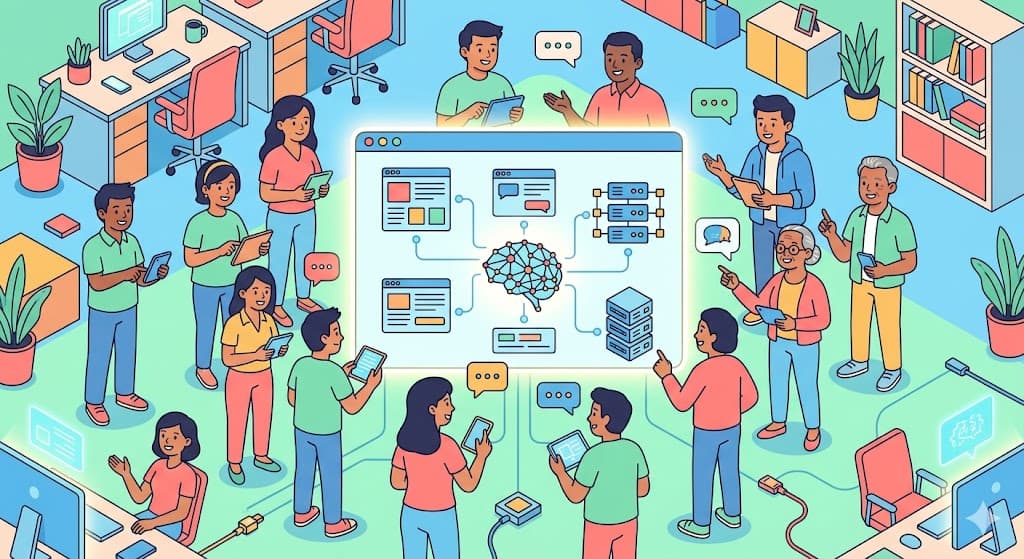 A one-stop partner unifies web, AI, hosting, and support under a single accountable team.
Integrated stack design is the quiet advantage. Instead of bolting AI onto an existing site through fragile workarounds, the partner builds the site and the AI features as one system. A customer chat that can actually read order history, a quotation tool that pulls real product data, a lead form that scores prospects automatically. These are straightforward when one team owns the architecture.
Phased rollouts protect the budget. A reasonable first project might be automating a single high-volume workflow such as appointment booking, FAQ responses, or invoice processing. Once that delivers measurable savings, the next phase builds on the same foundation. This is closer to how successful custom designs actually work: detailed upfront business analysis, phased implementation, and continuous adjustment, rather than a single big bang launch.
Local context matters more than vendors usually admit. A partner working in the same timezone, familiar with BIR requirements, GCash and Maya integrations, and Philippine telco quirks, removes friction that international vendors cannot address. Pricing in pesos with fixed monthly rates also protects against the dollar swings that have hit local businesses hard in recent years.
Related: Balancing Cost and Quality in AI Development explains this in detail.
Implementation Steps for Philippine SMEs
| Step | Focus |
|---|---|
| 1. Business audit | Identify the workflows costing the most time or money |
| 2. Pilot selection | Pick one workflow with clear, measurable output |
| 3. Build and integrate | Deploy AI feature inside the existing tech stack |
| 4. Measure and adjust | Track time saved, errors reduced, leads gained |
| 5. Expand to next workflow | Apply lessons to the second priority area |
Step one is a business audit, not a technology audit. The question is not "what AI tool should we buy" but "where are we losing the most hours each week to repetitive work." Common answers in Philippine SMEs include responding to the same customer questions on Facebook Messenger, manually copying order details from email into spreadsheets, and chasing overdue invoices.
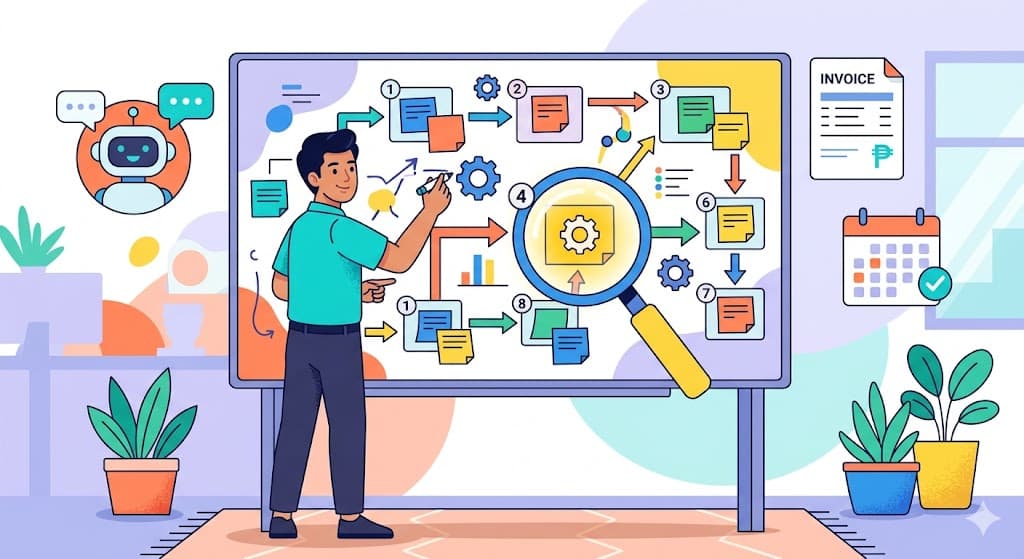 A focused business audit identifies the single workflow that delivers the highest-ROI AI pilot.
Step two narrows the audit findings to one pilot. The criteria are simple: the workflow must be measurable (hours saved, errors reduced, response time), high-volume enough to matter, and contained enough to ship in weeks rather than quarters. A customer FAQ bot for a retail store, an automated quotation generator for a B2B supplier, or a meeting note summarizer for a consulting firm all fit this profile.
Step three is the build phase. With a one-stop partner, this includes both the AI component and any necessary changes to the website, database, or internal tools. The output should be a working feature integrated into how the business already operates, not a standalone demo that requires staff to learn a new system.
Step four is where most projects underinvest. Before declaring success, define what "working" looks like in numbers. Average response time before and after. Hours of staff time freed per week. Conversion rate on leads handled by the AI versus humans. Without these baselines, expansion decisions become guesswork.
Step five takes the lessons from the pilot and applies them to the next priority. Because the foundation already exists, the second project usually costs less and ships faster than the first. This compounding effect is the real argument for one-stop adoption.
Related: Avoiding Costly AI Adoption Failures explains this in detail.
Results and ROI: What Philippine Businesses Can Expect
| Outcome Area | Realistic Expectation |
|---|---|
| Staff time savings | Several hours per week per automated workflow |
| Faster customer response | Reply times measured in seconds for common questions |
| Reduced rework | Documented changes prevent repeated mistakes |
| Predictable monthly costs | Bundled peso pricing replaces scattered USD bills |
| Compound returns | Each new workflow builds on the existing foundation |
Staff time savings are the most visible win. A small team handling a high volume of customer inquiries on Messenger can plausibly redirect a meaningful share of the repetitive ones to an AI assistant trained on their actual product catalog and policies, freeing humans for the more complex conversations that actually need judgment. The exact share depends on how narrow the question types are and how well the assistant is tuned.
Faster response times affect revenue directly. Online buyers tend to reward whichever business replies first, especially for quotation requests and service inquiries. Automated first-touch responses, even if just to acknowledge and qualify, keep deals warm until a human can follow up.
Reduced rework is harder to quantify but often the biggest hidden saving. In past large-budget web projects, mandatory documentation of specification changes was the single practice that minimized rework. The same principle applies to AI: when one partner owns both the build and the documentation, future changes do not require rediscovering how the system was put together.
Predictable peso pricing matters for cash flow planning. A bundled monthly fee covering hosting, maintenance, AI usage, and support is easier to budget than tracking USD invoices from four different vendors with different billing cycles.
Compound returns become visible by the second or third project. The customer database built for the FAQ bot also powers the lead scoring tool. The document parsing built for invoices also handles purchase orders. Each project's foundation reduces the cost of the next one.
FAQ
Q: How long does it take to see results from a first AI project?
A: For a focused pilot like a customer FAQ bot or document automation, a working version is typically achievable within a few weeks to a couple of months, depending on the integrations involved. Time savings start showing up shortly after launch, though the exact timeline varies with workflow volume and team adoption speed.
Q: What is a reasonable budget range for a Philippine SME starting with AI?
A: As a rough estimate, pilots in the Philippine SME context tend to land somewhere between ₱150,000 and ₱500,000 depending on complexity, with separate ongoing monthly costs for hosting, AI usage, and support. Starting small and expanding based on results keeps risk manageable.
Q: Do we need to replace our existing website or systems?
A: Usually not. A good one-stop partner integrates AI features into existing WordPress sites, accounting tools, or customer databases. Full replacement is only worth it when the existing system is already a bottleneck.
Q: What about data privacy and the Data Privacy Act?
A: AI projects handling customer data must comply with the Data Privacy Act of 2012 and NPC guidelines. A local partner familiar with these requirements can structure data handling, consent flows, and storage to meet compliance from the start.
Q: Can AI handle Filipino and Taglish customer messages?
A: Modern language models handle Filipino, Taglish, and Cebuano reasonably well, though accuracy improves significantly when the system is tuned with actual customer message samples from the business. Local context tuning is part of a quality implementation.
Q: What happens if our partner stops supporting us?
A: Insist on documentation, source code access, and standard tools (rather than proprietary platforms) from day one. A one-stop partner should make it easy to transition to another provider if needed, even if neither side expects that to happen.
Moving Forward with AI Adoption
| Focus Area | Action |
|---|---|
| Workflow priority | Identify the single workflow draining the most hours each week |
| Pilot scope | Define one measurable outcome before committing budget |
| Partner fit | Choose a team that owns web, AI, hosting, and support together |
| Foundation thinking | Treat the first project as the base for the next two |
The Philippine SME landscape rewards businesses that move from scattered tools to integrated systems. A one-stop AI approach removes the coordination tax that drains time from owners who should be focused on customers and growth. The path forward is not adopting more tools, but adopting the right ones in a structure that compounds over time.
A useful first step is a short conversation about which workflow is currently costing the most hours each week. That single answer usually points directly at the highest-ROI pilot, and from there the implementation roadmap writes itself.
Sources & References
- National Privacy Commission, Data Privacy Act of 2012 and Implementing Rules
- Department of Trade and Industry Philippines, MSME Statistics
- Bangko Sentral ng Pilipinas, Digital Payments Transformation Roadmap
About the author
Founder / AI Engineer (36+ years in IT)
- ●From Tokyo · based in Manila for 13+ years
- ●36+ years in IT (development, SEO, AI)
- ●IBM Certified Generative AI Engineer
- ●AI chatbots, RAG & AI agent development
A Japanese AI engineer with 36+ years in IT and 13+ years on the ground in the Philippines. I write from hands-on experience to help Japanese companies adopt AI that actually delivers results — chatbots, workflow automation, AI agents, and AI-driven marketing. Feel free to reach out in Japanese or English.
Your Competitors Are Already Using AI!
Is your business keeping up?
Related Articles

Competitor Research With AI in One Hour a Week
A four-step weekly routine that collects and compares competitor information, so pricing decisions rest on current data.
8/10/2026

When Not to Use AI: Tasks to Keep Human
An honest look at the five tasks Philippine businesses should keep human — consequential decisions among them.
8/9/2026

Turning Full-Stack Developers Into Agent Specialists
Hiring an AI agent specialist in the Philippines is slow and costly. Retraining the developers you have is usually faster.
8/7/2026

What to Put in an AI Vendor Contract
AI vendor contracts in the Philippines often skip what matters: data return, audit logs, model changes, and exit protection.
8/6/2026

Keeping AI Running Through Brownouts and Typhoons
Cloud AI does not stop when the office loses power — your access does. A continuity plan for Philippine operations.
8/5/2026

Your AI Vendor's Legal Form Changes the Deal
SEC-registered corporation or DTI sole proprietor — in the Philippines the difference changes contracts, banking, and recourse.
8/3/2026