
OpenAI and Anthropic APIs for Smarter Marketing
How Philippine SMEs automate marketing, personalise content, and cut costs with the OpenAI and Anthropic APIs.


AI Engineer · 36+ years in IT · Japanese, based in Manila for 13+ years

Summary
- Direct API access from OpenAI and Anthropic costs less per output than subscription tools for Philippine SMEs running high-volume marketing tasks.
- A working marketing automation setup can run on a monthly API budget of PHP 2,500 to PHP 15,000 for most SMEs.
- Human review of AI output remains essential, especially for Filipino cultural context and local Tagalog-English code-switching.
Why Philippine SMEs Struggle to Scale Marketing Content
| Challenge | What It Looks Like | Impact |
|---|---|---|
| Content volume demands | Need daily posts for FB, IG, TikTok, plus email and blog | Team burnout or thin output |
| Cultural localization gaps | Global AI tools miss Taglish, Filipino humor, local holidays | Content feels foreign to local audience |
| Budget pressure | Hiring 2-3 content writers costs PHP 60,000+ per month | SMEs cannot match bigger brands |
A small e-commerce shop in Quezon City told me they need 15 social posts a week, two email blasts, and a blog article every two weeks. Their one-person marketing team was working late every night. Hiring a second writer would add around PHP 30,000 to monthly costs, which they could not afford.
This is the daily reality for Philippine SMEs. Marketing content demand keeps growing, but hiring more staff is often not an option when profit margins are already thin.
Generic AI tools like the web versions of ChatGPT or Claude can help, but they have limits. They produce good English but often miss the feel of Taglish that connects with Filipino shoppers. They do not know that August 21 is Ninoy Aquino Day or that Christmas campaigns in the Philippines start in September, not December.
Subscription-based AI tools also pile up quickly. A mid-sized team might pay for ChatGPT Plus, Jasper, Copy.ai, and Canva Pro at the same time. The total can easily reach PHP 8,000 to PHP 12,000 per month, and most of those features overlap.
Where Standard AI Tools and Manual Workflows Fall Short
| Current Approach | Main Weakness | Hidden Cost |
|---|---|---|
| Manual copywriting | Slow, inconsistent output | Writer burnout and turnover |
| ChatGPT/Claude web subscriptions | Fixed monthly fee regardless of use | Paying for unused capacity |
| Multiple specialized SaaS tools | Feature overlap, separate logins | Subscription fatigue |
The manual approach is the most common starting point. One marketing person writes every post, email, and blog. Quality is usually decent, but output is limited by working hours. When the writer gets sick or takes leave, the whole content calendar stalls.
 Stacking ChatGPT Plus, Jasper, Copy.ai, and Canva Pro often pushes monthly tool costs past PHP 10,000 with heavy feature overlap
Many SMEs move to subscription AI tools next. ChatGPT Plus at about PHP 1,200 per month seems cheap at first. But when different team members need access, the company ends up paying for three or four seats, and features in other tools like Jasper or Copy.ai overlap with what ChatGPT already does.
There is also a deeper problem. Subscription tools are built for general use. They do not let you shape the output format exactly the way your brand needs. If you want every product description to follow a specific template with exact character counts for Shopee titles, you still end up rewriting the AI output by hand.
A template tool gets you most of the way, and the part it leaves — the part that makes content sound like your company rather than any company — is the part that still costs time and money.
How Direct API Access Changes the Picture for SMEs
| Capability | What It Enables | Why It Matters for PH SMEs |
|---|---|---|
| Pay per use | Cost scales with actual volume | Small shops pay small amounts |
| Custom prompts and output formats | Output matches your exact template | Less rework, consistent brand |
| Workflow integration | AI runs inside Shopee, Lazada, Google Sheets | No copy-paste between tabs |
| Model choice per task | Use cheaper models for simple tasks | Total cost drops by half or more |
Direct API access means you connect to OpenAI or Anthropic systems through code, not through their chat websites. You pay only for what you use, measured in tokens, which are roughly chunks of words. A token is about four characters of English text.
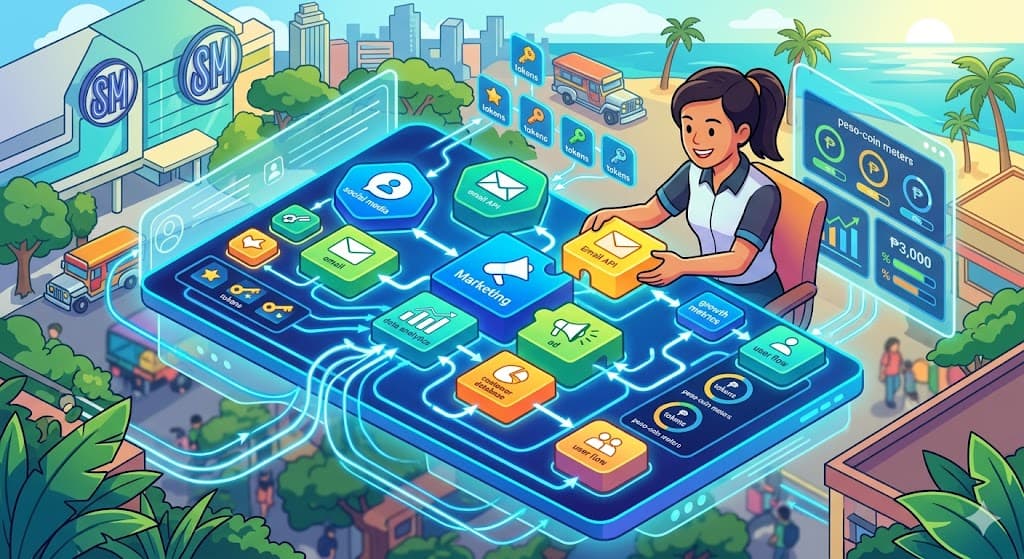 Direct API access lets Philippine SMEs pay only for what they use, with full control over prompt templates and output format
For a typical Philippine SME doing 200 social posts, 40 product descriptions, and 8 email campaigns per month, the API cost usually lands between PHP 2,500 and PHP 8,000, depending on which models are chosen. This is often cheaper than stacking three SaaS subscriptions.
The bigger win is control. With APIs, you write a prompt template once, lock it in, and every piece of content follows the same format. You can tell the system: "Write Shopee product titles in Taglish, maximum 60 characters, include one emoji, price range in pesos." The output comes back ready to paste, with almost no cleanup.
Model choice matters too. OpenAI offers cheaper, faster models for simple tasks like headline variations, and more capable models for longer work like blog drafts. Anthropic's Claude models have a similar tier system. A well-designed workflow uses the cheap model for 80 percent of tasks and saves the expensive model for writing that needs more thought. This alone can cut bills by half.
For Philippine SMEs, the API route also solves the cultural localization problem. You can include examples of good Taglish in your prompts, list Philippine holidays to avoid or reference, and even feed in your top-performing past posts as a style guide. The AI then produces content that sounds local, not translated.
Related: AI Content Generation for Philippine SMEs: Scale Output explains this in detail.
Building Your First API-Powered Marketing Workflow
| Step | Timeframe | What You Do |
|---|---|---|
| 1. Audit current content needs | Week 1 | List all content types, volumes, and pain points |
| 2. Set up API accounts and billing | Week 1 | Register with OpenAI and Anthropic, set spending limits |
| 3. Build prompt templates | Week 2-3 | Create and test prompts for each content type |
| 4. Connect to your tools | Week 3-4 | Use Zapier, Make, or custom code to automate |
| 5. Run pilot and measure | Month 2 | Test with real campaigns, track time and cost |
Step one is simple but often skipped. Write down every type of content your team produces: Facebook posts, Shopee product titles, Lazada descriptions, email subject lines, blog articles. Then count how many of each you need per month. This list becomes your spec for what the API workflow must handle.
 Keeping a human reviewer in the loop protects brand voice and catches cultural missteps before posts go live
Step two is opening API accounts. Both OpenAI and Anthropic let you sign up with a credit card, and both let you set a monthly spending cap. For most Philippine SMEs, starting with a USD 50 cap (about PHP 2,800) on each platform is enough to run tests without risking a surprise bill.
Step three is where most of the value is created. A good prompt template includes your brand voice rules, output format, examples of past good work, and constraints like character limits. I recommend keeping these templates in a shared Google Doc so the whole team can suggest edits. Every time you tweak a prompt, log what changed and why. Without that, a prompt that used to work and now does not is indistinguishable from a model that changed underneath you.
Step four connects the API to tools your team already uses. For non-technical teams, Zapier or Make (formerly Integromat) lets you wire up AI calls without writing code. You can set up flows like "when I add a row to this Google Sheet, generate five Facebook post variations and email them to me." For teams with a developer on hand, a small Python or Node.js script gives more control.
Step five is the pilot. Pick one content type, usually social media posts, and run the workflow for two to four weeks alongside your current process. Track three numbers: time spent per post, total API cost, and engagement rate of posted content. If AI-generated posts underperform, adjust the prompt before scaling to other content types.
Related: AI Content Marketing for Philippine Teams: Scale and ROI explains this in detail.
What Returns Can a Philippine SME Actually Expect
| Outcome | Realistic Range | Time to See It |
|---|---|---|
| Content production time saved | 40 to 60 percent per piece | 1 to 2 months |
| Monthly tool cost vs subscriptions | PHP 3,000 to 8,000 less | Month 1 |
| Output volume increase | 2x to 3x without adding staff | 3 months |
Time savings usually show up within the first month. A social media post that used to take 20 minutes to draft, edit, and finalize drops to about 8 to 10 minutes because the first draft is already close to final. Over 200 posts a month, that is roughly 30 to 40 hours of saved time. That time can go into strategy, campaign analysis, or customer conversations.
Cost comparison works out favorably for most SMEs. Three overlapping SaaS subscriptions might cost PHP 10,000 a month. A well-tuned API setup handling the same workload often runs at PHP 3,000 to 5,000. The saved money covers a Zapier plan (around PHP 1,200) and still leaves budget for paid ads.
Output volume is the outcome SMEs get most excited about. Teams that could only manage 15 social posts a week can comfortably do 30 to 40, with better consistency. One small caveat: more posts does not always mean better results. Track engagement, not just volume. If your audience gets tired of seeing your brand, reduce frequency and focus on quality.
There are limits worth naming. API setups still need human review, especially for culturally sensitive content. A generated post that references Filipino holidays or uses Taglish should be checked by a local team member before it goes live. Brand-voice mistakes and tone-deaf jokes cost more in social media backlash than the AI ever saves.
The author holds an IBM Generative AI Digital Marketing Professional certification, which covers prompt engineering, AI-driven content creation, and digital advertising workflows. The patterns above are drawn from applying that training to real client work in the Philippines, combined with an IBM Generative AI Engineer Professional certification for the technical build.
Related: Generative AI Digital Marketing for Philippine SMEs explains this in detail.
FAQ
Q: Do I need a developer on staff to use OpenAI or Anthropic APIs?
A: Not for the simpler setups. Zapier and Make let marketing teams build API workflows through visual drag-and-drop, no code needed. You do need a developer if you want tight integrations with Shopee, Lazada, or a custom CRM. For most Philippine SMEs, starting with no-code tools is the fastest way to prove value before investing in custom development.
Q: Is it safe to put customer data into OpenAI or Anthropic?
A: Both companies offer API terms where your inputs are not used for training their models by default. For customer data that falls under the Data Privacy Act of 2012, you still need to review their data processing terms and have your legal adviser confirm compliance. As a safer practice, send only the minimum information the AI needs, and avoid sending full customer records.
Q: Which is better, OpenAI or Anthropic, for Philippine SMEs?
A: Both work well. OpenAI has a wider range of model sizes and is often cheaper for high-volume simple tasks. Anthropic's Claude tends to handle longer, nuanced writing with less prompt tuning, which helps for blog content and email campaigns. Many teams use both, routing each task to whichever model does it better.
Q: How do I handle Taglish and Filipino cultural references in prompts?
A: Include 3 to 5 examples of past posts that used Taglish well, and list specific local context the AI should know, such as Philippine holidays, common brand expressions, and regional sensitivities. Be explicit: "Use Taglish naturally, not forced. Avoid deep Tagalog terms that younger Metro Manila audiences may not know." Keep refining these examples every month.
Q: What is the minimum monthly budget to start?
A: About PHP 1,500 to PHP 3,000 is enough for a one-person pilot. This covers API calls for around 100 social posts plus a few emails, with room for testing. Scale up only after you have verified the workflow works for your content and team.
Start Small, Then Scale What Works
The path forward for most Philippine SMEs is not to replace the marketing team with AI, but to give the team API tools that remove the repetitive parts of their job. Begin with one content type, measure the results, and only expand once the workflow is stable.
The next concrete step is the audit from step one above. List your content needs, count the volumes, and identify the one type that eats the most time. That is where API automation pays back fastest. Keep a human in the loop for review, especially for anything touching Filipino cultural context, and adjust prompts based on what actually performs in your market.
Direct API access puts enterprise-grade AI within reach of small Philippine businesses for the price of a lunch out. The technology is ready. The work now is building workflows that fit your brand, your customers, and your team.
Sources & References
- National Privacy Commission — Data Privacy Act of 2012 (Republic Act No. 10173)
- Department of Trade and Industry — MSME Statistics
- OpenAI API — Documentation and Pricing
- Anthropic API — Documentation and Pricing
- OpenAI — Enterprise Privacy and Data Handling
- Anthropic — Trust and Compliance Overview
- Statista — Digital Advertising Market in the Philippines
About the author
Founder / AI Engineer (36+ years in IT)
- ●From Tokyo · based in Manila for 13+ years
- ●36+ years in IT (development, SEO, AI)
- ●IBM Certified Generative AI Engineer
- ●AI chatbots, RAG & AI agent development
A Japanese AI engineer with 36+ years in IT and 13+ years on the ground in the Philippines. I write from hands-on experience to help Japanese companies adopt AI that actually delivers results — chatbots, workflow automation, AI agents, and AI-driven marketing. Feel free to reach out in Japanese or English.
Your Competitors Are Already Using AI!
Is your business keeping up?
Related Articles
Personalised Marketing: Four Segments First
Personalisation for a Philippine SME starts with four behavioural segments and language matching, not with a platform.
8/11/2026

Generative AI for Social Media in the Philippines
Five techniques Philippine businesses use to run social media with generative AI — one idea into a week of posts, and more.
7/24/2026

Content Marketing: Dividing Work Between Human and AI
Let AI handle research, drafts, and repurposing; keep judgement, experience, and the final read with people.
7/23/2026

AI-Powered SEO Tactics for Philippine Businesses
Five practical tactics: keyword clustering, AI-assisted drafting, on-page work, internal links, and measurement.
7/22/2026

What Is GEO? Customer Acquisition After SEO
GEO is how Philippine businesses get cited in ChatGPT, Claude, and Gemini answers. What it is and how it differs from SEO.
7/21/2026

Generative AI Content Workflow for Philippine SMEs
A generative AI content workflow that lets a Philippine SME publish more without losing quality — tools, steps, and review checks.
7/20/2026