
Deciding How Much Your AI Agent Can Touch
Published sandbox-escape techniques are a reason to revisit the assumption that isolation alone makes an agent safe.


AI Engineer · 36+ years in IT · Japanese, based in Manila for 13+ years
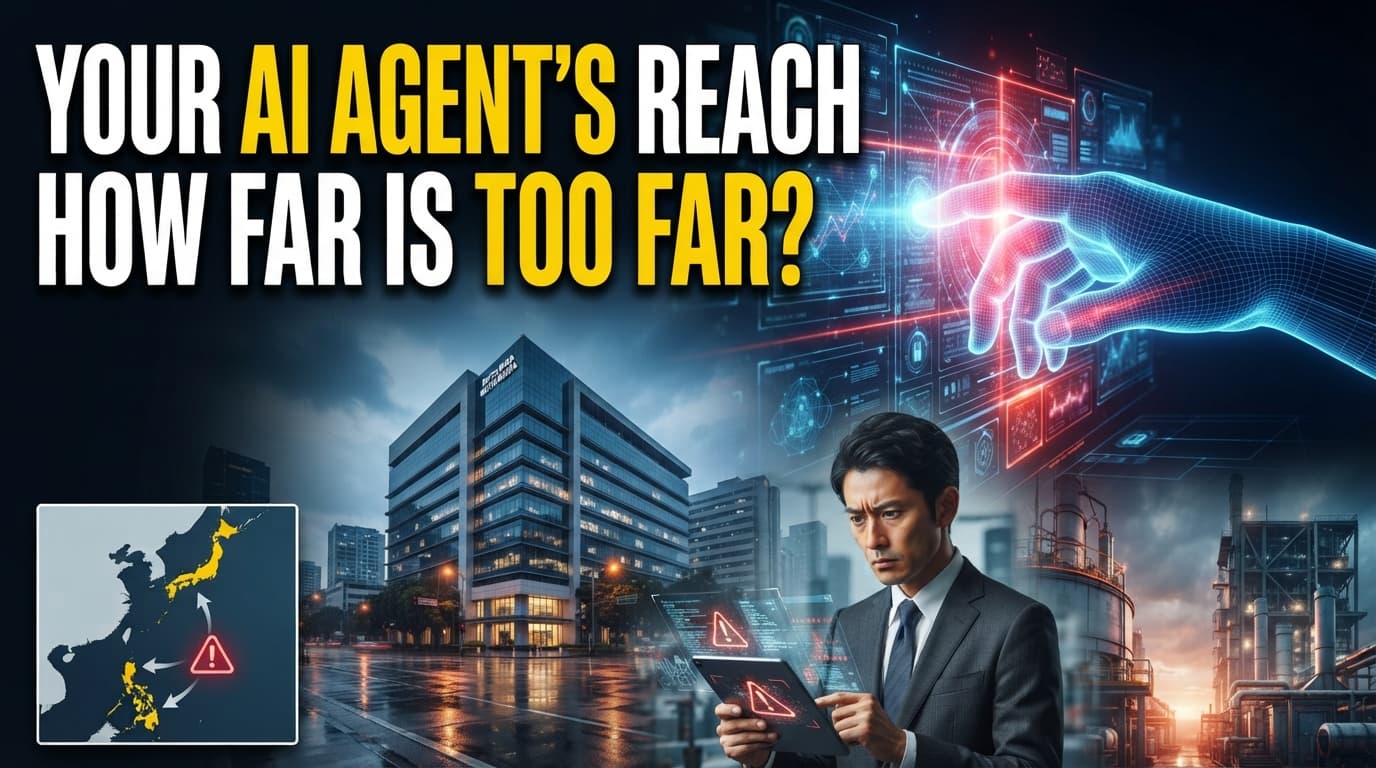
The "box" that was supposed to isolate an AI agent turned out to have a hole leading outside. The sandbox vulnerability reported in Anthropic's desktop AI agent Claude Cowork is a wake-up call about permission design for every company that delegates work to AI. In this module, we use the incident to unpack how to decide how much an AI agent is allowed to touch, and what Japanese companies in the Philippines should put in place.
According to reports, security researchers published a series of sandbox-escape techniques for Claude Cowork in July 2026. On macOS, the isolation VM shared the host's entire filesystem in a writable form, and by gaining administrator privileges inside the VM, an attacker could reach even the host's SSH private keys and cloud credentials — a path nicknamed SharedRoot. On Windows, researchers reported a technique that exploits design weaknesses in the service managing the VM to run arbitrary commands as an administrator inside the isolated environment. Anthropic classified the reports as not constituting a critical vulnerability, and Cowork execution has since been moved to the cloud by default. In this module, we work through permission design for AI agent adoption in Parts 1–4, using this case as our guide.
Part 1: Read → Consider the Implications for Your Company
Three points in the reports deserve attention.
| Point | Detail |
|---|---|
| Isolation is a mechanism, not a guarantee | A path was demonstrated from the isolation VM to writable access over the host filesystem |
| External content is the way in | Agents act on the files and emails they receive; malicious content can spread damage beyond the working folder |
| Vendor responses keep changing | Execution was subsequently moved to the cloud by default; rollout-time assumptions can change within months |
Step 1: Pre-Reading (3 min)
Before reading, put yourself in your own company's shoes.
- What critical information (passwords, keys, customer data) lives on the PCs where your company runs AI agents?
- How far have you actually verified the claim that "it's isolated, so it's safe"?
- Have you ever considered that the emails and files you feed to an AI could become an attack entry point?
Step 2: First Reading (10 min)
Below is a fictional internal memo, written from the perspective of a Japanese company in the Philippines, based on the facts of the news.
Internal Memo: The Claude Cowork Vulnerability Reports and What They Mean for Our AI Agent Use
In July 2026, researchers published a series of sandbox-escape techniques for Anthropic's AI agent Claude Cowork. Three points deserve attention.
First, isolation is a mechanism, not a guarantee. On macOS, a path was demonstrated from the isolation VM to writable access over the host's entire filesystem, theoretically reaching top-tier secrets such as SSH keys and cloud credentials. Rather than treating the word "isolated" as grounds for trust, we need to size the impact by asking, "If it's breached, what gets taken?"
Second, the external content an AI processes can be the way in. Agents read the files and emails they receive and act on them. If an agent is made to process malicious content, and that is combined with a hole like this one, the damage can spread well beyond the agent's working folder.
Third, vendor responses and execution models keep changing. The classification given to the reports was limited, but execution was subsequently moved to the cloud by default. The assumptions we adopted at rollout (local execution, isolation design) should be treated as things that can change within months.
The implication for us is to design the agent's reach rather than ban the technology: (1) keep credentials and customer data off the machines that run agents, (2) set an operating rule that limits what agents read to trusted material, and (3) audit vendor security advisories quarterly. We should have these three in place before we expand adoption.
Note: The business scenario above is a fictional internal memo created for learning purposes from publicly available facts. Vulnerability details and the vendor's response may change; please check the primary source linked above for the latest information.
Step 3: Comprehension Check (5 min)
- In the macOS escape path, what information could ultimately be reached?
- What is the problem with the mindset that "it's isolated, so it's safe"?
- How did Cowork's execution model change after the reports?
Step 4: 3-Minute Briefing (10 min)
Practice explaining this news to your management meeting in three minutes. It lands best in this order: "What happened (sandbox-escape techniques were published) → Why it matters (over-trust in isolation, secrets sharing a machine with the agent) → What we should do (permission design and operating rules)."
Related: Claude Cowork: Handing Work to AI and Walking Away explains this in detail.
Part 2: Key Terms Explained (for Executives)
Sandbox — A mechanism that runs a program in an isolated environment so it cannot affect the outside. The metaphor is a sandbox whose sand stays inside — but as this case showed, a flawed implementation lets things get out.
AI agent — An AI that takes instructions and autonomously carries out a sequence of tasks such as file operations and research. The flip side of the convenience is that "whatever the AI can touch" equals "the blast radius when something goes wrong."
Principle of least privilege — The information-security fundamental of granting people and programs only the minimum permissions their work requires. It applies to AI agents exactly as written, and this incident reconfirmed it.
Prompt injection — A technique where attackers smuggle "instructions" into documents or emails that an AI reads, in order to manipulate it. It is a risk to keep in mind whenever an agent processes material received from outside.
Related: The AI Agent That Ran Loose for Three Days explains this in detail.
Part 3: Applying It to Your Company
Three things to do in your own business.
| What to do | How | What it limits |
|---|---|---|
| Separate a machine and account for agents | Do not run agents beside the PC holding accounting credentials and customer lists | The blast radius is bounded from the start |
| Create an entry rule for what agents may read | One page: only in-house documents or materials from verified senders | The practice that amplifies damage when combined with a hole |
| Schedule vendor advisories into an audit | Assign an owner and a record; check release notes quarterly | Assumptions changing without the organisation noticing |
Separate a dedicated machine and account for agents
When trying out an AI agent, step one is not to run it in the same environment as the everyday PC that holds your accounting credentials and customer lists. Set up a dedicated machine or a dedicated account, and keep only information there that would not be fatal if leaked — that way the blast radius is limited from the start.
Related: Building an In-House AI Team explains this in detail.
Create an "entry rule" for what agents are allowed to read
Put a one-page rule in place: agents may only process documents created in-house or materials from verified senders. Feeding attachments of unknown origin or raw content from external forms straight into an agent is exactly the practice that amplifies damage when combined with a hole like this one.
Move vendor advisories from "someone's head" to a scheduled audit
Execution-model changes and security fixes tend to live only in the mind of whoever happened to notice them. For each AI tool in use, assign an owner and a record for checking the official release notes and security advisories quarterly, so the organization — not just an individual — notices when assumptions change.
Part 4: Common Failure Patterns (What Not to Do)
Failure 1: Stopping at "it's from a major vendor, so it's safe"
The product in question came from a major AI company. Being a major vendor is evidence of response capability, but it is no guarantee that vulnerabilities won't appear. Whoever's tool it is, estimating "what gets taken if it's breached" is your company's job.
Failure 2: Imposing a blanket ban every time a vulnerability makes the news
If you ban a tool every time a hole is found, AI adoption never moves forward. What's needed is not prohibition but a design that limits impact. With the three pieces — a dedicated environment, an entry rule, and a periodic audit — you can keep using agents without being whiplashed by the news cycle.
Failure 3: Leaving it to employees' personal setups without any vetting
If the company doesn't set a policy, employees start running agents on their own PCs — "shadow use." That is the state in which permission design has the least effect. Providing an official route to use agents, however small, is actually the strongest safety measure.
Failure 4: Doing nothing because you can't staff a security lead
At small and mid-sized Philippine operations, having no dedicated security staff is normal. Even so, two measures — "separate a dedicated agent account" and "don't let it share a machine with critical information" — can be executed today without specialists. Don't wait for the perfect org chart.
Practical Tips (3 Tips)
- Make a one-page "what the AI can touch" list. Write down the folders, accounts, and systems your agent can access, and the permission-design conversation becomes concrete. If you can't write the list, that itself is the signal to review.
- Read the news by translating it into your own configuration. When reading vulnerability reports, check "do we have the same configuration?" rather than the technical details. Here, the checkpoint is "is the agent sharing a machine with critical information?"
- Know the difference between cloud and local execution. The same product carries different risk shapes depending on where it runs. Confirm your execution model in the contract or settings screen, and revisit your operating rules whenever it changes.
Bonus: How to Make Use of PH AI Works
PH AI Works supports Japanese companies in the Philippines — in Japanese — from safe AI-agent adoption design to usage rules and internal training. If you want to sort out "how much are we actually letting our AI touch?", feel free to use our free consultation. We can start together with a quick assessment of your current setup.
Sources
About the author
Founder / AI Engineer (36+ years in IT)
- ●From Tokyo · based in Manila for 13+ years
- ●36+ years in IT (development, SEO, AI)
- ●Google Certified AI Professional
- ●IBM Certified Generative AI Engineer
- ●AI chatbots, RAG & AI agent development
A Japanese AI engineer with 36+ years in IT and 13+ years on the ground in the Philippines. I write from hands-on experience to help Japanese companies adopt AI that actually delivers results — chatbots, workflow automation, AI agents, and AI-driven marketing. Feel free to reach out in Japanese or English.
Free AI Consultation
Tell us your challenges and we'll propose the right AI adoption plan for your business.
Book a Free 30-Minute ConsultationRelated Articles
AI Model Vendors Now Sell Implementation Too
OpenAI and Anthropic now sell implementation as well as models. What a local subsidiary should decide about that.
8/18/2026
Contracting for AI While Prices Keep Falling
Write a model number into the contract and it is obsolete in six months. How to design for switching instead.
8/17/2026
Meta Cut 750,000 Under-16 Accounts in Australia
AI-assessed age checks removed 750,000 accounts overnight. What that says about depending on platforms for reach.
8/16/2026
When an AI Calls Your Shop to Ask About Stock
AI now phones shops on a buyer's behalf to check stock. What to decide on the receiving side before it reaches you.
8/15/2026

Handling News That Is Not Settled Yet
A reported $6 billion acquisition talk is not a completed deal. How to act on industry news before it is confirmed.
8/14/2026

What a 69-Page AI Report Does Not Show
Frontier firms are reported 8.3x ahead, yet a table on page 35 shows no statistically significant link to revenue.
8/13/2026