
GM's 50 FANUC Robots: Automation and Jobs
What GM's robot rollout says about balancing automation and employment, read from a Philippine operations standpoint.


AI Engineer · 36+ years in IT · Japanese, based in Manila for 13+ years
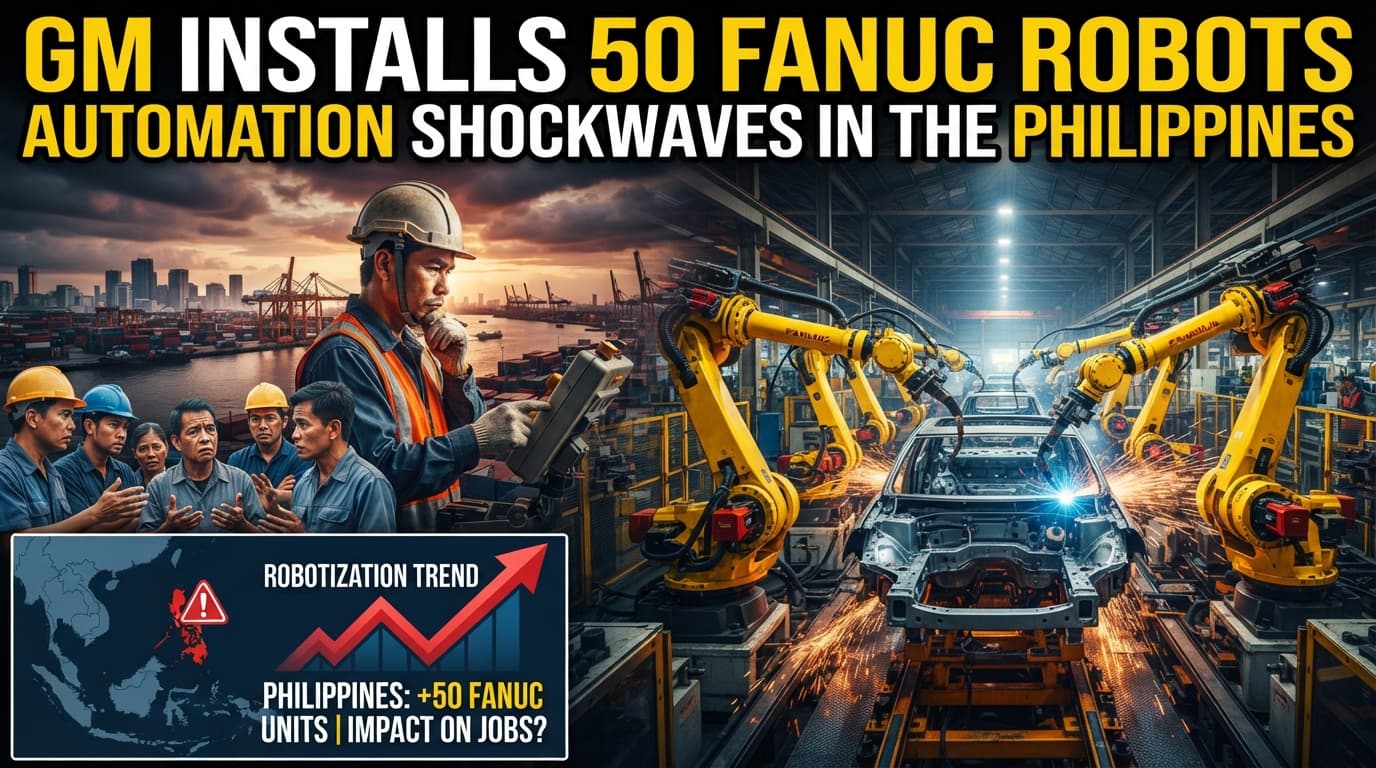
From automaker GM's automation case, learn in practical terms how Japanese companies doing business in the Philippines can adopt robots and AI while protecting local jobs and trust.
The news that American automaker GM (General Motors) installed Japanese-made robots in a factory after laying off 1,300 workers vividly illustrates the difficult relationship between automation and employment. This theme matters not only to manufacturing but also deeply to the Philippines' BPO sector (business process outsourcing — the industry that handles call centers, back-office work, and the like). It is a teaching case for Japanese companies doing business in the Philippines, and for Japanese businesspeople working there, to think through how to adopt automation and how to engage with local talent.
Part 1: Why This Matters
Step 1: The Philippine Business Context (3 min)
The Philippines is a country whose economy has been carried by human labor. The BPO industry in particular is a major pillar supporting the nation's export earnings, and many young workers are employed there. GM's case confronts us, backed by real numbers, with the question of how human work changes as automation advances.
For Japanese companies, this is not someone else's problem. Companies with manufacturing bases in the Philippines, and companies that entrust accounting and inquiry handling to local shared services (an organization that consolidates the back-office work of several sites in one place), all want to raise efficiency with AI and robots. At the same time, protecting local jobs is directly tied to a company's reputation and to maintaining good relations with DOLE (the Philippine Department of Labor and Employment). Leaning too far toward either efficiency or employment alone invites unexpected backlash.
For Japanese people in the Philippines, whether you treat automation merely as a "cost-cutting tool" or position it as a "tool for improving workers' safety and ease of work" makes a big difference to the trust of your local team. GM's case is excellent material for thinking through that fork in the road.
Picture yourself in a Manila office, showing this news to your local IT manager. "Apparently the union is angry that GM could have brought back the workers it laid off before installing robots. When we move ahead with automation, let's first talk about whose job changes and how." Open with that, and a technology conversation instantly becomes a conversation about your own workplace.
Step 2: Key Points From the Original Article (5 min)
This is a table we compiled independently, drawing only on the facts that appear in the original article.
| Item | Details |
|---|---|
| What happened | GM installed about 50 robotic arms at "Factory Zero," its flagship EV plant in Detroit |
| Robot maker | FANUC, the Japanese robotics manufacturer |
| Layoff situation | A March 2026 layoff put 1,300 people out of work, of whom more than 1,000 remain indefinitely laid off |
| Earlier layoffs | Prior to this, another 1,200 people were permanently laid off in October 2025 |
| Union reaction | James Cotton, president of UAW (United Auto Workers) Local 22, said the laid-off workers should have been brought back before the robots |
| Other companies' moves | Stellantis and Ford are also introducing robots on their assembly lines. Hyundai plans to bring Boston Dynamics' humanoid robot "Atlas" into its Georgia plant by 2028 |
| China's lights-out factories | Zeekr's Ningbo plant produces 300,000 units a year, and Xiaomi's Beijing plant uses over 700 robots to produce one EV every 76 seconds |
| Robot installations by country (2024) | China installed 295,000 industrial robots in the year, reaching a cumulative 2 million. Japan installed 44,500 and the United States 34,200 |
This table was created for learning purposes based on facts from public information. For details, please check the original article at the link above.
Related: AI Automation for Philippine SMEs: Streamline Operations explains this in detail.
Step 3: Comprehension Check (5 min)
Q1. How many robotic arms did GM install at Factory Zero, and what country's manufacturer made them?
Hint: The count is close to 50, and the maker is a famous Japanese robotics company.
Q2. State the number of people put out of work by GM's layoff, and how many of them remain indefinitely laid off.
Hint: The layoff affected 1,300 people, of whom more than 1,000 have not returned.
Q3. What did the UAW union argue regarding the introduction of robots?
Hint: It pointed out that a certain group of people could have been brought back before the new machines were installed.
Q4. According to the article, at what pace — one EV every how many seconds — does China's Xiaomi produce vehicles at its Beijing plant?
Hint: It's a short span, a little over a minute. The article gives a specific number of seconds.
Q5. Which country installed the most industrial robots in 2024, and how much larger was that number compared with Japan and the United States?
Hint: It's the country that reached a cumulative 2 million, far exceeding the annual installations of Japan and the United States.
Related: Talking About AI Layoffs Without Sparking Backlash explains this in detail.
Part 2: Putting It Into Practice
Step 4: Implementation Steps in the Philippines (10 min)
To advance automation while protecting local trust, here is an approach tailored to Philippine circumstances.
| Step | What to do | Philippines-specific notes |
|---|---|---|
| 1. Inventory the work | Identify which tasks to hand to machines and which to keep with people | Interview local staff carefully, and leave written minutes rather than relying on verbal agreement alone |
| 2. Estimate the budget | Roughly calculate installation and operating costs | Small-scale automation can start from a few hundred thousand pesos, while serious equipment can reach several million pesos, so check local market rates in peso terms |
| 3. Check the impact on jobs | Consider in advance whether reassignment or retraining can avoid layoffs | If headcount reductions are involved, procedures in line with DOLE (Philippine Department of Labor and Employment) rules are required, and consulting in advance is safer |
| 4. Test small | Introduce it on a trial basis in just one process or department | Share the results with local leaders and reflect frontline voices in the next decision |
| 5. Retraining and briefings | Set up a venue for affected workers to learn new roles | Explaining in both English and the local language, and always leaving time for questions, builds reassurance |
What matters at each step is to communicate automation not as a "plan to cut people" but as a "plan to change people's work into something safer and more valuable." Because Philippine culture places weight on verbal agreement, keeping the agreed content in writing as well helps prevent later discrepancies.
Related: Philippine Talent Strategy After the SSW Freeze explains this in detail.
Step 5: Common Failures and Countermeasures (5 min)
Failure pattern 1: Putting "cost cutting" front and center
If you explain the purpose of automation only in terms of cost, local staff take it to mean "I'll be cut," and you lose their cooperation.
Bad example: At an all-hands meeting, you only said, "We're introducing robots to lower labor costs."
Good example: You communicated, together, that people's roles will expand: "We want to hand dangerous tasks and simple repetitive work to machines, so that all of you can focus on judgment and improvement."
Failure pattern 2: Putting off labor-law procedures
If you proceed with changes affecting headcount without checking local procedures, it can later develop into legal trouble.
Bad example: You decided a reassignment or layoff plan internally and gave notice without checking DOLE (Philippine Department of Labor and Employment) rules.
Good example: As soon as it became clear that headcount might be affected, you consulted local HR staff or experts and worked out in advance the required procedures and the order of notifications.
Failure pattern 3: Not preparing post-installation training
If you simply install machines without preparing to train the people who use and maintain them, the frontline grinds to a halt when trouble strikes.
Bad example: You installed the robots but began operating them without anyone able to operate and inspect them.
Good example: At the same time as installation, you prepared training to learn operation and basic maintenance, and developed several reliable local staff in advance.
Part 3: Going Deeper
Step 6: Related Technical Terms (5 min)
An industrial robot is a robotic arm that automatically attaches and moves parts on a factory assembly line or similar. It helps to think of it as a strong mechanical hand that lifts heavy objects or repeats the same task precisely in place of a person. At a Philippine manufacturing base, you might hand dangerous welding and the carrying of heavy parts to industrial robots, and shift local staff to safer inspection and quality-check work.
A dark factory (lights-out factory) is a plant that runs with almost no people present; because it doesn't even need lighting, it's also called a "factory with the lights off." It is a factory where machines alone keep churning out products, with hardly any human presence in sight. Aiming straight for a fully unmanned factory in the Philippines is not realistic, but a partial approach — running some processes automatically only at night, for example — is worth considering.
A humanoid robot is a robot shaped like a human that can take over human tasks. It is a robot with arms and legs that can move around like a person. In Philippine warehouses and factories, using humanoid robots for inspecting places people can't easily enter, or for nighttime patrols, is beginning to be discussed as a future option.
Cybersecurity is the effort to protect machines and systems from unauthorized intrusion and attacks. Think of it as a mechanism that locks and watches over a factory or system so bad actors can't get in. The more automated a factory is, the greater the risk that a single attack shuts everything down, so at Philippine sites too it is important to build intrusion-prevention settings and regular inspections into the plan from the start.
Automation is having machines or software automatically carry out work that people used to do by hand. It is a mechanism for finishing tedious work with the press of a button or by leaving it to a machine. At Philippine BPO sites, the move to automate routine data entry and invoice processing — and shift local staff to higher-value work such as customer service and improvement proposals — is spreading.
Step 7: Thinking About Applying It to Your Company (10 min)
Where to redirect the capacity freed up by automation
In GM's case, automation became tied to layoffs and invited backlash. If you advance automation at your company, it is important to decide in advance where to redirect the freed-up labor.
Prompt: Name one routine task that currently takes up your local staff's time, and write out concretely what you could do with the time freed up if you automated it.
How to communicate in a way that raises efficiency while preserving local trust
The same automation can become a "welcomed change" or a "feared change" depending solely on how you communicate it. The key is how you involve local leaders.
Prompt: Name three local stakeholders with whom you should first share the automation plan, and consider what words would reassure each of them.
How to prepare for the fragility of full automation
The article pointed out the danger that relying too heavily on machines alone delays the response to problems. A design that leaves room for human judgment is necessary.
Prompt: Write out on a single sheet of paper who responds, and in what order, if your automated system goes down, and check for gaps.
As your next action, pick just one process in your operations that is "easy to see the effect of and has little impact on jobs when automated," and jot down a plan to test it small by the end of this week.
Part 4: FAQ
Q1. When advancing automation, is any filing legally required in the Philippines?
If reassignment or reduction of headcount is involved, procedures in line with the rules of DOLE, the Philippine Department of Labor and Employment, are required. Even if installing the equipment itself needs no special permit, if employment will be affected, consult local HR staff or experts early and confirm the order of notifications and required documents in advance, to be safe.
Q2. Even at Philippine BPO sites, will automation make jobs disappear?
It is true that routine work is more likely to become a target for automation. However, work such as conversing with customers, complex judgment, and improvement proposals are areas where human strengths come into play. If you plan to redirect the time freed up by automation to such high-value work, you can raise productivity while protecting jobs.
Q3. Japan headquarters says "automate everything right away," but isn't that out of step with the local sense?
It is a point where gaps easily arise. In Japan, efficiency discussions sometimes proceed matter-of-factly, but in the Philippines, consideration for employment and human relationships is very highly valued. It is good to explain to headquarters that an approach of testing in stages while reflecting local voices ends up taking root faster and failing less.
Q4. Is the risk high that automated equipment gets attacked or goes down?
The more automation advances, the greater the impact of a single malfunction or attack bringing everything to a halt. That is exactly why, at the same time as installation, it is essential to prepare intrusion-prevention settings and a procedure that decides who responds and how when something stops. It is also important to leave in place a mechanism by which people can notice abnormalities and respond quickly.
Q5. My budget is limited. How should I start small?
Testing it on just one process or department is realistic. In the Philippines, small-scale automation can sometimes start from the scale of a few hundred thousand pesos. First choose a task that is easy to see the effect of and has little impact on jobs, share the results with local leaders, and decide whether to expand next from there.
Tips for Making It Work (3 Tips)
Put into words at the outset that automation's purpose is "to expand people's roles"
If you hold up cost cutting alone, you lose the frontline's cooperation. Before deciding to introduce automation, write in one sentence where you'll redirect the freed-up labor — to which valuable work — and share it with local leaders, and the change will be received positively.
Begin employment-related procedures at the same time as the technical review
Rushing to check labor procedures only after choosing the equipment invites legal trouble and backlash. As soon as it becomes clear that headcount might be affected, work out the steps in line with DOLE rules together with a local expert, and advance the technology and labor sides in parallel.
Test small on one process, and review the results together with the local side
Automating everything at once makes both the impact of a breakdown and the learning opportunity too large to handle. Choose one task that is easy to see the effect of, test it, and hold a session to review the results with local staff, and your next decision will be more solid.
Bonus: How to Make Use of PH AI Works
PH AI Works supports companies advancing the adoption of AI and technology in the Philippines. We can respond to consultations directly tied to this theme — how to strike the balance between automation and employment, and where to start given local circumstances.
As a next step, you can consult us on things like the following.
- Sorting out which of your operations to start automating, where the effect is easy to see and the impact on jobs is small
- How to think about explaining automation to local staff and preserving trust as you advance
- Building an implementation plan tailored to local circumstances, to test small and then expand
Please feel free to get in touch. The initial consultation is free.
References and Sources
About the author
Founder / AI Engineer (36+ years in IT)
- ●From Tokyo · based in Manila for 13+ years
- ●36+ years in IT (development, SEO, AI)
- ●IBM Certified Generative AI Engineer
- ●AI chatbots, RAG & AI agent development
A Japanese AI engineer with 36+ years in IT and 13+ years on the ground in the Philippines. I write from hands-on experience to help Japanese companies adopt AI that actually delivers results — chatbots, workflow automation, AI agents, and AI-driven marketing. Feel free to reach out in Japanese or English.
Free AI Consultation
Tell us your challenges and we'll propose the right AI adoption plan for your business.
Book a Free 30-Minute ConsultationRelated Articles
AI Model Vendors Now Sell Implementation Too
OpenAI and Anthropic now sell implementation as well as models. What a local subsidiary should decide about that.
8/18/2026
Contracting for AI While Prices Keep Falling
Write a model number into the contract and it is obsolete in six months. How to design for switching instead.
8/17/2026

Meta Cut 750,000 Under-16 Accounts in Australia
AI-assessed age checks removed 750,000 accounts overnight. What that says about depending on platforms for reach.
8/16/2026

When an AI Calls Your Shop to Ask About Stock
AI now phones shops on a buyer's behalf to check stock. What to decide on the receiving side before it reaches you.
8/15/2026

Handling News That Is Not Settled Yet
A reported $6 billion acquisition talk is not a completed deal. How to act on industry news before it is confirmed.
8/14/2026

What a 69-Page AI Report Does Not Show
Frontier firms are reported 8.3x ahead, yet a table on page 35 shows no statistically significant link to revenue.
8/13/2026