
Cloud AI Infrastructure for Philippine SMEs
Building reliable systems by combining AWS or Google Cloud with AI APIs — architecture, cost, and failure points.


AI Engineer · 36+ years in IT · Japanese, based in Manila for 13+ years

Summary
- A reliable setup keeps the cloud platform (AWS or Google Cloud) and the AI APIs as separate layers, so a single AI provider outage does not stop the whole system.
- Philippine SMEs can start small with pay-as-you-go services and add redundancy as traffic grows, which avoids the large upfront cost of buying physical servers.
- Compliance with the Data Privacy Act of 2012 and a clear cost-monitoring plan matter as much as the technology choices themselves.
The Infrastructure Problems Philippine Businesses Hit First
| Challenge | What it means for your business |
|---|---|
| Power and internet interruptions | Systems go offline during brownouts or typhoons |
| High cost of on-premise servers | Large upfront spending before seeing any return |
| Limited round-the-clock technical staff | Hard to keep servers running and patched all day |
| Data privacy obligations | Penalties under local law if customer data is mishandled |
Many Philippine SMEs want to add AI features such as chatbots, document processing, or sales prediction, but the foundation underneath those features is where the real trouble starts. A typhoon season brownout or a fiber cut can take a locally hosted system offline for hours, and customers feel it immediately.
 Power and internet interruptions are a common risk for locally hosted systems in the Philippines.
Buying servers and running them in the office sounds like ownership, but it ties up capital that a growing business usually needs elsewhere. Hardware also needs cooling, backups, and someone to watch it.
Staffing is another quiet problem. Few small companies can hire engineers to cover nights, weekends, and holidays, yet online systems are expected to work at all those times. On top of this, any business that handles customer information carries legal responsibility under the Data Privacy Act of 2012, and that responsibility does not disappear just because a system is small.
Related: AI and Cloud for Next-Generation Websites explains this in detail.
Why On-Premise and Single-Vendor Setups Fall Short
| Traditional approach | Why it falls short |
|---|---|
| On-premise servers | High capital cost plus ongoing maintenance |
| Manual scaling | Cannot react fast enough to traffic spikes |
| Single AI provider | One outage can stop the entire service |
| No cost or usage monitoring | Bills and usage grow without warning |
On-premise servers give a feeling of control, but they age. After a few years you face replacement costs, and during that time someone has to apply security patches and handle failures. For most SMEs, that is time and money better spent on the business itself.
Manual scaling is the next weak point. If a promo goes viral or a payday rush hits an online store, a fixed server cannot grow on its own. The site slows down or crashes at the exact moment the business is winning attention.
Depending on a single AI provider creates a different risk. If that one API has an outage or changes its pricing, a service built directly on top of it has no fallback. Finally, without monitoring, cloud and API usage can quietly climb until the monthly bill becomes a surprise. The problem is rarely the technology alone; it is the lack of structure around it.
A Cloud-Plus-AI-API Architecture That Keeps Working
| Layer | Role |
|---|---|
| Cloud platform (AWS or Google Cloud) | Reliable foundation for storage and computing |
| AI API layer | Adds language, vision, or prediction features |
| Provider abstraction and failover | Switches providers if one becomes unavailable |
| Managed services | Reduces day-to-day operations work |
| Security and compliance tools | Helps meet local data-protection rules |
The core idea is to treat infrastructure and intelligence as two separate layers. The cloud platform handles storage, computing, and networking, while the AI features sit on top through APIs. Because the layers are separate, you can change or back up one without rebuilding the other.
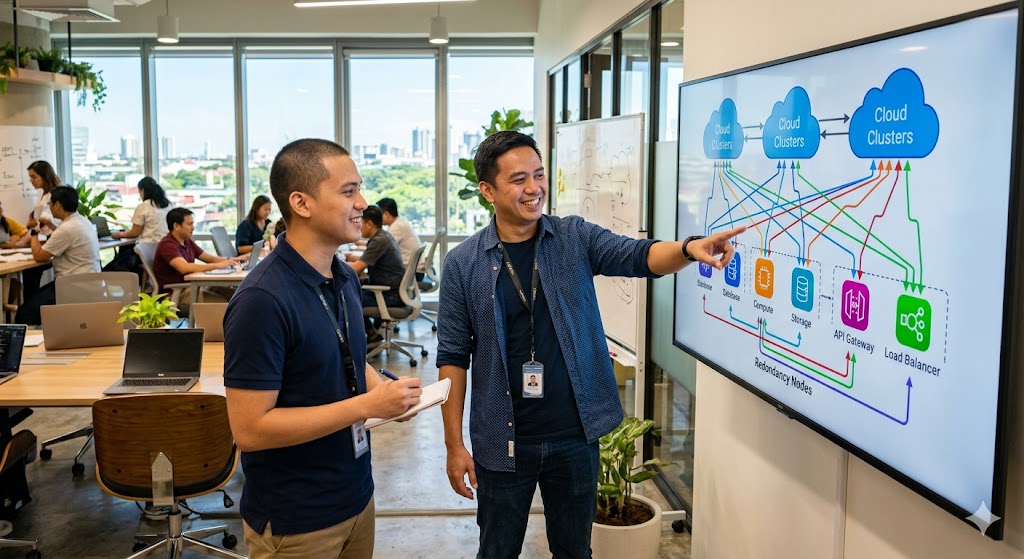 Separating the cloud platform from the AI API layer keeps the system running when one provider fails.
A major cloud platform such as AWS or Google Cloud gives you data centers, automatic backups, and uptime guarantees that a single office server cannot match. On top of that, AI APIs from providers like OpenAI, Anthropic, Google, or AWS Bedrock add language and analysis features without you training models from scratch.
The part many teams skip is a provider abstraction, a small piece of code that talks to AI providers through one shared interface. With it, if one API is down, the system can route requests to another. Managed services, such as serverless functions and managed databases, remove much of the operations work, and built-in security tools help align the setup with the Data Privacy Act of 2012.
Related: Preparing Your Systems Before Adopting AI explains this in detail.
5 Steps to Build Your Cloud AI Infrastructure
| Step | Action |
|---|---|
| 1. Map needs and data | Analyze workflows and where data moves |
| 2. Choose platform and region | Pick AWS or Google Cloud and a nearby region |
| 3. Build the AI API layer | Connect AI APIs through one shared interface |
| 4. Add monitoring and alerts | Track uptime, security, and spending |
| 5. Launch in phases | Release step by step and review progress weekly |
Start by mapping the work, not the technology. List the tasks AI will support, then trace where customer data comes from, where it is stored, and who can see it. This is also where you confirm which data must stay protected under local rules.
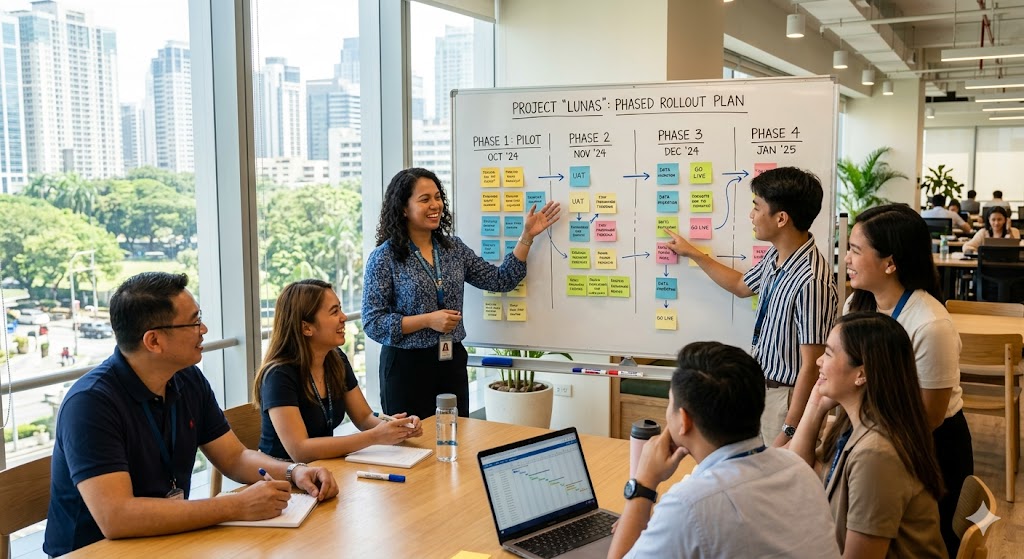 A phased rollout with regular progress reviews reduces rework during implementation.
Next, choose your cloud platform and region. Both AWS and Google Cloud have data centers in the Asia-Pacific area, so picking a nearby region keeps response times low for users in the Philippines. After that, build the AI API layer through a single interface so providers can be added or swapped later without touching the rest of the system.
Then add monitoring and cost alerts before launch, not after. Set spending limits and notifications so usage never grows unseen. Finally, release in phases rather than all at once.
This guide starts with the size of the machine rather than the choice of model, because the bill arrives monthly either way. Template-only setups look cheap at first and struggle once real business complexity arrives, and cloud infrastructure behaves the same way — sized once, then adjusted continuously.
Related: How AI Infrastructure Helps Philippine Businesses Build a Foundation for Sustainable Growth explains this in detail.
What to Expect: Reliability, Cost Control, and Growth
| Outcome | Benefit |
|---|---|
| Lower upfront cost | No need to buy and house physical servers |
| Pay-as-you-go billing | You pay mainly for what you actually use |
| Higher reliability | Built-in redundancy reduces downtime |
| Easier scaling | Capacity grows along with demand |
The clearest gain is on upfront cost. Instead of spending a large sum on servers before earning anything, you pay as you go, billed in US dollars and converted to peso on your card or invoice. For a business watching cash flow, this turns a big one-time purchase into a manageable monthly expense.
Reliability is the second gain. With data centers, backups, and failover between AI providers, the kinds of outages that once stopped an office server become far less disruptive. The system can keep serving customers through a local brownout, since the computing happens elsewhere.
Scaling becomes a setting rather than a project. As your traffic grows, capacity grows with it, and significant savings are realistic compared with over-buying hardware "just in case." The exact return depends on your workload, so it is worth modeling your own usage before committing.
FAQ
Q: Should a small Philippine business choose AWS or Google Cloud?
A: Both are reliable choices with data centers in the Asia-Pacific region. AWS has the widest range of services, while Google Cloud is often praised for data and machine-learning tools. The better question is which one matches your team's existing skills and the AI APIs you plan to use, since staff familiarity affects speed and cost more than the brand name does.
Q: How do I keep cloud costs under control when billing is in US dollars?
A: Set spending limits and budget alerts inside the platform from day one, and review usage weekly during the early months. Because billing is in US dollars, peso costs move with the exchange rate, so it helps to keep a small buffer in your monthly budget and to turn off unused services promptly.
Q: Is it legal to store customer data on AWS or Google Cloud under Philippine law?
A: Yes, using foreign cloud providers is allowed, but your business remains responsible for the data under the Data Privacy Act of 2012. You should document how data is collected, stored, and protected, choose appropriate regions, and apply the platform's security tools. For sensitive sectors such as finance, check the relevant regulator's guidance as well.
Q: Do I need a large IT team to run cloud AI infrastructure?
A: No. Managed and serverless services handle much of the maintenance that an on-premise setup would require. A small team, or a local partner, can run a well-designed system, since the cloud provider takes care of the underlying hardware, backups, and uptime.
Q: What happens to my system during a brownout if everything is in the cloud?
A: The computing continues in the data center, so the system itself stays online. What you need is a stable way to reach it, such as a backup internet connection or mobile data, so your staff and customers can still connect during a local power interruption.
Getting Started Without Overbuilding
A robust cloud AI setup for a Philippine SME does not start with the biggest possible architecture. It starts with a clear map of your data, a single cloud platform, an AI layer that can fall back to a second provider, and monitoring that warns you before costs climb. Build it in phases, review progress often, and adjust as you learn.
If you want help planning this for your own business, PH AI Works can review your current systems and design a cloud AI setup that fits your budget and your customers. A short scoping conversation is a practical first step.
Sources & References
- Department of Information and Communications Technology (DICT) — Philippine government agency for ICT policy and digital infrastructure programs.
- National Privacy Commission — regulator and guidance for the Data Privacy Act of 2012 (Republic Act No. 10173).
- AWS Well-Architected Framework — design principles for reliability, security, and cost optimization on AWS.
- Google Cloud Architecture Framework — best practices for building reliable and scalable systems on Google Cloud.
- Bangko Sentral ng Pilipinas (BSP) — regulatory guidance relevant to financial and fintech data handling in the Philippines.
- Department of Trade and Industry (DTI) — Philippine government resources and programs for SMEs and digital adoption.
About the author
Founder / AI Engineer (36+ years in IT)
- ●From Tokyo · based in Manila for 13+ years
- ●36+ years in IT (development, SEO, AI)
- ●IBM Certified Generative AI Engineer
- ●AI chatbots, RAG & AI agent development
A Japanese AI engineer with 36+ years in IT and 13+ years on the ground in the Philippines. I write from hands-on experience to help Japanese companies adopt AI that actually delivers results — chatbots, workflow automation, AI agents, and AI-driven marketing. Feel free to reach out in Japanese or English.
Your Competitors Are Already Using AI!
Is your business keeping up?
Related Articles

LoRA Fine-Tuning: Custom AI Without a Big Budget
How Philippine SMEs use LoRA fine-tuning to build custom AI with small data, modest hardware, and control over their own use cases.
7/8/2026

Generative AI for Philippine SMEs: Cut Costs, Save Time
Five ways generative AI cuts cost and time for Philippine SMEs, six steps to roll it out, and what results are realistic.
7/6/2026

Philippine AI Solutions Competing Worldwide
Philippine-built AI is gaining attention abroad. How local SMEs use AI and modern technology to compete globally.
6/27/2026

AI Chatbot for Philippine SMEs: Multilingual Support
An AI chatbot that handles customer service in English, Filipino, and Taglish 24/7 — what it costs, how to set one up, and when to build custom.
6/26/2026
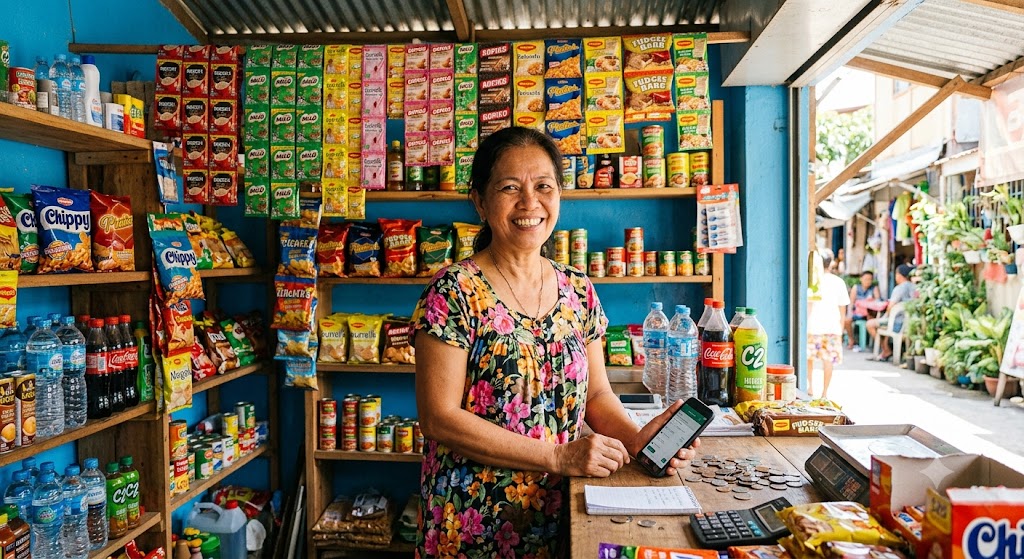
AI for Sari-Sari Stores: Smarter Micro-Retail
Behind SariSari Bench, an AI app built for Philippine micro-retailers — the technology, the build, and the results owners can expect.
6/25/2026

Finding Internal Data Faster With LangChain
How Philippine businesses build accurate AI search over their own internal documents with LangChain and Pinecone.
6/19/2026