
AI for Sari-Sari Stores: Smarter Micro-Retail
Behind SariSari Bench, an AI app built for Philippine micro-retailers — the technology, the build, and the results owners can expect.


AI Engineer · 36+ years in IT · Japanese, based in Manila for 13+ years
Summary
- A sari-sari store running on paper ledgers loses time and margin to stockouts, pricing guesswork, and unrecorded utang (store credit) that a well-designed app removes.
- SariSari Bench pairs a clean Next.js application with an AI layer that lets owners log sales in everyday Taglish, scan supplier invoices, and get restock suggestions without learning complex software.
- Custom retail software succeeds when it starts with detailed business analysis, rolls out in phases, and keeps improving after launch, not when it is dropped in as a generic template.
Where Philippine Small Retailers Lose Time and Money
| Daily task | Cost of doing it manually |
|---|---|
| Tracking stock | Owners discover a fast item is sold out only when a customer asks for it |
| Setting prices | Margins are estimated by feel, so profit per item is unclear |
| Ordering from suppliers | Reorders rely on memory, leading to overstock or empty shelves |
| Recording utang (store credit) | Unpaid balances written in a notebook are easily lost or forgotten |
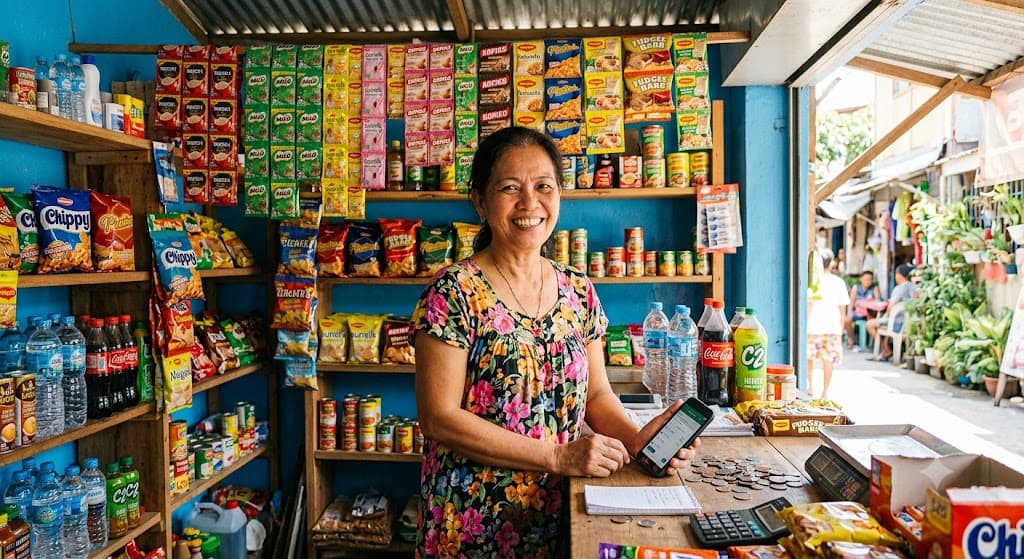
Around 1.3 million sari-sari stores operate across the Philippines, and these small neighborhood shops make up a large share of everyday retail spending. Most are family-run with limited capital, and the owner is also the cashier, the buyer, and the bookkeeper. That overload is exactly where small problems quietly add up.
 Sari-sari stores are everywhere in the Philippines, yet most still run on paper and memory.
The first weak point is stock visibility. Without a running count, a store often sells out of its best movers, like sachet shampoo or load, while slow items tie up cash on the shelf. The second is pricing. When the tingi (per-piece) price is set from habit rather than the actual landed cost, the store can sell more units yet earn less.
Ordering is the third pressure point. Reorders made from memory tend to swing between too much and too little, and both hurt. The fourth is utang: informal credit is part of how sari-sari stores keep loyal customers, but a notebook entry that fades or goes missing is money the store never recovers.
Related: Building AI Web Apps: Design Tips That Decide Success explains this in detail.
Why Notebooks and Generic Apps Don't Keep Up
| Current approach | Where it falls short |
|---|---|
| Paper notebook (listahan) | No totals, no trends, and entries are easy to lose |
| Spreadsheet | Better records, but manual entry is slow and error-prone |
| Off-the-shelf POS app | Built for chains, not for tingi selling and store credit |
| Generic template app | Low starting cost, but cannot handle real store complexity |
The paper notebook is trusted because it is simple, but it cannot answer basic questions: which item earns the most, how fast stock turns, or who still owes money. A spreadsheet improves the record but still depends on the owner typing every line at the end of a long day, and tired hands make mistakes.
Ready-made point-of-sale apps look like the obvious fix, yet most are designed for formal stores with barcodes and fixed pack sizes. Sari-sari selling is different: one cigarette, three pieces of candy, a half-cup of cooking oil. Software that assumes whole packs simply does not match the counter.
Generic template apps share a deeper issue. A sari-sari store runs on utang na loob, on selling by the sachet, on knowing which neighbour pays on the fifteenth. A template has nowhere to put any of that, and a tool that ignores the rhythm of the store gets abandoned within weeks.
How SariSari Bench Uses AI to Close the Gap
| AI feature | What it does for the store |
|---|---|
| Everyday-language input | Owner logs a sale by typing or speaking plain Taglish |
| Invoice scanning (OCR) | Reads supplier receipts from a photo and updates stock |
| Demand forecasting | Suggests what and when to restock from past sales |
| Conversational reports | Answers questions like "anong mabenta this week?" in seconds |
SariSari Bench is built around a simple idea: the owner should not have to learn the software, the software should understand the owner. At its core is a large language model, which is software trained to understand and produce everyday human language. Instead of tapping through menus, an owner can write "tatlong Milo at isang kape" and the app records the sale and adjusts the stock count.
 With SariSari Bench, owners log sales in Taglish and scan invoices instead of writing every line by hand.
Receiving deliveries is handled with OCR, short for optical character recognition, a technology that reads printed text from a photo. The owner snaps a picture of the supplier invoice, and the app pulls out the items and quantities so the inventory updates without manual typing.
The forecasting layer uses demand forecasting, which means predicting future sales from past patterns. If load and bottled water always sell out before the weekend, the app flags them for reorder early. Finally, conversational reports let the owner ask plain questions and get a clear answer, so the data becomes a daily decision tool rather than a record no one reads.
It is worth being precise here: AI technology is well-suited for reading messy receipts and spotting sales patterns, but it does not run the store. It removes repetitive work so the owner can focus on customers and cash.
Related: Reducing Costly Rework in AI Application Projects explains this in detail.
Five Steps to Build an AI-Powered Retail App
| Step | Main focus |
|---|---|
| 1. Business analysis | Map how the store actually buys, prices, and sells |
| 2. Data model and design | Define products, tingi units, and credit records |
| 3. Build the core app | Develop a fast, mobile-first app in Next.js |
| 4. Add the AI layer | Connect language input, OCR, and forecasting |
| 5. Test and phased rollout | Pilot with real stores, then expand gradually |
The first step is the one most often skipped and the one that matters most. Before any code, the build team needs to understand the store: which items move, how tingi pricing is set, and how utang is tracked. Skipping this is the main reason template tools fail.
 Custom retail apps work best when they start with business analysis and roll out in phases.
The second step turns that understanding into a data model, which is the structure that defines how information is stored and connected. Sari-sari selling needs flexible units, since a product can be sold by pack or by piece, and a clean way to record who owes what.
The third step is building the core application. SariSari Bench uses Next.js, a modern web framework suited to fast, mobile-first apps that work well on the mid-range Android phones most owners carry. The fourth step layers the AI features on top of that stable base, rather than treating them as the whole product.
The fifth step is disciplined delivery. Pilot with a handful of real stores, fix what the data shows, then expand. A phased rollout protects both the budget and the owners' trust.
Related: DX or AI? Telling the Two Apart explains this in detail.
What Results and ROI to Expect
| Area | Expected outcome |
|---|---|
| Time per day | Less time on manual recording and counting |
| Stock accuracy | Fewer stockouts on fast-moving items |
| Margins | Clearer view of profit per item and per category |
| Growth | A base that can scale as the store or chain grows |
Returns from a tool like this are best described in practical terms rather than invented percentages. The clearest gain is time: logging sales by voice or text and updating stock from a photo cuts the nightly bookkeeping that eats into rest. Significant time savings can be expected once daily entry stops being a chore.
The second gain is fewer stockouts. When the app flags reorders before shelves run empty, the store keeps selling its best items instead of turning customers away to the shop next door. Over a month, captured sales that would otherwise be lost add up.
Clearer margins follow. With per-item profit visible, an owner can adjust tingi prices that were set too low and drop products that never earn their shelf space. For a sector whose combined value is projected to reach about ₱2.4 trillion by 2030, even small per-store gains scale into a meaningful market. The honest caveat: results depend on consistent use, and any custom build should be weighed against its development cost in pesos before committing.
FAQ
Q: Is an AI app realistic for a single small sari-sari store?
A: For one store, a simple inventory and credit app is usually enough, and AI mainly helps by removing manual typing. The full value of SariSari Bench shows when an owner runs several outlets or a supplier wants visibility across many stores.
Q: Will it work on a basic Android phone with slow internet?
A: Yes, if it is designed for that from the start. A mobile-first build keeps data light, and key features should still function with a weak connection, syncing when the signal improves. This is a requirement, not an afterthought.
Q: Do owners need to type in perfect English?
A: No. The language layer is built to handle everyday Taglish, so an owner can log sales the way they naturally speak. Plain input is the whole point.
Q: How much does a custom retail app cost in the Philippines?
A: Cost varies widely with scope, the number of features, and whether AI is included, so any figure given without analyzing your needs is a guess. A short scoping phase gives a realistic peso estimate before you commit to a full build.
Q: Is our store data safe in an app like this?
A: Data handling should follow the Data Privacy Act of 2012, which governs personal information in the Philippines. Ask any developer how customer and credit records are stored, who can access them, and where they are kept before you sign on.
Bringing AI to Your Own Operation
A sari-sari store does not need to become high-tech to benefit from AI. It needs a tool shaped around how it already works, built in clear phases, and improved after launch. SariSari Bench is one example of that approach: a stable core app with an AI layer that handles the tedious parts of running a counter.
If you operate a retail business, a supplier network, or a small chain and want to explore a custom build, start with a short business-analysis conversation rather than a feature list. As an AI engineer working mainly in Next.js and holding professional certifications in AI agent and generative AI development, my advice is the same one the projects above taught me: define the problem carefully first, then build. Reach out to PH AI Works to scope what an AI-powered tool could do for your operation.
Sources & References
- DTI: Sari-sari store sales projected to reach ₱2.4 trillion by 2030 — Department of Trade and Industry Job Blueprint figures on the sari-sari sector's size and outlook.
- Department of Trade and Industry — MSME statistics — official data on the share of micro, small, and medium enterprises in the Philippines.
- ILO/DICT — Inclusive, Competitive and Responsible Digital Philippines (Digital PINAS) — government and UN programme on MSME digitalization and connectivity barriers.
- Digital Innovation and Entrepreneurial Success in the Philippine MSME Sector (Economics journal, 2025) — research identifying cultural resistance, lack of technical expertise, and financial constraints as top digital-adoption barriers.
- National Privacy Commission — Data Privacy Act of 2012 (R.A. 10173) — the Philippine law governing the handling of personal data in business systems.
About the author
Founder / AI Engineer (36+ years in IT)
- ●From Tokyo · based in Manila for 13+ years
- ●36+ years in IT (development, SEO, AI)
- ●IBM Certified Generative AI Engineer
- ●AI chatbots, RAG & AI agent development
A Japanese AI engineer with 36+ years in IT and 13+ years on the ground in the Philippines. I write from hands-on experience to help Japanese companies adopt AI that actually delivers results — chatbots, workflow automation, AI agents, and AI-driven marketing. Feel free to reach out in Japanese or English.
Your Competitors Are Already Using AI!
Is your business keeping up?
Related Articles

LoRA Fine-Tuning: Custom AI Without a Big Budget
How Philippine SMEs use LoRA fine-tuning to build custom AI with small data, modest hardware, and control over their own use cases.
7/8/2026

Generative AI for Philippine SMEs: Cut Costs, Save Time
Five ways generative AI cuts cost and time for Philippine SMEs, six steps to roll it out, and what results are realistic.
7/6/2026

Philippine AI Solutions Competing Worldwide
Philippine-built AI is gaining attention abroad. How local SMEs use AI and modern technology to compete globally.
6/27/2026

AI Chatbot for Philippine SMEs: Multilingual Support
An AI chatbot that handles customer service in English, Filipino, and Taglish 24/7 — what it costs, how to set one up, and when to build custom.
6/26/2026

Finding Internal Data Faster With LangChain
How Philippine businesses build accurate AI search over their own internal documents with LangChain and Pinecone.
6/19/2026

LoRA Fine-Tuning for Private, Company-Specific AI
How Philippine businesses use LoRA and QLoRA fine-tuning to build private, company-specific AI on modest hardware.
6/17/2026