
English-First AI Projects in the Philippines
Running AI projects in English gives Philippine SMEs faster access to tools, documentation, and global talent.

AI Engineer · 36+ years in IT · Japanese, based in Manila for 13+ years
Summary
- English-first AI project setups give Philippine SMEs direct access to the latest tools, documentation, and global engineering communities without translation delays.
- Mixing local-language workflows with English-only AI documentation creates rework, misunderstandings, and slower delivery cycles for Philippine teams.
- Weekly progress reviews and mandatory documentation of specification changes are the simplest controls to keep an English-first AI project on schedule and within budget.
Why Philippine SMEs Struggle to Run AI Projects in Mixed-Language Environments
| Challenge | Impact on the Business |
|---|---|
| Documentation language mismatch | Teams wait for translations before starting work |
| Mixed Tagalog-English chat threads | Specifications get lost between channels |
| Vendor communication in two languages | Quotes and scopes drift apart |
| Onboarding new AI tools | Tutorials and error messages are English-only |
Philippine SMEs sit in a unique position. The country has one of the largest English-speaking workforces in Asia, yet daily business communication often blends Tagalog, Bisaya, and English. When an AI project enters the picture, that mixed setup starts to slow things down.
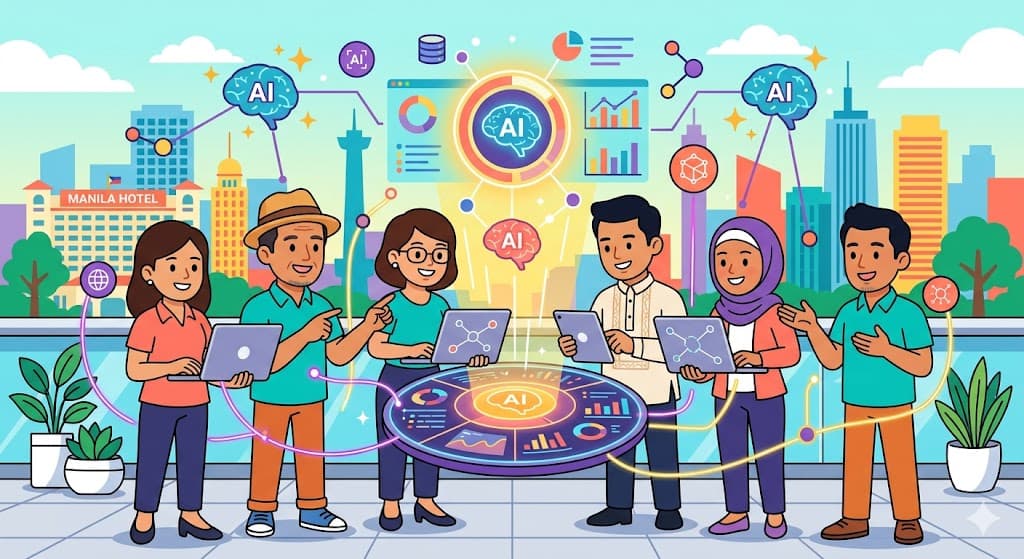
 Mixed-language workflows often slow down AI project delivery for Philippine SMEs.
Documentation language mismatch is the first friction point. Almost every major AI framework, from OpenAI's API reference to Hugging Face model cards, is published in English. When parts of a team prefer to summarize requirements in Tagalog and others in English, the working specification ends up living in two slightly different versions.
Mixed Tagalog-English chat threads cause specifications to drift. A product owner posts an instruction in one language on Viber, an engineer replies in another on Slack, and the AI prompt that finally gets coded is a third interpretation. For traditional websites this rarely caused problems, but for AI projects where prompts and parameters define the output, even small wording gaps lead to noticeably different results.
Vendor communication in two languages is the third issue. SMEs in Makati, Quezon City, and Cebu often hire a mix of local freelancers and overseas contractors. When proposals come in mixed languages, scope items get duplicated or lost, and final invoices rarely match the original quote.
Onboarding new AI tools is the fourth challenge. Cursor, Claude Code, n8n, LangChain, and similar platforms publish English-only release notes that change weekly. SMEs that wait for translated guides are usually six to twelve weeks behind the current best practice.
Related: AI Offshore Development in the Philippines: Ship Faster explains this in detail.
Why Translation-Heavy Workflows No Longer Keep Up with AI Project Pace
| Limit | Why It Falls Short |
|---|---|
| Translating after the fact | AI release cycles are too fast |
| Single bilingual coordinator | Becomes a bottleneck and single point of failure |
| Local-language specs only | Cannot be pasted into AI tools directly |
| Learning AI through translated tutorials | Information is outdated by publication |
The traditional approach of writing specifications in the team's preferred language and translating only when needed worked reasonably well for static websites and ERP rollouts. AI projects move on a different clock.
Translating after the fact falls apart because AI tools change faster than translation pipelines. A prompt template that worked last month may need rewriting this month because a model version was deprecated. By the time a translated runbook is approved internally, the underlying API has moved on.
Relying on a single bilingual coordinator to bridge English documentation and local-language teams creates a clear bottleneck. Running an export business from Japan years ago, I handled English-Japanese translation as a daily task for trade documents and supplier negotiations. Even with that volume, one person can only maintain accuracy for so long before backlog builds up. The same pattern hits Philippine SMEs that depend on one person to translate every AI ticket.
Local-language specifications cannot be pasted directly into AI tools. Most coding assistants, prompt builders, and evaluation frameworks expect English input for best results. Teams that draft specifications in mixed Tagalog-English then translate before pasting end up reworking the same content three times.
Learning AI through translated tutorials means the information is often outdated by the time it reaches the reader. A YouTube tutorial translated and re-uploaded six months later may demonstrate a workflow that the underlying tool no longer supports.
How an English-First Project Setup Solves These Issues for Philippine Teams
| Component | Function in an AI Project |
|---|---|
| English-only project documentation | Single source of truth that pastes into AI tools directly |
| English daily standups (text-based) | Reduces oral fluency pressure while keeping records |
| AI translation for client reports | Local-language summaries generated on demand |
| Shared English glossary | Aligns team on AI terms like "embedding" and "fine-tuning" |
| Version-controlled prompts | Treats prompts as code, not chat messages |
An English-first project setup does not mean banning Tagalog or Bisaya from the office. It means that the project's working artifacts, specifications, tickets, prompts, code comments, and test results, are written and stored in English.
 An English-first workspace becomes the single source of truth for AI project artifacts.
English-only project documentation becomes a single source of truth. When a developer needs to ask Claude or ChatGPT about a bug, they can paste the actual ticket without translating it first. When a new team member joins, they read the same documentation that the AI tools were trained against.
English daily standups in text form, run through Slack or Discord, work well for Philippine teams because written English is generally stronger than spoken English in CEFR terms. This matches my own situation as a CEFR B1 English user where reading and writing carry the work while spoken fluency lags. Text-based standups remove that gap and produce a searchable record at the same time.
AI translation handles the client-facing side. Once the project artifacts exist in English, generating a Tagalog or Japanese summary for a non-technical stakeholder is a one-click operation with modern translation models. The team writes once and serves many audiences.
A shared English glossary aligns the team on AI-specific terms. Words like "embedding," "fine-tuning," "RAG," and "agent" have specific technical meanings that do not translate cleanly. Pinning a one-line definition next to each term prevents confusion downstream.
Version-controlled prompts treat the prompt as code. Storing prompts in a Git repository with English commit messages means changes are reviewable, reversible, and auditable, which matters when an AI output suddenly behaves differently than expected.
Related: AI Partnerships That Cut Philippine Development Costs explains this in detail.
Implementation Steps for Philippine SMEs Moving to English-First AI Projects
| Step | Focus Area |
|---|---|
| Step 1 | Audit current language usage across project artifacts |
| Step 2 | Set up an English-only project workspace |
| Step 3 | Build a shared AI glossary with the team |
| Step 4 | Convert existing prompts and specs into version-controlled English |
| Step 5 | Establish weekly progress reviews and change-log discipline |
Step 1: Audit current language usage across project artifacts. Before changing anything, list where Tagalog, Bisaya, and English appear in project tickets, chat channels, code comments, and meeting notes. Most SMEs are surprised at how much critical information sits in informal chat threads.
 Weekly progress reviews and change-log discipline keep English-first AI projects on track.
Step 2: Set up an English-only project workspace. Create a dedicated channel, repository, or project board where only English is used. Keep general office chat in whatever language the team prefers. The boundary needs to be visible, not enforced through scolding.
Step 3: Build a shared AI glossary. Spend one workshop session listing the AI terms the project will use and writing one-line plain-language definitions in English. Include local-language equivalents in a side column for client conversations, but keep the English term as the canonical reference.
Step 4: Convert existing prompts and specifications into version-controlled English. Move prompts out of chat tools and into a Git repository. Each prompt gets a file, a commit history, and a short English description. This is the step where most teams discover that their "current prompt" was actually three slightly different prompts being used in parallel.
Step 5: Establish weekly progress reviews and a strict change-log. This matters more when the team is spread across several cities. A decision made in one channel does not reach the people who were not in it, and English-first only helps if the decision was written down somewhere they can find it.
Related: Balancing Cost and Quality in AI Development explains this in detail.
Expected Results and ROI for Philippine SMEs
| Outcome Area | What to Expect |
|---|---|
| Project velocity | Faster iteration cycles with fewer translation handoffs |
| Tool adoption | Direct access to the latest AI tooling without lag |
| Hiring reach | Wider pool including overseas contractors |
| Knowledge retention | Searchable English archive that AI tools can reference |
| Cost discipline | Reduced rework when specifications stay consistent |
Project velocity improves first. When the team stops translating between languages for every internal artifact, iteration cycles shorten. The same prompt that took half a day to refine through translation rounds can be tested in an hour.
Tool adoption accelerates because the team consumes English documentation directly. New AI tools released by Anthropic, OpenAI, Google, and the open-source community become usable on day one rather than after a translation lag.
Hiring reach widens considerably. An English-first project workspace makes it practical to bring in contractors from anywhere, including bilingual developers in Cebu, Davao, or overseas. For Philippine SMEs competing for AI talent against BPO salaries, access to a wider hiring pool matters.
Knowledge retention improves because English-language project history can be indexed and searched by the same AI tools the team uses for development. Past decisions become recoverable, and onboarding documentation writes itself over time.
Cost discipline follows from reduced rework. Every specification ambiguity caught early through version-controlled English documentation is one fewer revision invoice later. For SMEs running AI projects in the seven-figure peso range, even modest reductions in rework translate to meaningful budget savings.
FAQ
Q: Does English-first mean we have to ban Tagalog at the office?
A: No. The boundary is around project artifacts, specifications, tickets, prompts, code comments, and test results. Office chat, lunch conversations, and informal team communication can stay in whatever language the team prefers.
Q: Our team's spoken English is uneven. Can we still run an English-first project?
A: Yes, especially with text-based standups and written documentation. Written English is generally stronger than spoken English for many Philippine professionals, and AI tools like Grammarly and built-in editor suggestions help close any remaining gaps.
Q: How do we handle non-technical clients who prefer Tagalog?
A: Keep the project artifacts in English internally, then generate Tagalog or Bisaya summaries for client meetings using AI translation. This separates the working language from the client-facing language without creating two parallel sets of documentation.
Q: What is the typical budget range for an English-first AI project for a Philippine SME?
A: Budgets vary by scope, but custom AI integrations for SMEs in Metro Manila commonly run from a few hundred thousand pesos for focused automations up to seven-figure pesos for multi-module systems. Template approaches have low initial cost but often fail to handle business complexity, while custom designs require detailed upfront business analysis and phased implementation.
Q: How do we stop scope creep in an AI project?
A: Mandatory documentation of every specification change in English, combined with a weekly progress meeting, is the simplest control. Each change request gets logged, estimated, and approved before any code is touched.
Q: Are there local Philippine regulations to consider for AI projects?
A: The Data Privacy Act of 2012 and guidelines from the National Privacy Commission cover personal data handling. AI projects that process customer information should align with these rules, including consent, data minimization, and breach notification requirements.
Moving Forward with an English-First AI Project
An English-first project setup is a practical match for Philippine SMEs that want to adopt AI without falling behind global release cycles. The country's strong English foundation, combined with disciplined documentation and weekly progress reviews, removes most of the friction that slows mixed-language teams.
The next step is small and concrete: pick one current project, create an English-only workspace for it, and run the next two weeks of work entirely in that workspace. Compare velocity, rework, and tool adoption against the previous two weeks. The numbers usually make the case better than any pitch deck.
For SMEs ready to move further, a structured rollout plan with a clear glossary, version-controlled prompts, and weekly reviews keeps the transition manageable and measurable.
Sources & References
- National Privacy Commission — Data Privacy Act of 2012 (Republic Act No. 10173)
- Department of Information and Communications Technology (DICT) Philippines
- Department of Trade and Industry — MSME Statistics
- IT and Business Process Association of the Philippines (IBPAP)
- OpenAI API — Documentation and Pricing
- Anthropic API — Documentation and Pricing
- GitHub — Documentation Best Practices
About the author
Founder / AI Engineer (36+ years in IT)
- ●From Tokyo · based in Manila for 13+ years
- ●36+ years in IT (development, SEO, AI)
- ●IBM Certified Generative AI Engineer
- ●AI chatbots, RAG & AI agent development
A Japanese AI engineer with 36+ years in IT and 13+ years on the ground in the Philippines. I write from hands-on experience to help Japanese companies adopt AI that actually delivers results — chatbots, workflow automation, AI agents, and AI-driven marketing. Feel free to reach out in Japanese or English.
Your Competitors Are Already Using AI!
Is your business keeping up?
Related Articles

Competitor Research With AI in One Hour a Week
A four-step weekly routine that collects and compares competitor information, so pricing decisions rest on current data.
8/10/2026

When Not to Use AI: Tasks to Keep Human
An honest look at the five tasks Philippine businesses should keep human — consequential decisions among them.
8/9/2026

Turning Full-Stack Developers Into Agent Specialists
Hiring an AI agent specialist in the Philippines is slow and costly. Retraining the developers you have is usually faster.
8/7/2026

What to Put in an AI Vendor Contract
AI vendor contracts in the Philippines often skip what matters: data return, audit logs, model changes, and exit protection.
8/6/2026
Keeping AI Running Through Brownouts and Typhoons
Cloud AI does not stop when the office loses power — your access does. A continuity plan for Philippine operations.
8/5/2026

Your AI Vendor's Legal Form Changes the Deal
SEC-registered corporation or DTI sole proprietor — in the Philippines the difference changes contracts, banking, and recourse.
8/3/2026