
Selling Across ASEAN With AI: Language, Payments, Customs
How Philippine SMEs selling to other ASEAN countries can use AI for translation, customer support, and customs forms, plus regional payments and shipping.


AI Engineer · 36+ years in IT · Japanese, based in Manila for 13+ years
Summary
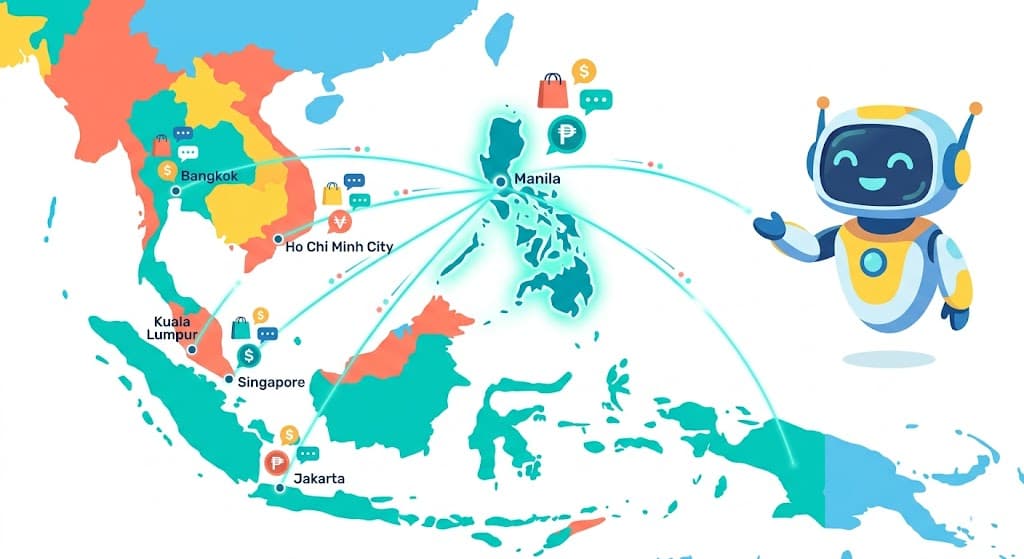
- Philippine SMEs face language, payment, and logistics barriers when expanding into ASEAN, and AI translation and automation tools directly address each of them.
- Manual market research and human-only translation cannot keep pace with the speed of ASEAN e-commerce, where competitors update prices and listings daily.
- A phased AI rollout, starting with translation and customer support, delivers measurable cost savings within the first year for most small businesses.
The Cross-Border Business Problems Philippine Companies Face in ASEAN
| Challenge | Impact on PH SMEs |
|---|---|
| Language diversity | Slows customer support and content localization |
| Fragmented payments | Lost sales from unsupported regional wallets |
| Logistics complexity | Higher shipping costs and longer delivery times |
| Regulatory differences | Compliance gaps across ten countries |
ASEAN is a market of more than 600 million people, and Philippine SMEs are uniquely positioned to serve it. The region keeps growing, with strong digital adoption in Indonesia, Vietnam, and Thailand. Yet many small business owners in Makati, Cebu, and Davao tell me the same thing: they want to sell beyond the Philippines but do not know where to start.
 Philippine SMEs face language, payment, and logistics barriers when expanding across ASEAN.
The first problem is language. A product page that works in Tagalog and English will not convert in Bahasa Indonesia or Vietnamese. Hiring native translators for every market is expensive, and machine translation alone often produces awkward wording that hurts trust.
The second problem is payments. Filipino businesses already handle GCash, Maya, and bank transfers. But selling into Indonesia means supporting GoPay or OVO. Selling into Thailand means PromptPay. Each new wallet adds technical work and accounting complexity.
Logistics is the third pain point. Shipping a parcel from Manila to Ho Chi Minh City can take a week or more, and customs paperwork varies by country. Without good systems, an SME owner spends hours each day on tracking and customer messages instead of growing the business.
Finally, regulations differ across ASEAN. Data privacy rules in Singapore are not the same as in the Philippines under RA 10173. Tax rules, product labeling, and consumer protection laws all vary. An SME entering three or four markets faces a real compliance burden.
Related: AI Multilingual Marketing for Global Reach explains this in detail.
Why Manual and Traditional Methods Cannot Keep Up
| Traditional Approach | Why It Falls Short |
|---|---|
| Hiring per-country translators | High peso cost, slow turnaround |
| Manual market research | Outdated within days |
| Spreadsheet-based pricing | Cannot react to competitor moves |
| In-house multilingual support | Hard to staff for 10 ASEAN languages |
The old way of expanding regionally was to hire one country manager per market, build a local team, and slowly roll out. This worked for large corporations with capital to burn. It does not work for a Philippine SME with twenty employees and a peso-denominated budget.
Hiring per-country translators is the most common first step, and it is also the first bottleneck. A skilled Indonesian translator in Jakarta charges rates that can quickly absorb a small marketing budget. Turnaround for a 50-page catalog can stretch into weeks, and by the time the work is delivered, the product line has already changed.
Manual market research has a similar problem. By the time a team finishes a competitor analysis in Vietnam, the prices and promotions have shifted. ASEAN e-commerce moves daily, especially on platforms like Shopee and Lazada.
Spreadsheet-based pricing is fine for a single market but breaks down across ten currencies, multiple tax regimes, and platform-specific fees. Many SME owners I have spoken with in Makati maintain enormous Excel files that no one fully understands except the person who built them.
In-house multilingual support is simply not realistic for most SMEs. Even staffing fluent Bahasa Indonesia and Thai speakers in Manila is difficult, and night-shift coverage for time zone gaps adds further cost.
How AI and Modern Technology Solve These ASEAN Challenges
| AI Solution | Function | Business Benefit |
|---|---|---|
| Neural machine translation | Localizes product pages and emails | Faster market entry |
| AI chatbots | Handles multilingual customer support | 24/7 coverage at lower cost |
| Predictive analytics | Forecasts demand and pricing | Smarter inventory decisions |
| OCR and document AI | Reads customs and tax forms | Reduces compliance errors |
| Recommendation engines | Personalizes product suggestions | Higher conversion rates |
The current generation of AI tools changes the economics of cross-border business. Neural machine translation has improved enough that, with light human editing, output is acceptable for product descriptions, FAQs, and marketing emails in most ASEAN languages. The cost per word is a fraction of fully manual translation.
 AI tools like neural translation and chatbots cut cross-border operating costs for Philippine SMEs.
AI chatbots trained on a company's own product catalog can answer most pre-sale questions in Bahasa Indonesia, Vietnamese, or Thai without a human agent. The chatbot escalates to a human only when the question is complex. This pattern lets a small Philippine team serve five or six countries.
Predictive analytics applies machine learning to sales data and external signals like search trends and weather. For an SME selling food products into Singapore and Malaysia, this can mean ordering the right quantity for Ramadan or Lunar New Year peaks instead of guessing.
Document AI, sometimes called intelligent document processing, reads commercial invoices, packing lists, and customs declarations. The same technology can flag missing fields before a shipment is rejected at the port. From my own export experience running operations from Japan, translation and document handling were daily, time-consuming work, and the kind of tooling that exists today would have saved many late nights.
Recommendation engines on a Philippine SME's own website lift average order value by showing each visitor relevant products in their own language and currency.
Related: AI Strategy for Competing in Global Markets explains this in detail.
Implementation Steps for Philippine SMEs
| Step | Action | Typical Duration |
|---|---|---|
| 1 | Audit current cross-border operations | 1-2 weeks |
| 2 | Select target ASEAN markets | 1 week |
| 3 | Pilot AI translation and chatbot | 4-6 weeks |
| 4 | Integrate payment and logistics APIs | 6-8 weeks |
| 5 | Measure, iterate, and scale | Ongoing |
Step 1: Audit current cross-border operations. List every task that involves language, payments, or logistics outside the Philippines. Identify which tasks consume the most staff hours. This audit gives a clear baseline for measuring AI impact later.
 A phased rollout with weekly reviews keeps AI integration projects on track.
Step 2: Select target ASEAN markets. Most SMEs cannot enter all ten countries at once. Pick two or three based on product fit, existing inquiries, and ease of shipping. Singapore and Malaysia are common first choices for Philippine exporters because of English usage and developed logistics.
Step 3: Pilot AI translation and chatbot. Start with one tool that solves the biggest pain point. For most product-based SMEs, that means translating the top 50 product pages and deploying a chatbot on the website and Facebook Page. Run the pilot for one to two months and measure inquiry volume and conversion.
Step 4: Integrate payment and logistics APIs. Once the language layer is working, connect regional payment gateways and shipping platforms. Local providers like Xendit and PayMongo support several ASEAN methods through a single integration, which reduces development time.
Step 5: Measure, iterate, and scale. Track conversion rate, customer support cost per ticket, and order fulfillment time per market. Adjust the AI tools based on real data. When the unit economics work, expand to additional countries.
On project management, the advice for an SME owner commissioning an AI integration is narrow: do not skip the check-in, and write down every change. Both are easy to drop in a busy month, and both are what make the timeline predictable.
Related: Competing in Southeast Asia With AI explains this in detail.
Expected Results, Cost Savings, and ROI
| Area | Expected Outcome |
|---|---|
| Translation costs | Significant reduction versus full manual translation |
| Customer support | Lower cost per ticket with 24/7 coverage |
| Market entry speed | Faster launch in new ASEAN countries |
| Inventory accuracy | Fewer stockouts and overstocks |
| Compliance | Fewer rejected shipments and tax penalties |
The return on investment from AI in cross-border operations comes from three places: lower per-unit costs, faster execution, and avoided losses.
On translation costs, replacing a fully manual workflow with an AI-first workflow plus human review can deliver meaningful savings. The exact figure depends on volume, but for SMEs translating hundreds of product pages, the difference is significant.
Customer support sees similar gains. A chatbot that resolves common questions reduces the load on human agents, which means a small team can serve more markets without hiring proportionally. Coverage outside Philippine business hours becomes practical because the AI does not sleep.
Market entry speed is the underappreciated benefit. An SME that previously needed six months to enter Vietnam can now run a pilot in a few weeks. Faster entry means earlier revenue and faster learning.
Inventory accuracy improves when predictive models replace gut feel. For a Philippine food exporter, fewer stockouts during a Singapore peak season directly translates into revenue that would otherwise be lost.
Compliance is harder to quantify but very real. A single rejected shipment at a customs port can cost tens of thousands of pesos in storage and re-export fees. AI-assisted document checks reduce this risk.
FAQ
Q: Is AI translation good enough for legal documents in ASEAN markets?
A: For contracts, tax filings, and regulatory submissions, a licensed human translator should still review and certify the work. AI is well-suited for marketing content, product pages, and customer messages, but legal documents require human accountability.
Q: Which ASEAN market should a Philippine SME enter first?
A: Singapore and Malaysia are common starting points because English is widely used and logistics are well developed. Vietnam and Indonesia offer larger populations but require stronger localization. The right answer depends on product fit and existing inquiries.
Q: How much does an AI chatbot for a Philippine SME website cost?
A: Costs range widely depending on whether you use a SaaS platform or build a custom solution. Entry-level SaaS chatbots start at a few thousand pesos per month. Custom builds on top of large language models cost more upfront but offer better control over brand voice and product knowledge.
Q: Do I need to comply with the EU AI Act if I sell to ASEAN?
A: The EU AI Act applies to operations affecting EU users. For ASEAN-only operations, the more immediate concerns are the Philippine Data Privacy Act (RA 10173) and the data protection laws of each target country, such as Singapore's PDPA and Indonesia's PDP Law.
Q: Can a small team without a CTO manage an AI rollout?
A: Yes, with the right partner. Many Philippine SMEs work with external IT consultants for the initial integration and then maintain the system in-house. The key is choosing a partner who documents the work clearly so the SME is not locked in.
Q: How long until I see ROI from AI in cross-border operations?
A: Most SMEs see measurable savings within the first three to six months of a focused pilot. Full ROI on a larger integration typically arrives within twelve months when translation, support, and analytics are all deployed.
Moving Forward with AI in the ASEAN Market
The opportunity in ASEAN is real, and the tools to capture it are now affordable for Philippine SMEs. The barriers that justified large country teams a decade ago, language, payments, logistics, and compliance, can each be addressed with focused AI deployments today.
The most reliable path is to start small, measure honestly, and expand based on evidence. Pick one ASEAN market, deploy one or two AI tools, and run the numbers after sixty days. If the unit economics work, repeat the pattern in the next country.
If you are a Philippine business owner considering this move, the next step is to audit your current cross-border tasks and identify the single biggest time drain. That is where AI will pay back fastest. From there, a phased rollout with proper documentation and weekly review will keep the project on track.
Sources & References
- ASEAN Secretariat, ASEAN Key Figures 2023, https://www.aseanstats.org/
- National Privacy Commission of the Philippines, Data Privacy Act (RA 10173), https://privacy.gov.ph/data-privacy-act/
- Personal Data Protection Commission Singapore, PDPA Overview, https://www.pdpc.gov.sg/
About the author
Founder / AI Engineer (36+ years in IT)
- ●From Tokyo · based in Manila for 13+ years
- ●36+ years in IT (development, SEO, AI)
- ●IBM Certified Generative AI Engineer
- ●AI chatbots, RAG & AI agent development
A Japanese AI engineer with 36+ years in IT and 13+ years on the ground in the Philippines. I write from hands-on experience to help Japanese companies adopt AI that actually delivers results — chatbots, workflow automation, AI agents, and AI-driven marketing. Feel free to reach out in Japanese or English.
Your Competitors Are Already Using AI!
Is your business keeping up?
Related Articles

Competitor Research With AI in One Hour a Week
A four-step weekly routine that collects and compares competitor information, so pricing decisions rest on current data.
8/10/2026

When Not to Use AI: Tasks to Keep Human
An honest look at the five tasks Philippine businesses should keep human — consequential decisions among them.
8/9/2026

Turning Full-Stack Developers Into Agent Specialists
Hiring an AI agent specialist in the Philippines is slow and costly. Retraining the developers you have is usually faster.
8/7/2026

What to Put in an AI Vendor Contract
AI vendor contracts in the Philippines often skip what matters: data return, audit logs, model changes, and exit protection.
8/6/2026
Keeping AI Running Through Brownouts and Typhoons
Cloud AI does not stop when the office loses power — your access does. A continuity plan for Philippine operations.
8/5/2026

Your AI Vendor's Legal Form Changes the Deal
SEC-registered corporation or DTI sole proprietor — in the Philippines the difference changes contracts, banking, and recourse.
8/3/2026