
An AI Adoption Roadmap for Philippine SMEs
A step-by-step AI adoption roadmap: how to assess needs, plan the rollout, and measure ROI in peso terms.


AI Engineer · 36+ years in IT · Japanese, based in Manila for 13+ years
Summary
- A practical AI adoption roadmap requires five sequential phases: assessment, pilot selection, tooling, rollout, and measurement.
- Template-based AI projects often fail for Philippine SMEs because business workflows rarely match off-the-shelf assumptions.
- Weekly progress meetings and documented specification changes reduce rework and protect the AI project budget.
- ROI for Philippine SMEs is clearest when measured in peso savings on repetitive tasks, not in abstract productivity gains.
Why Philippine SMEs Struggle to Start AI Projects
| Challenge | Impact on the Business |
|---|---|
| No clear starting point | Projects stall before budget approval |
| Fear of wasted spending | Owners delay decisions for months |
| Skills gap inside the team | Heavy reliance on outside vendors |
| Unclear ROI expectations | Hard to justify peso commitment |
Most Philippine small and medium enterprises (SMEs) I speak with agree that AI adoption matters. The harder question is where to begin. A sari-sari distributor in Quezon City, a BPO subcontractor in Cebu, and a logistics firm in Cavite all face the same blank page: too many tools, too little guidance, and no clear way to connect AI to daily operations.
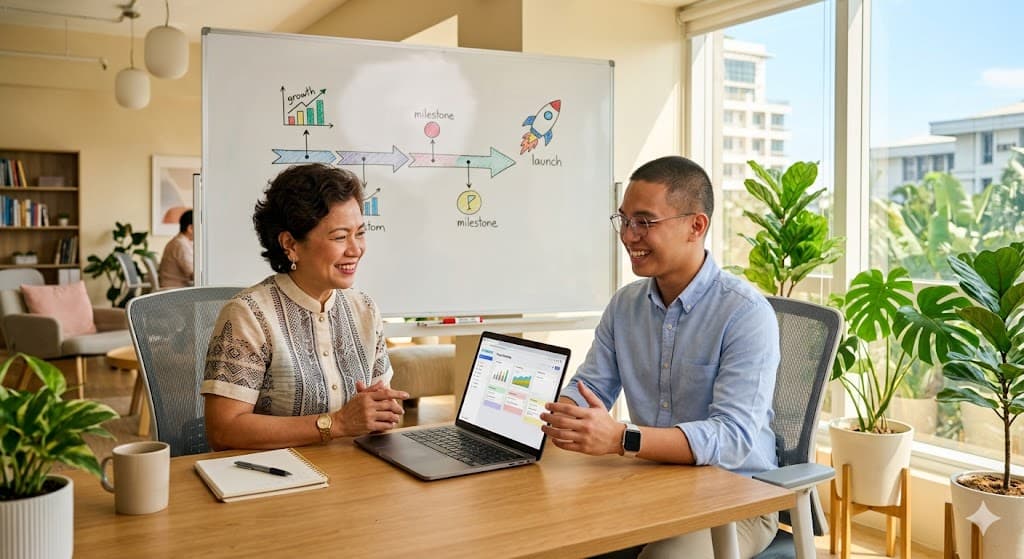
 SMEs face a blank page when deciding where to start with AI adoption.
The no clear starting point problem is the most common. Owners read about chatbots, forecasting models, and generative tools, but nothing explains which one fits a ₱50,000 monthly IT budget. The second challenge is fear of wasted spending. Many SMEs remember past software purchases that ended up unused, and they apply the same caution to AI.
A skills gap adds another layer. Few Philippine SMEs have an in-house data analyst, let alone a machine learning engineer. That means AI decisions often sit with the owner or the accountant, neither of whom has time to evaluate vendors. Finally, ROI expectations are vague. Without peso-denominated targets, AI projects feel like a gamble rather than an investment.
Related: Avoiding Costly AI Adoption Failures explains this in detail.
Why Traditional Planning Approaches Fall Short
| Traditional Approach | Why It Struggles with AI |
|---|---|
| Copy-paste from big-company case studies | Scale and budget assumptions do not match SMEs |
| One-shot vendor proposals | No room for iteration or testing |
| Template-based software rollouts | Business complexity is underestimated |
| Waiting for perfect data | Delays kill momentum |
Traditional IT planning methods rarely translate well to AI. Copying a roadmap from a large enterprise case study is a common mistake. A manufacturer in Laguna cannot apply the same plan as a multinational with a full IT department and a seven-figure dollar budget.
One-shot vendor proposals are another trap. A vendor visits, presents a fixed-scope quote, and disappears once the invoice is paid. AI projects need iteration and testing, not a single delivery. The signal to watch for is what happens after delivery. A partner who stops contacting you once the invoice clears has priced the engagement as a handover, whatever the proposal said.
Template-based rollouts look attractive because the initial cost is low. What they cannot hold is the part of the business that is specific to it — a retail chain with its own SKU rules, a clinic whose notes run in mixed Filipino and English.
Waiting for perfect data is the last pitfall. Some SMEs postpone AI adoption until their records are clean. In practice, data is never perfect. Starting small with imperfect data and improving it over time is more realistic than waiting indefinitely.
How an AI-Powered Roadmap Solves These Problems
| Roadmap Element | How AI Changes the Equation |
|---|---|
| Business analysis | AI tools help cluster workflow pain points quickly |
| Prioritization | Scoring models rank tasks by automation potential |
| Tool selection | Modern APIs lower cost of experimentation |
| Continuous adjustment | AI outputs improve with feedback loops |
An AI-powered roadmap is not a document you write once and forget. It is a living plan that adapts as your team learns what AI can and cannot do. The first element is business analysis. Tools like spreadsheet-based workflow mapping or lightweight process-mining software help surface the tasks that consume the most hours. These are your first AI candidates.
 A living AI roadmap adapts as teams learn what works in daily operations.
Prioritization becomes easier when you score each task on three axes: repetition, rule-based logic, and volume. A task that is highly repetitive, mostly rule-based, and handled in high volume is a strong AI candidate. A one-off creative task is usually not.
Tool selection has also changed. Cloud APIs from OpenAI, Anthropic, and open-source alternatives let a Philippine SME test a use case for a few thousand pesos before committing to a larger project. This is very different from the enterprise software era, where every test required a license purchase.
Continuous adjustment is the final element. AI systems improve when users correct outputs and feed examples back into the workflow. A roadmap that includes monthly review cycles will outperform a roadmap that treats AI as a one-time install.
Related: Maximising Technology ROI for Philippine SMEs explains this in detail.
Five Steps to Build Your AI Adoption Roadmap
| Step | Main Activity |
|---|---|
| 1. Assess | Map current workflows and pain points |
| 2. Pilot | Pick one small, high-impact use case |
| 3. Tool | Choose APIs, platforms, or custom builds |
| 4. Roll out | Train staff and integrate with existing systems |
| 5. Measure | Track peso savings and adjust quarterly |
Step 1: Assess. List the top ten tasks your team repeats every week. For each task, note how many hours it consumes and how rule-based it is. Interview two or three staff members per department. This step usually takes two to four weeks in a Philippine SME.
 Each step keeps the pilot focused on one measurable outcome in peso terms.
Step 2: Pilot. Pick one task from the assessment, not five. A common starting point is customer inquiry triage, invoice data extraction, or sales report generation. Keep the pilot scope to one team and one measurable outcome. Budget around ₱30,000 to ₱150,000 depending on complexity.
Step 3: Tool. Decide whether to use a ready-made SaaS tool, a cloud API, or a custom build. For most SMEs, starting with an API like those from OpenAI or Anthropic is cheaper than a SaaS subscription and more flexible than custom code. A custom build makes sense only when business logic is unusual enough to justify the cost.
Step 4: Roll out. Train the pilot team first, then expand. Document the prompts, workflows, and failure cases. Failure cases are the most valuable of the three and the ones most often left unwritten.
Step 5: Measure. Track hours saved, error rates, and peso impact every month. Compare against the pre-AI baseline. Adjust the roadmap quarterly based on what you learn. Skipping measurement is the fastest way to lose executive support.
Related: Avoiding Failed AI Projects: 3 Points That Decide It explains this in detail.
Expected Results and ROI for Philippine SMEs
| ROI Area | What to Expect |
|---|---|
| Time savings | Meaningful reduction on repetitive tasks |
| Error reduction | Fewer data entry mistakes in routine workflows |
| Staff reallocation | Team shifts to higher-value tasks |
| Cost control | Predictable monthly peso spending |
Realistic ROI from an SME roadmap usually appears within three to six months of the pilot phase. The clearest wins are time savings on repetitive tasks. A finance clerk who previously spent six hours a week cleaning invoice data may reduce that to one or two hours. In peso terms, that reallocation is easy to calculate against the staff's hourly rate.
Error reduction is the second common result. Routine data entry, document classification, and simple customer replies benefit from AI assistance. Staff reallocation follows. When repetitive tasks shrink, the same team can handle more volume without new hires, or shift to higher-value work like customer relationship building.
Cost control matters for Philippine SMEs operating on tight margins. Monthly AI costs for a small pilot often sit between ₱5,000 and ₱25,000, which is predictable and can be stopped or scaled based on results. Avoid marketing-style promises of massive cost cuts. Significant peso savings are achievable, but they require disciplined measurement and honest comparison against the pre-AI baseline.
FAQ
Q: How much should a Philippine SME budget for its first AI project?
A: A focused pilot usually costs between ₱30,000 and ₱150,000, depending on scope. This covers tool subscriptions or API credits, a developer or consultant, and internal staff time. Starting smaller is better than starting bigger.
Q: Do we need to hire a full-time AI engineer?
A: Not for a pilot. Most SMEs start with a part-time consultant or an IT virtual assistant. A full-time hire makes sense later, once AI is integrated into multiple workflows and the workload justifies it.
Q: What if our data is messy or incomplete?
A: Start anyway. Clean enough data for the pilot task, and improve the rest gradually. Waiting for perfect data usually means waiting forever.
Q: Which departments should adopt AI first?
A: Customer service, finance, and operations tend to have the highest density of repetitive tasks, which makes them good first candidates. Pick one department for the pilot rather than spreading thin.
Q: How do we prevent vendor lock-in?
A: Favor API-based solutions where you can swap providers, keep your prompts and data in your own storage, and document the workflow so a new vendor can take over if needed.
Q: Are there local regulations we should check?
A: Yes. The Data Privacy Act of 2012 and National Privacy Commission guidance apply when AI processes personal data. Keep consent, purpose limitation, and data retention rules in mind when designing workflows.
Getting Started With Your Roadmap
A working AI adoption roadmap for a Philippine SME is not a thick document. It is a short, living plan: one pilot task, one measurable outcome, one feedback loop, repeated every quarter. The companies that succeed are the ones that treat AI as an ongoing operational improvement, not a one-time software purchase.
If you are planning your first AI project, start with the assessment step this week. List ten repetitive tasks, pick one, and scope a pilot. PH AI Works supports Philippine SMEs at every step, from workflow assessment through custom development and measurement. Reach out when you are ready to turn your list into a roadmap.
Sources & References
- National Privacy Commission, Data Privacy Act of 2012 (Republic Act No. 10173)
- Department of Trade and Industry, MSME Statistics
About the author
Founder / AI Engineer (36+ years in IT)
- ●From Tokyo · based in Manila for 13+ years
- ●36+ years in IT (development, SEO, AI)
- ●IBM Certified Generative AI Engineer
- ●AI chatbots, RAG & AI agent development
A Japanese AI engineer with 36+ years in IT and 13+ years on the ground in the Philippines. I write from hands-on experience to help Japanese companies adopt AI that actually delivers results — chatbots, workflow automation, AI agents, and AI-driven marketing. Feel free to reach out in Japanese or English.
Your Competitors Are Already Using AI!
Is your business keeping up?
Related Articles

Competitor Research With AI in One Hour a Week
A four-step weekly routine that collects and compares competitor information, so pricing decisions rest on current data.
8/10/2026

When Not to Use AI: Tasks to Keep Human
An honest look at the five tasks Philippine businesses should keep human — consequential decisions among them.
8/9/2026

Turning Full-Stack Developers Into Agent Specialists
Hiring an AI agent specialist in the Philippines is slow and costly. Retraining the developers you have is usually faster.
8/7/2026

What to Put in an AI Vendor Contract
AI vendor contracts in the Philippines often skip what matters: data return, audit logs, model changes, and exit protection.
8/6/2026
Keeping AI Running Through Brownouts and Typhoons
Cloud AI does not stop when the office loses power — your access does. A continuity plan for Philippine operations.
8/5/2026

Your AI Vendor's Legal Form Changes the Deal
SEC-registered corporation or DTI sole proprietor — in the Philippines the difference changes contracts, banking, and recourse.
8/3/2026