
West Shore Home's AI Strategy: 2x Revenue, 1,000 Fewer Hires
How the US remodeler doubled revenue while holding back 1,000 hires with AI — the rollout steps, and where human judgment still decides.


AI Engineer · 36+ years in IT · Japanese, based in Manila for 13+ years
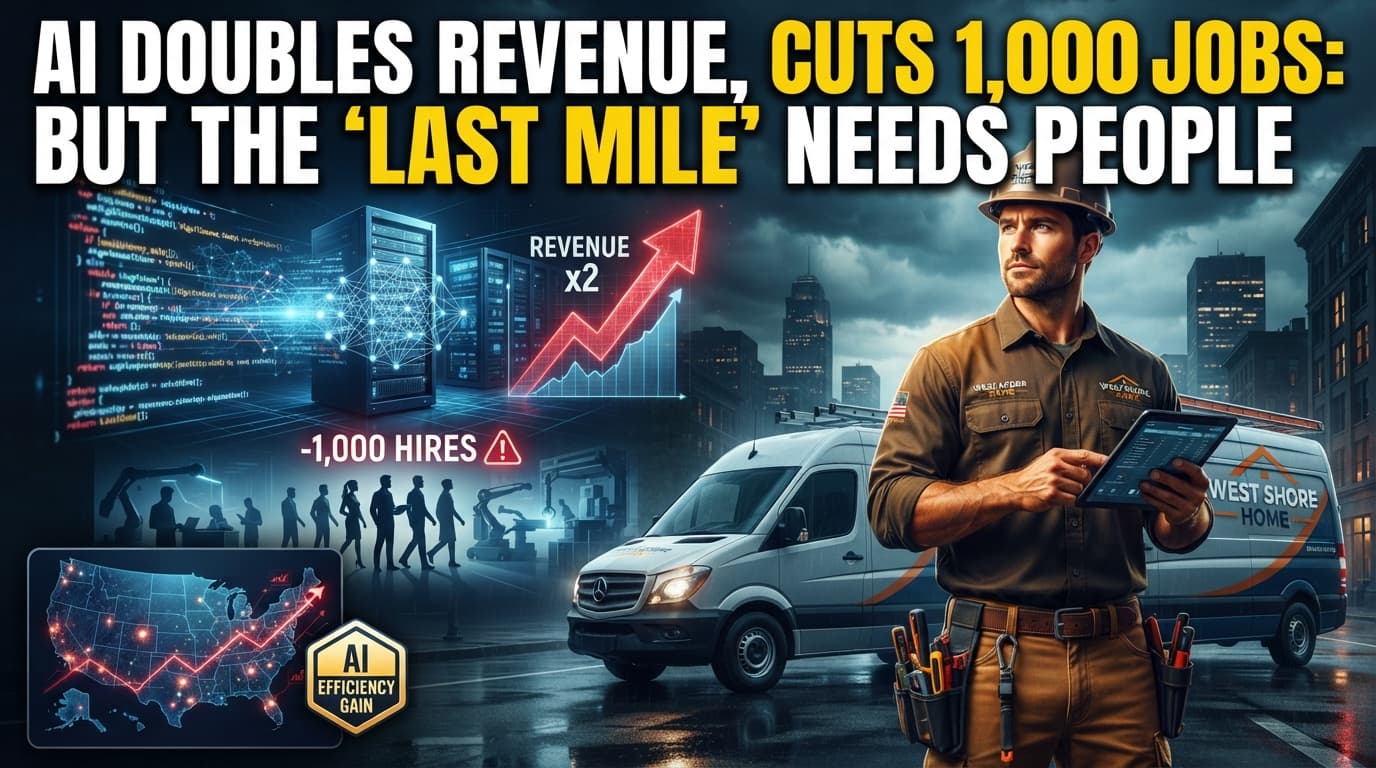
We unpack how a U.S. remodeling company used AI to double revenue while holding back the equivalent of 1,000 hires. From a practical standpoint, we look at how to guard against errors and how the "the last step belongs to people" mindset can be applied to on-the-ground operations in the Philippines.
Part 1: Why This Matters
Step 1: The Philippine Business Context (3 min)
Today's subject is West Shore Home, a bathroom remodeling company based in central Pennsylvania. This is not software or finance — it is a traditional industry still centered on paper (the clipboard) and subcontractors, and yet this company is aggressively adopting AI. It was reported to have doubled its revenue while holding back the equivalent of 1,000 hires.
Why this story matters to Japanese professionals working in the Philippines is clear. The Philippines is a country whose economy runs on labor-intensive work. Call centers, manufacturing floors, construction, retail — plenty of Japanese companies operate here with large teams of local staff. AI is often assumed to be "only for IT companies," but the West Shore Home case shows that a low-profile industry can grow on the back of it.
At the same time, the company's founder, B.J. Werzyn, says that "the last mile can't be replaced by anyone." It is the idea that the final moment of facing the customer directly is handled by people. This is a view that fits remarkably well with the Philippine workplace culture, which values face-to-face hospitality and person-to-person connection.
[Scene] A Manila office. You show this article to a Filipino manager colleague and open with: "This isn't a story about an IT company — it's a bathroom remodeling company in the United States. They doubled revenue with AI while holding back the equivalent of 1,000 hires. But the founder says, 'the final moment of dealing with the customer belongs to people.' Don't you think the same idea could work for our local operations?"
Step 2: Organizing the Key Points of the Source Article (5 min)
For study purposes, here are only the facts stated in the source article, arranged in a table.
| Item | Details |
|---|---|
| Company | West Shore Home |
| Location | Central Pennsylvania, USA |
| Business | Bathroom remodeling (a process you can move forward with while sitting on your own sofa at home) |
| Founder / CEO | B.J. Werzyn |
| Industry size | 500 billion dollars |
| Industry traits | A traditional industry still centered on paper documents and subcontractors |
| How AI is positioned | Aggressive adoption in a traditional industry, not software or finance |
| Reported results | Doubled revenue while holding back the equivalent of 1,000 hires |
| Founder's philosophy | "The last mile can't be replaced by anyone." |
| Technical limitation | AI is still imperfect and produces errors (hallucinations), such as mistaking EBITDA, a profit metric, for a length in millimeters |
| Outlet / date | Fortune, July 5, 2026, reporter Nick Lichtenberg |
This table was created from publicly available facts for study purposes. For details, please check the original article at the link above.
Step 3: Comprehension Check (5 min)
Q1. What kind of business does West Shore Home operate?
Hint: It is home-related construction work that the customer can move forward with while sitting on the sofa at home.
Q2. What results was this company reported to have achieved through its use of AI?
Hint: You can explain it with two words: "hiring" and "revenue."
Q3. Which part did founder Werzyn describe as something that "can't be replaced"?
Hint: The key is the phrase "last mile" in the article's headline.
Q4. In the source article, what example was used to illustrate that AI is still imperfect?
Hint: It is an analogy in which a profit metric is mistaken for a unit of length.
Q5. According to the article, what old practices still remain in the industry West Shore Home belongs to?
Hint: The two keywords are "paper documents" and "subcontractors."
Related: Vibe Coding: Building Business Tools Fast With AI explains this in detail.
Part 2: Applying This in Practice
Step 4: Steps for Rollout in the Philippines (10 min)
Here is a set of steps for testing the West Shore Home mindset — bringing AI into traditional work — in the Philippine field. Rather than aiming for a company-wide rollout all at once, we recommend a flow of starting small and verifying as you go.
| Step | What it involves | Philippine-specific caution |
|---|---|---|
| 1. Take stock of the work | Within your local operations, identify the tasks with a lot of repetition, such as preparing documents, making estimates, and handling inquiries. | A lot of what local staff actually do runs on verbal exchanges. First make the paper-and-verbal customs visible. |
| 2. Test small | Pick just one of the tasks you identified and try AI with a small team. Bound it to a short period of one to two months. | You can start with a budget in the range of a few thousand to a few tens of thousands of pesos per month. It is safer not to sign an expensive contract from the outset. |
| 3. Build a check for errors | Decide on a flow where AI's output is always checked by a person before use. Assume errors (hallucinations) and prevent them by design. | If you handle customer data, you need to handle it in line with the Data Privacy Act and the rules of the NPC (National Privacy Commission). Confirm in advance whether you can set it so your data is not used for training. |
| 4. Explain to local staff | Explain the purpose of the rollout carefully to the local team. Frame it as "reducing simple tasks," not "taking jobs away." | If you are changing people's roles, you also need to be mindful of the labor rules of DOLE (Department of Labor and Employment). Communicate early and honestly so you do not create anxiety. |
| 5. Leave the "last mile" to people | Deliberately design the final moment of facing the customer directly to be handled by people. AI sticks to a supporting, behind-the-scenes role. | In the Philippines, where face-to-face trust is valued, having people handle the final step translates directly into customer satisfaction. |
Step 5: Common Mistakes and Countermeasures (5 min)
Here are three situations where you are likely to stumble as you carry this out in the Philippines.
Failure pattern 1: Believing AI's output as-is
AI can plausibly fabricate content that is not true. The source article also introduced the example of mistaking a profit metric for a unit of length.
Bad example: You send an estimate amount or a reply to a customer exactly as the AI wrote it, without checking.
Good example: A draft written by AI is always used only after the person in charge checks the numbers and the content. Especially for amounts and contract terms, run it past human eyes twice.
Failure pattern 2: Rolling it out abruptly without explaining to local staff
When a new system arrives without explanation, the anxiety of "my job is going to disappear" spreads. In the Philippine workplace, this kind of distrust becomes an obstacle to retention and cooperation.
Bad example: You decide on the rollout by head-office judgment alone and one-sidedly notify the local team of only how to use it.
Good example: Before the rollout, hold a briefing and share the purpose — "to reduce simple tasks and spend time on higher-value work." Always make time to take questions as well.
Failure pattern 3: Treating the handling of customer data lightly
When you enter customer information into AI, protecting personal data becomes an issue. The Philippines has a Data Privacy Act, and violations carry heavy liability.
Bad example: You enter customers' names and contact details into an AI service without checking the rules.
Good example: Check the rules of the NPC (National Privacy Commission), then set it up to exclude the data from training and to keep records, before using it.
Related: Transforming Your Operating Model for AI explains this in detail.
Part 3: Learning More Deeply
Step 6: Related Technical Terms (5 min)
A hallucination (an AI's fabrication) is the phenomenon in which AI produces content that is not true as if it were real. In the source article, this danger was described with the example of mistaking EBITDA, a profit metric, for a length in millimeters. In Philippine call center operations, returning an AI-generated answer to a customer as-is can lead to misinformation, so a flow where a person does the final check is indispensable.
The last mile (the final point of contact) is a term for the very last moment before a product or service reaches the customer's hands. The founder in the source article says this final point of contact can only be handled by people. In the Philippines, having local staff handle the last step face-to-face — such as a contract deadline or a delivery handover — makes it easier to earn the customer's trust.
EBITDA (earnings before interest, taxes, depreciation, and amortization) is a profit metric that roughly shows how much earning power a company has in its core business. In the source article, the example of AI mistaking this figure for a unit of length came up as an illustration of the technology's immaturity. When reporting the performance of a Philippine subsidiary to a Japanese head office, sharing the meaning of such metrics correctly helps prevent gaps in judgment.
AI adoption (deploying AI into operations) means incorporating AI mechanisms into actual day-to-day work so they can be used. West Shore Home in the source article drew attention for advancing this boldly in a traditional industry that is not an IT company. In the Philippines too, more companies are gradually bringing it in, starting with repetitive tasks such as preparing estimates and first-line handling of inquiries.
Labor-saving (measures to reduce manpower) means arranging tools and systems so the same work can be done with fewer people. The point is not fewer staff but the same staff covering more work. In the Philippines, while labor costs are lower than in Japan, securing excellent talent is getting harder year by year, and there is a growing need for ways to raise results with limited manpower.
Related: Lean AI: Cutting Waste Before Adopting AI explains this in detail.
Step 7: Thinking About How to Apply This to Your Own Company (10 min)
Where is your company's "last mile"?
Within your company's Philippine operations, consider where the final moment of facing customers and business partners directly lies. That may be a part that people should continue to handle.
A hint for thinking: On paper, write out two columns — "behind-the-scenes tasks that can be left to AI" and "the final point of contact that people should handle." The dividing line will come into clear view.
How do you build a checking system that assumes errors?
Design where to insert human checks on the premise that AI will inevitably make mistakes. Especially for parts involving amounts and contracts, a double check gives peace of mind.
A hint for thinking: If you work backward from the worst case — "what happens if an AI error is delivered to the customer as-is" — the places where you should insert checks come into view.
How do you ease local staff's anxiety?
The topic of labor-saving is one that easily gives the local team anxiety. Think about how to convey the purpose so they will cooperate positively.
A hint for thinking: Explaining it with "what increases (higher-value work you can take on with the freed-up time)" as the subject, rather than "what decreases," changes how it is received.
Next action: At next week's team meeting, ask the local staff together to name three "repetitive tasks that have become a burden." Choose one of them as the first target to test small with AI.
Part 4: FAQ
Q1. If we adopt AI, do we have to cut local staff jobs?
Not necessarily. The company in the source article "held back the equivalent of 1,000 hires"; it did not state that it laid off large numbers of existing staff. In the Philippines, a realistic approach is to leave simple tasks to AI and redirect the freed-up time to customer service and quality improvement. If you change people's roles, be mindful of the labor rules of DOLE (Department of Labor and Employment).
Q2. We are not an IT company. Can AI still be useful?
There are many situations where it is useful. West Shore Home in the source article grew with AI even though it works in a traditional industry centred on paper documents and subcontractors. In the Philippines too, regardless of industry, you can start with repetitive tasks such as preparing estimates and first-line handling of inquiries.
Q3. I'm worried about AI producing wrong answers. How can we prevent that?
Because AI can fabricate content that is not true, the basic approach is to build a human final check into the system. The failure is rarely obvious: a number in the right format, in the right cell, meaning something else entirely. The more a part carries a large impact when it is wrong — such as amounts and contract terms — the more you should make it a flow where the person in charge always looks it over.
Q4. Is there any legal problem with entering customer data into AI?
The Philippines has a Data Privacy Act, managed by the NPC (National Privacy Commission). When handling customer information, you need to confirm settings that keep your data from being used for training and mechanisms that keep records before using it. Some parts are close to Japan's approach to personal data protection, but always check the local rules.
Q5. How much budget should we set aside?
We recommend testing small first. Start with a method that can begin in the range of a few thousand to a few tens of thousands of pesos per month, verify the effect, and then expand. Accumulating small successes, rather than signing a large contract from the outset, also makes it easier to gain internal understanding.
Tips for Making the Most of This (3 Tips)
First, pick just one "highly repetitive task" and test it
If you aim for a company-wide rollout all at once, the blow is greater when it fails. Narrowing it to one burdensome task — such as preparing estimates or first-line handling of inquiries — and starting small lets both the benefits and the issues surface quickly.
Always insert a human check on AI's output
AI can fabricate content that is not true. Especially for parts that carry a large impact when wrong, like amounts and contract terms, decide from the outset on a flow where the person in charge checks twice. The stance of protecting yourself by design, on the premise of errors, matters.
Leave the "last mile" of facing the customer to people
In the Philippines, where face-to-face trust is valued, having people handle the final point of contact translates directly into customer satisfaction. Keep AI to a supporting, behind-the-scenes role, and be conscious of designing to protect the parts only people can do.
Bonus: How to Make Use of PH AI Works
PH AI Works is a company that supports the use of AI and technology in the Philippines. We are strong in practical support grounded in the Philippines' particular circumstances — such as today's themes of "bringing AI into traditional work," "building a checking system to prevent errors," and "how to advance a rollout that involves local staff."
As a next step, you can consult us on things like the following:
- Sorting out which tasks in your operations are the most effective to start testing AI on
- A safe way, in line with Philippine rules, to proceed when handling customer data
- How to explain to local staff and how to gain internal understanding
Please feel free to get in touch. The initial consultation is free.
References / Sources
About the author
Founder / AI Engineer (36+ years in IT)
- ●From Tokyo · based in Manila for 13+ years
- ●36+ years in IT (development, SEO, AI)
- ●IBM Certified Generative AI Engineer
- ●AI chatbots, RAG & AI agent development
A Japanese AI engineer with 36+ years in IT and 13+ years on the ground in the Philippines. I write from hands-on experience to help Japanese companies adopt AI that actually delivers results — chatbots, workflow automation, AI agents, and AI-driven marketing. Feel free to reach out in Japanese or English.
Your Competitors Are Already Using AI!
Is your business keeping up?
Related Articles
AI Model Vendors Now Sell Implementation Too
OpenAI and Anthropic now sell implementation as well as models. What a local subsidiary should decide about that.
8/18/2026
Contracting for AI While Prices Keep Falling
Write a model number into the contract and it is obsolete in six months. How to design for switching instead.
8/17/2026

Meta Cut 750,000 Under-16 Accounts in Australia
AI-assessed age checks removed 750,000 accounts overnight. What that says about depending on platforms for reach.
8/16/2026

When an AI Calls Your Shop to Ask About Stock
AI now phones shops on a buyer's behalf to check stock. What to decide on the receiving side before it reaches you.
8/15/2026

Handling News That Is Not Settled Yet
A reported $6 billion acquisition talk is not a completed deal. How to act on industry news before it is confirmed.
8/14/2026

What a 69-Page AI Report Does Not Show
Frontier firms are reported 8.3x ahead, yet a table on page 35 shows no statistically significant link to revenue.
8/13/2026