
AI-Native Web Development for Philippine SMEs
Building intelligent, automated web applications with modern tooling — a practical guide for Philippine businesses.


AI Engineer · 36+ years in IT · Japanese, based in Manila for 13+ years
Summary
- AI-native web development means designing applications with AI built into the core architecture from the start, not added as an afterthought.
- Philippine SMEs can reduce development rework and long-term maintenance costs by adopting AI-native principles during the planning phase.
- A phased implementation approach — starting with 70% automation and iterating based on real usage data — is the most practical path for local businesses.
Why Philippine Businesses Struggle with Web Application Development
| Challenge | Impact on Business |
|---|---|
| Apps built without AI consideration require expensive retrofitting later | Higher long-term costs, slower feature releases |
| Generic template-based solutions fail to handle business-specific complexity | "Works but isn't usable" outcomes |
| Lack of clear requirements leads to repeated rework cycles | Budget overruns, missed deadlines |
A Philippine SME launches a custom e-commerce platform for PHP 400,000. Eight months later the marketing team wants a product recommendation feature and an AI chatbot tied into the product database. The development quote comes back at almost the full original budget again, because the database, APIs, and front-end were never designed to support those features. The rebuild is not technically impossible; it is just nearly as expensive as the first build.
 Many Philippine SMEs discover too late that their web applications were not designed to support AI features
The root cause is that AI capabilities were never part of the original design conversation. When I commissioned a large-budget web platform as the client, the requirements were left vague and the scope was delegated almost entirely to the development team. The result was a system that technically worked but did not fit how the business actually operated — the team ended up keeping a parallel spreadsheet process just to get through the week. That experience taught me a simple rule: the business owner must define the initial design criteria and decision benchmarks, even when implementation details are delegated. Skipping that step almost guarantees a rebuild.
For SMEs running on tight budgets, that kind of rework is not just inconvenient. It burns money that should have gone into marketing, hiring, or inventory.
Why Traditional Web Development Falls Short for AI Integration
| Traditional Approach | Limitation |
|---|---|
| Add AI features after launch | Requires architectural changes, often a near-complete rebuild |
| Use off-the-shelf plugins | Cannot handle business-specific logic or local market nuances |
| Rely on manual processes alongside the app | Creates bottlenecks as business scales |
Traditional web development treats AI as an optional add-on. The developer builds a conventional app with fixed logic, and if the business later wants intelligent search, chatbot support, or predictive analytics, those features get layered on top of a system that was never designed to carry them.
From my 2000s SEO and affiliate operations in Japan, I learned this in a smaller form. I used off-the-shelf SEO and reporting tools because they installed in an afternoon, but they could not handle the complex, business-specific processing we actually needed. When I finally built custom systems designed around our real workflows, a monthly report that had taken an entire day dropped to a few hours, and accuracy improved at the same time. The pattern matters here: generic tools are cheap to start and expensive to grow out of.
The same logic scales up to web applications today. A restaurant management system built conventionally tracks orders and inventory just fine. Add AI-powered demand forecasting or automated supplier ordering later, and you are rewriting the database schema, the API layer, and the front-end all at once. For a Philippine business that plans to grow past the initial launch, designing for these capabilities from day one is materially cheaper than the retrofit route. Our piece on full-stack AI development for Philippine SMEs digs into the technical side of unifying the layers.
Template solutions hit another ceiling: they rarely fit Philippine market requirements without heavy customization. Peso-based pricing tiers, local payment gateway integrations like GCash and Maya, BIR-compliant receipts, and mixed English-Filipino content all live outside the defaults most SaaS templates ship with.
What AI-Native Web Development Actually Means
| Principle | Practical Application |
|---|---|
| AI-first architecture | Database and API design that supports machine learning from day one |
| Continuous learning loops | Application improves its outputs based on real user behavior |
| Human-AI task separation | Routine tasks automated, complex decisions kept with humans |
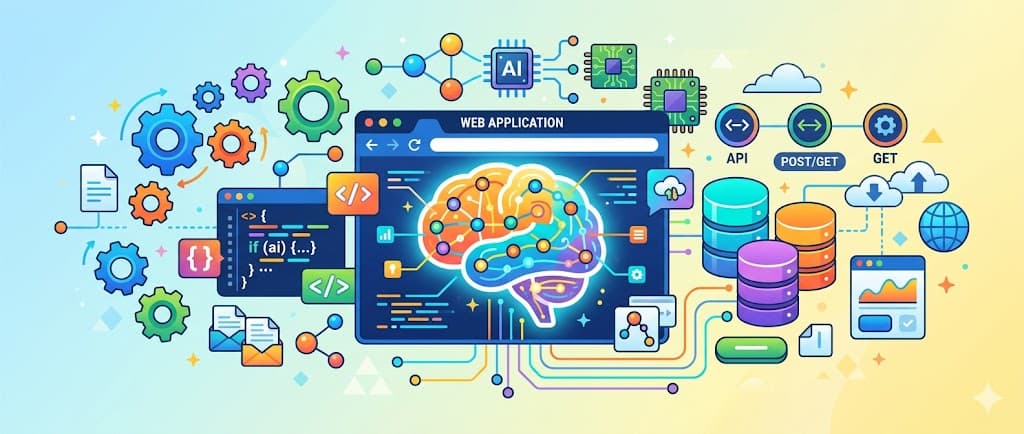
AI-native web development designs the application so that AI capabilities sit in the foundation rather than on top. It affects how the database is structured, how the API layer processes user inputs, and how the system gets better over time from real data.
 AI-native architecture integrates intelligent processing into every layer of the application from the start
In practical terms, an AI-native e-commerce app for a Philippine retailer carries three specific design choices. The product database is structured so recommendation algorithms can read it directly. The order system writes data in a shape that a demand-prediction model can actually consume. The customer service module has a natural language processing path — NLP, the technology that lets computers read and respond to everyday human text — wired into it from the start, not bolted on later. Our walk-through on smart search and recommendation for Philippine e-commerce covers how that looks in a retail context.
A core principle in AI-native work is defining clear boundaries between AI and human decisions. From using tools like ChatGPT Plus and Claude Pro in my own workflow, I have seen that AI handles rule-based, repetitive tasks well and struggles with context-dependent judgment. AI can draft a first reply to a customer or sort support tickets into categories. Reading a customer's frustration level or deciding whether to bend a return policy still needs a person. That boundary belongs in the architecture — who decides what, and where the hand-off happens — not in a meeting after launch.
AI-native does not mean your SME is building something as complex as what big tech companies run. It means making smart architectural decisions early. Pick a database that supports vector search (a method for finding similar items based on meaning rather than exact keywords). Design APIs that can route requests to AI processing when needed. Build feedback loops that let the system learn from local Philippine user behavior. These are choices made during planning, not during debugging. Our broader look at AI and cloud technology for next-generation Philippine websites covers the hosting side of the same picture.
Related: AI-Driven Web Design for Philippine Businesses explains this in detail.
A Phased Approach to Building AI-Native Web Applications
| Phase | Timeline | Focus |
|---|---|---|
| Phase 1: Foundation | Month 1–2 | Requirements definition, AI-ready architecture design |
| Phase 2: Core Build | Month 2–4 | Development with 70% automation target |
| Phase 3: Launch & Iterate | Month 4–6 | Deploy, collect real data, refine AI features |
Jumping straight into full AI automation is a short path to failure. A phased rollout with specific milestones at each stage gives you somewhere to stop and check, which the all-at-once version does not.
 A three-phase implementation approach keeps AI-native projects on track and within budget
Phase 1 defines exactly what the application needs to do and designs an architecture that carries AI from the ground up. This is where most projects quietly fail. If the client says "I want to automate everything" but cannot explain current workflows, time-on-task numbers, or specific pain points, that is a red flag. The first meeting must fix those details before a line of code gets written.
For a project in the PHP 300,000 to PHP 500,000 range, I run three structured meetings: an initial requirements confirmation, a mid-project review, and a final verification. Each meeting produces documented numerical targets and acceptance criteria. That rhythm keeps quality control tight without the overhead of a weekly call, which is overkill at this budget size.
Phase 2 is the core build. Start at a 70% automation target rather than aiming at full automation. Build the AI-native features that deliver the most value first — data processing, pattern recognition, and automated replies for common queries. Any specification change during this phase gets documented immediately, with an estimate of added hours and the features affected. The moment changes stop being tracked, rework starts.
Phase 3 launches with real users and collects actual usage data. This is where the AI components start learning from Philippine user behavior, local purchase patterns, and regional preferences. Refinements based on real data are worth more than any pre-launch assumption.
One essential safeguard: always prepare manual fallback procedures for when AI services are unavailable. In my 2000s SEO operations in Japan, I invested in automation tools that broke when search-engine specifications changed, and the team had to fall back to manual ranking checks that we had not documented. Recovery took longer than it should have. Every AI-native application should ship with a documented manual workflow for every automated process, written on day one and not day 400.
Related: Full-Stack AI Development for Philippine SMEs explains this in detail.
What Returns Can Philippine Businesses Expect
| Investment Area | Expected Outcome |
|---|---|
| AI-ready architecture (upfront) | Avoids costly rebuilds when adding intelligent features later |
| Automated routine processing | Staff time redirected to higher-value customer interactions |
| Continuous learning from user data | Application performance improves over time without proportional cost increases |
The return on AI-native development comes in two shapes: cost avoidance and capability growth.
Cost avoidance is the immediate one. Retrofitting AI into a conventionally built application typically costs close to the original build price. By designing AI-native from the start, Philippine SMEs skip that expensive rebuild cycle. The upfront investment is somewhat higher than a basic template route, but total cost of ownership over two to three years is clearly lower.
Capability growth is the less visible gain. An AI-native customer service module ships with basic automated replies and gets smarter as it processes more conversations with real Philippine customers. A product recommendation engine gets more accurate as it watches what local shoppers actually buy. That compounding does not require proportional increases in development spending — you are paying for a system that improves itself through use.
For an SME, the most practical benefit is redirecting human effort from routine tasks to client calls and planning decisions. From my IT VA engagements, the highest-paying jobs were always technical support and project management, never data entry. The same applies across the board: when AI carries the routine load, your team can spend their time on the activities that actually grow the business.
Results depend heavily on execution quality. A poorly planned AI-native project will not deliver any of this. The phased approach above is the difference between a system that quietly earns its keep and a technically impressive pilot that no operator wants to touch.
Related: AI Integration for Philippine SMEs: Cut Costs explains this in detail.
FAQ
Q: How much does AI-native web development cost for a Philippine SME?
A: A basic AI-native web application with core intelligent features typically starts at PHP 300,000 to PHP 500,000 for initial development, depending on complexity. That is higher than a pure template site, but it is clearly less expensive than building a standard application now and retrofitting AI later. For most growth-stage SMEs, the math favors AI-native if any intelligent features are on the roadmap within two to three years.
Q: Do we need AI expertise on our team to maintain an AI-native application?
A: Not for day-to-day operations. A well-designed AI-native app should be manageable by your existing technical staff for routine tasks like content updates and user management. Periodic reviews by someone with AI experience — in-house or through a consulting arrangement — are worth scheduling quarterly, so the AI components stay tuned as business conditions change and as model pricing shifts.
Q: Can we convert our existing web application to AI-native?
A: It depends on the current architecture. Some applications can be migrated module by module — the customer service component first, then search, then recommendations — while keeping the rest intact. Others need a more comprehensive rebuild. An honest assessment of your database schema and API design will tell you which path is realistic; a weekend audit by a senior developer usually produces a clear answer.
Q: How long before we see results from AI-native features?
A: Basic automation benefits — faster processing, less manual work — are typically visible within the first month after launch. The learning-based improvements, where the AI gets better from real user data, usually become noticeable two to three months in once the system has seen enough Philippine customer interactions to adjust.
Q: Is AI-native development practical for businesses outside Metro Manila?
A: Yes. AI-native applications are cloud-hosted, so the benefits are available regardless of where your office sits. The requirement is reliable internet for your end users, not for your staff. Development and maintenance work happens remotely by default, which is standard practice across Philippine IT projects — a team in Makati can maintain an app serving customers in Davao or Cagayan de Oro without any location penalty.
Building Your Next Web Application with AI in Mind
The practical takeaway is clear: if your business plans to use any AI-powered features within the next two to three years, start with an AI-native approach. It costs less over the life of the system and delivers better results than adding those features after launch.
Begin by documenting your current workflows with real numbers — how long each task takes, where errors happen most, which processes follow predictable patterns. Those are your first candidates for AI automation. Then bring a development team that understands both AI architecture and Philippine business realities into the conversation early, while requirements are still being shaped.
The most successful projects I have been part of shared one trait: the business owner defined clear design criteria and decision boundaries, then delegated implementation details to the technical team. Knowing what to control and what to hand off is the skill that separates AI-native projects delivering real value from expensive experiments.
Sources & References
- McKinsey & Company, "The state of AI in 2023: Generative AI's breakout year," 2023. McKinsey AI Report
- Philippine Statistics Authority, "Annual Survey of Philippine Business and Industry," 2023. PSA ASPBI
- International Data Corporation (IDC), "Worldwide Artificial Intelligence Spending Guide," 2024. IDC AI Spending
About the author
Founder / AI Engineer (36+ years in IT)
- ●From Tokyo · based in Manila for 13+ years
- ●36+ years in IT (development, SEO, AI)
- ●IBM Certified Generative AI Engineer
- ●AI chatbots, RAG & AI agent development
A Japanese AI engineer with 36+ years in IT and 13+ years on the ground in the Philippines. I write from hands-on experience to help Japanese companies adopt AI that actually delivers results — chatbots, workflow automation, AI agents, and AI-driven marketing. Feel free to reach out in Japanese or English.
Your Competitors Are Already Using AI!
Is your business keeping up?
Related Articles

What a Philippine Company Website Needs Now
Most company sites are built for a desktop visitor who no longer matters. The specs that serve phones and AI search.
8/14/2026

Adding AI to Existing Systems: A Retrofit Flow
Most Philippine companies cannot rebuild before adopting AI. How a retrofit works — find the seam, build beside it, cut over.
8/12/2026

AI and Customer Experience: The Whole Journey
Adding one AI feature rarely fixes CX. How to design AI across the journey rather than bolting it onto one step.
7/27/2026

Building AI Web Apps: The Design Choices That Matter Most
AI web app projects in the Philippines usually fail on design, not on the AI. Human checkpoints, loading feedback, and more.
7/25/2026

Core Web Vitals for Philippine Online Stores
Core Web Vitals measure how fast and stable a site feels. How Philippine stores pass Google's thresholds and rank better.
7/9/2026
Docker and Kubernetes: Preventing Downtime in the PH
How Docker and Kubernetes keep online systems stable for Philippine SMEs, reduce downtime, and support steady business growth.
6/10/2026