
Full-Stack AI Development for Philippine SMEs
Practical strategies for cost-efficient full-stack AI development, from an engineer based in Manila.


AI Engineer · 36+ years in IT · Japanese, based in Manila for 13+ years

Summary
- Full-stack AI development combines frontend, backend, and AI model integration into a single workflow, enabling Philippine SMEs to build smarter products without hiring separate specialists for each layer.
- Adopting a phased implementation approach — starting at 70% automation and refining with real usage data — reduces risk and accelerates return on investment.
- Clear boundaries between AI-handled tasks and human judgment remain essential, especially when dealing with client-specific business logic and local regulatory requirements in the Philippines.
Philippine SMEs feel the pressure to adopt AI-powered tools while keeping costs within SME reach. The hard part is not picking the right technology. It is finding developers who can connect the whole stack, from the user interface down to the AI model running in the background. Full-stack AI development answers that gap: one developer or a small team handles frontend, backend, database, and AI integration as a single coordinated build.
The Technology Gap Facing Philippine Businesses
| Challenge | Impact on SMEs |
|---|---|
| Fragmented development teams | Higher coordination costs and slower delivery |
| Limited AI expertise locally | Dependence on expensive overseas consultants |
| Budget constraints | Inability to hire separate specialists for each layer |
Many Philippine SMEs run on disconnected technology stacks. The website sits on one platform. Inventory lives in a spreadsheet. Customer data lives in a different spreadsheet. When the owner decides to add AI — say, a chatbot or a demand forecasting feature — the first discovery is that none of the current systems were designed to talk to each other.
 Disconnected tools and fragmented systems are a common reality for Philippine SMEs before adopting integrated AI development
The usual next step makes it worse: hire a frontend developer, then a backend developer, then an AI specialist, each working in a different Slack channel. The result is higher total cost, longer timelines, and systems that technically function but do not serve the business well. The pattern repeats because nobody owns the whole. When the business owner does not define clear initial design and decision criteria, the delivery ends up as something that "works but cannot be used" in the daily operation.
Related: Custom AI Tool Integration for Philippine SMEs explains this in detail.
Why Hiring Separate Specialists No Longer Works
| Traditional Approach | Limitation |
|---|---|
| Separate frontend/backend/AI hires | Communication gaps between teams |
| Outsourcing AI to overseas firms | Loss of context about local business needs |
| Off-the-shelf AI tools | Cannot handle business-specific complex workflows |
The narrow-specialist model made sense when stacks were simpler and AI lived in a separate research department. Today, AI needs to sit inside the application — not beside it. A chatbot that cannot read your live inventory table in real time is a demo, not a product.
Off-the-shelf AI tools run into the same wall. They install quickly but struggle with business-specific complexity. From my 2000s SEO and ASP operations in Japan, the generic tools were simple to deploy, but a monthly report that used to eat a full day still took a full day with them. When I built custom systems around our actual workflows, efficiency on the same tasks improved several times over. The lesson transfers: a general-purpose AI assistant cannot understand the approval workflows, pricing rules, or compliance requirements of a Makati logistics operator or a Cebu retail chain. Our deeper look at customizable AI tool integration for Philippine SMEs covers how to bridge that gap.
How Full-Stack AI Development Solves the Problem
| Capability | Business Benefit |
|---|---|
| Unified frontend-to-AI pipeline | Faster feature delivery, fewer integration bugs |
| AI model integration at the backend | Smarter automation without separate AI infrastructure |
| Single-team accountability | Clearer communication and lower project management overhead |
Full-stack AI development puts everything in one pair of hands: the user interface (typically Next.js or React), the server logic and database, and the AI layer itself — whether through APIs like OpenAI and Anthropic or custom-trained models. One codebase, one deploy pipeline, one person who can trace a bug from the button click to the model call and back.
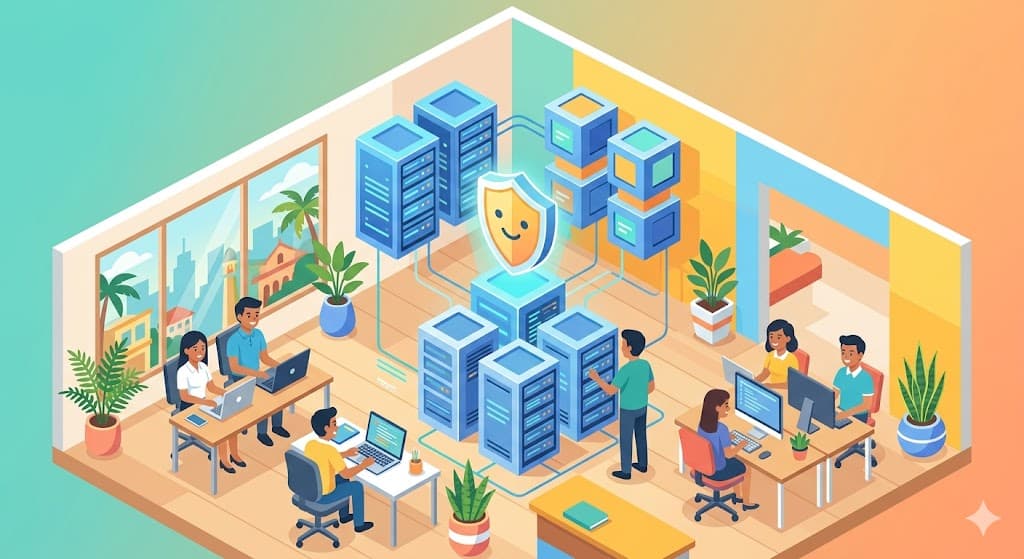
 Full-stack AI development unifies frontend, backend, and AI into one coordinated workflow managed by a single team
For Philippine SMEs, the practical shape looks like this. One full-stack AI developer builds an inventory dashboard that uses machine learning to predict stock shortages. The dashboard displays predictions on a clean web UI and pushes alerts to the team's Viber or email, all within the same codebase. No integration broker. No weekly standup where two teams debug each other's assumptions.
Three trends make this practical in 2026. AI-assisted coding tools such as Cursor and GitHub Copilot speed up the boilerplate work. Retrieval-augmented generation (RAG — where the AI pulls from your business documents before answering) lets a chatbot reference your own product catalog. AI agent frameworks allow systems to take multi-step actions like updating a record and sending a notification, rather than only answering questions. These are production tools, not future ones. For a wider view of the web-development side, our guide to AI-native web application development in the Philippines covers the architecture choices that make these patterns easier to adopt.
Related: AI Integration for Philippine SMEs: Cut Costs explains this in detail.
A Step-by-Step Path to Implementation
| Phase | Timeline | Focus |
|---|---|---|
| Assessment and planning | Month 1 | Define what AI should and should not handle |
| Core build | Months 2–4 | Develop the integrated system at 70% scope |
| Refinement | Months 5–6 | Optimize based on real usage data |
Step 1: Define the boundary between AI and human judgment. Before any code gets written, list the tasks AI can reliably handle — data entry, pattern matching, report generation, routine support replies. Then list the tasks that require human expertise — interpreting BIR regulations, handling sensitive client complaints, negotiating supplier terms. Write that boundary down, so any team member can read it and maintain the system.
 A phased implementation plan with clear checkpoints helps Philippine businesses reduce risk when adopting AI systems
Step 2: Start with a 70% solution. Instead of trying to automate everything at once, build a system that covers 70% of the target workflow and ship it. Collect real usage data, then improve in small steps. The "perfect launch" plan rarely launches on time, and when it does, it launches against assumptions nobody has tested. Schedule three checkpoints — requirements confirmation, mid-review, and final verification — with numerical acceptance criteria at each.
Step 3: Build for handover from day one. The most damaging mistake in technology projects is creating systems only one person can maintain. During acquisition negotiations for one of my 2000s web platforms in Japan — which included ASP services and video streaming — the buyer's evaluation came back as "the system is attractive, but the handover risk is too high." Too much of the architecture lived in my head, and that single finding tanked the deal's value. No matter how strong a system is technically, if nobody else can run it, its business value is limited. Every AI system should ship with documentation, standardized configurations, and manual fallback procedures from the start.
Step 4: Verify AI outputs with human review. Use a two-pass check. First, review the overall logical structure of the AI's output. Then check individual data points for accuracy. Cross-reference AI results against known patterns, and flag anything that looks off for human review before it reaches a customer.
Related: AI-Native Web Development for Philippine SMEs explains this in detail.
What Returns Can Philippine Businesses Expect
| Metric | Expected Outcome |
|---|---|
| Development timeline | Shorter compared to multi-team approaches |
| Maintenance costs | Lower due to unified codebase |
| Time spent on repetitive tasks | Significant reduction through automation |
Returns come from several directions at once. A unified team means fewer developers on payroll, which directly reduces monthly costs. For Philippine SMEs, developer compensation is one of the biggest budget lines, and consolidating into a full-stack AI role instead of three specialists usually produces meaningful monthly savings.
The bigger win is on time. Repetitive tasks that used to eat hours daily — data consolidation, report generation, customer inquiry classification — move to the AI side of the boundary. In my 2000s SEO operations, switching from manual keyword ranking checks to automated tooling took that single task from one hour per day on 100 keywords to a quick review of the output. The freed-up hour went straight into client improvement work, which is what grew the business. Our companion piece on how AI-powered websites help Philippine SMEs win more customers walks through how those freed hours flow back into revenue.
For SMEs, the realistic expectation is not overnight change but steady, measurable improvement over a three-to-six-month implementation window. The businesses that succeed are the ones that define clear metrics at the start and review against those metrics at each phase. The ones that skip metrics tend to argue about whether anything is working.
FAQ
Q: Can a single developer really handle frontend, backend, and AI?
A: For SME-scale projects, yes. Modern frameworks and AI APIs have made it feasible for one skilled developer to build and maintain integrated systems. For larger enterprises or more complex operations, a small team of two to three developers with complementary skills is more realistic — and still far cheaper than assembling four separate specialist teams.
Q: What programming languages should I look for?
A: Python is the most common language for AI and machine learning work, with strong libraries for model training and inference. For web applications, JavaScript or TypeScript with Next.js is the current default. A full-stack AI developer typically works in both, and knowing one language deeply beats knowing three shallowly.
Q: Is it safe to use AI for handling customer data in the Philippines?
A: The Philippines has the Data Privacy Act of 2012 (Republic Act No. 10173), which sets clear requirements for personal data handling. Any AI system must comply with it. Avoid sending confidential business or customer data to public AI services without a proper security review. On-premise or private cloud deployments give you more control, and for sensitive use cases that extra control is usually worth the cost.
Q: Should we build custom AI or use existing AI services?
A: For most Philippine SMEs, starting with existing AI services — APIs from established providers — is more practical and cost-effective. Custom model training only makes sense when your business has truly unique data that general models cannot handle well. Start with off-the-shelf APIs, learn where they fall short for your specific case, and only then invest in custom work.
Q: How do we prevent our AI system from becoming dependent on one developer?
A: Require documentation of all AI configurations, decision logic, and manual fallback procedures from the project's first week. Run regular knowledge-sharing sessions, and make sure at least two team members understand the system end to end. This is not optional for business continuity — the time you save by skipping it is the time you will lose when the key developer leaves.
Q: How long before we see measurable results?
A: With a phased approach, most SMEs see initial efficiency gains within two to three months after launch. Full tuning usually takes five to six months as the system is adjusted with real usage data. Setting specific, measurable targets before you begin is what makes "measurable results" something you can actually point at later.
Getting Started with Full-Stack AI for Your Business
| Action | Purpose |
|---|---|
| Identify one repetitive workflow | Focus your first AI project on a clear, measurable problem |
| Document the current process | Create a baseline for evaluating improvement |
| Engage a full-stack AI developer | Ensure unified accountability from frontend to AI layer |
The most practical next step is to pick one repetitive, time-consuming workflow in your business and evaluate whether an integrated AI solution could improve it. Write down exactly how that workflow operates today — the time it takes, the errors that occur, the people involved. That single document becomes the foundation for a real conversation with any developer or technology partner.
Philippine businesses that approach AI adoption with clear problem definitions, phased implementation plans, and realistic expectations are the ones that see returns. The technology is accessible. The talent pool in the Philippines is growing. The difference between a project that pays back and one that does not is almost always in the execution, not the technology.
Sources & References
- Republic of the Philippines, Data Privacy Act of 2012 (RA 10173)
- Philippine Statistics Authority, Annual Survey of Philippine Business and Industry
About the author
Founder / AI Engineer (36+ years in IT)
- ●From Tokyo · based in Manila for 13+ years
- ●36+ years in IT (development, SEO, AI)
- ●IBM Certified Generative AI Engineer
- ●AI chatbots, RAG & AI agent development
A Japanese AI engineer with 36+ years in IT and 13+ years on the ground in the Philippines. I write from hands-on experience to help Japanese companies adopt AI that actually delivers results — chatbots, workflow automation, AI agents, and AI-driven marketing. Feel free to reach out in Japanese or English.
Your Competitors Are Already Using AI!
Is your business keeping up?
Related Articles

What a Philippine Company Website Needs Now
Most company sites are built for a desktop visitor who no longer matters. The specs that serve phones and AI search.
8/14/2026

Adding AI to Existing Systems: A Retrofit Flow
Most Philippine companies cannot rebuild before adopting AI. How a retrofit works — find the seam, build beside it, cut over.
8/12/2026

AI and Customer Experience: The Whole Journey
Adding one AI feature rarely fixes CX. How to design AI across the journey rather than bolting it onto one step.
7/27/2026

Building AI Web Apps: The Design Choices That Matter Most
AI web app projects in the Philippines usually fail on design, not on the AI. Human checkpoints, loading feedback, and more.
7/25/2026

Core Web Vitals for Philippine Online Stores
Core Web Vitals measure how fast and stable a site feels. How Philippine stores pass Google's thresholds and rank better.
7/9/2026
Docker and Kubernetes: Preventing Downtime in the PH
How Docker and Kubernetes keep online systems stable for Philippine SMEs, reduce downtime, and support steady business growth.
6/10/2026