AI and Philippine BPO: The New Outsourcing Economics
How AI is changing the cost structure of Philippine BPO, and what it means for firms deciding whether to outsource or automate.

AI Engineer · 36+ years in IT · Japanese, based in Manila for 13+ years
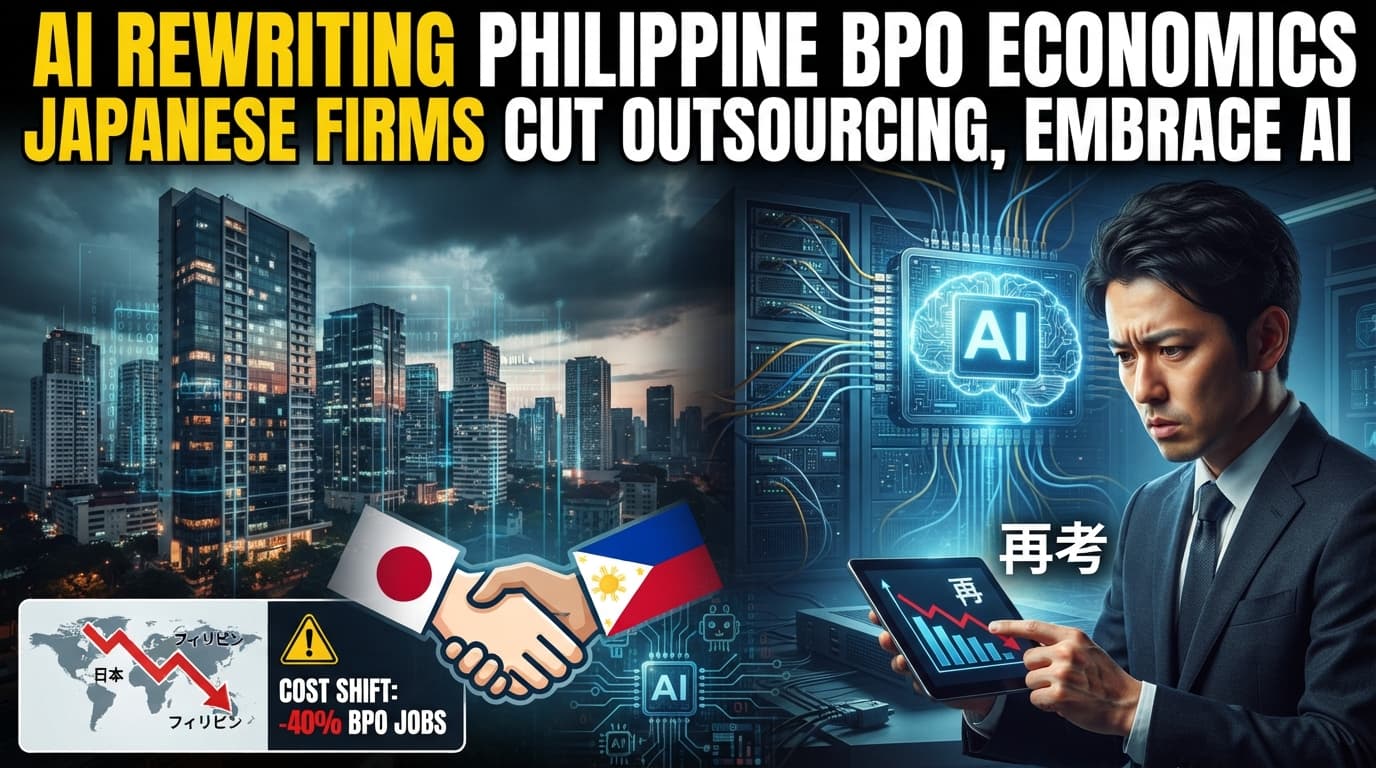
Generative AI is shaking the premises of outsourcing work to the Philippines. The question for Japanese firms is not whether to keep outsourcing, but what the split between people and AI should now look like.
Part 1: Why This Matters
Step 1: The Philippine Business Context (3 min)
The Philippines is one of the world's leading hubs for BPO (business process outsourcing, the practice of handing work such as accounting or call centers wholesale to an outside company). Many Japanese firms have entrusted call centers, accounting shared services, IT help desks, and the like to Philippine companies, holding down labor costs.
The source article here points out that the very premise of "outsourcing makes things cheaper" is beginning to crumble under generative AI (AI that automatically produces text and code). In other words, the foundation for deciding whether to send work to the Philippines is now being severely shaken.
This change directly concerns both Japanese firms that outsource work to the Philippines and Japanese business professionals who work on the receiving side of that outsourcing in the country. Over the next few years, there will be moves to reselect outsourcing partners and to change the substance of contracts. If you understand this ahead of time, you can prepare without panic.
"Say, I read an HBR article—apparently AI is starting to break the very mechanism that makes cheap outsourcing work." Picture yourself opening with that to a local staff member in a Manila office. They will surely ask, "So what happens to our jobs?" This material is meant to help you answer that question calmly.
Step 2: Key Points from the Source Article (5 min)
We have organized the facts discussed in the source article to make them easier to study.
| Point | What the source article says |
|---|---|
| The premise until now | For more than 30 years, outsourcing has rested on the idea that "if you define and standardize work and move it to a cheaper labor market, it gets cheaper." |
| What is changing | Generative AI is changing the foundation of the build-versus-buy decision—whether to make something in-house or buy it from outside. |
| Where the impact shows first | The impact is appearing first in IT work, which is digital, easy to measure, and machine-readable. |
| How far it spreads | The same logic reaches almost all outsourced work: accounting, HR, procurement, customer service, legal support, insurance claims processing, data analysis, and more. |
| Outsourcing that remains | Fields requiring deep expertise—building data infrastructure, security measures, system integration, regulatory compliance—will keep being outsourced. |
| The old model that breaks | Making money on labor-cost differences, large headcounts, rate cards, and long-term contracts measured by headcount and service levels will no longer work. |
| Conclusion | The very shape of the company—what it keeps in-house and what it sends outside—will change. |
Source: Harvard Business Review — "AI Is Rewriting the Economics of Outsourcing" (June 5, 2026)
This table was created for study purposes based on facts from public information. For details, please check the original article at the link above.
Related: AI Agents and Philippine IT/BPO Work: The Devin Effect explains this in detail.
Step 3: Comprehension Check (5 min)
Try confirming the content of the source article with the following five questions.
Q1. What idea has outsourcing rested on until now? Hint: Recall the flow of "define and standardize work, then move it somewhere cheap."
Q2. What kind of decision's foundation is generative AI changing? Hint: It's the term for the either/or choice between making something in-house and buying it from outside.
Q3. In which field is the impact appearing first? Hint: Work that is machine-readable and easy to measure.
Q4. Name two or more fields the source article says will keep being outsourced even as AI advances. Hint: Security and system integration are among them.
Q5. What specifically is the "old model" that will no longer work? Hint: Labor-cost differences and long-term contracts measured by headcount are the keywords.
Related: What Is Loop Engineering? A Business-Automation Primer explains this in detail.
Part 2: Putting It Into Practice
Step 4: Rollout Steps in the Philippines (10 min)
We have organized into four stages the steps for applying the source article's concerns to Philippine practice.
| Step | What to do | Philippine-specific notes |
|---|---|---|
| 1 | Take inventory of outsourced work | First, list the work you currently send to the local site. Writing the monthly cost in pesos alongside it makes later decisions easier. |
| 2 | Identify which work is easy to replace with AI | The more routine and machine-readable the work, the easier it tends to be to replace with AI. Conversely, work like regulatory compliance and negotiation stays with people. |
| 3 | Proceed together with local staff | In the Philippines, verbal agreement and face-to-face trust carry weight. Don't notify by written word alone; set up an in-person briefing and talk things through carefully. |
| 4 | Confirm how regulations and data are handled | For outsourcing that handles personal data, you must comply with the personal-data protection law set by the Philippines' National Privacy Commission (NPC). Confirm that your outsourcing partner can uphold it. |
Here is more detail, in order from Step 1.
In Step 1, you begin by writing out all the work you currently send to the local site. Record the monthly cost in pesos and keep it visible alongside the yen-converted figure, so you also notice movements in the exchange rate.
In Step 2, you divide that list into "work easy to hand to AI" and "work that stays with people." As the source article notes, routine IT work and data entry tend to fall into the former, while regulatory compliance and complex negotiation remain in the latter.
In Step 3, you decide how to proceed together with the local IT lead. In Philippine workplaces, conveying sudden changes one-sidedly easily breeds distrust, so explain the background in person and always set aside time to take questions.
In Step 4, you confirm how data is handled. Work involving personal data requires operating in line with the NPC's personal-data protection law. Before signing, confirm that your outsourcing partner and AI vendor can meet this standard.
Related: Outsourcing AI Development to Philippine IT Firms explains this in detail.
Step 5: Common Mistakes and How to Avoid Them (5 min)
Here are three situations where you easily stumble when tackling this topic in the Philippines, and how to avoid them.
Mistake 1: "Making cost reduction the only goal"
This is the mistake of looking only at the labor-cost difference and abruptly trying to terminate outsourcing.
Bad example: Simply because it's cheaper, you stopped all outsourcing to the local site. As a result, regulatory-compliance knowledge didn't stay in-house, and confusion only spread.
Good example: First you identified which work to hand to AI and which to keep with people. You kept outsourcing the work that requires expertise, and switched over only the routine work, little by little.
Mistake 2: "Putting off the explanation to local staff"
This is the mistake of deciding the policy only at headquarters and pushing ahead without adequately conveying it to the local site.
Bad example: Without explaining the reason for the change, you made do with a written notice alone. Local staff grew anxious, and one excellent employee after another quit.
Good example: Together with the Manila IT lead, you held a briefing for the local team. You carefully explained the background of the change and always set aside time to take questions at the end.
Mistake 3: "Adopting AI without confirming how data is handled"
This is the mistake of using AI for work involving personal data while neglecting to confirm the details.
Bad example: You fed customer data straight into the AI and put off the filing with the NPC. Later you were cited for a legal violation and scrambled to respond.
Good example: You set things up so data wouldn't be used for training, and so you could keep records of who operated it and when. You began operations only after meeting the NPC's standard.
Part 3: Going Deeper
Step 6: Related Technical Terms (5 min)
We have selected five important terms from the source article and explain them simply.
Generative AI is a mechanism that, when a person gives instructions, automatically produces text or programs for you. At Philippine call centers, the use of having generative AI draft replies to customers, which an agent then revises and sends, is spreading.
BPO (business process outsourcing) is the practice of handing work such as accounting or call centers wholesale to an outside company. In the Philippines this BPO has become a major industry, and many outsourcing firms are concentrated in Manila and Cebu.
Labor arbitrage refers to the practice of moving work to a country with lower labor costs to bring costs down. Behind Japanese firms sending work to the Philippines lay the cost savings from this practice.
Build-versus-buy is the decision of whether to do a piece of work inside your own company or hand it to outside. Considering whether to bring accounting work outsourced to the Philippines back in-house is exactly this kind of decision.
A rate card is a list of unit prices set by an outsourcing partner for each type of task. When contracting with a Philippine partner, it was common to estimate the monthly cost based on this price list.
Step 7: Thinking About How to Apply This at Your Company (10 min)
Try discussing your own situation along the following three themes.
Of your current outsourced work, which is easy to replace with AI?
Prompt to think about: The more routine and machine-readable the work, the easier it tends to be to replace. Try listing it out and separating it from "work to keep with people."
Next action: Write out about ten pieces of work you currently outsource to the Philippines, and sort them into two columns: "easy to hand to AI" and "keep with people."
Are you keeping the work that requires expertise in-house?
Prompt to think about: Fields like regulatory compliance and security need human knowledge even as AI advances. Confirm whether that knowledge remains within your company.
Next action: Identify one field where you have no in-house expert, and decide who will take over that knowledge.
How will you maintain trust with local staff?
Prompt to think about: In the Philippines, face-to-face dialogue and verbal agreement carry weight. Think about how you will create occasions to communicate change.
Next action: Before you communicate your next policy change, put one in-person briefing with the local lead on the schedule.
Part 4: FAQ
Q1. As AI advances, will outsourcing to the Philippines disappear entirely? No, not all of it will disappear. The source article, too, says that building data infrastructure, security measures, system integration, and regulatory compliance will keep being outsourced. What disappears is "work that held together solely on labor-cost differences." Philippine outsourcing partners, too, are likely to shift their role toward more specialized fields.
Q2. Can we abruptly terminate outsourcing on the instruction of the Japanese head office? It is safer to avoid terminating abruptly. In the Philippines, face-to-face dialogue and verbal agreement carry weight, so a one-sided notice breeds distrust. We recommend first talking it over with the local lead, setting a transition period, and proceeding in stages.
Q3. When feeding data into AI, is there anything to watch for under Philippine law? When handling personal data, you must comply with the personal-data protection law set by the National Privacy Commission (NPC). Set things up so data isn't used for training, and so you can keep records of who operated it and when. Because the filing procedures differ from Japan's personal-data protection law, confirm the local standard separately.
Q4. What happens to local staff employment if we adopt AI? While routine work decreases, work such as checking AI's output and handling more complex matters increases. Because the Philippines has strict labor-law procedures around dismissal, it is realistic to consider reassignment and retraining first. Rather than abruptly reducing employment, the key mindset is shifting roles.
Q5. Is there a difference between Japan and the Philippines in how outsourcing is approached? In Japan, the tendency is to nail down contracts and specifications in detail before proceeding, whereas in the Philippines, face-to-face trust and verbal agreement often come first. The knack for moving smoothly is to build the relationship through repeated dialogue rather than relying on written documents alone.
Tips for Getting It Right (3 Tips)
First, make a single "work inventory" sheet. Just by listing the work you currently send to the Philippines and laying the peso costs alongside it, you'll start to see where to begin. Since it becomes your starting point for decisions, it's effective to tackle it first.
Think separately about "work to hand to AI" and "work to keep with people." As the source article shows, routine work is easy to replace with AI, while work requiring expertise stays with people. Drawing this line prevents the mistake of hastily switching everything over.
Brief the local site "before" the change. In the Philippines, face-to-face dialogue underpins trust. Rather than deciding the policy and then reporting after the fact, involve the local lead while you're still deciding, and the transition will go far more smoothly.
Bonus: How to Make Use of PH AI Works
PH AI Works is a company that supports the use of AI and technology in the Philippines. We can help when Japanese firms that outsource work to the Philippines, and Japanese business professionals working locally, put today's theme into practice.
As a next step, you can consult us on things like the following.
- Identifying where to start with AI among the work you currently outsource to the Philippines
- How to use AI safely in line with the NPC's standards for work involving personal data
- How to carry out the transition of work smoothly while bringing local staff on board
Please feel free to get in touch. The initial consultation is free.
References and Sources
About the author
Founder / AI Engineer (36+ years in IT)
- ●From Tokyo · based in Manila for 13+ years
- ●36+ years in IT (development, SEO, AI)
- ●IBM Certified Generative AI Engineer
- ●AI chatbots, RAG & AI agent development
A Japanese AI engineer with 36+ years in IT and 13+ years on the ground in the Philippines. I write from hands-on experience to help Japanese companies adopt AI that actually delivers results — chatbots, workflow automation, AI agents, and AI-driven marketing. Feel free to reach out in Japanese or English.
Free AI Consultation
Tell us your challenges and we'll propose the right AI adoption plan for your business.
Book a Free 30-Minute ConsultationRelated Articles
AI Model Vendors Now Sell Implementation Too
OpenAI and Anthropic now sell implementation as well as models. What a local subsidiary should decide about that.
8/18/2026
Contracting for AI While Prices Keep Falling
Write a model number into the contract and it is obsolete in six months. How to design for switching instead.
8/17/2026

Meta Cut 750,000 Under-16 Accounts in Australia
AI-assessed age checks removed 750,000 accounts overnight. What that says about depending on platforms for reach.
8/16/2026
When an AI Calls Your Shop to Ask About Stock
AI now phones shops on a buyer's behalf to check stock. What to decide on the receiving side before it reaches you.
8/15/2026

Handling News That Is Not Settled Yet
A reported $6 billion acquisition talk is not a completed deal. How to act on industry news before it is confirmed.
8/14/2026
What a 69-Page AI Report Does Not Show
Frontier firms are reported 8.3x ahead, yet a table on page 35 shows no statistically significant link to revenue.
8/13/2026