
Claude Tag: A Slack-Based AI Worker at Your Operation
A walkthrough of putting Claude Tag, an AI worker that lives inside Slack, to work at a Philippine operation.


AI Engineer · 36+ years in IT · Japanese, based in Manila for 13+ years
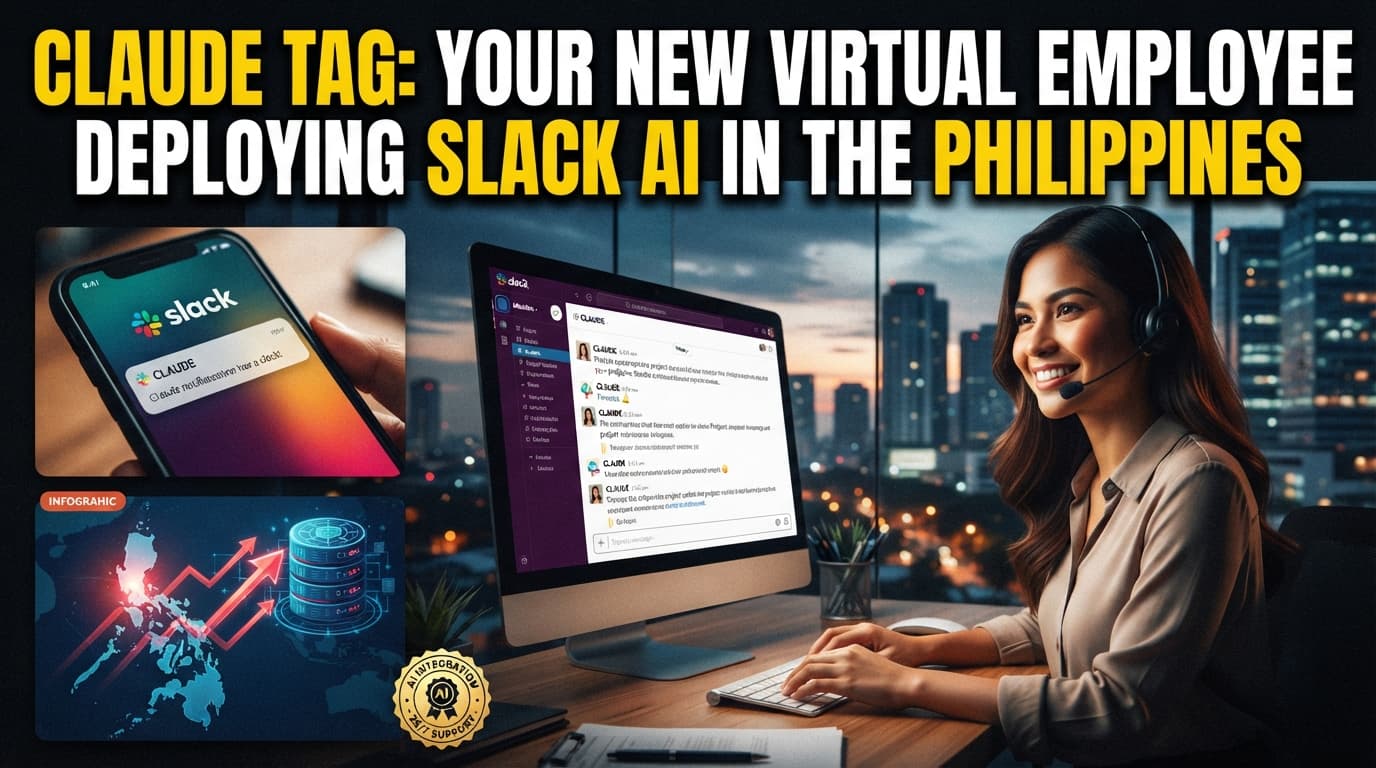
This guide explains how to use Anthropic's Claude Tag as a team AI inside Slack. You will learn practical points for using it at a Manila or Cebu site to strengthen coordination between headquarters and the local team and to automate work.
Part 1: Why This Matters
Step 1: The Philippine Business Context (3 min)
The Philippines has grown into one of the world's leading BPO hubs (business process outsourcing — the industry that takes on call centers, accounting support, and similar work on behalf of other companies). Many Japanese companies run operations in Manila and Cebu — call centers, accounting shared services, IT help desks, and the like. At these sites, an information barrier easily forms between the Japanese head office and the local team, and the chore of repeating the same explanations over and over becomes a real problem.
The "Claude Tag" featured in the source article is a mechanism that works like a virtual employee inside the Slack chat tool. Everyone on the team asks the AI to do work on the same screen, and they can watch it happen and move forward together. If headquarters and the local site can share the AI in the same Slack channel, handing over knowledge and coordinating across the language barrier becomes far easier.
For Japanese business professionals living in the Philippines, this shift has the potential to change "how you hand work over to local staff." Because the AI remembers in-house information, it can ease the burden of training new hires and maintaining manuals. At the same time, as we will note later, handling personal information requires care to comply with local law.
At the Manila office. Before the morning meeting, Tanaka, the Japanese manager, shows his laptop to Irene, the local IT lead, and says, "Irene, Anthropic put out something interesting. They say the whole team can use an AI together in a Slack channel. If our head office and Manila could both have the same AI learn our work, the monthly handovers would get a lot easier, wouldn't they?" Irene leans in to look at the screen and replies, "That sounds good. But for channels that handle customer personal information, let's check the rules from the NPC (the government agency that oversees personal-data protection in the Philippines) first."
Step 2: Key Points from the Source Article (5 min)
Here are the facts presented in the source article, organized point by point.
| Item | Details |
|---|---|
| Product name and announcer | Anthropic announced Claude Tag, a new tool that runs in Slack |
| Announcement date | Reported on June 23, 2026 |
| How it works | It breaks work into stages, the AI moves through them on its own, and it delivers the results to the team in Slack |
| Distinguishing feature | Everyone in the company shares the same AI "persona," and they can hand off work in progress to one another |
| In-house track record | Inside Anthropic, Claude Tag approves and merges 65% of the product team's code changes |
| Market movement | In Ramp's May survey, Anthropic surpassed its rivals in business usage for the first time (34.4% vs. 32.3%, across more than 50,000 companies) |
| Safety measures | Administrators can finely restrict the tools and scope of memory available in each channel |
| Cost management | Usage limits for the AI can be set per channel or per organization |
| Availability | It is being released first as a research preview to Claude Enterprise and Claude Team users |
This table was created for learning purposes based on facts in publicly available information. For details, please check the original article at the link above.
Step 3: Comprehension Check (5 min)
Let's review what we've covered so far. Try answering the following five questions.
Q1. Which chat tool does Claude Tag run on top of? Hint: It's a channel-based business chat tool widely used at American companies.
Q2. What is the big difference between Claude Tag and earlier offerings like Claude Code and Cowork? Hint: Focus on the difference between using it "alone" and using it "as a group."
Q3. Inside Anthropic, what percentage of the product team's code changes does Claude Tag approve and merge? Hint: It's more than half — close to two-thirds.
Q4. When you want to handle highly confidential information such as personal data, what method does the article introduce for using it safely? Hint: There's a way to interact with the AI one-on-one without showing it to everyone in the channel.
Q5. Which group of users is Claude Tag released to first? Hint: Two enterprise-tier plan names are mentioned.
Related: What Is Loop Engineering? A Business-Automation Primer explains this in detail.
Part 2: Putting It into Practice
Step 4: Steps for Adoption in the Philippines (10 min)
If you want to bring a virtual-employee tool like Claude Tag into your Philippine operation, the following steps are a safe way to proceed.
| Step | Details | Philippine-specific note |
|---|---|---|
| 1. Pick a single target task | Start by trying a simple internal task | It's safest to start with work that doesn't include customer personal information |
| 2. Decide how data is handled | Decide the scope of information the AI may use | Check how to obtain consent in line with the Data Privacy Act overseen by the NPC (the government agency that oversees personal-data protection) |
| 3. Set a budget ceiling | Set a monthly usage limit | Start with a trial budget of a few tens of thousands of pesos per month, then increase it as you see results |
| 4. Brief local staff | Share how to use it and the rules | Holding a short briefing in both English and Tagalog deepens understanding |
| 5. Review the results | Check outcomes once a month | Build the habit of putting agreements in writing rather than relying on verbal agreement |
Let's say a bit more about Step 2. The Philippines has a personal-data-protection law, and before you hand customer or employee information to an AI, the individual's consent may be required. Confirm whether the AI provider can configure a setting so that your data is not used for training, and if you do use such data, make sure you can keep audit logs (records of who did what and when).
On the budget in Step 3, the cost typically grows with how much you use the AI. The source article also noted that administrators can set usage limits per channel. If you set a small limit at the start, you can avoid unexpected costs.
Related: Claude for Legal: Legal AI for Philippine Operations explains this in detail.
Step 5: Common Mistakes and How to Avoid Them (5 min)
Here are three mistakes that often happen when adopting this kind of tool in the Philippines.
Failure pattern 1: "Handing it confidential information right away"
If you hand customer personal information or payroll data to the AI from the very start, you risk an incident such as a data leak.
Bad example: At a Manila call center, the AI was placed straight into a channel containing customer phone numbers and email addresses.
Good example: First try the AI on work that contains no personal information, such as writing internal meeting minutes. Once you've confirmed it's safe, gradually broaden the information it handles.
Failure pattern 2: "Skipping the briefing for local staff"
If the Japanese head office decides on adoption by itself and puts off briefing local staff, the tool ends up unused on the ground.
Bad example: The head office decided it was useful and finished by simply telling the Manila team, "Please use this."
Good example: Work with the local IT lead to map out a way of using it that fits the Philippine operation. Hold a briefing while showing concrete examples, and always set aside time for questions at the end.
Failure pattern 3: "Starting to use it without setting a cost ceiling"
If you start using it without setting a usage limit, an unexpected bill can arrive at the end of the month.
Bad example: Because it was useful, the whole team was allowed to use it freely, and a month later everyone scrambled when a large bill came in.
Good example: Decide a monthly usage limit per channel in advance. Check the amount used each week and revise the limit as needed.
Related: AI Agents and Philippine IT/BPO Work: The Devin Effect explains this in detail.
Part 3: Going Deeper
Step 6: Related Technical Terms (5 min)
Agentic AI is AI that breaks a goal set by a person into small tasks and works through them in order on its own. The source article's Claude Tag also breaks requested work into stages and carries it out automatically. At a Philippine BPO site, a chain of work such as "compile invoice data into a table" can be handed to the AI without a person directing each step.
A virtual employee is an AI that takes on work within a team like a human staff member. There's no employment contract, but it gets work done when you talk to it in chat. On a Manila team, you might have the virtual employee draft replies to overnight inquiries, with a person reviewing them the next morning.
Ambient behavior refers to the AI noticing the situation and proactively letting you know, even when it hasn't been asked. The source article noted that it can chase down and remind you of forgotten work. On a team split between the Philippines and Japan across a time difference, it helps when the AI sorts out and reports on cases that moved while one side was asleep.
Token spend is a unit for measuring how much you've used the AI, and it's also used to calculate cost. The more you use, the higher the cost. At a Philippine site, setting a spend ceiling that matches your monthly peso budget makes the costs easier to manage.
Scoped access is a mechanism by which administrators finely decide which information and tools the AI may touch. The source article explained that you can wall things off so an HR team's AI doesn't pass information to the engineering team. Even when several departments at a Philippine site use the same tool, you can separate what each department sees, which is reassuring.
Step 7: Thinking About How to Apply This at Your Company (10 min)
Discuss the following three themes with your team.
How to close the knowledge gap between headquarters and the local site
When a virtual employee remembers in-house information, headquarters and the local site can more easily work from the same assumptions. Think about which of your tasks involves the most "repeated explanation."
Prompt to consider: Write down where the same questions come up every time a new hire joins.
Drawing the line on using AI while protecting personal information
The Philippines has a personal-data-protection law, so care is needed in handling customer and employee information. It's safer to sort out which information may be given to the AI and which should be handled by people only.
Prompt to consider: List the "information you can't afford to leak" and decide, for each, whether it may be given to the AI.
Keeping AI costs within budget
How you balance convenience and cost can make or break adoption. Deciding in advance which tasks to prioritize within your monthly peso budget reduces waste.
Prompt to consider: Start with tasks where results are easy to see, and build a routine of checking each month whether the cost is worth it.
Next action: This week, pick one internal task that contains no personal information, and write up on a single sheet of paper a plan to try the AI on a small trial budget.
Part 4: FAQ
Q1. Can we use Claude Tag at our Philippine site right now?
As of the source article, it's at the stage of being released as a research preview, first to users on enterprise-tier plans. The article notes there are plans to broaden availability going forward. Whether you can use it at your Philippine site depends on the plan you're contracted to and on availability, so confirm the latest availability terms before adopting it.
Q2. If we use it in the Philippines, what should we be careful about regarding personal information?
The Philippines has a personal-data-protection law, overseen by the NPC (the government agency that oversees personal-data protection). Before handing customer or employee information to an AI, confirm whether consent is required. The thinking is close to Japan's personal-data-protection law, but the notification procedures and filing requirements differ. It's reassuring to consult a local legal expert.
Q3. How much does it cost?
The cost typically grows with how much you use the AI. The source article noted that administrators can set usage limits per channel or per organization. In the Philippines, a realistic approach is to start with a trial budget of a few tens of thousands of pesos a month and increase it as you see results. For exact pricing, check the provider's latest information.
Q4. I'm worried about whether local staff will actually use it well. What should I do?
It's important to involve local staff early rather than deciding everything at the Japanese head office. In Philippine workplaces, proceeding on verbal agreement alone can lead to a mismatch in understanding later. Putting the usage and rules in writing and holding a short briefing in English and Tagalog helps it take root.
Q5. If the Japanese head office and the Philippine site use the same AI, won't the information get mixed up?
The source article explained that administrators can restrict the information and tools shown in each channel. For example, you can wall things off so HR information isn't passed to the engineering team. Even when Japan and the Philippines handle different information, separating channels and permissions prevents unnecessary cross-flow of information.
Tips for Getting the Most Out of It (3 Tips)
Start by trying it on a single task with no personal information Handing it confidential information right away raises the risk of an incident. If you start with work that doesn't matter if it leaks, such as writing internal minutes, you can safely test how usable it is. Once you've confirmed the results, gradually broaden the information it handles.
Set a monthly usage limit from the start Because the AI costs more the more you use it, starting without a limit leaves you scrambling at month's end. Set a peso-denominated limit per channel and build the habit of checking the amount used each week, so you can use it with peace of mind within budget.
Involve local staff and put the rules in writing If you decide everything at the head office, it ends up unused on the ground. Work with the local IT lead to map out how to use it, and put what you agree on in writing. A way of proceeding that doesn't rely on verbal promises alone is especially important in the Philippines.
Bonus: How to Make Use of PH AI Works
PH AI Works is a company that supports the use of AI and technology in the Philippines. We can help you safely bring new tools like the "Slack-based virtual employee" featured in this article into your Philippine operation. Taking the circumstances of both the Japanese head office and the local team into account, we'll think through a realistic approach with you.
As a next step, you can consult us on things like the following.
- Sorting out how to handle data when adopting AI, with attention to the personal-data-protection law
- How to run a trial AI deployment at a Philippine site, and how to build a peso budget
- Support for staff briefings and for creating usage rules for local staff
Please feel free to get in touch. The initial consultation is free.
References and Sources
About the author
Founder / AI Engineer (36+ years in IT)
- ●From Tokyo · based in Manila for 13+ years
- ●36+ years in IT (development, SEO, AI)
- ●IBM Certified Generative AI Engineer
- ●AI chatbots, RAG & AI agent development
A Japanese AI engineer with 36+ years in IT and 13+ years on the ground in the Philippines. I write from hands-on experience to help Japanese companies adopt AI that actually delivers results — chatbots, workflow automation, AI agents, and AI-driven marketing. Feel free to reach out in Japanese or English.
Your Competitors Are Already Using AI!
Is your business keeping up?
Related Articles
AI Model Vendors Now Sell Implementation Too
OpenAI and Anthropic now sell implementation as well as models. What a local subsidiary should decide about that.
8/18/2026
Contracting for AI While Prices Keep Falling
Write a model number into the contract and it is obsolete in six months. How to design for switching instead.
8/17/2026

Meta Cut 750,000 Under-16 Accounts in Australia
AI-assessed age checks removed 750,000 accounts overnight. What that says about depending on platforms for reach.
8/16/2026

When an AI Calls Your Shop to Ask About Stock
AI now phones shops on a buyer's behalf to check stock. What to decide on the receiving side before it reaches you.
8/15/2026

Handling News That Is Not Settled Yet
A reported $6 billion acquisition talk is not a completed deal. How to act on industry news before it is confirmed.
8/14/2026

What a 69-Page AI Report Does Not Show
Frontier firms are reported 8.3x ahead, yet a table on page 35 shows no statistically significant link to revenue.
8/13/2026