
Preparing for the Day Your AI Becomes Unavailable
A government order told contractors to stop using one AI provider. How to prepare for losing access to yours.


AI Engineer · 36+ years in IT · Japanese, based in Manila for 13+ years
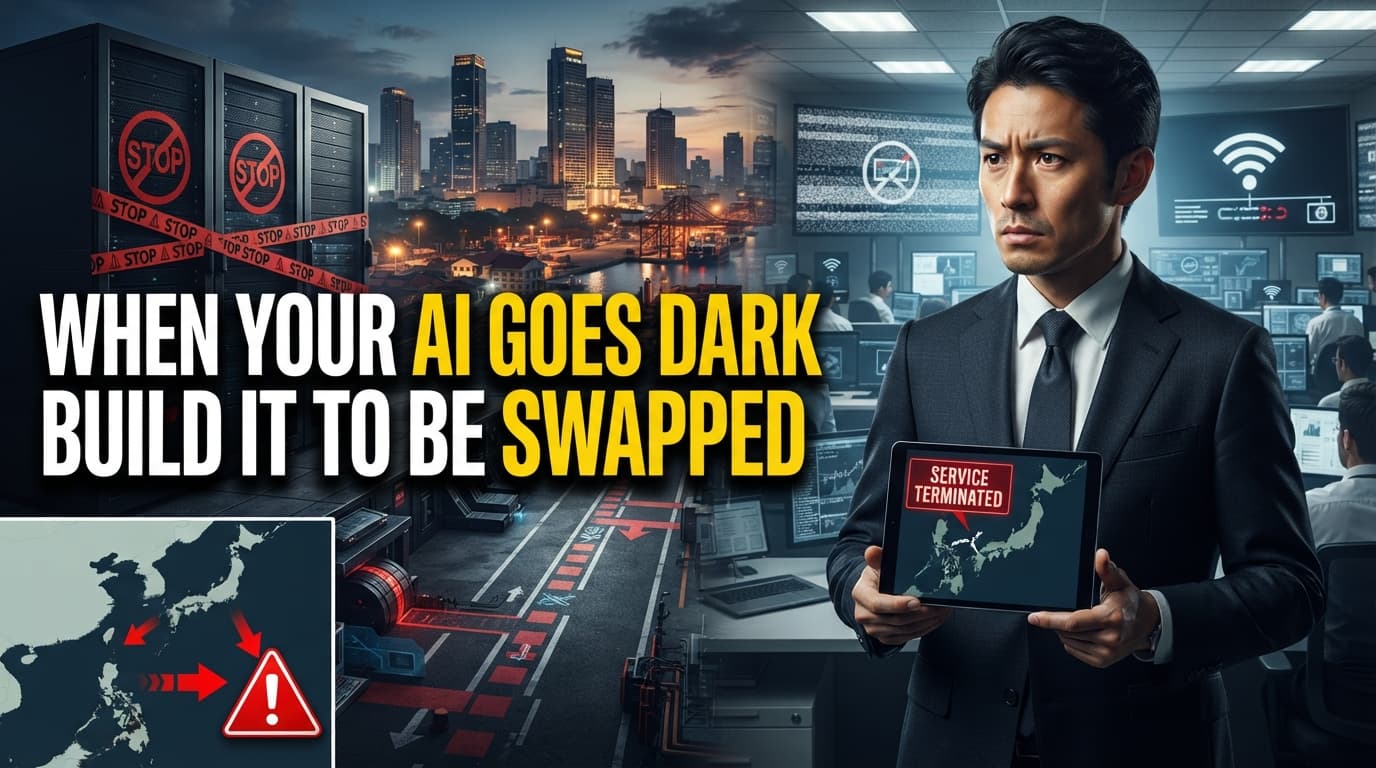
The AI you rely on suddenly becomes unusable, for reasons entirely unconnected to any decision you made — this is actually happening. In this module we use the case of the US government directing its contractors to stop using Anthropic's products, and work through, in concrete steps, how a Japanese company operating in the Philippines should choose its AI providers and prepare.
According to published reporting, on 27 February 2026 the Trump administration directed federal agencies to cease use of Anthropic's technology immediately, with a six-month transition period for agencies such as the Department of Defense that were using the company's products. The end of that transition period is 31 August 2026, and businesses that contract with the government are reported to need to stop using all Claude products, including the web version, the API and Claude Code, with non-compliance potentially affecting government contracts. The background cited is Anthropic's refusal to remove contractual clauses barring the Department of Defense from using its models for large-scale domestic surveillance or for fully autonomous weapons systems capable of firing without human involvement. The Department of Defense is also reported to have designated the company a supply chain risk. In this module we work through the implications in Parts 1 to 4, applying them to your own situation.
Part 1: Read, Then Consider the Implications for Your Company
Three points stand out in the reporting.
| Point | Detail |
|---|---|
| The reason was not technical | Not a performance drop or an outage, but a dispute over contractual terms between provider and government |
| The effect travels through business relationships | Reported to reach not only agencies but contractors doing business with government |
| The transition window was six months | Instruction on 27 February 2026, deadline 31 August 2026 |
Step 1: Pre-Reading (3 min)
Before you read, consider how this applies to your own company.
- Can you list every AI service currently used anywhere in your business?
- If one of them became unavailable next month, which work would stop?
- Could a contract or a client's requirements restrict which AI you are permitted to use?
Step 2: First Reading (10 min)
The following is a fictional internal memo, written for this module with a Japanese company in the Philippines as the subject, based on the facts of the news.
Internal memo: When a provider becomes unusable, and what we should prepare
Reports indicate that the US government has required its contractors to stop using a particular AI provider's products, with the deadline set at 31 August 2026. Three points deserve attention.
First, the reason for the stoppage is not technical. Performance did not degrade and there was no outage. The cause is reported to be a dispute over contractual terms between the provider and the government. In other words, this is the kind of event no amount of careful use on our side could prevent.
Second, the effect travels through business relationships. The scope is reported to cover not only government agencies but also businesses that contract with the government. Even if we are not directly covered, if a partner is covered then the tools available on a joint project may be restricted.
Third, the transition period was six months. That sounds generous, but moving a system embedded in daily operations onto a different provider is not comfortable work within that window.
Whether we fall directly within the scope of this measure depends on the nature of our business relationships. That is a point of fact we need to confirm.
Our three takeaways: (1) build a list of the AI services we use, (2) write down, for each area of work, what would stop, and (3) check whether our systems are built so the provider can be swapped.
Source: Trump administration orders military contractors and federal agencies to cease business with Anthropic — CNN Business (27 February 2026) / Pentagon Designates Anthropic a Supply Chain Risk — Mayer Brown (March 2026)
Note: the business scenario above is a fictional internal memo written for learning purposes on the basis of published reporting. The scope and deadline of the measure are open to interpretation and may change, so any determination of whether your company is covered must rest on primary sources and professional advice.
Step 3: Comprehension Check (5 min)
- Was the reason for the required stoppage a technical problem?
- Does the measure apply only to government agencies?
- How long was the transition period?
Step 4: Three-Minute Briefing (10 min)
Practise explaining this news to your management team in three minutes. Presenting it in the order "what happened (a deadline was set for AI to become unusable, for reasons unrelated to how it was being used) → why it matters (the effect can reach us through a business partner) → what we should do (list the services in use and check whether the provider can be swapped)" tends to land well.
Related: The DICT-CSC Circular as a Procurement Condition explains this in detail.
Part 2: Key Terms Explained (for Management)
Supply chain risk designation: a determination by an authority that there is concern about using something as a procurement item. It is a separate question from whether the product has any technical defect.
Transition period: the grace period allowed before use must stop. Any move to an alternative has to happen inside it.
Contractual clauses: terms under which a provider places conditions on how its technology may be used. In this case a dispute over such clauses is reported to be the trigger.
A swappable design: keeping the provider and model names for the AI you use in a single place, so that changing that one place moves you to a different provider.
Related: Executive Order 119 as a Vendor Checklist explains this in detail.
Part 3: Applying This to Your Company
Work through it in this order.
| Order | What to do | What to write down |
|---|---|---|
| 1 | List the AI services in use | Service name, the work it supports, who uses it, whether under contract |
| 2 | Write the impact if each stopped | One line: "what stops if this is unavailable tomorrow" |
| 3 | Consolidate the provider setting | Keep model names in one configuration file so they can be switched |
Build a list of the AI services in use
Start by writing down the AI services used inside the company. Include not only the ones you hold contracts for, but the ones individual staff are using on personal accounts. In practice, plenty of companies cannot account for this.
Four columns are enough for the list: service name, the work it is used for, who uses it, and whether there is a contract.
Related: Contracting for AI While Prices Keep Falling explains this in detail.
For each area of work, write down what would stop
Once the list exists, write one line against each entry: what stops if this becomes unavailable tomorrow.
Some areas of work will not stop at all. That is good news. Once only the genuinely painful ones remain, you know what you actually need to prepare for.
Put the provider setting in one place
As a technical precaution, this is the most effective single step. Keep the provider and model names for the AI you use in one place, such as a configuration file. If they are written directly into different parts of your systems, every switch means hunting them down.
Built this way, you have a far better chance of migrating without stopping work, even in a situation like this one.
Part 4: Common Failure Patterns (What Not to Do)
Failure 1: Deciding it does not apply because you have no government contracts
The question is not whether you are covered but whether anyone you work with is. Trace the chain of your business relationships and confirm. If you cannot tell, asking a professional is the reliable route.
Failure 2: Putting everything with one provider
On cost and administration, consolidating with a single provider is the rational choice. But if that provider becomes unavailable, all of your work stops. For your important processes, simply having tried an alternative makes a difference.
Failure 3: Not knowing what staff are using individually
Even without a company contract, staff may be using personal accounts for company work. This matters not only for restrictions of this kind but for how information is handled. If you find this while building the list, do not treat it as misconduct — first, get visibility.
Failure 4: Assuming the switch will work without testing it
Even with the settings consolidated in one place, an actual switch tends to surface other problems. For important work, run the switch once and see it operate. The gap between companies that have tested this and companies that have not shows up exactly when it matters.
Three Tips for Getting Value from This
- Finish the list this week: the judgements can wait. Not knowing what you are using is the genuinely dangerous state.
- Set the political assessment aside: how you evaluate this decision and how you prepare your own company are separate questions. Stay with the preparation.
- Go to primary sources: the scope and treatment of the deadline will keep moving. Check the authorities' own publications and law firm analyses rather than news summaries.
Bonus: How to Make Use of PH AI Works
"We do not know what is being used internally" and "we cannot tell whether our systems are built to be switched" are both hard to resolve from inside. In a free PH AI Works consultation we take questions from Japanese companies operating in the Philippines on inventorying the AI services in use and reviewing systems so the provider can be swapped. Contractual and legal judgements themselves belong to qualified professionals; our part is helping you build the internal setup.
Sources
- Trump administration orders military contractors and federal agencies to cease business with Anthropic — CNN Business (27 February 2026)
- Pentagon Designates Anthropic a Supply Chain Risk — What Government Contractors Need to Know — Mayer Brown (March 2026)
- Is Claude a Supply Chain Risk? What Federal Contractors Need to Know About This Designation — Goodwin (March 2026)
- Federal Government and Anthropic: Considerations for AI Innovation and Competition — Congressional Research Service
About the author
Founder / AI Engineer (36+ years in IT)
- ●From Tokyo · based in Manila for 13+ years
- ●36+ years in IT (development, SEO, AI)
- ●IBM Certified Generative AI Engineer
- ●AI chatbots, RAG & AI agent development
A Japanese AI engineer with 36+ years in IT and 13+ years on the ground in the Philippines. I write from hands-on experience to help Japanese companies adopt AI that actually delivers results — chatbots, workflow automation, AI agents, and AI-driven marketing. Feel free to reach out in Japanese or English.
Free AI Consultation
Tell us your challenges and we'll propose the right AI adoption plan for your business.
Book a Free 30-Minute ConsultationRelated Articles
AI Model Vendors Now Sell Implementation Too
OpenAI and Anthropic now sell implementation as well as models. What a local subsidiary should decide about that.
8/18/2026
Contracting for AI While Prices Keep Falling
Write a model number into the contract and it is obsolete in six months. How to design for switching instead.
8/17/2026

Meta Cut 750,000 Under-16 Accounts in Australia
AI-assessed age checks removed 750,000 accounts overnight. What that says about depending on platforms for reach.
8/16/2026
When an AI Calls Your Shop to Ask About Stock
AI now phones shops on a buyer's behalf to check stock. What to decide on the receiving side before it reaches you.
8/15/2026

Handling News That Is Not Settled Yet
A reported $6 billion acquisition talk is not a completed deal. How to act on industry news before it is confirmed.
8/14/2026

What a 69-Page AI Report Does Not Show
Frontier firms are reported 8.3x ahead, yet a table on page 35 shows no statistically significant link to revenue.
8/13/2026