What Anthropic's Mythos Signals for AI Security
The latest shifts in AI security, read through Anthropic's Mythos model and its engagement with the White House.

AI Engineer · 36+ years in IT · Japanese, based in Manila for 13+ years
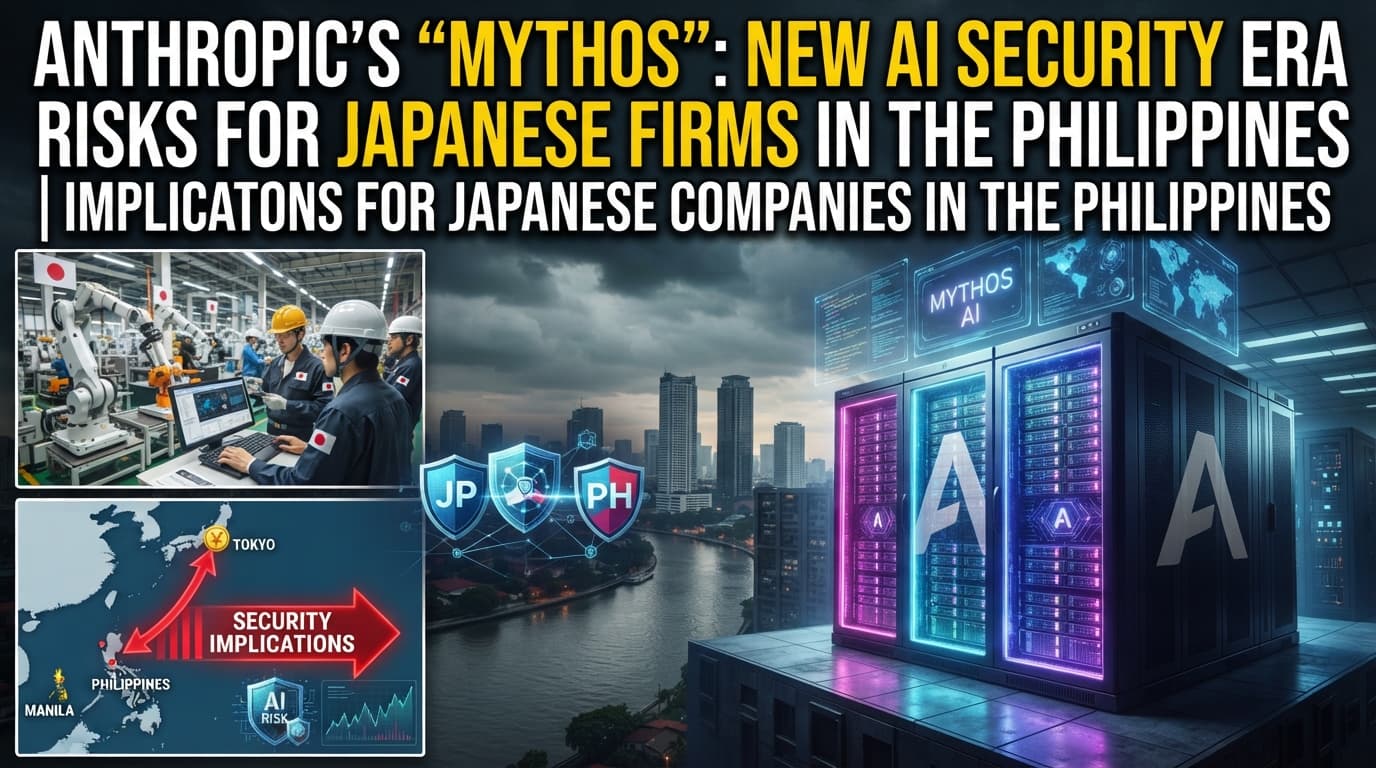
The meeting between Anthropic's CEO and the White House, and the new AI model "Mythos," together set the direction for AI security defences and the management structures (the mechanisms of governance) that Japanese companies in the Philippines should prepare for.
Part 1: Why This Matters
Step 1: The Philippine Business Context (3 min)
News broke that Anthropic's CEO visited the White House and discussed the new AI model "Mythos." This isn't merely a matter of American politics. Mythos is an AI model strong at finding software weaknesses and security holes. It has the potential to change the conventional wisdom of cybersecurity.
For Japanese companies entering the Philippines, too, this topic is not someone else's problem. Offices in Manila and Cebu carry out their work while connected to Japanese headquarters via the cloud. Companies running BPO (business process outsourcing) or call centers handle large volumes of customer data. In an era where AI becomes a "weapon usable for both attack and defense," the security level of the local office ties directly to headquarters' risk.
In the Philippines, the National Privacy Commission (NPC) keeps a strict eye on the handling of personal information. The documents submitted to the BIR (Bureau of Internal Revenue) and the SEC (Securities and Exchange Commission) are increasingly digitized. A local information-leak incident is reported to Japanese headquarters right away. "AI security" has entered the conversations of management.
Scene: An office in BGC, Manila. At the morning meeting, local staff member Maria says: "Boss, Japanese headquarters sent a question asking, 'Do you know about Mythos?' Customers are also asking for an update on our AI audit. How should we answer?" Coffee in hand, you open this material.
Step 2: The Key Facts From the Original Article (5 min)
We have organized the facts of the original article into an easy-to-understand form.
| Item | Details |
|---|---|
| The principal | Anthropic CEO Dario Amodei |
| Meeting counterpart | White House Chief of Staff Susie Wiles |
| Also present | Treasury Secretary Scott Bessent |
| Date of meeting | Friday, April 17, 2026 |
| The AI model at issue | Mythos (cybersecurity-specialized) |
| Distribution method | Limited to select companies as "Project Glasswing," with no public release |
| Immediate background | The Trump administration had designated Anthropic a "national security risk" |
| Current status | A federal judge in San Francisco temporarily stayed the administration's use-suspension order |
| The point of contention | The Department of Defense demanded "full use," while Anthropic insisted on "carving out use for autonomous weapons and domestic mass surveillance" |
| The President's reaction | Told reporters, "Who? I don't know" |
This table was created for study purposes based on facts from publicly available information. For details, please check the original article at the link above.
Step 3: Comprehension Check (5 min)
Let's check your understanding of the original article. Think about the answers before moving on.
Q1: What kind of AI model is Mythos good at being? Hint: Its ability to find software "weaknesses" and "holes."
Q2: What is the name of the initiative Anthropic started in place of releasing Mythos publicly? Hint: An English combination of "glass" and "wing."
Q3: Name two of the points the Department of Defense and Anthropic could not agree on. Hint: The autonomy of weapons, and the scope of surveillance over citizens.
Q4: Whom did Mr. Amodei meet on this visit? Give at least two names. Hint: The practical head of the White House, and the secretary who handles the money.
Q5: About two weeks before the meeting, what kind of conflict was Anthropic in with the U.S. government? Hint: The government designated it a certain "risk," and Anthropic sued in court.
Related: What GPT-5.5's Cyber-Capability Evaluation Means for the AI Risk Defenses of Japanese Firms in the Philippines explains this in detail.
Part 2: Putting It Into Practice
Step 4: Implementation Steps in the Philippines (10 min)
We lay out the steps for advancing AI-security preparedness at your local Philippine office.
| Step | Details | Philippine-specific points to watch |
|---|---|---|
| 1. Take stock of the current state | Catalog the AI tools in use and the data the AI touches | Many cases involve local staff using free AI on personal accounts. Watch out for use via free Wi-Fi in BGC and Cebu, too |
| 2. Confirm the law | Check the Data Privacy Act (DPA 2012) and the NPC's latest circulars | The rules for cross-border transfer of personal information differ from Japan's personal-data protection law. The cost of a local lawyer's confirmation is roughly PHP 15,000–50,000 |
| 3. Assess the risk | Imagine the scenario where an "offensive AI" like Mythos targets your company | Local SMEs often use old Windows or PHP-built systems, so dormant vulnerabilities are highly likely |
| 4. Create internal rules | Prepare AI usage guidelines in both English and Tagalog | Because the culture of verbal agreement is strong, emphasize documentation and signatures. Don't rely on the "tacit understanding" of a sari-sari-style culture |
| 5. Regular audits | Undergo a penetration test at least once a year | Roughly PHP 200,000–800,000 at a Manila specialist firm. Prepare contracts that also cover the DOLE labor-contract aspects |
Budget benchmark: As one reference point, set annual AI-security spending for a local subsidiary of about 50 employees at PHP 500,000–1,500,000 (about 1.3 million–4 million yen).
Related: Safe Use of Frontier AI, Read Through Claude Fable 5: Risk Management for Japanese Firms in the Philippines explains this in detail.
Step 5: Common Mistakes and How to Avoid Them (5 min)
Mistake 1: Applying headquarters' rules to the local site as is
-
Bad example: You just distribute an English translation of the Japanese headquarters' AI policy and leave operation to the local site. Local staff feel "this is a rule meant for Japanese people," and it ends up as compliance in name only.
-
Good example: You hold a workshop together with the local IT manager. Rewrite the policy to fit Philippine practice, and reflect local realities such as Barangay-level power-outage responses.
Mistake 2: Ending at merely banning AI tools
-
Bad example: You issue a notice saying "AI must not be used for work" and leave it at that. Local staff keep using it secretly on personal phones, raising the risk of data leaks.
-
Good example: You prepare and distribute safe, company-approved AI tools. Budget license fees of roughly PHP 500–2,000 per month, and convey the official way to use them in training.
Mistake 3: Not writing AI handling into contracts
-
Bad example: Your existing BPO and outsourcing contracts have no clauses on AI use. Even when an incident occurs, the locus of responsibility is left vague.
-
Good example: For new contracts and at renewal, you spell out "whether AI use is permitted," "data handling," and "the obligation to notify if a vulnerability is found." Also account for reporting obligations to the SEC and BIR.
Related: Lessons From the Anthropic "Mythos" Unauthorized-Access Incident: AI Security for Japanese Companies in the Philippines explains this in detail.
Part 3: Going Deeper
Step 6: Related Technical Terms (5 min)
Cybersecurity
- It refers to protecting computers and networks from bad actors.
- Like locking your house, it's a mechanism to protect your company's data from being entered without permission.
- BPO companies based in Manila are entrusted with Japanese headquarters' customer information. As a result, cybersecurity certification often becomes a condition of doing business.
Vulnerability
- It's a "hole" or "weak spot" in a system.
- Like a broken lock on a house door, it's a place that's easy for an attacker to enter.
- There have been reported cases where a vulnerability was found in the old accounting software used by an SME in Cebu, putting banking transaction information at risk.
Penetration Test
- It's the work of deliberately attacking a system to check whether there are any problems.
- It's close to an exercise where you have a burglar-role expert enter your house to test where they can get in from.
- An increasing number of Japanese companies conduct it before an NPC audit. It's common to commission a specialist firm in Manila.
Autonomous System
- It's a system that judges and acts on its own without a human's instructions.
- It's like a robot that thinks and moves on its own without your pressing a button.
- A mechanism that "automatically reorders when stock runs low" in inventory management is one familiar example of an autonomous system.
Supply Chain Risk
- It's the danger that arises from your business partners and the supply network of parts.
- It's the danger that even if your own company is fine, a problem at a partner causes trouble for you too.
- A case where a Japanese auto-parts maker suffers a delivery delay due to an IT incident at a Philippine partner is one example of supply chain risk.
Step 7: Applying This to Your Own Company (10 min)
How well can your company's AI use withstand "being attacked"?
A prompt to consider: A security-specialized AI like Mythos can become a weapon for the attacking side if misused. Among the tools your local office uses, start by taking inventory of which would likely be targeted first.
How should you unify "AI governance" between headquarters and the local subsidiary?
A prompt to consider: Bringing headquarters' rules to the local site as is won't fit local realities and ends up being compliance in name only. Together with the local lead, design a form that satisfies both the Philippine NPC rules and Japan's personal-data protection law.
How far should you check on your business partners' AI use?
A prompt to consider: Do you know what kinds of AI your Philippine BPO and IT outsourcers use? Simply adding an "obligation to report AI use" to the contract can greatly reduce supply chain risk.
Next action: By next week, create an inventory list at your local office of "what AI tools, who is using them, and on which data." A single A4 page is fine. This is the starting point for everything.
Part 4: FAQ
Q1: Do I need to check AI security at my Philippine BPO outsourcer too?
Yes, you do. If the outsourcer's staff put customer data into free AI on personal accounts, the responsibility reaches Japanese headquarters too. Spell out in the contract "use only company-approved AI" and "the obligation to notify on violation." Even a simple quarterly interview is effective.
Q2: How does the NPC (National Privacy Commission) view AI?
The NPC supervises the processing of personal information overall, and AI processing is covered as well. Sending customer data to an overseas AI service is treated as a "cross-border transfer." Obtaining consent and preparing contract clauses are necessary. Data sent to Japan is no exception.
Q3: Can I hire AI security experts locally?
Manila and Cebu have a certain number of specialized personnel, but the competition to hire is fierce. A salary benchmark is around PHP 150,000–300,000 per month for a senior (about 400,000–800,000 yen). Rather than hiring full-time straight away, first partially outsource to a local specialist firm. The safe approach is to consider hiring after in-house expertise has accumulated.
Q4: How should I convey AI risks to local staff?
Concrete examples land better than abstract talk. Leave realistic talk—like "if you put XYZ into free AI, there's no telling who will see it"—to a local manager who can also explain it in Tagalog. Having a Japanese expatriate explain it only in English doesn't get through well to younger staff.
Q5: When an AI-related incident occurs, when should I report it to Japanese headquarters?
As a rule, file a first report "within the same day it's discovered." In the Philippines, there are cases where a 72-hour notification obligation to the NPC applies. The time difference between Japan and the Philippines is one hour, so the iron rule is to make contact early without worrying too much about headquarters' business hours. Don't rely on verbal alone—leave a record by email or chat.
Tips for Putting This to Use (4 Tips)
Tip 1: Create a "AI tools in use" inventory sheet this week
Risk countermeasures begin with grasping the current state. A single A4 spreadsheet is enough. Start with three columns: "tool name," "user," and "type of data handled." Rather than aiming for perfection, the important thing is to write it out first.
Tip 2: Add an "AI clause" paragraph to your contract templates
At the timing of new contracts and renewals, build in whether AI use is permitted, data handling, and the incident-notification obligation. The cost of asking a local lawyer to review the template is on the order of tens of thousands of yen—a small investment compared with later losses.
Tip 3: Distribute an "AI you're allowed to use" list for local staff
Rather than listing prohibitions, it's more effective to distribute a list of three to five approved tools. The reassurance of "use these and you'll be fine" lowers the risk of tools being used secretly behind the scenes. Keep it current with a monthly review.
Tip 4: Hold a quarterly "AI risk review meeting" between headquarters and the local site
Even 30 minutes is fine. Having a regular forum where the headquarters IT lead and the local IT manager talk leads to early detection of problems. Keep minutes and run it so that you decide three homework items for next time.
Bonus: How to Make Use of PH AI Works
PH AI Works supports the use of AI and technology for Japanese companies in the Philippines. In connection with this theme, we can help with the following:
- Support for taking inventory of your local office's AI usage: We'll sort out together which tools are used and where the risks lie.
- Bilingual (Japanese-English) creation of AI usage guidelines: We'll create practical documents that bridge headquarters' rules and local realities.
- AI-skills training for local staff: In partnership with instructors who can work in Tagalog, we provide training that ties directly to practice.
Please feel free to get in touch. The initial consultation is free.
Citations and References
References and Sources
About the author
Founder / AI Engineer (36+ years in IT)
- ●From Tokyo · based in Manila for 13+ years
- ●36+ years in IT (development, SEO, AI)
- ●IBM Certified Generative AI Engineer
- ●AI chatbots, RAG & AI agent development
A Japanese AI engineer with 36+ years in IT and 13+ years on the ground in the Philippines. I write from hands-on experience to help Japanese companies adopt AI that actually delivers results — chatbots, workflow automation, AI agents, and AI-driven marketing. Feel free to reach out in Japanese or English.
Free AI Consultation
Tell us your challenges and we'll propose the right AI adoption plan for your business.
Book a Free 30-Minute ConsultationRelated Articles
AI Model Vendors Now Sell Implementation Too
OpenAI and Anthropic now sell implementation as well as models. What a local subsidiary should decide about that.
8/18/2026
Contracting for AI While Prices Keep Falling
Write a model number into the contract and it is obsolete in six months. How to design for switching instead.
8/17/2026
Meta Cut 750,000 Under-16 Accounts in Australia
AI-assessed age checks removed 750,000 accounts overnight. What that says about depending on platforms for reach.
8/16/2026
When an AI Calls Your Shop to Ask About Stock
AI now phones shops on a buyer's behalf to check stock. What to decide on the receiving side before it reaches you.
8/15/2026

Handling News That Is Not Settled Yet
A reported $6 billion acquisition talk is not a completed deal. How to act on industry news before it is confirmed.
8/14/2026

What a 69-Page AI Report Does Not Show
Frontier firms are reported 8.3x ahead, yet a table on page 35 shows no statistically significant link to revenue.
8/13/2026