
The BSP Rate Hike and Your Cash Flow
The Philippine central bank has raised its policy rate to 4.75%. The cash-flow measures worth taking in response.

AI Engineer · 36+ years in IT · Japanese, based in Manila for 13+ years
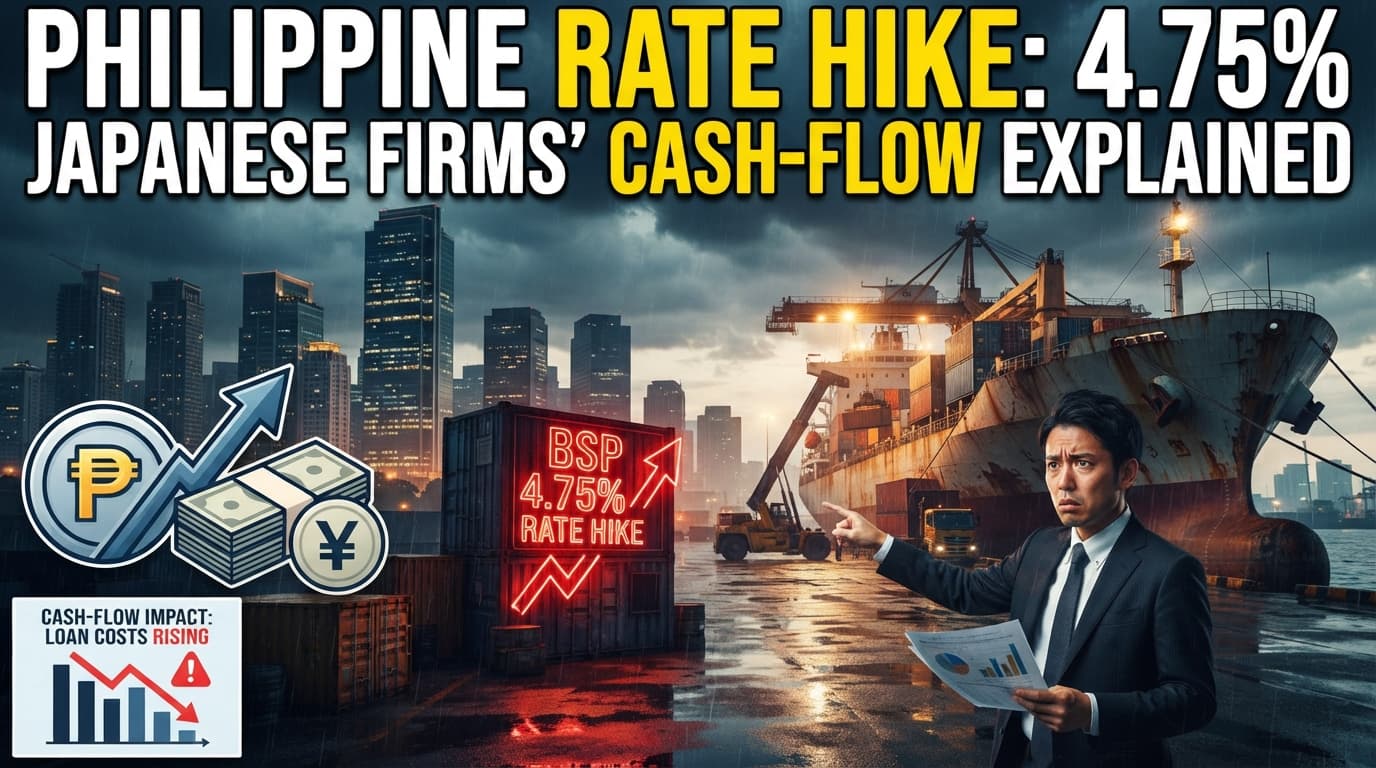
We lay out, in plain and practical terms, how the Philippine central bank's (BSP) rate hike to a 4.75% policy rate affects the cash flow and foreign-exchange exposure of Japanese companies doing business on the ground.
Part 1: Why This Matters
Step 1: The Philippine Business Context (3 min)
The Philippine central bank (Bangko Sentral ng Pilipinas, BSP for short) has raised its policy rate—the benchmark interest rate that the central bank sets. When the policy rate rises, the interest you pay to borrow money from a bank goes up. In other words, companies with peso-denominated loans on the ground face a heavier repayment burden.
The trigger for this hike was stubbornly high inflation (prices rising continuously). Tensions in the Middle East have pushed up the price of crude oil and other commodities, and that has fed through to local fuel and food prices. The central bank raised rates to keep this excessive price growth in check.
For Japanese companies already operating in the Philippines, or considering entering the market, this is not someone else's problem. If you have peso-denominated borrowings, your repayments change. It also affects costs such as raw materials and labor. And if the yen-peso exchange rate moves, the picture changes for remittances to your Japanese headquarters and for converting profits back into yen. Getting an early grasp of where interest rates and prices are heading is the first step toward protecting your cash flow on the ground.
Your Manila office. On a Monday morning, a colleague from accounting comes to your desk and says: "I heard the BSP raised rates again last week. How will the monthly repayment on our peso-denominated capital-investment loan change?" Drawing on what you learn in this guide, you can calmly explain how a rate increase affects your cash flow.
Step 2: The Key Facts From the Original Article (5 min)
We have organized the facts reported in the original article into a table for study purposes.
| Item | Details |
|---|---|
| Who announced it | The Philippine central bank (BSP) |
| Date of announcement | June 18, 2026 |
| What was decided | Policy rate raised from 4.50% to 4.75% |
| The rate in question | The overnight reverse repurchase rate (the central bank's benchmark rate) |
| Reason for the hike | Rising prices (inflation) against the backdrop of Middle East tensions |
| The central bank's stance | Prepared to hike further if needed to bring inflation back to target |
| Previous move | A rate hike in April 2026 as well (carried out even amid a slowing economy) |
Source: WSJ — "Philippine Central Bank Hikes Rates to Get Inflation Back on Target" (June 18, 2026)
This table was created for study purposes based on facts from publicly available information. For details, please check the original article at the link above.
Step 3: Comprehension Check (5 min)
Q1. The policy rate that the BSP just raised went from what percentage to what percentage? Hint: It was a 0.25% increase. The figure after the hike is in the "What was decided" row of the table.
Q2. What was the main reason for this rate hike? Hint: Look at what is happening in the Middle East and at the movement in prices.
Q3. What stance did the BSP signal regarding future monetary policy? Hint: Recall what it said it would do, if necessary, to bring inflation back to target.
Q4. As a development within 2026, this hike came after a previous rate increase in which month? Hint: Check the month listed in the "Previous move" row of the table.
Q5. When the policy rate rises, what happens to the repayment burden of companies that have borrowed in pesos? Hint: Think about how the interest charged on borrowed money changes when rates rise.
Related: Yen at a 40-Year Low: An FX-Risk and AI Guide for Japanese Companies in the Philippines explains this in detail.
Part 2: Putting It Into Practice
Step 4: Implementation Steps in the Philippines (10 min)
Here is a process for translating the rate-hike news into "how this affects our own company."
First, take stock of your peso-denominated borrowings and their interest terms in a single list. Variable-rate contracts feel the full impact of a hike like this one. Check, contract by contract, whether each is fixed or variable.
Second, estimate how much your repayments will increase. In the Philippines, it helps to build your budget in pesos and manage the yen conversion separately to avoid confusion. Working out the monthly difference in concrete figures when the rate rises by 0.25% makes decisions easier.
Third, factor the yen-peso movements into your transaction plans and your remittance plans for headquarters. Even a small shift in remittance timing changes the gain or loss on yen conversion. When you want to limit losses from exchange-rate swings, consult your local bank as you proceed.
Fourth, consider how much of the cost increase to pass on to prices, adapting to local realities. The Philippines has a culture where verbal agreements tend to move things forward first. When it comes to price increases or changes in terms, do not get ahead of yourself with verbal promises—always confirm in writing.
Fifth, consult local financial institutions and experts, and verify the latest information from primary sources. For the rate outlook and inflation situation, confirm against the official announcements of the BSP (the central bank). For tax-related decisions, you can rest easier by also checking the information from the BIR (Bureau of Internal Revenue).
| Step | What to do | Philippine-specific points to watch |
|---|---|---|
| 1 | List your peso-denominated borrowings and interest terms | Variable-rate contracts feel the direct impact of a hike |
| 2 | Estimate the repayment increase in concrete figures | Build the budget in pesos and manage the yen conversion separately |
| 3 | Factor yen-peso rates into transaction and remittance plans | Watch out—remittance timing changes your gain or loss |
| 4 | Consider how much of the cost increase to pass on to prices | Don't get ahead of yourself verbally on price hikes—always confirm in writing |
| 5 | Confirm the latest information with local banks and experts | Base decisions on official primary sources such as the BSP and BIR |
Step 5: Common Mistakes and How to Avoid Them (5 min)
Failure pattern 1: "Judging Philippine rates by a Japanese-yen sense of interest rates alone"
When you are used to Japan's low rates, it is easy to underestimate how high peso-denominated rates are. Misjudge the repayment burden, and your cash flow can suddenly get tight.
Bad example: Thinking, with a Japanese mindset, "rates only went up a little," and leaving the peso-loan repayment unestimated.
Good example: Calculating the monthly repayment in pesos, working out the difference in actual amounts when the rate rises by 0.25%, and factoring it into your funding plan.
Failure pattern 2: "Putting off the exchange-rate issue"
When interest rates and prices move, the yen-peso exchange rate tends to move too. Putting off remittances and yen conversion of profits can lead to unexpected losses.
Bad example: Remitting to headquarters at the usual timing without paying attention to exchange-rate movements, and ending up with less value once converted to yen.
Good example: Checking exchange-rate movements regularly and deciding remittance timing in consultation with your local bank, thereby limiting losses.
Failure pattern 3: "Skipping the explanation to local staff"
Changes in interest rates and prices directly affect the lives of your local employees. Skipping the explanation lets anxiety and misunderstanding spread.
Bad example: Management decides the response on its own and changes the pricing and cost policy without telling local staff anything.
Good example: Giving local staff a brief explanation of the background, sharing why you are reviewing costs and prices, and only then proceeding with concrete measures.
Related: Bracing for a Weak Peso and High Oil Prices: How Japanese Companies Strengthen FX and Cost Management with AI explains this in detail.
Part 3: Going Deeper
Step 6: Related Technical Terms (5 min)
The policy rate (the benchmark interest rate set by the central bank) is the most fundamental interest rate that a central bank sets to regulate the flow of money. In the Philippines, the BSP raises and lowers this rate to influence banks' lending and deposit rates. Companies considering a capital-investment loan locally watch the movement of this policy rate to decide the timing of their borrowing.
The reverse repurchase rate (the rate the central bank uses to temporarily absorb money from the market) is something like the interest a bank earns when it parks money with the central bank for a short period. What the BSP raised this time was this overnight reverse repurchase rate. Philippine financial institutions use this rate as a benchmark when setting their lending terms for companies.
Inflation (prices rising continuously) refers to a state in which the prices of the same goods and services creep up over time. This rate hike was a move to rein in that inflation. Japanese companies with factories or offices in the Philippines feel the effects of inflation firsthand, in the form of rising raw-material prices and wages.
Core inflation (the movement in prices excluding volatile food and energy) is an indicator that smooths out temporary price swings to reveal the true underlying trend. When it is rising, it is taken as a sign that price increases are spreading across a wide range of goods. Companies devising a pricing strategy on the ground use core-inflation movements as a basis for judging whether a price increase is temporary or deep-rooted.
Monetary tightening (a policy of raising rates to restrain the flow of money) is the central bank's response to cool excessive price increases by reducing the money circulating in the economy. This rate hike was one such measure. For companies doing business in the Philippines, it is important to build funding plans on the assumption that borrowing costs will run higher for as long as monetary tightening continues.
Related: Reading the Weak Yen and FX Intervention with AI: An FX Risk Management Guide for Japanese Companies in the Philippines explains this in detail.
Step 7: Applying This to Your Own Company (10 min)
Review your own peso-denominated funding
When rate hikes continue, peso-denominated borrowing costs tend to rise. Take a fresh look at the interest rates at which your company is currently raising funds.
A prompt to consider: Do you have more variable-rate or more fixed-rate borrowing? If rates rise further, think about which contract would be hit hardest.
Next action: List your peso-denominated borrowings contract by contract, and organize the type of rate and the balance into a single table.
Design pricing and costs that can withstand exchange-rate swings
Set your prices so the margin survives a rate you did not plan for. A structure decided in advance holds up better than one negotiated after the move.
A prompt to consider: Of your purchases and sales, which portions are denominated in pesos, and which in yen or dollars? Map out where you would be hit hardest when the exchange rate moves.
Next action: Write out your main transactions broken down by currency, and rank them in order of how badly they would be affected when the exchange rate moves.
Build a system for sharing interest-rate and price information with your local team
Changes in interest rates and prices affect both your local employees' lives and your management. Rather than letting information be held by only a few people, set up a flow that lets the team share it.
A prompt to consider: Who is following the local economic news right now? Is that information reaching the departments that need it?
Next action: Designate one person to compile a brief monthly summary of the latest interest-rate and price information and share it with the local team.
Part 4: FAQ
Q1. When the policy rate rises, will repayments on our peso-denominated loan increase right away?
If it is a variable-rate contract, the repayment amount will increase at the rate-review timing. If it is fixed-rate, you will not be affected for the time being during the contract term. The key first step is to check whether your contract is variable or fixed. Because low rates persisted for so long in Japan, people there have a strong fixed-rate mindset—but in the Philippines, be aware that rate movements feed directly into repayments.
Q2. When rates rise, how does it affect the yen-peso exchange rate?
Generally, when a country's interest rates rise, its currency tends to be bought more. However, exchange rates move on many factors—prices, global conditions, and more—so you cannot determine the direction by interest rates alone. In your remittance and yen-conversion plans, you can rest easier by building in a margin on the assumption that the exchange rate can move in either direction.
Q3. Is this rate hike a reason to hold off on a new entry into the Philippines?
A rate hike pushes up borrowing costs, but that alone is no reason to change your entry decision. The Philippines is a market with a large population and strong long-term growth prospects. It is important to consider short-term funding costs and the medium-to-long-term appeal of the market separately. Consult local banks and experts, and make your decision in light of the latest rate outlook.
Q4. A local business partner told me verbally that they want to add their cost increase to the price. How should I respond?
In the Philippines, there are many situations where things move forward verbally first. However, for any agreement involving amounts or terms, we recommend always confirming in writing. To prevent later discrepancies in understanding, keep a record of what was agreed in the form of an email or contract. Even more than in Japan, written confirmation is a pillar that protects your company.
Q5. Where should I check for the latest information on interest rates and prices?
For interest rates and prices, the official announcements of the BSP (the central bank) are the primary source. For tax-related points, check the BIR (Bureau of Internal Revenue) information as well. Make it a habit not to judge from news headlines alone, but to verify all the way down to the official announcements—that way you won't be jerked around by inaccurate information.
Tips for Putting This to Use (3 Tips)
First, write out your peso-denominated borrowings on a single table. The first step in gauging the impact of rates is to accurately grasp the current state. Simply listing the balance and rate type for each contract lets you see at a glance where you need to pay attention.
Always convert that 0.25% rate difference into a concrete amount. Left as a percentage, the scale of the impact is hard to feel. Expressing the difference in monthly repayments as an amount makes it easier to reach internal agreement and speeds up your decisions.
Set up a monthly forum for the team to share interest-rate and price information. When only a few people track the changes, the response falls behind. Sharing regularly, even briefly, lets the whole local team operate on the same assumptions.
Bonus: How to Make Use of PH AI Works
PH AI Works is a company that supports the use of AI and technology in the Philippines. We can help you build systems that "visualize" figures such as interest rates, prices, and exchange rates, and put them to work in your day-to-day management decisions.
As a next step, you can consult us on things like the following:
- Building a dashboard that automatically gathers the latest interest-rate and exchange-rate information and lets you check it on a single screen
- Building a system that automatically estimates peso-denominated cash flow and repayment simulations based on your data
- Automating report creation so that your local team and management share the same information
Please feel free to get in touch. The initial consultation is free.
References and Sources
About the author
Founder / AI Engineer (36+ years in IT)
- ●From Tokyo · based in Manila for 13+ years
- ●36+ years in IT (development, SEO, AI)
- ●IBM Certified Generative AI Engineer
- ●AI chatbots, RAG & AI agent development
A Japanese AI engineer with 36+ years in IT and 13+ years on the ground in the Philippines. I write from hands-on experience to help Japanese companies adopt AI that actually delivers results — chatbots, workflow automation, AI agents, and AI-driven marketing. Feel free to reach out in Japanese or English.
Free AI Consultation
Tell us your challenges and we'll propose the right AI adoption plan for your business.
Book a Free 30-Minute ConsultationRelated Articles
AI Model Vendors Now Sell Implementation Too
OpenAI and Anthropic now sell implementation as well as models. What a local subsidiary should decide about that.
8/18/2026
Contracting for AI While Prices Keep Falling
Write a model number into the contract and it is obsolete in six months. How to design for switching instead.
8/17/2026

Meta Cut 750,000 Under-16 Accounts in Australia
AI-assessed age checks removed 750,000 accounts overnight. What that says about depending on platforms for reach.
8/16/2026

When an AI Calls Your Shop to Ask About Stock
AI now phones shops on a buyer's behalf to check stock. What to decide on the receiving side before it reaches you.
8/15/2026

Handling News That Is Not Settled Yet
A reported $6 billion acquisition talk is not a completed deal. How to act on industry news before it is confirmed.
8/14/2026

What a 69-Page AI Report Does Not Show
Frontier firms are reported 8.3x ahead, yet a table on page 35 shows no statistically significant link to revenue.
8/13/2026