
The Law That Makes Your Chatbot Say 'I'm an AI'
The EU AI Act's chatbot disclosure requirement applies from August 2026. What it means for businesses in the Philippines.


AI Engineer · 36+ years in IT · Japanese, based in Manila for 13+ years
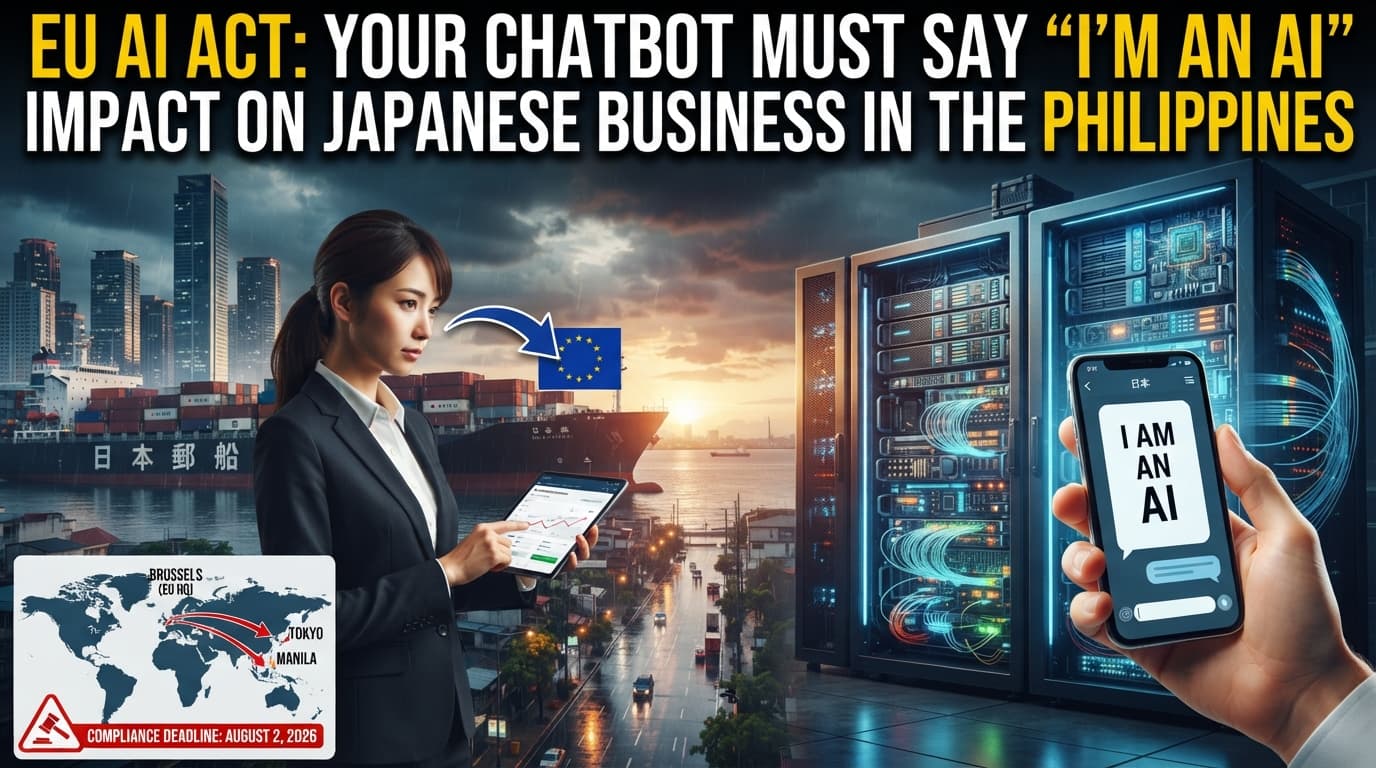
An obligation to make chatbots identify themselves as AI is starting to move. For the BPO and customer-facing operations run out of Manila, we walk through the audit and the wording work that Japanese companies should begin now, from a hands-on, practical perspective.
Part 1: Why This Matters
Step 1: The Philippine Business Context (3 min)
On August 2, 2026, one provision inside the EU AI Act (the European Union's AI regulation) takes effect. When an AI converses with a person in Europe, it must tell them, "This is an AI." In the United States, several states already have similar laws.
You might think, "That's a European matter." But for Japanese companies doing business in the Philippines, it is not someone else's problem. Manila and Cebu host many operations that handle customer service for clients in Japan and the West — call centers, accounting shared-services, IT help desks. Even if a chatbot you run there has only slight contact with European customers, the disclosure rule can apply the moment a European party is among those it serves.
There is a second angle: getting ahead of it. The idea of making an AI identify itself will, sooner or later, filter down into your Japanese parent company's internal policies and into procurement requirements from business partners. If the Philippine side has it in order first, you won't have to scramble when head office starts asking.
A Manila office, Friday afternoon. Sato-san, the Japanese manager, has a Forbes article up on his laptop as he turns to Joanna, the local staff lead. "Joanna, from August 2, chatbots in Europe apparently have to identify themselves as AI. What does our support bot say in its opening greeting?" Joanna thinks for a moment. "'Hi, I'm Maya from support!' It only gives a name." "Then that's our first bit of homework. Let's start by mapping out where we stand."
Step 2: Organizing the Key Points of the Source Article (5 min)
Below is a table of only the facts stated in the source article.
| Item | What the article states |
|---|---|
| Law in question | One provision within the EU AI Act (the EU's AI regulation) |
| Effective date | August 2, 2026 |
| What is required | When an AI interacts with a user, it must disclose that it is an AI |
| Scope | AI across the whole of Europe. Some U.S. states also have similar laws |
| Legislative aim | To keep users from mistaking whether they are talking to a human or to a generative AI / large language model (LLM) |
| Points under debate | Do users really confuse humans and AI? Might this end up a "feel-good law" that values appearance over substance? |
| Exemption mechanism | A "reasonable person" standard that waives disclosure when it is "obvious" that you are dealing with an AI |
| Problem with the exemption | The line for "obvious" is vague and can become a loophole. The same ambiguity arises in some U.S. state laws |
| Direction of the article's conclusion | The disclosure duty makes sense, but doubts remain about whether this minimal rule truly protects users |
This table was compiled from publicly available facts for educational purposes. For details, please check the original article at the link above.
Step 3: Comprehension Check (5 min)
Q1. On exactly what date does the EU AI Act provision requiring AI to identify itself as AI take effect?
Hint: the article was written in July 2026 and treats the effective date as "soon."
Q2. Besides the EU, which place does the article cite as having a similar system?
Hint: the subject is not a whole country but a sub-national unit within one.
Q3. What kind of confusion is this law trying to protect users from?
Hint: it concerns "who" is on the other end of the conversation.
Q4. In what situation does the "reasonable person" provision in the EU AI Act waive disclosure?
Hint: picture a situation that is plain to anyone at a glance.
Q5. What doubt does the article's author raise about this disclosure duty?
Hint: the angle is that it "looks good," but what does it actually change?
Related: Cheaper Chinese AI Models: Cost Against Security explains this in detail.
Part 2: Putting It Into Practice
Step 4: Implementation Steps in the Philippines (10 min)
Here are the steps for putting an "identify itself as AI" setup in place at a Philippine operation, broken into five stages.
| Step | What to do | Philippine-specific note |
|---|---|---|
| 1 | Write out every AI conversational touchpoint running in the company | Free tools adopted independently by the front line tend to slip in. Assume a culture where operations start on a verbal OK, and gather them through interviews |
| 2 | Sort who is being talked to, by region | Is there any contact with European customers or employees? For BPO contract work, check all the way through to the party behind the client |
| 3 | Decide the disclosure wording and implement it | Prepare both English and Tagalog. Budget a few thousand to a few tens of thousands of pesos for outsourced wording changes |
| 4 | Review how personal data is handled | If conversation logs contain personal data, confirm the consent and retention requirements set by the Philippine Data Privacy Act and the NPC (National Privacy Commission) |
| 5 | Brief local staff and keep records | Save the briefing materials and attendance records. They become your "proof that you did it" if an audit is requested |
Step 1: Take inventory of your AI conversational touchpoints. First, list every AI that talks with customers or employees inside the company. Not just the website chatbot, but the internal help desk's auto-responder and the auto-reply tools sales quietly uses. On the Philippine front line, people often start using a handy tool on their own initiative. If you ask in an accusing tone, it stays hidden; ask "tell me what you're struggling with," and it comes out honestly.
Step 2: Organize who the conversation partners are, region by region. Check whether you interact with European customers or employees. For contract work, you need to confirm not only the client company but the location of the end users behind them. This often isn't written into the contract, so email the client's contact directly and keep the answer in writing.
Step 3: Decide the disclosure wording and actually build it in. Make it so that "This is an automated response by AI" comes across at the very start of the conversation. Philippine customer service is mostly in English, but for consumer-facing services it is courteous to add Tagalog. A change that only edits the wording usually stays within a few thousand to a few tens of thousands of pesos even if you ask an outside developer — and cheaper still with an in-house engineer.
Step 4: Review the handling of conversation logs and personal data. Conversations with AI pick up names, phone numbers, and payment details. The Philippines has a Data Privacy Act, overseen by the NPC (National Privacy Commission). Confirm where conversation logs are stored, how long they are kept, and whether they are configured not to be used for AI training. Always re-read the terms of any external service you use.
Step 5: Brief local staff and keep records. Together with your Manila IT lead, create a procedure manual that fits the local workflow. In team meetings, keep the explanation short while showing the actual screen. Always leave time for questions at the end. Keep the briefing materials and the attendance record.
Related: AI Agents and Philippine IT/BPO Work: The Devin Effect explains this in detail.
Step 5: Common Mistakes and Fixes (5 min)
Failure pattern 1: Dismissing it as "an EU law — nothing to do with us"
A Philippine operation can be tied to Europe in ways you can't see. It's common for a client's own customer to turn out to be a European company.
NG example: "We only serve customers inside the Philippines, so we judged the EU AI Act irrelevant and looked into nothing."
OK example: "For each client, we checked the location of the users behind them. For the two cases with contact with European users, we added disclosure wording."
Failure pattern 2: Leaning on the exemption clause with "it's obviously AI"
As the source article points out, there is an exemption: if it is "obvious" you're dealing with an AI, no disclosure is needed. But that line is vague. Interpreting it in your own favor risks being overturned later.
NG example: "A robot icon shows on the chat screen, so we figured anyone could tell it's AI and left out the disclosure wording."
OK example: "Rather than relying on the exemption, we adopted a method that states, in one sentence at the top of the conversation, that this is an automated response. We keep the rationale and the decision date in an internal document."
Failure pattern 3: Translating head-office wording literally and handing it to the front line
The tone of Philippine customer service differs from Japan's. An overly stiff literal translation breeds distrust instead.
NG example: "We machine-translated the Japanese notice head office wrote and pasted it straight into the top of the chatbot."
OK example: "We had local staff read the English and reworked it into phrasing customers won't find off-putting. A contact on the Japanese side checks at the end that the meaning hasn't changed."
Related: AI and Philippine BPO: The New Outsourcing Economics explains this in detail.
Part 3: Going Deeper
Step 6: Related Technical Terms (5 min)
EU AI Act A law that sets out what those who build and use AI in Europe must follow. According to the source article, its provision that "AI must identify itself as AI" takes effect on August 2, 2026. If your Manila BPO operation runs chatbots that touch European customers, put this date on the company calendar.
Disclosure Requirement The rule that when an AI talks with a person, it must let them know "I am an AI." In a Philippine customer support department, it comes down to a very concrete task: how to write the chat's opening greeting.
Reasonable Person Standard A yardstick of "what an ordinary person would conclude," used to decide how a law applies. The source article notes that this standard — which waives disclosure when dealing with an AI is "obvious" — creates ambiguity at the boundary. At a Philippine operation, it is safer to keep the rationale for your judgment in a document than to skip disclosure by relying on this standard.
Large Language Model (LLM) An AI that has read huge amounts of text and can return writing much like a person's. What is used in a Manila office to summarize meeting minutes or draft English emails is usually this kind of AI.
Generative AI An umbrella term for AI that creates new text, images, and the like. At Japanese companies in the Philippines, it is starting to be used to draft recruitment ads and internal documents, and the disclosure issue arises when you turn it toward customer service.
Step 7: Thinking About How to Apply It (10 min)
Map all your AI touchpoints onto a single sheet
A prompt to think with: Can you list every place where AI is currently conversing with a person in your company? Website, internal chat, auto-replies to job applicants, automated phone voice — write down everything that comes to mind. Note who the administrator is, too, and the gaps start to show.
Who decides "it's obviously AI"?
A prompt to think with: What the source article takes issue with is the ambiguity of this judgment. In your case, who makes it — legal at the Japanese head office, or the site lead in Manila? If no one is designated to decide, that itself is a risk.
How does the customer's reaction change once you disclose?
A prompt to think with: If you say "This is an AI" up front, will customers leave, or will they feel reassured? Philippine customers often give candid reactions, so try it on a small touchpoint and you'll get your answer quickly.
Next action: Take 15 minutes at next week's team meeting and have everyone write out your AI conversational touchpoints. Make a list on the spot and fill in just two columns for each: "Is there any contact with European parties?" and "Does it already identify itself as AI?" With this one sheet, the next step decides itself.
Part 4: FAQ
Q1. If we do business only inside the Philippines, can we ignore the EU AI Act?
Whether the law applies at all comes down to whether you have contact with Europe. That said, Philippine BPO work often has European users behind the client. First, for each client, confirm where your actual counterparts are located. If you can confirm zero contact, there's no rush for now. Even so, the idea of making AI identify itself will enter future procurement requirements, so it does no harm to be ready.
Q2. If there's a clause saying disclosure isn't needed when it's "obviously AI," can't we just rely on it?
As the source article points out, this "obvious" line is very vague. What's obvious to you may not be to a regulator or a customer. In Philippine practice, much moves on a verbal OK alone, but be sure to document this judgment. Writing down who skipped disclosure, when, and for what reason pays off later.
Q3. Is English alone enough for the disclosure wording?
For business-to-business dealings, English is often enough. But for services aimed at ordinary Philippine consumers, adding Tagalog gets through better. If you prepare a "polite long text" in the Japanese sense, it just gets skimmed past. A short line understood at a glance is kinder.
Q4. How much does it cost?
If you're only changing an existing chatbot's greeting, it often stays within a few thousand to a few tens of thousands of pesos even with an outside developer. What actually costs is the work of finding what AI touchpoints exist in-house, and the time spent briefing staff. Secure the manpower headroom first.
Q5. On personal data, what differs between Japan and the Philippines?
Japan has the Act on the Protection of Personal Information; the Philippines has the Data Privacy Act, overseen by the NPC (National Privacy Commission). Conversation logs with AI pick up personal data, so confirm the storage location, the retention period, and whether it is configured not to be used to train external services. Rather than importing the Japanese head office's rules as-is, it's important to lay the Philippine requirements alongside them and check both.
Three Tips for Making This Work
First, write out "where AI talks with people" in 15 minutes. Your response starts with an inventory. Don't aim for a perfect list; start by laying out everything you can think of. You can add what's missing later.
Always keep your disclosure judgment as a document. As the source article shows, the line for the exemption is vague. If you put "disclose / don't disclose" and how you decided onto a single sheet, you won't be stuck when asked to explain later. Not moving on a verbal OK alone is especially important in Philippine practice.
Decide the disclosure wording only after local staff have read it. Stiff text translated literally from Japanese doesn't reach customers. Have local staff read it once and rework it into natural phrasing before you publish. Aim for a length that gets through in a single line.
Bonus: How to Make Use of PH AI Works
PH AI Works supports companies that want to put AI and technology to work in the Philippines. Our strengths include deploying and running AI chatbots, building internal rules for AI use, and training for local staff.
As a next step, you can consult us on things like the following:
- Inventorying the AI conversational touchpoints running in your company and organizing the scope that needs disclosure
- Designing disclosure wording in both English and Tagalog and building it into your chatbot
- Creating briefing materials and training on AI-use rules for your local Philippine staff
Please feel free to get in touch. The initial consultation is free.
References & Sources
About the author
Founder / AI Engineer (36+ years in IT)
- ●From Tokyo · based in Manila for 13+ years
- ●36+ years in IT (development, SEO, AI)
- ●Google Certified AI Professional
- ●IBM Certified Generative AI Engineer
- ●AI chatbots, RAG & AI agent development
A Japanese AI engineer with 36+ years in IT and 13+ years on the ground in the Philippines. I write from hands-on experience to help Japanese companies adopt AI that actually delivers results — chatbots, workflow automation, AI agents, and AI-driven marketing. Feel free to reach out in Japanese or English.
Free AI Consultation
Tell us your challenges and we'll propose the right AI adoption plan for your business.
Book a Free 30-Minute ConsultationRelated Articles
AI Model Vendors Now Sell Implementation Too
OpenAI and Anthropic now sell implementation as well as models. What a local subsidiary should decide about that.
8/18/2026
Contracting for AI While Prices Keep Falling
Write a model number into the contract and it is obsolete in six months. How to design for switching instead.
8/17/2026

Meta Cut 750,000 Under-16 Accounts in Australia
AI-assessed age checks removed 750,000 accounts overnight. What that says about depending on platforms for reach.
8/16/2026
When an AI Calls Your Shop to Ask About Stock
AI now phones shops on a buyer's behalf to check stock. What to decide on the receiving side before it reaches you.
8/15/2026

Handling News That Is Not Settled Yet
A reported $6 billion acquisition talk is not a completed deal. How to act on industry news before it is confirmed.
8/14/2026

What a 69-Page AI Report Does Not Show
Frontier firms are reported 8.3x ahead, yet a table on page 35 shows no statistically significant link to revenue.
8/13/2026