
How AI Chatbots Help Philippine Businesses Deliver Better Customer Support
AI chatbots for Philippine business websites - practical guide to implementation, cost savings, and 24/7 customer support for SMEs


AI Engineer · 36+ years in IT · Japanese, based in Manila for 13+ years
Summary
- AI chatbots can handle repetitive customer inquiries around the clock, freeing Philippine SMEs from the burden of manual support staffing
- Implementation follows a practical, phased approach — starting with FAQ automation and expanding based on real customer data
- Businesses that integrate chatbots into their websites can expect measurable improvements in response time, customer satisfaction, and operational costs
A Makati-based retailer gets the same ten customer questions every day — store hours, delivery areas, return policy, shipping cost to Davao, product availability. Answering each one by hand costs staff hours that should go into sales and fulfillment. An AI-powered chatbot on the business website handles that repetitive load at 2 a.m. as reliably as at 2 p.m., without adding a new hire to the payroll.
Customer Support Is Draining Philippine SME Resources
| Challenge | Impact on Business |
|---|---|
| Repetitive inquiries consume staff hours | Less time for sales and growth activities |
| After-hours messages go unanswered | Lost leads and lower customer satisfaction |
| Scaling support means hiring more people | Rising labor costs, especially in Metro Manila |
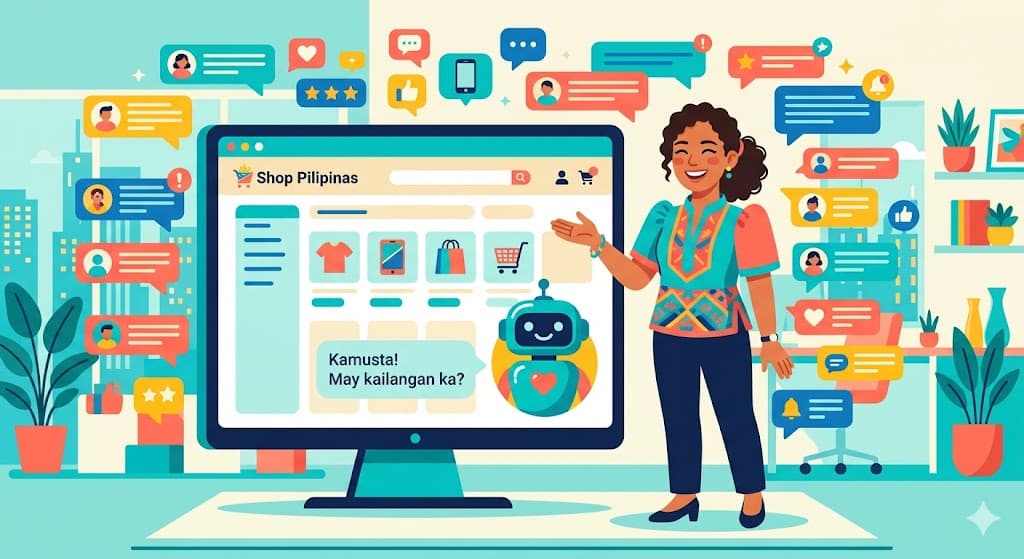
In most Philippine SMEs, customer support is not a dedicated department — it is a side job. The sales associate handles Messenger between store duties. The owner personally answers emails at 11 p.m. from a phone. The admin assistant covers inquiries during lunch breaks because that is when messages pile up.
 Juggling customer support alongside other duties is a daily reality for many Philippine SMEs
During peak seasons the workload jumps hard. A retailer running an 11.11 Lazada campaign can see inquiries triple in a single weekend. With no system to absorb the spike, reply times stretch from hours to days, customers lose patience, and carts sit abandoned. By Monday the campaign looks less profitable than the spreadsheet predicted.
I ran into this same pattern in my 2000s SEO and affiliate business in Japan. Customer support went through email and static FAQ pages. The most time-consuming part was answering the same question over and over: "Why isn't my site ranking higher?" I typed variations of the same explanation several times a day, and the repetition ate up most of my morning. That was time I should have spent improving the actual service for clients.
Related: How AI-Powered Websites Help Philippine Businesses Win More Customers explains this in detail.
Why Manual and Basic Approaches Fall Short
| Approach | Limitation |
|---|---|
| Dedicated support staff | Expensive to maintain, limited to business hours |
| Static FAQ pages | Customers rarely search them; no interactivity |
| Canned email replies | Slow turnaround, impersonal, hard to scale |
A static FAQ page feels like a reasonable answer until you watch the analytics. Most visitors never open it. They want a conversation, not a table of contents, and they leave instead of hunting through twenty question headings.
Hiring a dedicated customer support rep solves the volume but adds real payroll. In Metro Manila, a full-time CSR's total monthly cost — salary plus SSS, PhilHealth, Pag-IBIG, and the 13th month pay allocation — runs past PHP 20,000 for an entry-level hire. For a small business where most inquiries are the same five questions, paying PHP 240,000 per year to repeat those answers is hard to justify.
Canned email replies solve the speed problem but lose the personal feel. Customers can tell when the message is a template, and for service businesses where the relationship is the product, generic replies actively damage trust. They buy you five minutes and cost you a returning customer.
How AI Chatbots Solve the Support Problem
| Capability | Business Benefit |
|---|---|
| 24/7 automated responses | No missed inquiries, even on holidays |
| Natural language understanding | Handles varied phrasings of the same question |
| Escalation to human agents | Complex issues still get personal attention |
An AI chatbot uses natural language processing (the technology that lets software read everyday human messages) to interpret what a customer actually means. It handles "How much is shipping?" and "What are delivery fees to Davao?" as the same question, pulls the right answer, and replies in seconds. Our broader guide to AI-powered websites for Philippine businesses places this in the wider context of a smarter corporate site.
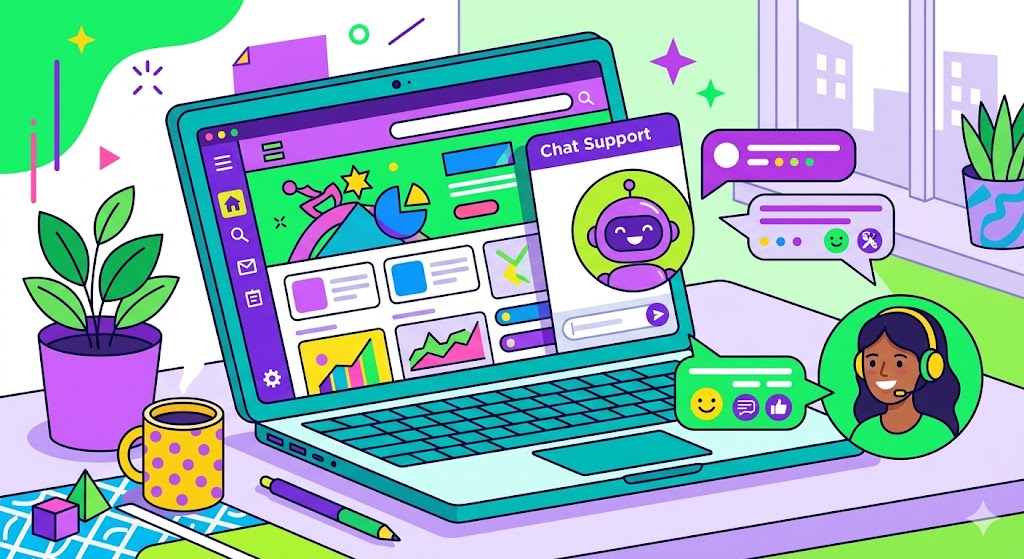 A chatbot handles common questions instantly, letting staff focus on complex issues
Modern chatbot platforms let you define conversation flows, set automatic replies for common topics, and hand the visitor over to a human for anything that needs judgment. The bot carries the repetitive volume; your team handles the cases that actually require a person.
The technology fits best where questions follow predictable patterns. Pricing checks, order status, business hours, service availability, return policy, shipping zones — these are the same across nearly every Philippine SME website, and they are exactly the questions that eat the most support time. For a retailer tying support into the rest of the stack, our overview of customizable AI tool integration for Philippine SMEs covers the back-office side.
Related: How AI Integration Helps Philippine Business Websites Drive Growth explains this in detail.
A Step-by-Step Guide to Adding a Chatbot to Your Website
| Phase | Timeline | Key Action |
|---|---|---|
| Planning | Week 1–2 | Identify top 20 customer questions |
| Setup | Week 3–4 | Configure chatbot with initial FAQ content |
| Testing & Launch | Week 5–6 | Test with real scenarios, then go live |
| Optimization | Ongoing | Refine based on actual conversation data |
Phase 1: Identify your most common inquiries. Before picking a tool, open the last 30 days of your customer messages across email, Messenger, Viber, and website forms. Write down the 15 to 20 questions that come up most often. That list is the backbone of your chatbot's knowledge base, and it is the single most important input for a good launch.
 Reviewing chatbot data regularly helps refine responses and improve customer satisfaction
Phase 2: Choose a platform that fits your budget. Tidio, Crisp, and Chatbase all offer website widgets with basic AI features and have free or low-cost entry tiers aimed at SMEs. If your site runs on WordPress or Shopify, their plugins cut setup time further. Paid AI-enhanced plans generally start at a few thousand pesos per month in early 2026 — check each provider's current pricing page before signing up, because this market shifts quickly.
Phase 3: Build your conversation flows. Write short, clear answers to each common question. Group them by topic: shipping, pricing, returns, services. Add one fallback response that offers to hand off to a human agent whenever the bot is not confident. That single fallback prevents most of the "bad chatbot" stories you read online.
Phase 4: Test before going live. Ask three team members and two trusted customers to try the bot. Pay close attention to the questions it gets wrong — those gaps tell you what content you still need to add. Ship only when the top 20 questions are answered correctly at least nine times out of ten.
Phase 5: Launch and keep improving. Review chatbot logs once a week after launch. New question patterns will appear, existing answers will need to be sharpened, and some responses will turn out to confuse customers. The ongoing refinement is what turns a mediocre bot into a useful one over the first three months.
One lesson from my project management experience commissioning larger web builds: aim for about 70% coverage at launch and improve from real usage data, instead of trying to anticipate every question before go-live. Teams that try to ship at 100% usually ship late and still miss the real questions — because the real questions only show up once real customers start typing.
Related: How AI Agents Help Philippine Customer Support Teams Achieve Full Automation explains this in detail.
What to Expect: Response Times, Satisfaction, and Cost Impact
| Metric | Before Chatbot | After Chatbot |
|---|---|---|
| Average response time | Hours (or next business day) | Seconds for common queries |
| After-hours inquiry handling | None or delayed | Fully automated |
| Staff time on repetitive questions | Several hours daily | Significantly reduced |
The first win customers notice is speed. Questions that used to sit in an inbox until morning get answered in under ten seconds. For an e-commerce store, a shopper at 11 p.m. asking about a product detail gets the answer immediately and completes the purchase, instead of adding to cart and forgetting by Monday.
Staff productivity moves next. When the bot takes the repetitive load, the person who used to spend three hours a day answering "what are your store hours" can redirect that time to handling complex customer cases, following up on quote requests, or improving the support content itself. The team gets more done with the same headcount.
Cost savings depend on your volume. A business currently paying one full-time support hire to handle mostly repetitive questions can often cut that allocation noticeably, or move the same person onto higher-value work. A chatbot subscription is typically a fraction of the fully loaded cost of a support hire in Metro Manila.
In many Philippine SME deployments, the return becomes visible in the first two to three months as the bot accumulates conversation data and takes over a larger share of total inquiries. The timeline depends on your inquiry volume and how actively you tune the answers — passive deployments coast; actively reviewed deployments compound.
FAQ
Q: Do I need a developer to install a chatbot on my website?
A: Most modern chatbot platforms give you a small JavaScript snippet to paste into your site's HTML footer, which any marketing staff member can handle. WordPress users often have a plugin option that skips the code step entirely. For custom-built websites, a developer can complete the integration in under an hour, usually inside your existing hosting support agreement.
Q: Will customers get frustrated talking to a bot instead of a real person?
A: The key is transparency and an easy escalation path. Make it clear the visitor is chatting with an automated assistant, and always offer a visible "talk to a person" button. When the bot handles simple questions well, most Philippine customers actually prefer the instant answer over waiting overnight for a human reply.
Q: Can a chatbot handle inquiries in Filipino or Taglish?
A: Many current AI chatbot platforms support multiple languages, and the stronger ones cope with mixed-language input reasonably well. If your customer base communicates mainly in Taglish, test the chatbot with real Taglish phrases during setup and add Filipino-language versions of your top FAQ answers explicitly. Do not assume translation alone will carry the right tone.
Q: What about data privacy? Is customer data safe?
A: Choose a platform that complies with the Philippine Data Privacy Act (Republic Act 10173). Review the provider's data-handling and data-residency policies before signing up. Make sure your chatbot shows a short privacy notice on first message, explaining how customer input is used, and avoid collecting unnecessary personal data in the chat itself.
Q: How much does an AI chatbot cost for a small business in the Philippines?
A: Entry-level plans from Tidio and Crisp start with free tiers that cover basic use. Paid plans with AI features and higher conversation limits cost more, and pricing on this market changes often — always check the provider's current page before committing. Most Philippine SMEs can start productively at the free or lowest-cost tier and upgrade only once volume demands it.
Q: Can I connect the chatbot to my existing Messenger or Viber?
A: Yes. Many chatbot platforms integrate with Facebook Messenger, which is widely used in the Philippines. Viber integration is less common but available through some providers. This lets your team manage website chat and messaging-app inquiries from a single inbox, which matters once you run more than one channel.
Start With Your Top 10 Questions
The most practical way to begin is not technical at all. Open your recent customer messages, list the ten questions you see most often, and write clear answers for each. That list becomes the starting content for your chatbot, and a basic version can go live on your site within a week or two.
AI chatbot technology does not require a large budget or deep engineering expertise. What it does require is a willingness to read real customer data, set up thoughtful answers, and commit to ongoing refinement over the first few months. Philippine businesses that approach chatbots that way see real improvements in how support feels to customers — without overhauling the rest of their operations.
Sources & References
- Republic Act No. 10173 - Data Privacy Act of 2012, National Privacy Commission, Philippines: NPC Official Site
- Tidio Chatbot Platform — Pricing and Features: tidio.com
- Crisp Chatbot Platform — Pricing: crisp.chat
- Chatbase AI Chatbot Platform: chatbase.co
About the author
Founder / AI Engineer (36+ years in IT)
- ●From Tokyo · based in Manila for 13+ years
- ●36+ years in IT (development, SEO, AI)
- ●IBM Certified Generative AI Engineer
- ●AI chatbots, RAG & AI agent development
A Japanese AI engineer with 36+ years in IT and 13+ years on the ground in the Philippines. I write from hands-on experience to help Japanese companies adopt AI that actually delivers results — chatbots, workflow automation, AI agents, and AI-driven marketing. Feel free to reach out in Japanese or English.
Your Competitors Are Already Using AI!
Is your business keeping up?
Related Articles

How LangChain and Pinecone Help Philippine Businesses Find Internal Data Faster
A practical guide for Philippine SMEs on building accurate AI search for internal company data with LangChain and Pinecone, covering the technology, implementation steps, peso costs, and ROI.
6/19/2026

How LoRA Fine-Tuning Helps Philippine Businesses Build Affordable Custom AI
A practical guide for Philippine SMEs and Japanese-affiliated companies on using LoRA and QLoRA fine-tuning to build private, company-specific AI on a small budget while keeping data local and secure.
6/17/2026

How Cloud AI Infrastructure Helps Philippine SMEs Build Reliable Systems
A practical guide for Philippine SMEs on building robust cloud AI infrastructure by combining AWS or Google Cloud with AI APIs for reliability, scalability, and cost control.
6/14/2026
How LoRA and QLoRA Help Philippine SMEs Build Affordable Custom AI
A plain-language guide for Philippine SMEs comparing LoRA and QLoRA — two AI fine-tuning methods that make custom AI models affordable on modest hardware and tight budgets.
6/11/2026

How PEFT (Efficient AI Fine-Tuning) Helps Philippine SMEs Cut AI Costs
A plain-language guide to PEFT, the energy-efficient way to customize AI, and how Philippine SMEs can adopt this technology affordably.
6/8/2026

How LangChain and Pinecone Help Philippine SMEs Build Their Own AI Assistant
LangChain and Pinecone let Philippine SMEs build a company-specific AI assistant that answers from their own data. A plain-language guide to the orchestrator and memory store behind custom business AI.
6/8/2026