Second-Life EV Batteries for Data-Centre Power
How energy storage built from used EV batteries addresses data-centre power shortages in the Philippines.

AI Engineer · 36+ years in IT · Japanese, based in Manila for 13+ years
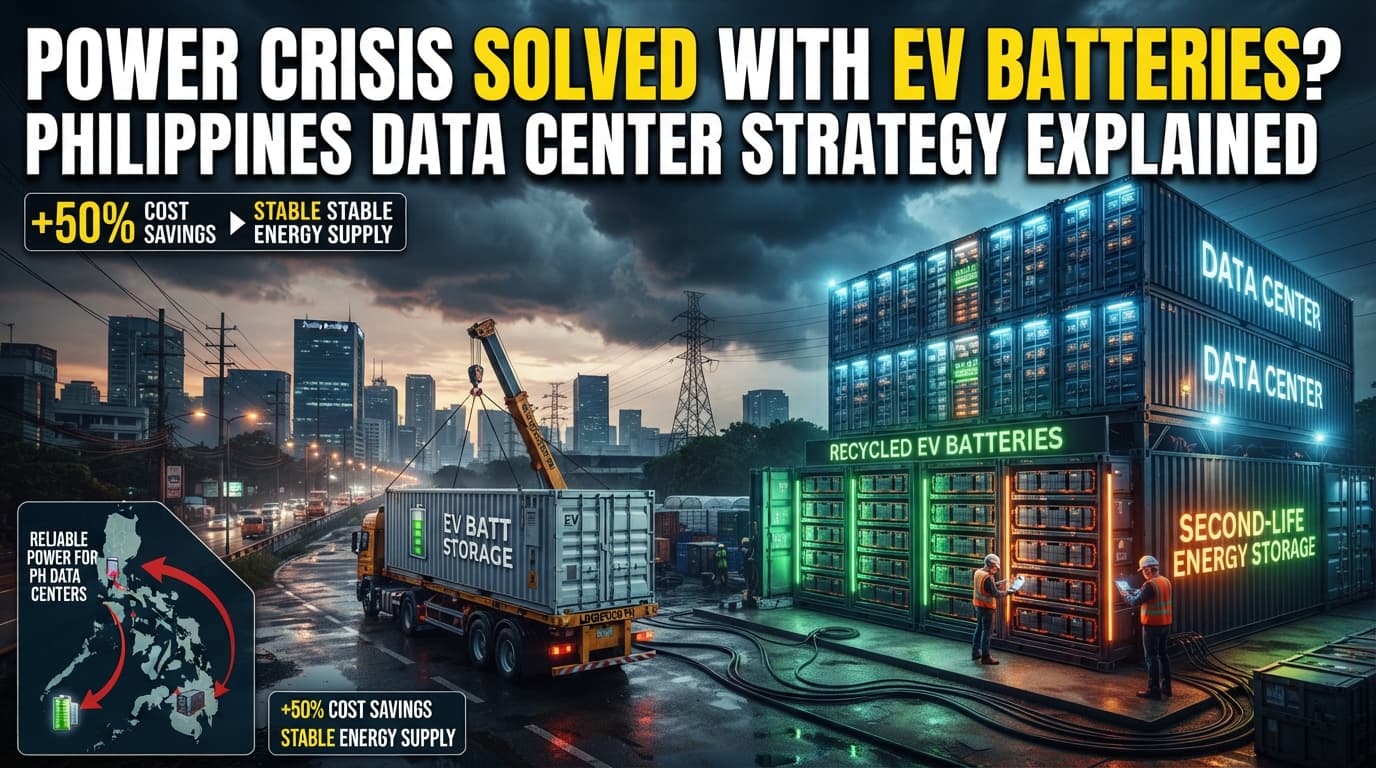
We unpack U.S. firm Redwood Materials' reuse of second-life EV batteries and lay out the energy-storage and renewable-energy options available to Japanese companies struggling with power shortages and outages in the Philippines.
Part 1: Why This Matters
Step 1: The Philippine Business Context (3 min)
The Philippines has seen a data-center construction boom in recent years. In Metro Manila, Cebu, and the Clark special economic zone, Singaporean and Japanese operators are planning large facilities, and as AI demand rises, power consumption is surging too. At the same time, Philippine electricity rates are among the highest in Southeast Asia, and on Luzon, planned outages (called "brownouts" in the Philippines) occur routinely.
Against this backdrop, the "large-scale energy-storage system using second-life EV (electric vehicle) batteries" that U.S. firm Redwood Materials is working on is not someone else's problem for Japanese companies doing business in the Philippines either. Situations where you wait years for grid connection from the power company, and rising electricity unit prices, are both headaches in running a Japanese company's Philippine hub.
At an office in Manila You are the general-affairs head of a Japanese-affiliated BPO (business process outsourcing) hub. Head office has inquired: "We want to add a new AI-processing server room in Manila. Can you secure power?" When you check with the local Meralco (Manila Electric Company), the answer is that an additional power contract will take more than 18 months. At the next morning's meeting, a local Japanese staff member raises the topic: "Apparently in the U.S., a scheme using second-life EV batteries to supply power to data centers is getting off the ground." You need to organize this information and share it with head office and the local team.
The significance for Japanese companies is threefold. First, the range of power-procurement options may broaden. Second, it works in your favor from a sustainability-reporting standpoint. Third, the Philippines is expected to discard large volumes of EV batteries in the 2030s, which could become the seed of a local reuse business.
Step 2: Key Points from the Original Article (5 min)
Based on the facts stated in the original article, we have organized the main points.
| Item | Content |
|---|---|
| Company name | Redwood Materials (a startup valued at $6 billion) |
| Founder | JB Straubel (former Tesla CTO and one of its co-founders) |
| Core business | Providing large-scale energy-storage systems that reuse second-life EV batteries |
| U.S. storage market | In 2025, a record 18.9 gigawatt-hours of storage capacity was added, equivalent to power for about 15 to 20 million households |
| California's track record | A record exists of 43% of the state's entire electricity being supplied by batteries |
| U.S. outlook | The U.S. Energy Information Administration expects storage capacity to grow by more than 50% by early 2027 |
| Cumulative funds raised | Has raised $2.25 billion to date from the likes of Goldman Sachs and Nvidia NVentures |
| U.S. market share | Holds about 90% of the U.S. lithium-ion battery recycling market |
| Business partners | Automakers such as Tesla, Rivian, Ford, and General Motors |
| 2024 revenue | About $200 million |
| First project | In 2025, jointly with Crusoe, realized a data center at its Nevada headquarters running on solar power and second-life EV batteries |
| Cost-reduction effect | Cut the cost of battery storage by about half |
| Inventory volume | About 3 gigawatt-hours of battery inventory ready for immediate deployment |
| 2030 target | Estimated capable of supplying more than half of the storage market with used batteries |
This table was created for learning purposes based on facts from publicly available information. For details, please check the original article at the link above.
Step 3: Comprehension Check (5 min)
Use the following five questions to confirm your understanding of the original article.
Q1. At which company did Redwood Materials' founder JB Straubel serve as a senior executive before launching Redwood?
Hint: A U.S. electric-vehicle maker, where he worked as chief technology officer (CTO).
Q2. About what percentage of the U.S. lithium-ion battery recycling market does Redwood Materials hold?
Hint: A level you could describe as "close to a monopoly."
Q3. The data center that Crusoe and Redwood realized in 2025 is powered by what and what?
Hint: One is energy from the sun; the other is something removed from cars.
Q4. How does the cost change when second-life EV batteries are used for storage, compared with using new storage batteries?
Hint: The original article gives the figure "about half."
Q5. How long does the original article say it takes for a U.S. data-center operator to sign a new grid-connection contract with a power company?
Hint: It's a matter of years, and approval is said to be not even guaranteed.
Related: Rooftop Solar and Rising Electricity Costs explains this in detail.
Part 2: Putting It Into Practice
Step 4: Adoption Steps in the Philippines (10 min)
We organize the flow for considering "storage using used batteries" or "self-generation combining renewable energy and storage" in the Philippines.
| Step | Content | Points specific to the Philippines |
|---|---|---|
| 1. Make power demand and the current state visible | Record your hub's monthly electricity usage, peak hours, and outage frequency for at least a month. Gather and analyze bills from Meralco or a regional electric cooperative (EC). | In the Philippines, the unit of electricity rates is peso/kWh, and for commercial contracts it can run around PHP 10 per kWh. Also convert outage losses into monetary terms. |
| 2. Confirm regulations and permits | Confirm the installation requirements for captive solar and storage batteries with the Energy Regulatory Commission (ERC: the government agency that oversees electricity rates and wholesale) and the Department of Environment and Natural Resources (DENR). | Generation facilities of 1 MW or more require filing with the ERC. The Net Metering (a scheme to sell surplus self-generated power) cap was once 100 kW, but there is movement toward expansion through regulatory revision. Checking the latest information is essential. |
| 3. Procure equipment and select local partners | Choose suppliers of storage-battery modules and solar panels, installation contractors, and maintenance providers. Consider going through a Japanese trading company or collaborating with a local renewables firm. | In the Philippines there is a culture where verbal agreements come first and the contract is put off. Be sure to put cost, maintenance responsibility, and outage compensation in writing. Also confirm registration status with the BIR (Bureau of Internal Revenue) and the SEC (Securities and Exchange Commission) registration number in advance. |
| 4. Pilot operation and internal briefing | Introduce small-scale storage on a few floors or in a server room, and verify automatic switchover during outages and usage for about three months. | It is important to carefully explain to local staff "why we're introducing this system." If only Japanese expatriates decide, Filipino staff tend to feel distrust. Hold a briefing in Filipino or English. |
| 5. Company-wide rollout and continuous improvement | Once you've confirmed the effect, expand to other hubs in stages. Review performance data monthly and discuss improvements with the maintenance provider. | Outages increase during typhoon season (June to November), so it gives peace of mind to specify a "response within 24 hours" in the maintenance contract. Don't forget measures against humidity and salt damage (especially watch out in coastal areas). |
Step 5: Common Mistakes and How to Avoid Them (5 min)
Self-procuring power in the Philippines fails in three recognisable ways, and sustainability targets fail in the same ones.
Mistake 1: "Bringing in Japanese head-office standards as-is"
Bad example: You hand the spec sheet for storage batteries used in Japan straight to a Manila installation contractor, take only a quote, and decide. Because it doesn't account for the effects of humidity, salt damage, and voltage fluctuation, the equipment degrades within a year of installation.
Good example: You redraft specs suited to Philippine climate conditions (hot and humid, typhoons, salt damage) together with a local contractor. Treat Japanese-spec equipment as a "reference," and decide the final specs to match the local environment.
Mistake 2: "Putting the contract off until later"
Bad example: Having met a trustworthy local partner, you agree verbally to "let's do this together" and push ahead with ordering equipment first. Later, discrepancies in understanding about maintenance costs and outage compensation surface, leading to trouble.
Good example: In the Philippines there is a culture where verbal agreements come first, but always prepare an English-language contract. Spell out payment terms for costs, the scope of maintenance, the division of responsibility during outages, and the SLA (service-level agreement). Have it reviewed not by a Japanese lawyer but by a local lawyer well-versed in Philippine law.
Mistake 3: "Not checking the latest regulatory information"
Bad example: Based on a report you read a few years ago, you judge that "the Net Metering cap is 100 kW, so it's impossible" and abandon your study of self-generation. In fact, there are cases where the regulation had been revised and larger capacity was possible.
Good example: You regularly check the official sites of the ERC and the DOE (Department of Energy) and get the latest information from a consultant well-versed in local energy law. Because Philippine regulations can change significantly over a span of a few years, always confirm primary sources before deciding.
Related: ADB's $70 Billion Plan for Philippine Infrastructure explains this in detail.
Part 3: Going Deeper
Step 6: Related Technical Terms (5 min)
We take up five important technical terms that appear in the original article.
Second-life EV battery Reusing a battery that has reached the end of its life in an electric vehicle for another purpose (such as storage) by making use of its still-usable capacity. In the Philippines, EV buses and electric tricycles for ride-hailing apps are increasing, and large volumes of used batteries are expected to arise in five to ten years. This could become the foundation for Japanese-affiliated automotive firms to launch a reuse business within the Philippines.
Microgrid (small-scale power network) A small electricity network that generates, stores, and uses electricity within a specific building or area. It can also run without relying on the grid of a large power company like Meralco. In the Philippines there are remote islands and mountainous areas the transmission grid doesn't reach, and microgrids are beginning to be introduced at industrial parks and tourist resorts in Mindanao.
Grid-scale battery storage (large-scale storage for power companies) A storage-battery system large enough to supply electricity to an entire town or factory, of the kind power companies use. In the Philippines, the National Grid Corporation of the Philippines (NGCP) is considering the use of storage batteries for frequency regulation, which could become a new revenue source for renewables operators.
Modular data center (container-type data center) A data center that, like a storage case, packs servers and cooling equipment into a container that can be hauled by truck to where it's needed and installed. Because securing land and obtaining construction permits take time in the Philippines, it is drawing attention as a means for Japanese-affiliated IT firms to stand up quickly in places like the Clark Freeport Zone.
Critical materials Metals indispensable for making batteries and electronics, such as lithium and cobalt. Global supply is concentrated in certain countries, posing risks of sudden price changes and export restrictions. The Philippines is a globally significant producer of nickel (one of the battery materials), and moves by Japanese companies to partner with the Philippine government and local firms to secure stable supply could accelerate going forward.
Related: Keeping AI Running Through Brownouts and Typhoons explains this in detail.
Step 7: Applying It to Your Own Company (10 min)
Discuss the following three themes in-house.
Taking stock of power risk at your Philippine hub
Something to think about: Identify the number and duration of outages over the past year and the losses from work stoppages during those times. Add the annual spend on electricity rates and the upkeep cost of backup power (diesel generators, etc.), and start by "making visible" the current costs.
Next action: Ask the general-affairs and facilities-management departments to compile the past 12 months of electricity bills and outage records into Excel.
Room to consider self-generation combining renewable energy and storage
Something to think about: Sort out whether your roof area or site has spare capacity, and over what period you want to recoup the initial investment. In the Philippines, solar radiation is high year-round, and solar generation efficiency is better than in Japan. Try estimating the break-even point when combined with storage.
Next action: Obtain simple quotes for your facility from two local renewables operators.
Linking with the Japanese head office's sustainability reporting
Something to think about: Consider how your Philippine hub can contribute to the CO2-reduction targets and renewable-energy ratios the parent company has announced. Talking early with head office's corporate-planning department or sustainability office can become a tailwind for the investment decision.
Next action: Contact head office's sustainability officer and confirm how renewable-energy adoption at the Philippine hub would be reflected in the report.
Part 4: FAQ
Q1. Can storage using second-life EV batteries be introduced right away in the Philippines?
At present, services deployed at scale locally are limited. However, the Philippine government is pushing EV adoption, and the supply of used batteries is expected to increase over the next five years. For now, the realistic approach is to consider new storage batteries as the mainstay while continuously tracking trends in used-battery utilization. If you have an affiliated company at the Japanese head office doing similar work, having them share their know-how is a shortcut.
Q2. If we introduce self-generation, what happens to our contract with Meralco?
Completely cutting off (going off-grid) is a high hurdle; in most cases you maintain the existing power contract while combining renewables and storage as a supplementary power source. Using the Net Metering scheme, you can also sell surplus power, but the procedure must go through Meralco and the ERC. Plan for it to take six months to a year.
Q3. What is a rough guide for the initial investment?
It varies greatly by scale, but for a solar-and-storage set for a medium-sized office, a guide is on the order of several million to several tens of millions of pesos in Philippine-peso terms. Converted to yen, it can reach the scale of several tens of millions of yen. The payback period is generally about 7 to 10 years given upward pressure on electricity rates, but factoring in the benefit of avoiding outage losses, it feels shorter in practice.
Q4. Are there differences between Japan and the Philippines in how to proceed with renewable-energy adoption?
The big differences are "regulatory fluidity" and "power quality." In Japan the system is stable and predictable, whereas in the Philippines the system changes over a span of a few years. Power quality (voltage fluctuation and momentary interruptions) is also more unstable in the Philippines, so you need to design equipment with heavier protective circuitry. The iron rule is not to bring the Japanese approach in as-is, but to design together with local engineers.
Q5. How should we explain this to local Filipino staff?
In the Philippines, conveying "the impact on family and daily life" tends to win empathy. Talking in contexts such as "stabilizing power lets us cut overtime and give people more time with family" and "caring for the environment leads to protecting our children's future" raises the sense of conviction. Hold a briefing in English or a local language (Tagalog, Cebuano, etc.) and always make time for questions.
Tips for Making the Most of It (3 Tips)
1. Line up power costs and outage losses in the same table, "denominated in pesos"
When explaining to the Japanese head office, looking at electricity rates alone tends to lead to the conclusion that "the Philippines is more expensive." But when you also factor in the cost of work stoppages from outages, the basis for judgment changes. Lining up the bill-based electricity unit price and the loss per hour of outage, denominated in pesos, makes the investment decision on renewables and storage realistic.
2. In choosing a local partner, use "can they produce an English version of the contract?" as a criterion
In Philippine business customs where verbal agreements come first, contractors who can present a solid English-language contract tend to be more reliable. At the quoting stage, try asking, "Could you show me a draft contract?" It's safest to avoid contractors who have no template or whose template is vague.
3. Update regulatory information on the ERC and DOE official sites "once a quarter"
Philippine renewable-energy regulations change fast, and information from six months ago can already be outdated. Designate a person in charge and build the habit of checking the official sites of the ERC (Energy Regulatory Commission) and the DOE (Department of Energy) once every three months. Keeping your decision-making material up to date prevents lost opportunities.
Bonus: How to Make Use of PH AI Works
PH AI Works supports business improvement using AI and technology for Japanese companies expanding into the Philippines and Japanese business professionals in the Philippines.As a next step, you can consult us for free on matters such as the following.
- Analyzing your Philippine hub's power-usage data with AI to find opportunities for power saving and operational improvement
- Consulting on data-center and server-room operations grounded in local circumstances
- Supporting the grasp of local figures and report creation for sustainability reporting
Please feel free to get in touch. We'll propose a manageable first step tailored to the realities of Philippine business.
Citations and References
References and Sources
- Fast Company — "Data centers are breaking the electric grid. Meet the $6 billion startup and its visionary CEO solving the problem" (2026-05-04)
- Redwood Materials
- Crusoe (Crusoe Energy / Crusoe AI)
- U.S. Energy Information Administration (EIA)
- Department of Energy (DOE), Philippines
- Energy Regulatory Commission (ERC), Philippines
About the author
Founder / AI Engineer (36+ years in IT)
- ●From Tokyo · based in Manila for 13+ years
- ●36+ years in IT (development, SEO, AI)
- ●IBM Certified Generative AI Engineer
- ●AI chatbots, RAG & AI agent development
A Japanese AI engineer with 36+ years in IT and 13+ years on the ground in the Philippines. I write from hands-on experience to help Japanese companies adopt AI that actually delivers results — chatbots, workflow automation, AI agents, and AI-driven marketing. Feel free to reach out in Japanese or English.
Free AI Consultation
Tell us your challenges and we'll propose the right AI adoption plan for your business.
Book a Free 30-Minute ConsultationRelated Articles
AI Model Vendors Now Sell Implementation Too
OpenAI and Anthropic now sell implementation as well as models. What a local subsidiary should decide about that.
8/18/2026
Contracting for AI While Prices Keep Falling
Write a model number into the contract and it is obsolete in six months. How to design for switching instead.
8/17/2026
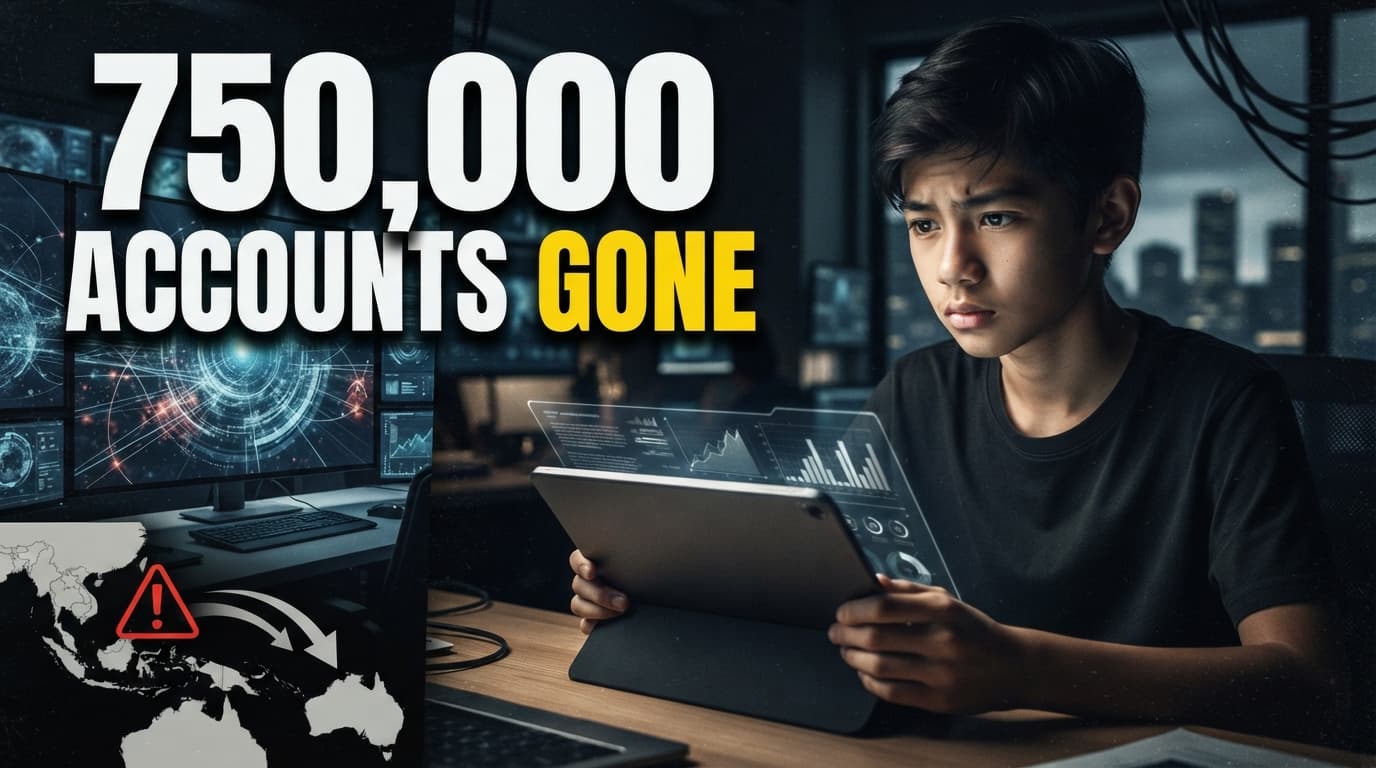
Meta Cut 750,000 Under-16 Accounts in Australia
AI-assessed age checks removed 750,000 accounts overnight. What that says about depending on platforms for reach.
8/16/2026
When an AI Calls Your Shop to Ask About Stock
AI now phones shops on a buyer's behalf to check stock. What to decide on the receiving side before it reaches you.
8/15/2026

Handling News That Is Not Settled Yet
A reported $6 billion acquisition talk is not a completed deal. How to act on industry news before it is confirmed.
8/14/2026
What a 69-Page AI Report Does Not Show
Frontier firms are reported 8.3x ahead, yet a table on page 35 shows no statistically significant link to revenue.
8/13/2026