
The 'Thinking You're Using It' Trap in AI Adoption
Google's internal debate over its own AI adoption gap, and the trap of believing a tool is in use when it is not.


AI Engineer · 36+ years in IT · Japanese, based in Manila for 13+ years
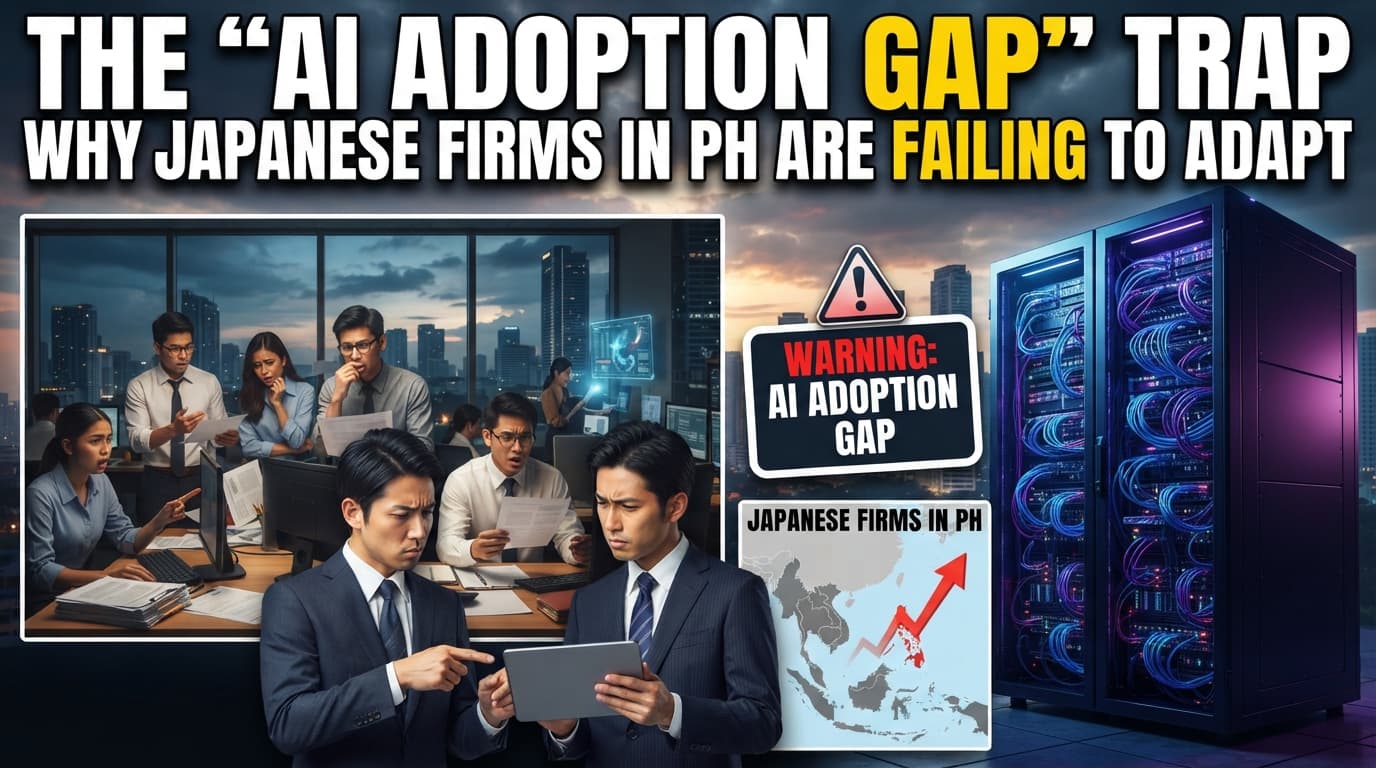
A single post by a former Google engineer escalated into a major debate that pulled in CEO Hassabis and others. The point of contention is the difference between "how widely people are using it" and "how deeply the work has changed." The question is which axis to report on, so the numbers hold up in Tokyo.
In April 2026, former Google engineer Steve Yegge posted an opinion on X (formerly Twitter). This escalated into a major debate that pulled in Google's AI leaders. The point of contention is the difference between "using AI" and "the work being changed by AI." This debate is not someone else's problem for executives of Japanese firms with a presence in the Philippines. In this material, we take up this case and explain how to apply it to your own AI adoption strategy.
Part 1: Read → Consider the Implications for Your Company
Step 1: Pre-Reading (3 min)
Before getting into the main topic, reflect on your own company's situation.
- At your company's Philippine site, what percentage of local staff use AI tools (ChatGPT, Gemini, Claude, etc.) for work at least once a week? A rough sense is fine.
- After reporting to the head office that you "adopted AI," are there departments where the way of working itself changed? Or have tools simply been added?
- If the head office asked, "What are the results of AI adoption?", what would you base your answer on? The number of users? Time saved? Or some other metric?
Step 2: First Reading (10 min)
The following is a fictional management-planning report, written with a Japanese firm in the Philippines as the subject, based on the facts of a news article.
Internal report: Reading our Manila site's AI adoption evaluation through Google's internal debate
On April 13, 2026, former Google engineer Steve Yegge made a post on X. It conveyed the view of a friend (a current Google employee) that AI use inside Google splits into "20%-60%-20%." The breakdown is 20% AI refusers, a 60% chat-centric middle layer, and a 20% advanced layer that masters agentic tools. As of April 14, this post had been viewed 1.9 million times and gathered more than 4,500 "likes."
In response, Demis Hassabis, CEO of Google DeepMind, strongly pushed back, calling it "completely wrong and clickbait." Addy Osmani, AI director at Google Cloud, also responded with concrete numbers. His rebuttal was that "more than 40,000 software engineers use agentic coding weekly." He further added that employees can also use Anthropic's Claude models on Vertex.
Yegge, however, did not back down. He countered that what matters as meaningful metrics is "token usage" and "whether traditional development habits are being replaced by true agentic workflows."
Bringing this to our Manila site, the breadth metric of "how many people are using it" and the depth metric of "whether the way of working has changed" are different things. If we present only the former in head office reporting, we risk receiving the same criticism as Google.
Note: The business scenario above is a fictional internal report created for learning purposes based on publicly available facts. For details, please check the original article at the link above.
Related: After RAG: The Agentic AI Knowledge Layer explains this in detail.
Step 3: Comprehension Check (5 min)
Confirm your understanding with the following five questions.
- What do the "20%-60%-20%" that Yegge's friend claimed each refer to?
- How did Hassabis assess Yegge's post?
- What concrete number did Osmani cite as the basis for his rebuttal?
- What two things did Yegge cite as "meaningful metrics"?
- What is the essential point of contention in this debate?
Sample answers
- 20% AI refusers, a 60% chat-centric middle layer, and a 20% advanced layer that masters agentic tools.
- He strongly denied it as "completely wrong and clickbait."
- The point that more than 40,000 software engineers use agentic coding weekly.
- Token usage, and whether traditional development habits have been replaced by agentic workflows — these two.
- It's a conflict of evaluation criteria: whether to measure "the breadth of using AI" or "the depth to which the way of working has changed."
Related: Gemini Spark: Autonomous AI Agents for Philippine Work explains this in detail.
Step 4: A 3-Minute Briefing (10 min)
This is a template for explaining to a head office executive in three minutes. Fill in the blanks with your company's actual situation.
Thank you for your time. I'd like to share the debate over AI adoption unfolding at Google.
Former Google employee Yegge pointed out that AI use inside Google splits into three layers. The breakdown is "20% AI refusers, a 60% chat-centric middle layer, and a 20% advanced layer." In response, Google DeepMind CEO Hassabis pushed back, calling it "completely wrong." Google Cloud's Osmani also responded with numbers: "more than 40,000 engineers use agentic AI weekly."
Yegge, however, countered that "what matters is not the number of users but whether the way of working has truly changed."
Applying this to our Manila site, the number of employees currently using AI at least once a week is _______, which is _______% of the total. However, the areas where the business processes themselves have changed are limited to _______.
Therefore, going forward, we will add not just the number of users but _______ as a results metric. We would like to report it quarterly in the form of _______.
Related: What a 69-Page AI Report Does Not Show explains this in detail.
Part 2: Key Term Explanations (for Executives)
1. Agentic AI
Meaning: AI that, rather than waiting for human instructions each time, executes multiple steps on its own once given a goal. This is the form that Hassabis's subordinate, Paige Bailey, described in the article as "agents running 24/7/365."
Example use in a management meeting: "Our AI use is still stuck at the chat type. Next term I think we should consider a shift to the agentic type."
Why it matters: The chat type is a "convenient subordinate" that answers each time a human asks. The agentic type, by contrast, is a "subordinate you can delegate to." The order of magnitude of productivity changes.
2. AI Transformation
Meaning: Not merely adopting AI, but rebuilding the business processes themselves on the premise of AI. What Yegge argued was that Google may have "adopted" AI but not reached "transformation."
Example use in a management meeting: "Reports on AI adoption come up every month, but from the perspective of transformation, how is progress?"
Why it matters: If you're satisfied with tool adoption, you won't be able to answer when the head office asks, "So what changed?"
3. Token Usage
Meaning: A metric showing the amount of text (the number of word fragments) an AI has processed. Yegge cited this as a gauge of "whether you're really using AI heavily."
Example use in a management meeting: "The number of users increased, but if per-person token usage isn't growing, we should see it as still at the experimental stage."
Why it matters: The number of registrants is easy to increase. But token usage doesn't grow unless people use AI in earnest. It's a metric that sees through adoption that's adoption in name only.
4. Vendor Lock-in
Meaning: A state of becoming too dependent on a particular AI provider and unable to switch to others. The article claimed that some Google employees regarded Anthropic's Claude Code as "the enemy" and couldn't use it.
Example use in a management meeting: "I'd like to set a policy on whether we go all-in on Gemini, or also include Claude and ChatGPT as options."
Why it matters: Sole dependence on one company costs you price-negotiation power and creates the risk of falling behind on new technology.
5. Power-User Behavior
Meaning: The behavioral pattern of the top 20% who don't merely "use" AI but use it to the hilt and rebuild their work. The article made it a point of contention whether this layer pulls the whole along.
Example use in a management meeting: "Let's first develop three power users in-house, and from there roll out best practices laterally."
Why it matters: Lifting all employees at once isn't realistic. It's more realistic to identify the advanced layer and spread their methods.
Fill-in-the-blank Review Exercise
Consider which of the five terms above goes in each blank in the following sentences.
- "The number of AI users is growing steadily, but in terms of ( ① ) there's a large individual variance."
- "Standardizing on Gemini is efficient, but we should also consider the risk of ( ② )."
- "Breaking away from the chat type — that is, the shift to ( ③ ) — is the next challenge."
- "To advance to the stage of ( ④ ) rather than adoption, we need to review business processes."
- "Let's first identify the in-house ( ⑤ ) and standardize their behavior."
Answers: ① Token Usage ② Vendor Lock-in ③ Agentic AI ④ AI Transformation ⑤ Power Users
Part 3: Thinking About How to Apply This to Your Own Company
Take inventory of your own "20%-60%-20%"
Apply Yegge's framework to your company and make the current state visible.
| Layer | Definition | Headcount at your company | Share of total | Representative usage |
|---|---|---|---|---|
| Advanced layer | Uses agentic type daily | e.g., 3 | 5% | e.g., automating minutes → summary → task creation |
| Middle layer | Translation and writing with ChatGPT, etc. | e.g., 25 | 42% | e.g., writing English emails, summarizing documents |
| Refuser layer | Doesn't use or refuses AI | e.g., 15 | 25% | e.g., not using out of "fear of information leaks" |
| Unclassified | Status unknown | e.g., 17 | 28% | — |
If the advanced layer is below 5%, it's risky to state in your head office report that "AI adoption is being promoted." Reporting by the composition of each layer, rather than the number of users, is more honest.
Designing depth metrics
To avoid chasing only the number of users, set three depth metrics.
| Metric | Measurement method | Target value (example) |
|---|---|---|
| Monthly token usage per person | Obtain from each AI tool's admin dashboard | +20% month-over-month |
| Number of business processes changed because of AI | Quarterly interviews with the field | 3 per quarter |
| Number of power users | Employees using AI 10+ hours a week | 10% of the total |
Estimating return on investment
Here is an example estimate for a Manila site of about 50 people.
- AI tool cost: $30 per person per month × 50 people = $1,500/month ($18,000/year)
- Assumed time saved: 2 hours per person per week × 50 people × 50 weeks = 5,000 hours/year
- Hourly conversion: at a hypothetical average of $8/hour, equivalent to $40,000
- Net effect: $22,000/year in productivity gains
However, this is an estimate of "if it gets used." If the 25% refuser layer doesn't budge, the effect shrinks to 75%.
Part 4: Common Failure Patterns (NG Collection)
Failure 1: Reporting to the head office on "number of users" only
Bad: Reporting only the number — "At the Manila site, AI users reached 80%."
Good: Reporting depth and challenges as a set — "Users are at 80%, but the business processes changed in two departments, accounting and HR. We'll make the remaining departments a priority area next term."
Explanation: When Google's Osmani countered with "40,000 use it weekly," Yegge replied, "That's breadth, not depth." The head office looks at it the same way. A report on breadth alone collapses at the next question.
Failure 2: Narrowing your options out of deference to a head office-designated tool
Bad: Because the head office decided to "standardize on Microsoft Copilot," not considering at all Claude or Gemini that are easier to use locally.
Good: Respecting head office policy while proposing, with data attached, that "there are areas in local operations where other tools are more effective."
Explanation: The article raised the claim that Google employees treated Claude Code as "the enemy" and couldn't use it. Against this, Osmani countered that "you can also use Anthropic's models on Vertex." Sole dependence on one company lowers productivity. At Japanese firms too, narrowing your options out of deference to the head office leads to the same result.
Failure 3: Proceeding with the attitude of "making" Filipino staff use it
Bad: A Japanese expatriate unilaterally instructs, "Use this AI tool," and doesn't listen to local staff's voices.
Good: Discovering an advanced layer (power users) from among local staff and using those people as in-house instructors.
Explanation: Filipino staff are often at an advantage over Japanese expatriates in using AI in English. Rather than top-down command, finding the driving force from among local staff makes it take root.
Failure 4: Lacking consideration for the Data Privacy Act (Republic Act No. 10173)
Bad: Pasting customer information and employees' personal data straight into ChatGPT and having it summarize them.
Good: Setting a rule to anonymize before input for data containing personal information, and enforcing it through training. Choosing an enterprise version where, under the contract, data is not used for training.
Explanation: The Philippines has the Data Privacy Act of 2012 (Republic Act No. 10173), which regulates the handling of personal information. The more you speed up AI use, the more the risk of information management rises. You need to check the National Privacy Commission (NPC) guidelines and then translate them into internal rules.
Tips for Making the Most of This (4 Tips)
-
This week, identify three power users within your company. Rather than trying to lift everyone at once, it's faster to expand outward from the advanced layer.
-
Prepare a proposal to switch your head office reporting metric from "number of users" to "token usage" or "number of changed business processes." As Google's debate shows, a report on number of users alone collapses at the next question.
-
Interview local staff directly about "what they're struggling with in AI." What Japanese expatriates imagine and the local reality are often misaligned. Just slotting in five 15-minute interviews changes the view you see.
-
Build in Data Privacy Act compliance from the start as "part of the package" rather than "a brake on AI adoption." If you address it later, the cost of redoing it exceeds the adoption cost.
Bonus: How to Make Use of PH AI Works
Preparing for the consultation
Fill in the Topic A inventory table from Part 3 (the 20%-60%-20% inventory table) and bring it. Even without current numbers, rough estimates are fine. In addition, jotting down in bullet points the AI-related requests and reporting obligations you receive from the head office deepens the discussion.
What you'll learn during the consultation
We diagnose, from a third-party perspective, whether your AI adoption is stuck at "breadth" or has reached "depth." We also discuss concretely, drawing on examples from other companies, how to close the gap between head office policy and local reality, and how to maintain consistency with the Data Privacy Act.
Output after the consultation
You'll take home three priority issues to tackle next quarter, and a draft of depth metrics for head office reporting. We'll organize and hand it over in a form you can use in management meetings from that day.
Citations and References
References and Sources
About the author
Founder / AI Engineer (36+ years in IT)
- ●From Tokyo · based in Manila for 13+ years
- ●36+ years in IT (development, SEO, AI)
- ●IBM Certified Generative AI Engineer
- ●AI chatbots, RAG & AI agent development
A Japanese AI engineer with 36+ years in IT and 13+ years on the ground in the Philippines. I write from hands-on experience to help Japanese companies adopt AI that actually delivers results — chatbots, workflow automation, AI agents, and AI-driven marketing. Feel free to reach out in Japanese or English.
Free AI Consultation
Tell us your challenges and we'll propose the right AI adoption plan for your business.
Book a Free 30-Minute ConsultationRelated Articles
AI Model Vendors Now Sell Implementation Too
OpenAI and Anthropic now sell implementation as well as models. What a local subsidiary should decide about that.
8/18/2026
Contracting for AI While Prices Keep Falling
Write a model number into the contract and it is obsolete in six months. How to design for switching instead.
8/17/2026

Meta Cut 750,000 Under-16 Accounts in Australia
AI-assessed age checks removed 750,000 accounts overnight. What that says about depending on platforms for reach.
8/16/2026

When an AI Calls Your Shop to Ask About Stock
AI now phones shops on a buyer's behalf to check stock. What to decide on the receiving side before it reaches you.
8/15/2026

Handling News That Is Not Settled Yet
A reported $6 billion acquisition talk is not a completed deal. How to act on industry news before it is confirmed.
8/14/2026

What a 69-Page AI Report Does Not Show
Frontier firms are reported 8.3x ahead, yet a table on page 35 shows no statistically significant link to revenue.
8/13/2026