
How AI Agents Help Philippine Businesses Automate Internal Operations
AI agents for Philippine businesses - benefits, risks, and practical steps to automate internal operations with in-house AI solutions


AI Engineer · 36+ years in IT · Japanese, based in Manila for 13+ years

The HR team in a 120-person Philippine company answers the same question 40 times a week: "How many vacation leaves do I have left?" Over in accounting, staff re-key receipts into an Excel tracker line by line. IT fields password resets that a self-service system could solve. None of this is hard work — it is just a wall of small, repetitive tasks that eats entire afternoons. Internal AI agents close that gap without replacing the team.
In this article I explain where manual internal workflows break down, how internal AI agents actually help, and a four-step plan to get your first agent into production. I draw on a direct lesson from advising an overseas YouTuber client. The AI model is rarely the hard part — understanding the workflow and training the staff is.
Summary
- Internal AI agents can handle repetitive tasks like document processing, employee inquiries, and data entry, freeing up staff for higher-value work
- Philippine SMEs need to consider data privacy (including the Data Privacy Act of 2012), employee training, and realistic expectations before deploying AI agents
- A phased rollout starting with one department and expanding gradually is the most practical approach for local businesses with limited IT resources
Why Philippine Businesses Struggle with Repetitive Internal Tasks
| Challenge | Impact on Business |
|---|---|
| Manual data entry and document handling | Staff spend hours on low-value work |
| Slow internal communication | Delays in HR, IT, and admin responses |
| Inconsistent processes across branches | Errors and compliance risks increase |
Many Philippine SMEs still rely heavily on manual processes for day-to-day operations. HR teams answer the same leave-balance question dozens of times per week. Accounting staff re-enter data from paper receipts into spreadsheets. IT fields password-reset requests that should resolve themselves.
 Many Philippine SMEs still rely on manual data entry for everyday operations
These tasks are not difficult, but they eat a large part of the workday. For a company with 50 to 200 employees, the total hours spent on repetitive internal requests can be staggering. The cost is not only the payroll — it is the opportunity cost of skilled staff doing work that does not need their expertise.
Related: How AI Agents Help Philippine Businesses Automate Complex Tasks explains this in detail.
Why Spreadsheets and Email Threads Are No Longer Enough
| Traditional Approach | Key Limitation |
|---|---|
| Shared spreadsheets | Version conflicts, no automation |
| Email-based requests | Requests get buried, no tracking |
| Manual FAQ documents | Outdated quickly, rarely consulted |
Most businesses have tried to fix internal inefficiency with better spreadsheets, shared drives, or Viber group chats. These help for a while, but they do not scale. A shared Google Sheet for leave requests works for a 10-person team. It becomes chaos at 50 or more, with version conflicts, accidental edits, and requests that nobody owns.
Email-based workflows create another problem. There is no easy way to track which requests have been resolved and which are still open. Managers follow up by hand, which kills the point of having a system in the first place. Internal FAQ documents tend to go stale within weeks because nobody is assigned to maintain them. Employees find it faster to just ask somebody directly.
The core issue is that these tools need constant human attention to work. They do not learn, adapt, or respond on their own.
How Internal AI Agents Solve These Bottlenecks
| AI Agent Function | What It Does |
|---|---|
| Chatbot for internal queries | Answers HR, IT, and policy questions instantly |
| Document processing | Extracts and organizes data from forms and receipts |
| Workflow automation | Routes approvals and notifications without manual steps |
An AI agent is a software program that can receive a request, figure out what is being asked, and either answer or take action. A simple chatbot follows a fixed script. An AI agent handles variations in how people phrase the same question and can plug into internal systems like payroll or inventory databases.
Take an AI agent connected to your HRIS (Human Resource Information System). It can answer a question like "How many vacation leaves do I have left?" directly from the system. It can also process common requests like Certificate of Employment generation or overtime filing, so HR only steps in for the cases that need a human. For deeper context on how Philippine businesses use this pattern for customer-facing work, see our guide on AI agents that automate Philippine customer support.
When I was advising an overseas YouTuber client on their workflow and content systems, one lesson stood out. The AI-related pieces were only a small fraction of the work. Most of the effort went into understanding the client's actual daily workflow, mapping out the edge cases, and fitting the solution into existing habits and tools. Philippine businesses considering AI agents should expect the same pattern. The technology is available and the cost is manageable, but the real effort is understanding your own processes well enough to automate them cleanly. For the broader picture of how agents fit into internal operations, see our piece on AI agents that automate complex tasks for Philippine businesses.
Document processing agents are another practical application. A staff member normally types invoice data into your accounting software. An AI agent instead extracts the vendor name, amount, date, and TIN from the PDF and fills in the fields automatically. This is useful for businesses that process high volumes of receipts, delivery notes, and purchase orders.
Related: How Autonomous AI Agents Help Philippine Businesses Scale Beyond Human Limits explains this in detail.
A Step-by-Step Approach to Deploying Your First AI Agent
| Step | Key Action |
|---|---|
| 1. Audit | Identify the most repetitive internal tasks |
| 2. Pilot | Deploy one agent for one department |
| 3. Train | Prepare staff and refine the agent's responses |
| 4. Scale | Expand to other departments based on results |
Step 1: Audit your internal workflows. Before looking at any AI tool, document which tasks eat the most staff time. Common ones: routine HR questions, reimbursement processing, onboarding checklists, IT helpdesk tickets. Focus on tasks that are high-volume and low-complexity — those are the first pilots.
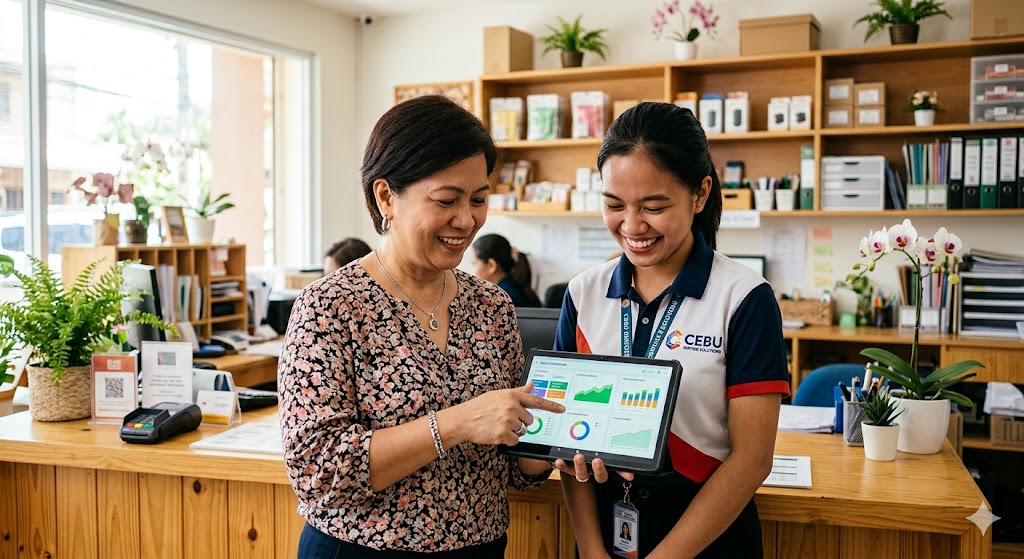
 Training your team is just as important as setting up the AI agent itself
Step 2: Choose a single use case for your pilot. Resist the urge to automate everything at once. Pick one department and one workflow. An HR chatbot is often a good start because the questions are predictable and the data sources (employee handbook, leave policies) are well-defined.
Step 3: Train your team, not just the AI. Employees need to understand what the agent can and cannot do. Set clear expectations. An HR agent will not replace the HR manager, but it will handle the routine questions so the HR team can focus on harder issues. Run a two-week trial where the agent and the traditional process operate in parallel, and collect feedback daily.
Step 4: Review and expand. After the pilot, gather feedback. Which questions did the agent handle well? Where did it fail? Use the data to refine the agent before rolling it out to other departments. A phased approach lowers risk and builds internal trust.
One critical point for Philippine businesses: make sure your AI agent deployment lines up with the Data Privacy Act of 2012 (RA 10173). If the agent reads employee personal data, you need proper consent mechanisms and data handling procedures. Talk to your Data Protection Officer or legal team before going live.
Related: How AI Agents Help Philippine SMEs Build a Digital Workforce explains this in detail.
What to Expect in Terms of Results and Return on Investment
| Metric | Realistic Expectation |
|---|---|
| Response time for internal queries | Routine questions answered in seconds instead of hours |
| Staff time recovered | Noticeable reduction in hours spent on repetitive tasks |
| Payback period | Varies by scope, but many SMEs see returns within the first year |
The most immediate result after deploying an internal AI agent is faster response times. Questions that used to sit in an HR inbox for hours get answered in seconds. That has a compounding effect — employees spend less time waiting and more time on productive work, and managers stop being the helpdesk for policy questions.
 Faster response times and reduced manual work are among the first benefits businesses notice
On cost, AI agent platforms vary. Basic cloud-based chatbot services are available at a modest monthly fee. Customised solutions that integrate with your existing systems cost more up front and deliver stronger results because they match your actual workflows. The exact price depends on how complex the integration is, how many users it supports, and how deep the system hooks go. Request quotes from two or three vendors.
ROI comes from two places. Direct labour savings — fewer hours on repetitive tasks — and indirect gains. Indirect gains include fewer data-entry errors, faster onboarding for new hires, and more consistent policy enforcement across branches. For businesses with multiple locations — common in Philippine retail and food service — that consistency alone often justifies the investment.
AI agents are not a magic fix. They work best on structured, predictable tasks. Complex decisions that need judgment, empathy, or deep context still need human involvement. Setting realistic expectations from the start prevents disappointment and helps the team see the agent as a useful tool rather than a threat.
FAQ
Q: What is a realistic budget for an internal AI agent for a small Philippine business?
A: Cost depends on scope. A simple FAQ-style chatbot on a cloud platform has a modest monthly subscription. Custom-built agents that plug into your HR, accounting, or inventory systems require a larger up-front investment. The cleanest approach is to write down your requirements in detail and request quotes from two or three providers so you can compare apples to apples.
Q: Will an AI agent replace our HR or admin staff?
A: No. An AI agent handles the routine, repetitive questions and tasks. Your HR and admin teams will still be needed for complex situations, employee relations, policy decisions, and anything that needs human judgment. The goal is to free them from the repetitive work, not to eliminate the roles.
Q: Do we need to worry about the Data Privacy Act when using AI agents internally?
A: Yes. If your AI agent processes personal data of employees — names, salaries, leave records, health information — you must comply with the Data Privacy Act of 2012. That means proper consent, security measures, and a Data Protection Officer if you do not already have one. Treat this as part of the project, not as an afterthought.
Q: What if our internet connection is unreliable?
A: This is a real concern for businesses outside Metro Manila. Cloud-based AI agents need a stable connection. If connectivity is shaky, consider hybrid setups that can cache responses locally or operate with limited functionality when the internet is down. Raise this with your vendor early, because not every platform handles it well.
Q: How long does it take to deploy an internal AI agent?
A: A basic FAQ chatbot can be up in one to two weeks. A fully integrated agent that connects to your HRIS, accounting software, or inventory system typically takes two to three months, including testing and staff training. Budget time for the training part — that is where most rollouts run into trouble.
Getting Started with AI Agents for Your Business
The practical path forward is straightforward. Identify one repetitive internal process that eats too much staff time, run a small pilot, and measure the results before expanding. Philippine businesses do not need a huge IT budget or an in-house AI team to get started — many cloud-based platforms are designed for non-technical users.
If you are not sure where to begin, start by tracking how your HR or admin team spends time for one week. The tasks that show up most often and follow a predictable pattern are your best candidates for AI agent automation. From there, talk to a local IT partner who can match your actual needs, budget, and infrastructure to the right approach.
Sources & References
- Data Privacy Act of 2012 (Republic Act No. 10173) — National Privacy Commission of the Philippines
About the author
Founder / AI Engineer (36+ years in IT)
- ●From Tokyo · based in Manila for 13+ years
- ●36+ years in IT (development, SEO, AI)
- ●IBM Certified Generative AI Engineer
- ●AI chatbots, RAG & AI agent development
A Japanese AI engineer with 36+ years in IT and 13+ years on the ground in the Philippines. I write from hands-on experience to help Japanese companies adopt AI that actually delivers results — chatbots, workflow automation, AI agents, and AI-driven marketing. Feel free to reach out in Japanese or English.
Your Competitors Are Already Using AI!
Is your business keeping up?
Related Articles

How AI Agent Development Helps Philippine Businesses Automate Beyond Prompt Engineering
A practical guide for Philippine SMEs on moving from AI chat tools and prompt engineering to full-stack AI agent development that connects to real business systems.
6/6/2026

How OpenAI and Anthropic APIs Help Philippine Businesses Build Custom AI Agents
A practical guide for Philippine SMEs on building custom AI agents using OpenAI and Anthropic APIs, covering challenges, solutions, implementation steps, and expected ROI.
5/26/2026

How Multi-Agent AI Systems Help Philippine Businesses Handle Complex Operations
Multi-agent AI systems let several specialised AI models work together to handle complex business workflows. A practical look at what they are, why Philippine SMEs should care, and how to start adopting this technology.
5/24/2026

How Autonomous AI Agents Help Philippine Customer Support Teams Scale Service Quality
Discover how autonomous AI agents transform customer support for Philippine SMEs. Practical guide to AI implementation, ROI, and success strategies for local businesses.
5/23/2026

How AI Agents Help Philippine SMEs Build a Digital Workforce
AI agents are becoming the next digital workforce for Philippine SMEs. Learn how AI agent technology solves staffing gaps, the implementation steps, and realistic ROI for local businesses.
5/17/2026
How AI Agents Help Philippine Customer Support Teams Achieve Full Automation
AI agents for customer support automation in the Philippines. Learn how Philippine SMEs can reduce costs and improve service with AI-powered support systems.
3/23/2026