
Adapting Large AI Models to Local Business Needs With PEFT
How PEFT adapts large AI models to local business needs while keeping development costs within reach for Philippine SMEs.


AI Engineer · 36+ years in IT · Japanese, based in Manila for 13+ years

Summary
- Full custom AI training is expensive because it updates every parameter in a large model, but PEFT trains only a small set of new parameters and leaves the rest frozen.
- A PEFT method called LoRA can reduce the number of trainable parameters by roughly 90%, so a small business can fine-tune a model on a single rented GPU instead of a large cluster.
- For Philippine SMEs, the practical value of PEFT is local fit at low cost: a model can be adapted to Filipino-English phrasing, local product names, and BIR or DTI document formats without a corporate-size budget.
4 Cost Barriers That Stall AI Projects for Philippine SMEs
| Cost Barrier | Why It Hurts Small Businesses |
|---|---|
| Compute and GPU expense | Training a model from scratch needs many high-end GPUs, which most SMEs cannot rent for long periods. |
| Large labeled datasets | Full training needs huge, clean datasets that small teams rarely have. |
| Scarce AI talent | Specialists who can train models are few and command high salaries. |
| Long project timelines | Months of work delay the return and raise the opportunity cost. |
More than nine in ten establishments in the country own computers and most have internet access, yet day-to-day AI use stays limited, especially among micro and small businesses. The gap is not interest. It is cost and capacity.
 The high cost of training AI from scratch keeps many Philippine SMEs from starting their first project.
The first barrier is hardware. Training a large language model from zero requires many graphics processing units (GPUs, the chips that handle the heavy math behind AI) running for days or weeks. A Makati startup or a Cebu retailer simply cannot justify that bill for one project.
The second barrier is data. A model trained from scratch needs a very large, well-organized dataset, and most SMEs hold only modest records spread across spreadsheets and chat logs.
The third barrier is people. Engineers who can design and train models are in short supply, and this talent scarcity remains a real obstacle for smaller firms.
The fourth barrier is time. When a project takes many months before it produces anything useful, the opportunity cost grows, and smaller firms feel that delay more sharply than large enterprises.
Related: How PEFT (Efficient AI Fine-Tuning) Helps Philippine SMEs Cut AI Costs explains this in detail.
Why Building or Retraining a Full Model Falls Short
| Traditional Approach | Limitation for SMEs |
|---|---|
| Full fine-tuning of a model | Updates every parameter, so it needs heavy compute and storage. |
| Using a generic off-the-shelf model | Does not understand local context, product names, or document formats. |
| Keeping a separate full model per task | Each saved copy is large and costly to store and maintain. |
Two common paths exist today, and each has a weak point for small businesses.
The first path is full fine-tuning. This means taking a large pre-trained model and continuing to train all of its internal values, often billions of them, on your own data. The result can be accurate, but it brings back the same compute and storage costs that made training from scratch impractical.
The second path is using a generic model as it ships, with no adaptation. It is cheap to start, but it does not know your local context. A general model may misread "COD," mishandle a sari-sari store inventory note, or format a quotation in a way that does not match local practice.
There is also a hidden cost in maintenance. If you fully fine-tune one model for customer support and another for invoice reading, you now store and maintain two complete large models, which doubles the storage and the operational burden.
The trade-off is the familiar one: the generic option is cheap and shallow, the full custom option is deep and expensive. PEFT sits between them.
How PEFT Adapts AI Models at a Fraction of the Cost
| PEFT Feature | Practical Benefit |
|---|---|
| Freezes the base model, trains small adapters | Keeps proven model quality while learning your task. |
| Roughly 90% fewer trainable parameters | Runs on a single modest GPU instead of a cluster. |
| Small adapter files per task | Easy to store, swap, and version for different jobs. |
| QLoRA quantization option | Lowers memory needs so older or cheaper hardware can train. |
PEFT stands for Parameter-Efficient Fine-Tuning. The core idea is simple: instead of changing the whole model, you freeze the original model and train only a small number of new parameters that sit alongside it. The base knowledge stays intact, and your task-specific layer learns on top.
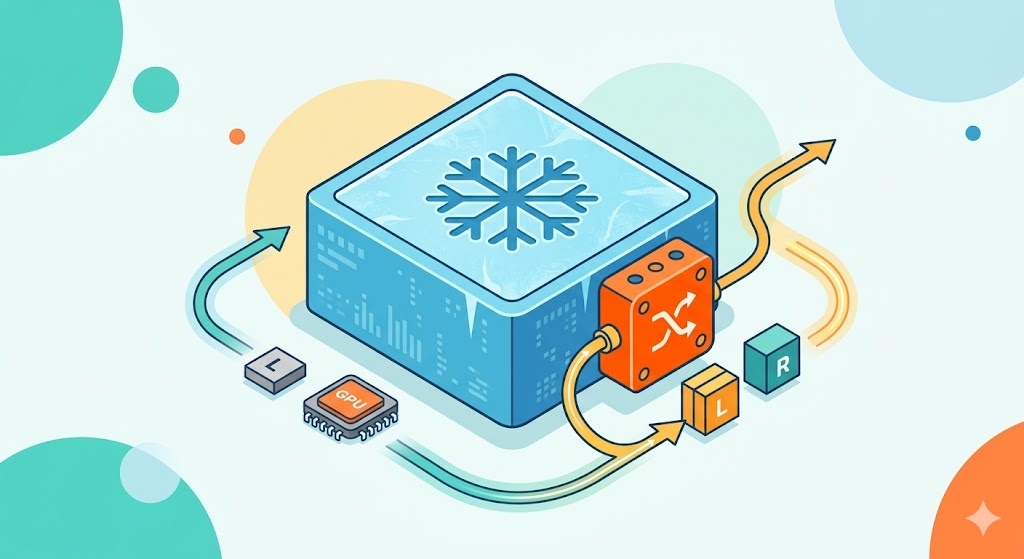 PEFT freezes the base model and trains only a small adapter, cutting the compute needed to customize AI.
The most widely used PEFT method is LoRA (Low-Rank Adaptation). LoRA inserts small trainable matrices into the model's attention layers and trains only those. This often reduces the number of trainable parameters by about 90%, while keeping output quality close to full fine-tuning. In plain terms, you get most of the benefit for a small slice of the work.
Because so few parameters change, the job fits on a single rented GPU billed by the hour, rather than a long cluster rental. The trained result is a small adapter file, not a full model copy. You can keep one base model and attach different adapters for different tasks, which keeps storage low and management simple.
A further option called QLoRA loads the base model in a compressed form (quantization) so it uses less memory. This means even a modest or older GPU can handle the training, which matters when local cloud GPU supply is tight or costly.
Related: How PEFT Helps Philippine SMEs Build Affordable Custom AI explains this in detail.
5 Steps to Apply PEFT in Your Business
| Step | What You Do |
|---|---|
| 1. Define the task and collect data | Pick one clear job and gather real examples. |
| 2. Choose a base model and PEFT method | Select an open model and a method such as LoRA or QLoRA. |
| 3. Prepare and clean the dataset | Format examples and remove errors and private data. |
| 4. Train the adapter and validate | Run training on a single GPU and check results on held-out data. |
| 5. Deploy, monitor, and iterate | Put it into use and refine the adapter over time. |
Start by defining one task, not ten. A good first project is narrow and measurable, such as sorting customer messages into categories or drafting standard reply templates in Filipino-English. Collect a few hundred to a few thousand real examples that reflect how your business actually communicates.
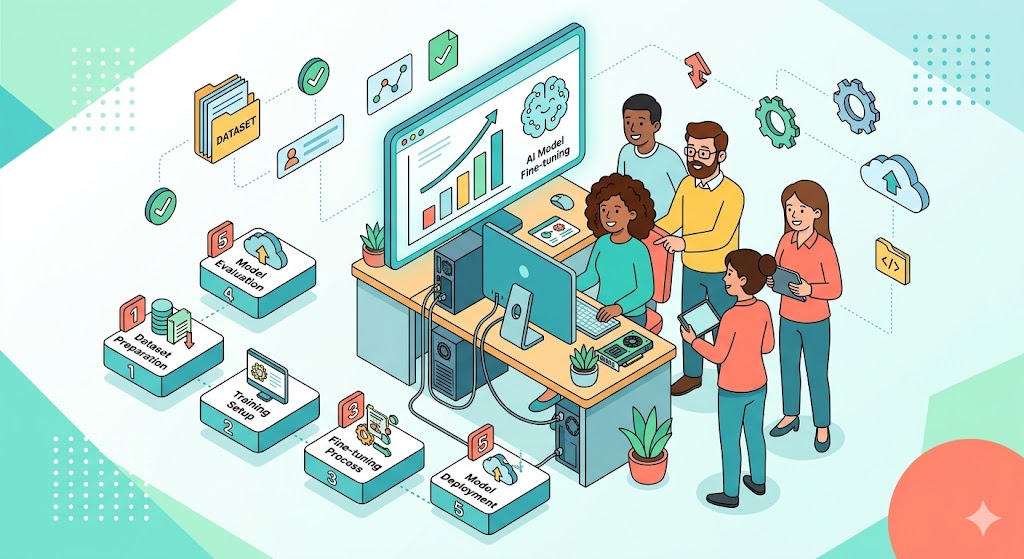 A narrow, well-scoped task lets a small team train a PEFT adapter on a single GPU within weeks.
Next, choose a base model that is open and permitted for commercial use, then choose a PEFT method. LoRA is a sensible default, and QLoRA helps when hardware is limited. Open libraries such as Hugging Face PEFT make this step approachable for a small technical team.
Then prepare the data. Format your examples consistently, remove duplicates and obvious errors, and strip out personal information to stay aligned with the Data Privacy Act of 2012. Clean data matters more than large data at this stage.
Training comes next. Run the adapter training on a single GPU and hold back a portion of your examples for validation, so you can measure quality against data the model has not seen. Start with small settings and adjust based on results.
Finally, deploy and iterate. Connect the adapter to your application, monitor real outputs, and retrain when patterns shift. Retraining without a record of what you changed last time turns each round into guesswork.
Related: How LoRA Fine-Tuning Helps Philippine SMEs Build Custom AI Without Big Data or Big Budgets explains this in detail.
What Philippine SMEs Can Expect in Cost and ROI
| Outcome | What It Means for the Business |
|---|---|
| Lower compute spend | Single-GPU training instead of cluster rental reduces the bill. |
| Faster time to value | A narrow task can move from data to deployment in weeks, not months. |
| Reusable adapters | One base model serves many tasks, lowering maintenance cost. |
| Better local fit | The model learns Filipino-English and local document formats affordably. |
The clearest gain is compute savings. Because PEFT trains a small fraction of parameters, the hardware bill drops from cluster-scale to a single GPU rented by the hour, which is the difference between a budget most SMEs cannot reach and one they can plan for.
The second gain is speed. A focused task can move from dataset to working adapter in a matter of weeks, so the return arrives sooner and the project stays inside a small-business budget cycle.
Reusability adds quiet value over time. Since adapters are small and attach to one shared base model, a firm can build a library of task-specific adapters without multiplying storage or maintenance work. This keeps the total cost of ownership manageable as needs grow.
The honest caveat is that PEFT is not free of effort. You still need clean data, a basic technical setup, and ongoing tuning. The return is real but it follows preparation, so treat early projects as measured experiments rather than guaranteed wins, and scale what works.
FAQ
Q: Do I need expensive GPUs in my office to use PEFT?
A: No. Most teams rent a single cloud GPU by the hour for the training period, then stop paying once the adapter is trained. This avoids buying hardware and suits a small-business budget.
Q: Is PEFT only for large language models?
A: It is most common with language models, but the same idea applies to image and other models. For most Philippine SMEs starting out, language tasks such as support replies and document handling are the practical entry point.
Q: Can a model adapted with PEFT understand Filipino-English and Taglish?
A: Yes, within limits. If your training examples include real Filipino-English and Taglish messages from your business, the adapter learns those patterns. The quality depends on how well your examples reflect actual usage.
Q: How does PEFT relate to data privacy rules here?
A: You are responsible for the data you train on. Remove personal information you do not need, document your handling, and align your process with the Data Privacy Act of 2012 and National Privacy Commission guidance before training.
Q: Should we build this in-house or hire a local partner?
A: Either can work. A small in-house team can start with open libraries, while a local AI partner shortens the learning curve. Begin with one narrow task so you can judge results before committing to a larger plan.
Start Small, Measure, Then Scale
PEFT gives Philippine SMEs a realistic path into custom AI: keep a proven base model, train a small adapter for one clear task, and pay single-GPU costs instead of cluster-scale bills. The method does not remove the need for clean data and steady tuning, but it lowers the financial barrier that has kept many smaller firms on the sidelines.
A sound first move is to pick one repetitive, text-heavy task in your operation, gather a few hundred real examples, and run a small pilot. If you want a technical review of whether your task and data fit a PEFT approach, PH AI Works can help you scope a low-risk pilot before any large commitment.
Sources & References
- PH businesses lag in AI adoption despite digital access — PIDS — Philippine data on computer and internet access versus limited AI use among MSMEs.
- National AI Strategy Roadmap 2.0 (NAISR 2.0) — OECD.AI — The Philippines' AI strategy, including barriers such as scarce compute and talent for SMEs.
- DOST builds on national AI strategy (NAIS Ph) — Government push to bring AI adoption to MSMEs and regional industries.
- Hugging Face PEFT documentation — Official documentation for the PEFT library, covering LoRA, QLoRA, and adapter methods.
- LoRA: Low-Rank Adaptation of Large Language Models (Hu et al., 2021) — The original research paper introducing LoRA and its parameter-efficiency results.
About the author
Founder / AI Engineer (36+ years in IT)
- ●From Tokyo · based in Manila for 13+ years
- ●36+ years in IT (development, SEO, AI)
- ●IBM Certified Generative AI Engineer
- ●AI chatbots, RAG & AI agent development
A Japanese AI engineer with 36+ years in IT and 13+ years on the ground in the Philippines. I write from hands-on experience to help Japanese companies adopt AI that actually delivers results — chatbots, workflow automation, AI agents, and AI-driven marketing. Feel free to reach out in Japanese or English.
Your Competitors Are Already Using AI!
Is your business keeping up?
Related Articles

Competitor Research With AI in One Hour a Week
A four-step weekly routine that collects and compares competitor information, so pricing decisions rest on current data.
8/10/2026

When Not to Use AI: Tasks to Keep Human
An honest look at the five tasks Philippine businesses should keep human — consequential decisions among them.
8/9/2026

Turning Full-Stack Developers Into Agent Specialists
Hiring an AI agent specialist in the Philippines is slow and costly. Retraining the developers you have is usually faster.
8/7/2026

What to Put in an AI Vendor Contract
AI vendor contracts in the Philippines often skip what matters: data return, audit logs, model changes, and exit protection.
8/6/2026
Keeping AI Running Through Brownouts and Typhoons
Cloud AI does not stop when the office loses power — your access does. A continuity plan for Philippine operations.
8/5/2026

Your AI Vendor's Legal Form Changes the Deal
SEC-registered corporation or DTI sole proprietor — in the Philippines the difference changes contracts, banking, and recourse.
8/3/2026