
PEFT and RAG Together: Custom AI Without Heavy GPU Costs
A practical guide for Philippine businesses on using PEFT and RAG together to customize AI without heavy GPU costs.


AI Engineer · 36+ years in IT · Japanese, based in Manila for 13+ years

Summary
- RAG feeds an AI model fresh facts at the moment of use, while PEFT changes how the model behaves — and most company AI needs both, not one or the other.
- PEFT trains only a small slice of a model, so a customized AI can run on modest hardware instead of an expensive GPU cluster.
- A clear data set and one narrow first use case matter far more than a big budget when a Philippine SME starts building custom AI.
Where Off-the-Shelf AI Falls Short for Philippine Businesses
| Challenge | What it looks like in practice |
|---|---|
| Generic voice | Replies sound foreign and miss local courtesy or natural Taglish phrasing |
| No company knowledge | The tool cannot answer about your own products, prices, or policies |
| Unstable format | Output needs constant reformatting before staff can actually use it |
| Compliance worry | Sending customer records to outside tools raises Data Privacy Act concerns |
Public AI tools are easy to start with, and many Filipino teams already use them for drafts and quick research. The trouble appears when a business wants the AI to behave like part of the company. A general model does not know your price list, your refund rules, or the polite tone your customers expect, so staff end up rewriting much of what it produces.
 Generic AI tools often miss a company's voice, knowledge, and format, leaving staff to rewrite the output.
There is also a quieter cost. When a tool sounds slightly off-brand or formats answers in a way no one can paste into a report, employees stop trusting it. The Philippines has strong digital access — most establishments own computers and have internet — yet actual AI use in day-to-day operations remains low, especially among micro and small firms. The gap is rarely about hardware. It is about turning a generic model into something that fits one specific business.
Related: How PEFT AI Fine-Tuning Helps Philippine SMEs Cut Development Costs explains this in detail.
Why RAG Alone or Prompting Alone Falls Short
| Approach | Strength | Limit |
|---|---|---|
| Prompt instructions | Quick to try, no setup | Breaks as rules pile up; long prompts cost more per call |
| RAG | Adds your current facts and documents | Does not change tone, format, or behavior |
| Full fine-tuning | Deeply reshapes how the model acts | Needs large data and costly GPUs |
Most teams improve their AI in three ways, and each has a ceiling. The first is writing longer and longer prompt instructions — the plain-language directions you type before a request. This works for simple needs, but as the rules grow, the instructions become fragile and the cost per request rises.
The second is RAG, short for retrieval-augmented generation. In simple terms, RAG looks up relevant pages from your own documents and hands them to the model before it answers. This is excellent for keeping answers current and grounded in your files. What RAG does not do is change the model's underlying habits: it can supply the right policy text, yet still reply in the wrong tone or the wrong structure.
The third is full fine-tuning, which retrains the whole model on your data. It can reshape behavior well, but it usually needs a large data set and expensive GPU time that is hard to justify for a small or medium business. For most Philippine SMEs, none of these three alone gives a custom AI that is both affordable and well-behaved.
How PEFT Customizes AI Without the Heavy Cost
| Method | What it does | Why it helps SMEs |
|---|---|---|
| Adapters (the PEFT idea) | Trains a small add-on; the base model stays frozen | Tiny files and low compute |
| LoRA | Inserts small matrices into the model's layers | Trains only a small fraction of the parameters |
| QLoRA | Compresses the model first, then applies LoRA | Can run on a single modest GPU |
| Adapter swapping | One base model, many task-specific add-ons | Different behaviors without new full models |
PEFT stands for parameter-efficient fine-tuning. The plain idea is this: instead of retraining a whole model, you freeze it and train a small add-on, called an adapter, that nudges its behavior toward your needs. Because the big model never changes, the work is far lighter than full fine-tuning while still reshaping how the AI responds.
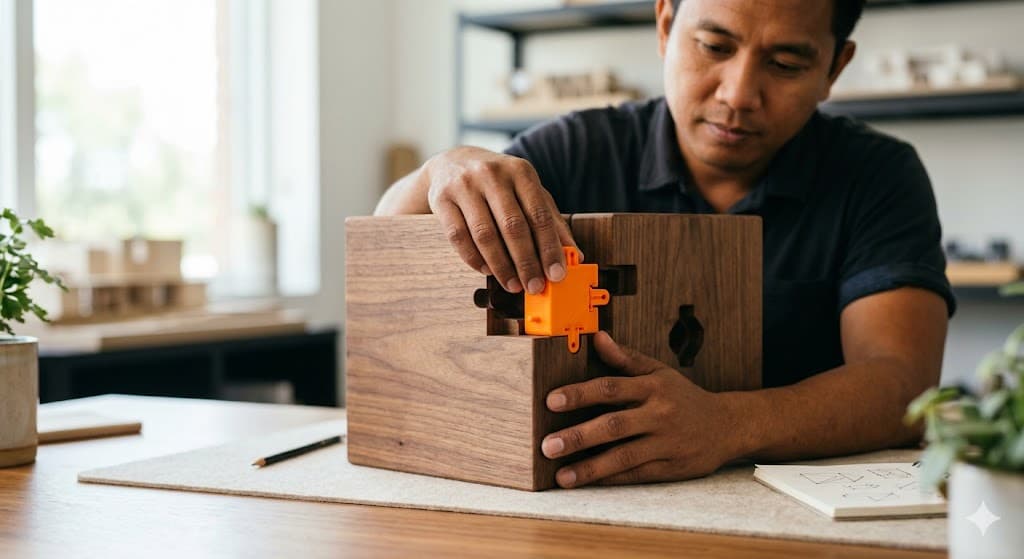 PEFT keeps the base model frozen and trains a small adapter, making custom AI affordable to build and store.
The most common PEFT method is LoRA (low-rank adaptation). It inserts small extra matrices into the model and trains only those, so you adjust a small fraction of the total parameters rather than billions. The resulting adapter file is small — often a few megabytes against many gigabytes for the full model — which makes it cheap to store, move, and load.
A related method, QLoRA, first compresses the base model into a smaller form and then applies LoRA on top. This lets teams fine-tune sizable models on a single modest GPU, the kind a small studio or agency can rent by the hour. One more practical benefit is adapter swapping: you keep one base model and attach different adapters for different jobs, so a support adapter and a sales adapter can share the same foundation.
PEFT and RAG are not rivals. RAG supplies the up-to-date facts, and PEFT shapes the voice, format, and behavior. Used together, they cover the two things a generic model gets wrong — what it knows and how it acts.
Related: How PEFT (Efficient AI Fine-Tuning) Helps Philippine SMEs Cut AI Costs explains this in detail.
Five Steps to Build a PEFT-Customized AI
| Step | Action | Output |
|---|---|---|
| 1. Scope | Pick one narrow, high-value task | A clear success measure |
| 2. Data | Collect and clean real examples | A quality training set |
| 3. Choose | Select a base model and PEFT method | A right-sized setup |
| 4. Train and test | Run LoRA or QLoRA, then evaluate | A working adapter |
| 5. Deploy | Combine with RAG and monitor | A live, improving AI |
Start by scoping one narrow task, such as drafting reply emails in your house style or sorting support tickets. A tight scope gives you a clear way to judge success and keeps the first project small.
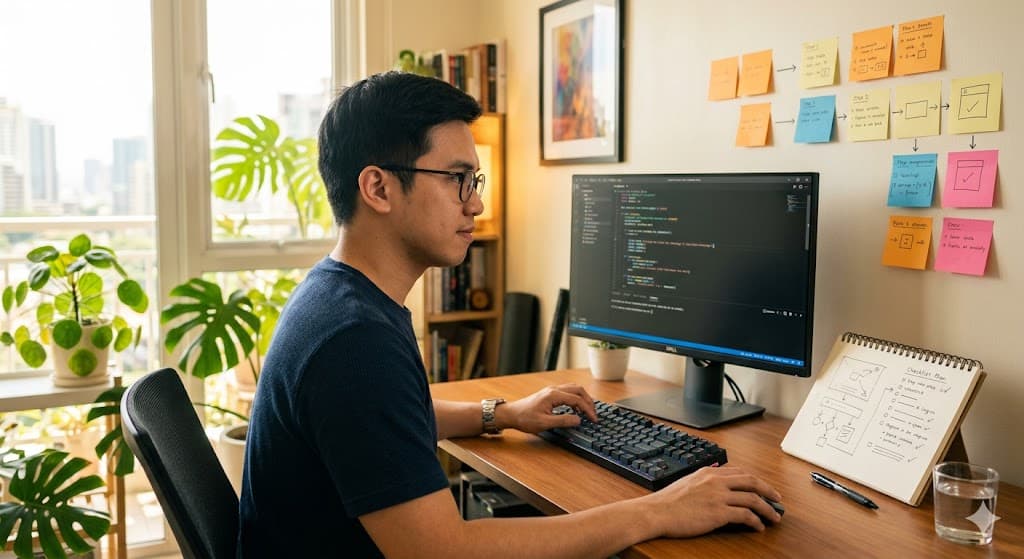 A narrow scope, clean data, and phased rollout turn a base model into a well-behaved custom AI.
Next, gather data. For PEFT, that means real examples of the input and the ideal output — past replies, labelled tickets, sample reports. Clean data matters more than large data here; a few hundred good examples often beat thousands of messy ones. Then choose a base model and method: an open model with LoRA, or QLoRA if you want to keep hardware costs low.
After that, train the adapter and test it against examples it has never seen, comparing its answers to your standard. Finally, deploy it, connect RAG so it can pull current facts, and watch how it performs in real use. Plan to adjust it over time rather than treating launch as the finish line.
Custom AI rewards the narrow, well-scoped pilot that you keep refining. The ambitious all-at-once build usually runs out of budget at the point where it would have started being useful.
Related: How LoRA Fine-Tuning Helps Philippine SMEs Build Custom AI Without Big Data or Big Budgets explains this in detail.
What Philippine SMEs Can Expect in Return
| Benefit | Business impact |
|---|---|
| Lower compute cost | A custom AI without renting an expensive GPU cluster |
| Faster updates | Swap a small adapter instead of rebuilding a whole model |
| Consistent output | Less manual rework by staff on every reply or report |
| Data control | Keep sensitive records in-house to support compliance |
The clearest return is cost. Because PEFT trains only a small add-on, the compute bill is far smaller than full fine-tuning, and many teams can work within a budget that makes sense in peso terms rather than the scale a large enterprise would spend. Significant savings can be expected, though the exact figure depends on your model choice and data size.
The other returns are operational. Small adapters are quick to update, so you can refine behavior without long rebuilds. Output becomes more consistent, which cuts the hidden hours staff spend reformatting and rewriting. And because PEFT can run on hardware you control, sensitive customer data can stay in-house — a real advantage for firms thinking about the Data Privacy Act and their obligations to the National Privacy Commission. The timing also fits the wider shift in the country, where AI's possible contribution to the economy could reach the tens of billions of dollars by 2030.
FAQ
Q: Do we need a full data science team to use PEFT?
A: No. A small project usually needs one capable developer who can prepare data and run an open fine-tuning library. Many Philippine SMEs handle this through a local IT partner or an experienced freelancer rather than a full in-house team.
Q: Should we choose RAG or PEFT for our customer chatbot?
A: For most chatbots, both. RAG keeps answers tied to your current documents and prices, while PEFT fixes the tone, courtesy, and format. Starting with RAG is reasonable, then adding a PEFT adapter once you see where the behavior still feels off.
Q: How much data do we really need to start?
A: Less than people expect. A few hundred clean, well-chosen examples of the exact task often work better than thousands of inconsistent ones. Quality and relevance matter more than raw volume for PEFT.
Q: Can this run reliably on Philippine internet and infrastructure?
A: Training can be done on rented cloud GPUs by the hour, so a fast office connection is enough for the setup. Once trained, a small adapter is light to deploy, and you can host it locally if you prefer to keep data on your own servers.
Q: Is our customer data safe if we customize AI this way?
A: It can be, which is one of PEFT's advantages. Because you can train and run the model on hardware you control, sensitive records need not be sent to outside services. You still need to follow the Data Privacy Act and document how data is handled.
Getting Started Without Overcommitting
Custom AI does not require a large first investment. The practical path is to choose one narrow task, gather a clean set of examples, and build a small PEFT adapter that you pair with RAG for current facts. Judge it against a clear standard, then improve it in stages. If you would like help scoping that first pilot or preparing your data, the team at PH AI Works can work through it with you and keep the project sized to your business.
Sources & References
- PIDS — PH Businesses Lag in AI Adoption Despite Digital Access — adoption rates and the gap between digital access and real AI use among Philippine firms.
- DOST — Building on the National AI Strategy — government direction on AI, MSME support, and economic projections.
- Oxford Insights — Government AI Readiness Index 2024 — the Philippines' AI readiness ranking and pillars.
- Hugging Face — PEFT Documentation — how parameter-efficient fine-tuning reduces compute and storage costs while keeping the base model frozen.
- LoRA: Low-Rank Adaptation of Large Language Models (arXiv) — the original method behind training only a small fraction of parameters.
- QLoRA: Efficient Finetuning of Quantized LLMs (arXiv) — combining quantization with LoRA to fine-tune on a single modest GPU.
- National Privacy Commission — Data Privacy Act of 2012 — the legal basis for handling customer data when deploying custom AI in the Philippines.
About the author
Founder / AI Engineer (36+ years in IT)
- ●From Tokyo · based in Manila for 13+ years
- ●36+ years in IT (development, SEO, AI)
- ●IBM Certified Generative AI Engineer
- ●AI chatbots, RAG & AI agent development
A Japanese AI engineer with 36+ years in IT and 13+ years on the ground in the Philippines. I write from hands-on experience to help Japanese companies adopt AI that actually delivers results — chatbots, workflow automation, AI agents, and AI-driven marketing. Feel free to reach out in Japanese or English.
Your Competitors Are Already Using AI!
Is your business keeping up?
Related Articles

Competitor Research With AI in One Hour a Week
A four-step weekly routine that collects and compares competitor information, so pricing decisions rest on current data.
8/10/2026

When Not to Use AI: Tasks to Keep Human
An honest look at the five tasks Philippine businesses should keep human — consequential decisions among them.
8/9/2026

Turning Full-Stack Developers Into Agent Specialists
Hiring an AI agent specialist in the Philippines is slow and costly. Retraining the developers you have is usually faster.
8/7/2026

What to Put in an AI Vendor Contract
AI vendor contracts in the Philippines often skip what matters: data return, audit logs, model changes, and exit protection.
8/6/2026
Keeping AI Running Through Brownouts and Typhoons
Cloud AI does not stop when the office loses power — your access does. A continuity plan for Philippine operations.
8/5/2026

Your AI Vendor's Legal Form Changes the Deal
SEC-registered corporation or DTI sole proprietor — in the Philippines the difference changes contracts, banking, and recourse.
8/3/2026