
Robot Units Explained: Radians, Torque and Power
Learn the units in robot spec sheets: m/s, radians, rad/s, torque in N·m and power in W, with worked examples and a robot simulator test.


AI Engineer · 36+ years in IT · Japanese, based in Manila for 13+ years
Summary
- When you work with robots, the first rule is simple: always write a unit next to every number. If you mix up units, the result can be far off, even when every step of the math is right.
- Robots usually measure angles in rad (radians), not degrees. 90 degrees is about 1.5708 rad, and one full turn is about 6.2832 rad. In a robot simulator, you set a motor's position in rad and its turning speed in rad/s.
- You can work out two key numbers with one multiplication each: torque is "force × distance," measured in N·m, and electric power is "voltage × current," measured in W.
If your company is thinking about robots or physical AI (AI that controls machines that move in the real world), you will soon see units like "rad," "N·m" and "rad/s" in spec sheets and in proposals from developers. If you don't know what those numbers mean, it is hard to compare products or explain what you want.
I run PH AI Works from Manila, in the Philippines. We help small and mid-sized businesses adopt AI and automate their work. I also test and write about physical AI. In one test, I ran the robot simulator Webots R2025a on my own computer. I wrote Python code to control a robot's wheels, ran it from a virtual environment (a separate workspace that keeps a project's Python tools apart from the rest of the computer), and drove the robot about 19.2 cm.
In this article, I explain the units used in robot spec sheets and simulators.
Why Units Matter So Much in Robot Math
A space probe lost to a unit mix-up
One famous case of a unit mix-up causing a big failure is NASA's Mars Climate Orbiter. It launched on December 11, 1998, and the last contact with it was on September 23, 1999.
According to NASA, the failure came from a navigation error. Numbers in imperial units (feet and pounds) were never converted to metric units. Because of this mismatch, the path calculations were off, and the probe flew too close to Mars.
The math itself can be correct, but if the units don't match, the answer is useless. The same thing can happen when you build robots.
Unit mix-ups can also happen at Japanese companies in the Philippines. Here are some cases that could happen at restaurants, warehouses, delivery services and factories.
- Restaurant: You want frying oil at 180°C, but the fryer shows temperature in °F (Fahrenheit). If you enter "180," the oil only reaches about 82°C, and the food does not cook properly.
- Warehouse: A transport robot can carry up to 50 kg. If a 100 kg package is registered as "100 lb" (pounds), the system treats it as about 45 kg and lets the robot carry a load over its limit.
- Delivery: Staff enter "10" as the speed limit for a delivery robot, meaning 10 km/h. If the setting uses m/s, the robot can run at 36 km/h.
- Factory: A drawing from an overseas supplier uses inches, but someone reads it as mm. A 10-inch (254 mm) part is then cut to 10 mm, and it does not fit.
In every case, recording each number with its unit and checking the unit of every number you receive prevents the problem.
One shared system for the whole world: the SI
The world has one shared set of rules for units, called the SI (International System of Units). The U.S. National Institute of Standards and Technology (NIST) lists base units such as the meter (m) for length, the second (s) for time, the ampere (A) for electric current, and the kilogram (kg) for mass.
There are seven base units. By combining them, the SI defines 22 derived units that have their own names and symbols. The N (newton), W (watt) and V (volt) in this article are all derived units.
Record numbers and units together
In Robot Experiment Basics, I explained a basic habit for experiments: write down what you changed, what happened, and any errors. Here, I add one more rule: always write the unit with every number.
Say your notes only show "19.2." Someone reading them later can't tell if that means cm or m. If you write "19.2 cm," everyone reads it the same way.
I learned this the hard way. I once let an AI calculate the nutrients in my meal log, and it read "2 eggs" as "2 grams." Later, without knowing about the mistake yet, I changed how I split the work: Python now does the calculations for my meal log, and the AI only writes the text. The AI's mistake only came to light much later, through Python's calculation. A unit mix-up is that easy to miss.
Length and Time: m, cm, mm and s, ms
Length is the marks on a ruler
Length is what you measure with a ruler. In robot math, the basic unit is the m (meter).
- 1 m is 100 cm
- 1 m is 1,000 mm (1 × 1000 = 1,000)
- 1 mm is 0.001 m (1 ÷ 1000 = 0.001)
In my test, the robot moved about 19.2 cm. In meters, that is 0.192 m (0.192 × 100 = 19.2, so 0.192 m equals 19.2 cm). The distance is the same, but the number looks very different depending on the unit.
Time is the number on a stopwatch
Time is what you measure with a stopwatch. The basic unit is the s (second). For very short times, we use the ms (millisecond).
- 1 s is 1,000 ms
- 1 ms is 0.001 s
You see ms a lot in the robot world. For example, Webots has a setting called basicTimeStep. It sets how big each time step of the simulation is, and it is written in milliseconds (ms). The smallest value is 1, and the default value is 32. So when it says "32," that means 32 milliseconds, not 32 seconds.
Type a number in any box. The other boxes change to the same amount in another unit.
Speed and Acceleration: m/s and m/s²
Speed is "how many meters in one second"
The unit of speed is m/s (meters per second). It tells you how many meters something moves in one second.
Say a robot moves 2 m in 4 seconds. Its speed is:
- 2 m ÷ 4 s = 0.5 m/s
That means it moves 0.5 m every second.
Acceleration is "how much the speed grows each second"
The unit of acceleration is m/s² (meters per second squared). It tells you how much the speed goes up in one second.
Picture yourself starting to ride a bicycle. You start from a stop, then go faster and faster. How quickly you speed up is the acceleration.
Say you start at a stop (0 m/s) and reach 2 m/s in 4 seconds. The acceleration is:
- (2 m/s − 0 m/s) ÷ 4 s = 0.5 m/s²
This means your speed goes up by 0.5 m/s every second. An easy way to keep them apart: speed is "how fast you are going now," and acceleration is "how fast your speed is changing."
The slope of this line is the speed.
The slope of this line is the acceleration.
Angles and rad (Radians)
Degrees are like slicing a pizza
When people hear "angle," most think of degrees. Going all the way around a round pizza is 360 degrees (180 × 2 = 360). Cut it in half and each half is 180 degrees. Cut it into four, and the corner of each slice is 90 degrees.
A radian is the angle made by an arc as long as the radius
In robot math, angles are often measured in rad (radians).
The distance from the center of a circle to its edge is called the radius. Take a string as long as the radius and lay it along the edge of the circle. The angle it covers is 1 rad. NIST also describes rad as "m/m," which means a length divided by a length.
Here is how degrees and radians match up:
| Degrees | rad | Picture it as |
|---|---|---|
| About 57.2958 degrees | 1 rad | The angle of an arc as long as the radius (180 ÷ π = 57.2958) |
| 90 degrees | About 1.5708 rad | One slice of a pizza cut into four (π ÷ 180 × 90 = 1.5708) |
| 180 degrees | About 3.1416 rad (π) | Half a pizza |
| 360 degrees | About 6.2832 rad (2π) | A whole pizza, one full turn (π × 2 = 6.2832) |
If you remember that one full turn is about 6.2832 rad and half a turn is π (about 3.1416) rad, other angles become easier to work out.
Robot tools expect radians
Radians matter because robot simulators and programs are built to take angles in rad.
- In Webots, you set the position of a rotating motor in rad
- The Webots position sensor also reports the angle of a rotating joint in rad
- In Python's math tools, the sine function (sin) takes its angle in rad too. There are also tools to convert degrees to radians and radians to degrees
Say you want to turn something 90 degrees, and you just pass in "90." It gets treated as 90 rad, which is a completely different angle. For 90 degrees, you need to pass in "1.5708." The basic rule: think in degrees if you like, but convert to rad before you pass the number in.
Angular Speed: rad/s
How fast a merry-go-round spins
The unit of angular speed is rad/s (radians per second). It tells you how many radians something turns in one second.
Picture a merry-go-round. The shorter the time it takes to go around once, the bigger its angular speed.
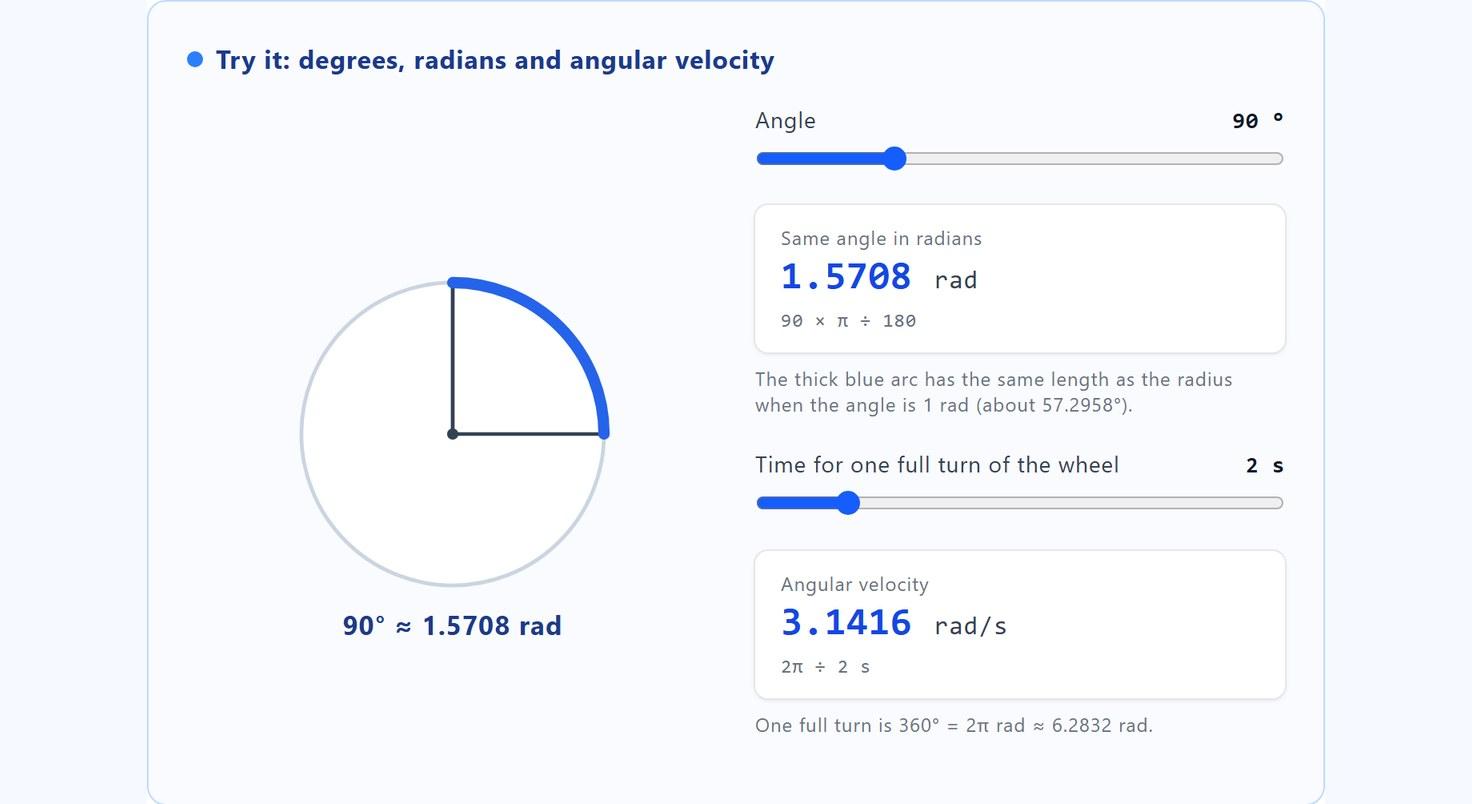
Say it goes around once every 2 seconds. One full turn is about 6.2832 rad, so the angular speed is:
- 6.2832 rad ÷ 2 s = about 3.1416 rad/s
Wheel speed is set in rad/s too
In Webots, the speed of a rotating motor is set in rad/s. When I control a robot's wheels in Webots, I set their speed in rad/s.
You set how many rad/s the wheel turns, not how many m/s the robot moves forward. This is the part that confuses many people at first.
The thick blue arc has the same length as the radius when the angle is 1 rad (about 57.2958°).
One full turn is 360° = 2π rad ≈ 6.2832 rad.
Force and Torque: N and N·m
Force is how hard you push or pull
The unit of force is the N (newton). NIST describes the newton as a derived unit made from m, kg and s.
Here is an everyday example: holding up a 1 kg object in your hand takes about 9.8 N of force. You get this by multiplying 1 kg by 9.8.
Torque is "turning force," and a door makes it easy to see
The unit of torque is N·m (newton meter). You find it with "force × distance from the center of turning."
Picture a door. It turns around its hinges.
- Push with 10 N at 0.1 m from the hinges, and the torque is 10 × 0.1 = 1 N·m
- Push at 0.05 m from the hinges, and you need 20 N to get the same 1 N·m (20 × 0.05 = 1)
So if you push close to the hinges, you need more force to get the same turning effect. That is why door handles sit far away from the hinges.
Webots motors also use N·m for torque and N for force. When you want to know how strongly a robot can turn its joints or wheels, look at the N·m number.
With the same force, pushing farther from the hinge gives more torque.
Voltage, Current and Power: V, A and W
Think of a garden hose
Electrical units are easier to understand if you think of a garden hose.
- Voltage (V, volt): how hard the water is pushed out
- Current (A, ampere): how much water flows through the hose
- Power (W, watt): how much work actually gets done
The ampere is one of the SI base units. The volt and the watt are derived units. NIST describes the watt as "energy per second" and the volt as "watts divided by amperes."
Power is "voltage × current"
From these definitions, power is voltage multiplied by current.
For example, if 2 A of current flows at 5 V, the power is:
- 5 V × 2 A = 10 W
When you choose motors or batteries for a robot, check how many V each part runs on, how many A flow through it, and how many W it uses.
Power is voltage × current. The wider and faster the water, the more work it can do.
Quick Reference Table of Robot Units
Here are all the units from this article in one table.
| Quantity | Unit | Symbol | Everyday picture | Example |
|---|---|---|---|---|
| Length | meter | m (cm, mm) | Ruler | 1 m = 1,000 mm |
| Time | second | s (ms) | Stopwatch | 1 s = 1,000 ms |
| Speed | meters per second | m/s | Walking speed | 2 m in 4 s → 0.5 m/s |
| Acceleration | meters per second squared | m/s² | Starting on a bicycle | 0 → 2 m/s in 4 s → 0.5 m/s² |
| Angle | radian | rad | Slicing a pizza | 90 degrees = about 1.5708 rad |
| Angular speed | radians per second | rad/s | Merry-go-round | One turn in 2 s → about 3.1416 rad/s |
| Force | newton | N | Pushing, pulling | Holding up 1 kg → about 9.8 N |
| Torque | newton meter | N·m | Turning a door | 10 N × 0.1 m = 1 N·m |
| Voltage | volt | V | How hard the water is pushed | 5 V |
| Current | ampere | A | How much water flows | 2 A |
| Power | watt | W | Work actually done | 5 V × 2 A = 10 W |
What to Check If Your Company Is Considering Robots
Owners and managers don't need to memorize every unit in detail. But when you read a developer's documents or explain what you need, checking these points will help prevent misunderstandings.
- Does every number have a unit? Check that it says "0.5 m/s," not just "speed 0.5"
- Is the angle in degrees or rad? Documents written for people often use degrees, while values passed to programs and simulators use rad
- Is the time in s or ms? If it just says 32, it could mean 32 seconds or 32 milliseconds, and one is 1,000 times longer than the other
- Do your records keep the units? When your team records experiments or tests, always write the number and the unit together
As the Mars Climate Orbiter case shows, a unit mix-up is harder to spot than a math mistake. That is why it pays to check units at the very start.
FAQ
Q: Should I use radians or degrees?
For documents and conversations between people, degrees are easier to picture. But Webots motors and position sensors, and Python's sin, all expect rad, so the values you use in math and programs should be in rad. The basic rule is to think in degrees, then convert to rad before passing the value in.
Q: How many degrees is 1 rad?
It is about 57.2958 degrees (180 ÷ π = 57.2958). Also, 90 degrees is about 1.5708 rad, and one full turn (360 degrees) is about 6.2832 rad.
Q: What is the difference between force and torque?
Force (N) is how hard you push or pull. Torque (N·m) is how hard you turn something. You get torque by multiplying the force by the distance from the center of turning. Even with the same 10 N of force, the farther from the center you push, the bigger the torque.
Q: What is the difference between speed and angular speed?
Speed (m/s) is how many meters you move in one second. Angular speed (rad/s) is how many radians you turn in one second. With a wheel, how fast the wheel spins is the angular speed, and how fast the robot moves forward is the speed.
Q: The simulator's time setting says "32." How many seconds is that?
Webots writes basicTimeStep in milliseconds (ms), so 32 means 32 milliseconds, not 32 seconds. Since 1 s is 1,000 ms, reading it without checking the unit would put you off by a factor of 1,000.
Conclusion
The units used in robot math are length, time, speed, acceleration, angle, angular speed, force, torque, voltage, current and power. Once you have a handle on these, robot documents become much easier to read.
The three most important points are:
- Always record a unit with every number
- Angles are usually handled in rad (90 degrees is about 1.5708 rad, and one full turn is about 6.2832 rad)
- Torque is "force × distance," and power is "voltage × current"
In my own simulator tests, I always record every number with its unit, such as wheel speed in rad/s and distance in cm.
PH AI Works is based in Manila and helps small and mid-sized businesses with AI adoption, business automation and web development. If you are considering robots or physical AI and aren't sure how to read the numbers in a spec sheet or how to move forward, feel free to book a free consultation.
References
- NIST: SI Units
- NIST Guide to the SI, Chapter 4: The Two Classes of SI Units and the SI Prefixes
- Webots Reference Manual: Motor
- Webots Reference Manual: WorldInfo
- Webots Reference Manual: PositionSensor
- Python documentation: math — Mathematical functions
- NASA Science: Mars Climate Orbiter
- NIST Guide to the SI, Appendix B.8: Factors for Units Listed Alphabetically
About the author
Founder / AI Engineer (36+ years in IT)
- ●From Tokyo · based in Manila for 13+ years
- ●36+ years in IT (development, SEO, AI)
- ●Google Certified AI Professional
- ●IBM Certified Generative AI Engineer
- ●AI chatbots, RAG & AI agent development
- ●Physical AI Engineer
A Japanese AI engineer with 36+ years in IT and 13+ years on the ground in the Philippines. I write from hands-on experience to help Japanese companies adopt AI that actually delivers results — chatbots, workflow automation, AI agents, and AI-driven marketing. Feel free to reach out in Japanese or English.
Your Competitors Are Already Using AI!
Is your business keeping up?
Related Articles
Robot Experiment Basics: 5 Things to Decide Before You Start
Before a robot experiment, decide five things: your prediction, the one thing you will change, what to record, success criteria and how many times to run it.
11/16/2026

Research, Analysis, and Writing in One Workflow
Research, analysis, and writing are three separate jobs whose handoffs now cost more than the work itself. How to run them as a single workflow in four steps, and what to measure.
8/18/2026
AI Model Vendors Now Sell Implementation Too
OpenAI and Anthropic now sell implementation support as well as AI models. What a Japanese-affiliated local subsidiary in the Philippines should decide in-house first, before choosing an AI partner.
8/18/2026
Contracting for AI While Prices Keep Falling
Write a model number into a contract and it is obsolete in six months. Learn how to design AI contracts for switching instead, with capability-based specifications, price-revision terms, and migration clauses.
8/17/2026

Building an In-House AI Team With Multi-Agent Systems
A multi-agent system is a team, and the hard part is organisational. How to define what each agent must not do, connect two agents first, and measure whether the setup actually works.
8/17/2026

Meta Cut 750,000 Under-16 Accounts in Australia
Meta removed access to over 750,000 under-16 accounts in Australia using AI-assisted age checks. What this shows about depending on one platform for reach, and what a Philippine company should review.
8/16/2026