
AI E-Commerce for Philippine Retailers
Personalised shopping, automated inventory, and smarter customer engagement for Philippine online retailers.


AI Engineer · 36+ years in IT · Japanese, based in Manila for 13+ years
Summary
- Philippine e-commerce retailers using AI for product recommendations and inventory management can expect significant improvements in conversion rates and operational efficiency.
- Starting AI integration with a single high-impact area such as customer support chatbots keeps initial costs manageable for SMEs, with a typical timeline of three to six months from evaluation to a working system.
- AI handles repetitive, pattern-based tasks well, but human judgment remains essential for cultural nuances, supplier negotiations, and building genuine customer trust.
The Growing E-Commerce Challenge for Philippine Businesses
| Challenge | Impact on PH Retailers |
|---|---|
| Rising customer expectations | Shoppers expect personalized, instant service across platforms |
| Manual inventory management | Stock-outs and overstocking eat into thin margins |
| Competition from large marketplaces | Lazada, Shopee, and TikTok Shop set high service benchmarks |
The Philippine e-commerce market has been growing fast, pushed by high smartphone penetration and a young, digitally active population. For small and medium retailers, the growth brings opportunity — and steady pressure. A shopper who browses Lazada or Shopee expects fast replies, relevant product suggestions, and a checkout that just works. Landing on an independent store that misses any of those, the shopper leaves inside two minutes.
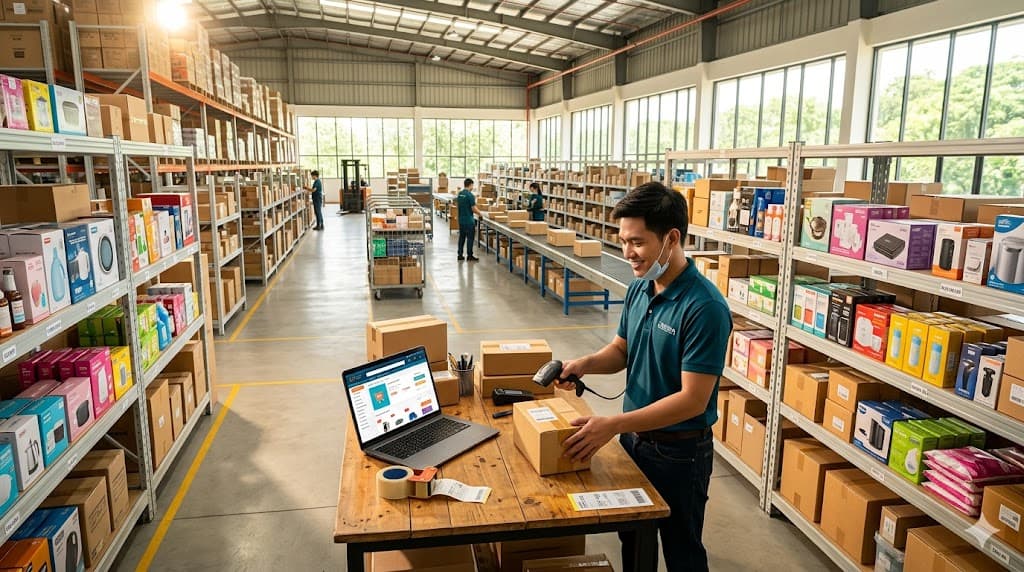
 Many Philippine retailers juggle multiple sales channels with small teams, making manual processes hard to sustain
Most Philippine SMEs run their online shops with small teams. The same person handling Messenger replies is updating product listings and coordinating with suppliers. As order volume grows, that setup breaks. Inventory counts get out of sync, response times slow, and marketing efforts turn scattered instead of targeted.
The core issue is not effort. Manual processes simply cannot keep up with the speed e-commerce now demands.
Related: Smart Search and Recommendations for E-Commerce explains this in detail.
Why Traditional Approaches Hit a Ceiling
| Traditional Method | Key Limitation |
|---|---|
| Manual product recommendations | Staff cannot analyze browsing behavior for thousands of visitors |
| Spreadsheet-based inventory | Updates lag behind real-time sales, causing stock mismatches |
| Generic email blasts | Low open rates because content is not tailored to individual buyers |
A typical Philippine online retailer runs inventory in spreadsheets, marketing on Facebook, and customer support in a shared Messenger inbox. Each tool works in isolation. The breaks happen at the seams.
Take product recommendations. A sari-sari store owner knows her regulars by name and remembers what each one usually buys. Online, that personal touch disappears once you have hundreds of visitors a day. Manually curating "you might also like" blocks for each segment is simply not realistic past a few dozen products.
Inventory management follows the same pattern. When a store sells across its own site, Shopee, and Facebook Marketplace, keeping stock counts synced by hand invites mistakes. A product shows as available on Shopee after it has already sold out on the website, the order gets cancelled, and the customer writes a one-star review. That sequence repeats quietly every weekend.
I saw this same pattern of repetitive confirmation tasks eating the day in my 2000s SEO and affiliate operations in Japan. Checking search rankings for 100 keywords took an hour every morning. Monthly report compilation took a full working day. Those hours should have gone into rewriting landing pages and calling clients. E-commerce retailers face the same structural problem today, just with packaging and stock counts instead of rankings. Our piece on smart search and recommendation for Philippine e-commerce covers the discovery side of the same coin.
How AI Technology Transforms Online Retail Operations
| AI Application | What It Does for Retailers |
|---|---|
| Recommendation engines | Analyze browsing and purchase patterns to suggest relevant products automatically |
| Demand forecasting | Predict which products will sell and when, reducing overstock and stock-outs |
| Chatbots and virtual assistants | Handle common customer questions around the clock in English and Filipino |
AI suits the repetitive, data-heavy tasks that slow down e-commerce operations. Instead of replacing human staff, it handles the high-volume pattern matching that people cannot do at scale.
 AI recommendation engines and demand forecasting tools help retailers automate tasks that are impossible to handle manually at scale
A recommendation engine watches what each visitor clicks, adds to cart, and buys. It notices patterns — customers who buy baby bottles also buy sterilizers, shoppers who view raincoats often buy umbrellas — and surfaces those suggestions on the product page automatically. The concept is simple; doing it by hand for thousands of SKUs is impossible.
Demand forecasting combines your historical sales with signals like seasonal trends and promo calendars to predict near-term demand. For a Philippine retailer getting ready for 11.11 or 12.12 shopping festivals, this means ordering the right quantities from suppliers several weeks ahead instead of guessing.
Customer support chatbots handle the repetitive questions that burn staff time: "Where is my order?", "Do you have this in medium?", "What is your return policy?" All follow predictable patterns. In my 2000s SEO business, the single most time-consuming task was answering "Why isn't my site ranking higher?" Preparing FAQ templates cut the time on each reply by roughly two-thirds. The same approach works in e-commerce — AI handles the predictable questions while staff focus on issues that need judgment and empathy. Our deeper look at AI chatbots for Philippine SMEs covers the chatbot side in full.
Related: AI Smart Search for Philippine Online Stores explains this in detail.
A Step-by-Step Path to AI Integration
| Phase | Timeline | Focus |
|---|---|---|
| Assessment and planning | Month 1–2 | Identify highest-impact area; define success metrics |
| Pilot implementation | Month 2–4 | Deploy one AI tool; monitor results against baseline |
| Expansion and optimization | Month 4–6 | Scale to additional areas based on pilot learnings |
The most common mistake with AI adoption is trying to automate everything at once. From managing projects with significant budgets as a client, I learned that successful implementations need clear upfront requirements and phased delivery. Vague requests like "just automate everything" consistently produced systems that technically worked but did not fit actual business workflows.
 A phased approach with clear metrics at each stage keeps AI adoption manageable for Philippine SMEs
Phase 1: Pick one high-impact area. For most Philippine e-commerce SMEs, customer support chatbots offer the fastest return. Tools like Tidio or Zendesk AI have entry plans starting around PHP 1,500 to PHP 3,000 per month. Before choosing the tool, document the current process — daily inquiry count, percentage of repetitive questions, and average response time.
Phase 2: Implement with clear metrics. Set specific targets: cut average first-response time from four hours to under 30 minutes, or handle a specific percentage of inquiries without human intervention. Run the pilot for at least eight weeks so the numbers mean something.
Phase 3: Expand based on evidence. If the chatbot pilot shows clear results, move to the next area — product recommendations or inventory forecasting. Each expansion follows the same pattern: document current state, set measurable goals, implement, review.
One discipline runs through every phase: AI settings and decision criteria must be documented so any team member can maintain the system. I learned this the hard way during acquisition negotiations for one of my Japan-based web platforms in the 2000s. The potential buyer rated the operation as high handover risk because too much of the system depended on my personal knowledge. That single finding killed deal value, and it stays with me as a rule for every system I help set up.
Related: AI-Powered Websites That Win More Customers explains this in detail.
What Returns Can Philippine Retailers Realistically Expect?
| Area | Realistic Expectation |
|---|---|
| Customer support efficiency | Noticeable reduction in response time and staff workload on routine inquiries |
| Conversion rates | Gradual improvement as personalized recommendations reach more visitors |
| Inventory costs | Fewer stock-outs and less dead stock through better demand prediction |
Honest expectations matter. AI integration does not produce overnight change. Philippine SMEs should expect gradual, measurable improvement rather than sudden results.
For customer support, the first visible effect is response time. When a chatbot handles common questions instantly — including outside office hours — customers get answers faster, and staff focus on cases that actually need a human. For a store that sells across time zones, that after-hours capability alone often justifies the monthly tool cost.
Product recommendation engines typically show results over weeks as they accumulate real behavior data. The effect compounds: better recommendations drive higher basket sizes, more basket data improves the model, and the next month looks a little better than the last.
Inventory forecasting benefits depend heavily on clean historical data. Retailers who have tracked their sales systematically will see results faster than those starting from scratch. The time spent cleaning and organizing existing data upfront is worth more than buying a better algorithm later.
Cost-wise, many AI tools for e-commerce run on subscription, ranging from PHP 1,500 to PHP 15,000 per month depending on features and scale. For a small retailer doing PHP 500,000 or more in monthly sales, even modest gains in conversion or reduced dead stock can cover subscription costs within a few months. Our broader overview of AI-powered websites for Philippine SMEs puts these numbers in the context of the wider digital stack.
FAQ
Q: Do I need technical staff to implement AI tools for my online store?
A: Most modern e-commerce AI tools are built for non-technical users and set up through visual interfaces. What matters more than technical skill is having someone on your team who understands the business — the person who can decide what questions the chatbot should answer, which products to prioritize in recommendations, and what inventory thresholds matter. For heavier integrations, Philippine IT freelancers on OnlineJobs.ph can help at reasonable rates.
Q: Will AI chatbots work well for Filipino customers who mix English and Tagalog?
A: This is a real challenge. Current AI chatbot platforms handle English well, and some support Filipino. Code-switching — mixing languages in one sentence, which is very common in Philippine online shopping — is where performance varies by provider. Test any chatbot with realistic Taglish conversations before committing. Start with English-language support and add Filipino-language handling as the technology matures.
Q: How do I protect customer data when using AI tools?
A: Choose AI vendors that comply with the Philippine Data Privacy Act of 2012 and store data in encrypted environments. Review each vendor's data processing agreement before signing up. Avoid sending sensitive customer financial data to general-purpose AI tools like ChatGPT — use purpose-built e-commerce AI platforms that are designed for customer data from the start.
Q: What is a reasonable starting budget for AI e-commerce tools?
A: A Philippine SME can start with a basic AI chatbot and a simple recommendation engine for roughly PHP 3,000 to PHP 8,000 per month combined. That is comparable to hiring a part-time support agent but provides 24/7 coverage. Scale spending only after you have evidence that the initial tools are moving the numbers — subscription costs add up fast if nobody is watching the dashboard.
Q: Can AI help me compete with Lazada and Shopee?
A: AI will not match the scale of the major marketplaces, but it can help you compete on personalization and customer experience. Large platforms treat most sellers as interchangeable. An independent store using AI for personalized recommendations, fast support, and smart inventory can offer a more curated shopping experience that builds real customer loyalty over time — something a Shopee storefront structurally cannot do.
Your Next Move Toward a Smarter Online Store
Philippine e-commerce keeps growing, and the retailers who invest in AI-assisted operations now will be better positioned as competition intensifies. Do not overhaul everything at once. Start with one defined area, measure the results, and expand from there.
Pick the single biggest bottleneck in your current operation — slow customer responses, poor product discovery, or inventory mismatches. Research two or three AI tools that target that specific problem, run a pilot for two months, and let the data guide the next step. If you need help selecting the right tools or planning the rollout, PH AI Works can help you evaluate options that fit your budget and business goals.
Sources & References
- Philippine Statistics Authority, "Philippine E-Commerce Statistics," 2024
- National Privacy Commission, "Data Privacy Act of 2012 (Republic Act No. 10173)," NPC Website
- Statista, "E-Commerce — Philippines," 2025, Statista Philippines E-Commerce
About the author
Founder / AI Engineer (36+ years in IT)
- ●From Tokyo · based in Manila for 13+ years
- ●36+ years in IT (development, SEO, AI)
- ●IBM Certified Generative AI Engineer
- ●AI chatbots, RAG & AI agent development
A Japanese AI engineer with 36+ years in IT and 13+ years on the ground in the Philippines. I write from hands-on experience to help Japanese companies adopt AI that actually delivers results — chatbots, workflow automation, AI agents, and AI-driven marketing. Feel free to reach out in Japanese or English.
Your Competitors Are Already Using AI!
Is your business keeping up?
Related Articles

LoRA Fine-Tuning: Custom AI Without a Big Budget
How Philippine SMEs use LoRA fine-tuning to build custom AI with small data, modest hardware, and control over their own use cases.
7/8/2026

Generative AI for Philippine SMEs: Cut Costs, Save Time
Five ways generative AI cuts cost and time for Philippine SMEs, six steps to roll it out, and what results are realistic.
7/6/2026

Philippine AI Solutions Competing Worldwide
Philippine-built AI is gaining attention abroad. How local SMEs use AI and modern technology to compete globally.
6/27/2026

AI Chatbot for Philippine SMEs: Multilingual Support
An AI chatbot that handles customer service in English, Filipino, and Taglish 24/7 — what it costs, how to set one up, and when to build custom.
6/26/2026
AI for Sari-Sari Stores: Smarter Micro-Retail
Behind SariSari Bench, an AI app built for Philippine micro-retailers — the technology, the build, and the results owners can expect.
6/25/2026

Finding Internal Data Faster With LangChain
How Philippine businesses build accurate AI search over their own internal documents with LangChain and Pinecone.
6/19/2026