
Talking About AI Layoffs Without Sparking Backlash
How to tell employees about AI adoption — what the Standard Chartered CEO's misstep shows about messaging that fails.


AI Engineer · 36+ years in IT · Japanese, based in Manila for 13+ years
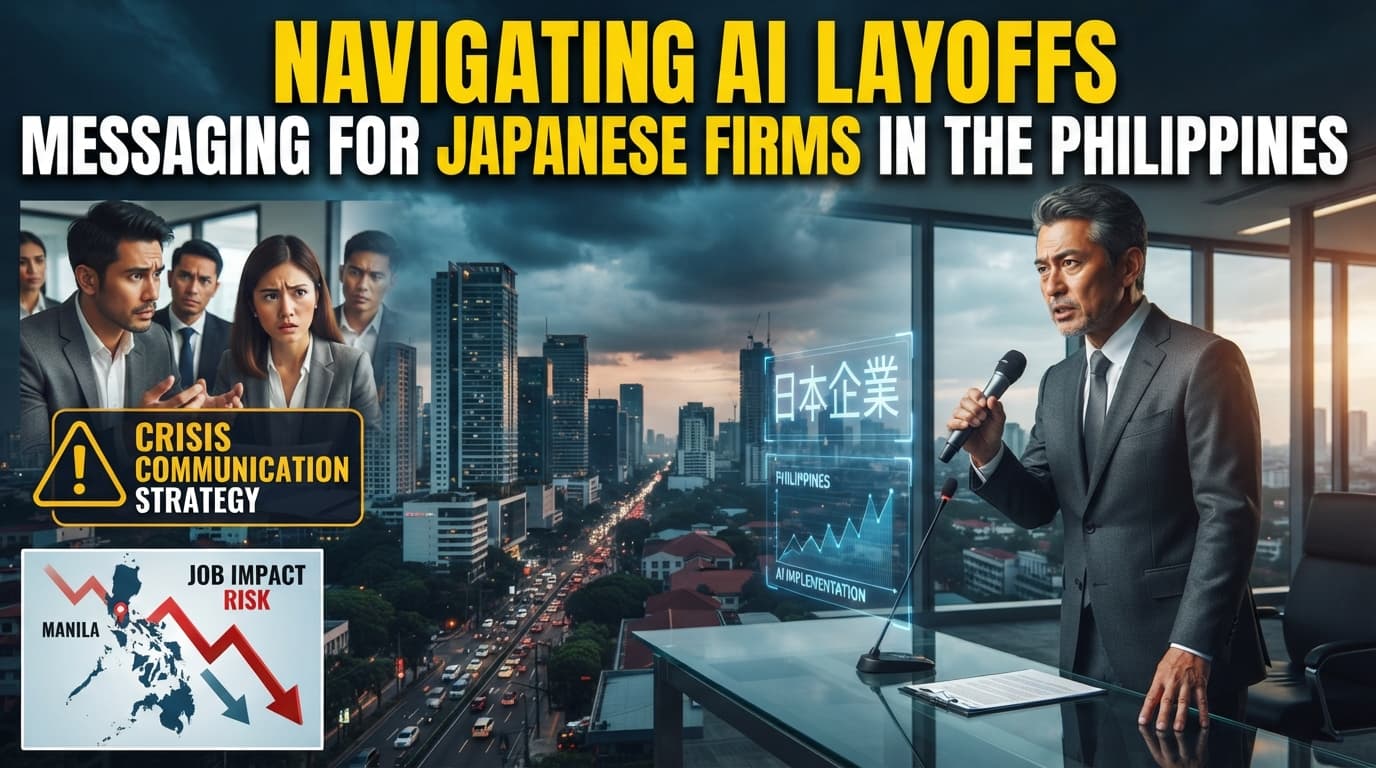
From the Standard Chartered CEO's "low-value people" remark, we learn how to communicate AI adoption to employees. Here we've organized messaging and practical procedures that won't cost you trust on the ground in the Philippines.
Part 1: Why This Matters
Step 1: The Philippine Business Context (3 min)
The Philippines is a country where outsourced work such as call centers and accounting (BPO—the model of handing a bundle of business processes to an outside firm) has grown into one of the largest of its kind in the world. Many Japanese companies, too, base their administrative centers and outsourcing operations in Manila and Cebu, supported by local staff. Some of this work is also in an area easily affected by automation through AI.
That's precisely why "how to communicate it to employees" matters more than ever, not just "how to adopt AI." The original article takes up an incident in which the chief executive officer (CEO) of the major UK bank Standard Chartered drew heavy criticism for the way he described replacing people with AI, calling them "low-value human capital." It's a lesson that a single misstep in messaging can ruin an initiative that was supposed to be positive.
In Philippine workplaces, a culture of protecting people's face and valuing harmony in the moment runs deep. Language in which management talks about people in terms of "high or low value" cuts deep into local staff, and it spreads in an instant by word of mouth. A single remark made with a head-office Japanese mindset risks costing you local trust.
Monday morning, your office in Manila. A Japanese manager turns to a local team leader: "Apparently next week headquarters is going to announce a 'headcount review through AI adoption.' Did you hear how a London bank's CEO sparked a backlash with a similar story last week? Depending on how it's phrased, the mood on the ground could chill in an instant. Before the announcement, I want us to think together about how we tell our local staff." This learning material was made precisely to be shared with colleagues in exactly such a moment.
Step 2: Key Points From the Original Article (5 min)
Here are the facts reported in the original article, organized into a table for learning.
| Item | Fact | What we can learn from it |
|---|---|---|
| Who made the remark | Bill Winters, CEO of the London-based major bank Standard Chartered | The higher up the leader, the farther their words travel |
| The problematic remark | Said AI would replace "low-value human capital" | Phrasing that ranks people by value invited backlash |
| The reaction | The remark drew backlash outside the company too, with labor unions and authorities voicing concern over the impact on jobs | A single word stirs multiple stakeholders at once |
| The apology | He spent several days explaining himself afterward, but the criticism didn't subside | After-the-fact explanations make it hard to win back lost trust |
| Share price movement | After the remark, the share price rose on the Hong Kong market | Short-term market valuation and on-the-ground trust are different things |
| The subsequent trend | According to CNBC, of companies that cited AI as a reason for layoffs, more than half saw their share price fall after the announcement | Investor-facing explanations don't necessarily pay off in the long run |
| The overlooked fact | The bank had been retraining some employees who needed to be reassigned due to a systems overhaul in Hong Kong | Even a good initiative can be buried by a single blunder |
This table was created for learning purposes based on facts from publicly available information. For details, please check the original article at the link above.
Related: GM's 50 FANUC Robots: Automation and Jobs explains this in detail.
Step 3: Comprehension Check (5 min)
Q1. What was the expression CEO Winters used that triggered the backlash? Hint: It was a turn of phrase that sorts people by "value."
Q2. After the problematic remark, how did the share price move on the Hong Kong market? Hint: It moved in the opposite direction from the backlash on the ground.
Q3. According to CNBC's analysis, what trend was seen in the subsequent share prices of companies that laid off staff citing AI? Hint: The figure "a bit over half" is the key.
Q4. What is the name for the psychological mechanism Harvard professor Sucher pointed to—rephrasing people as if they were machines? Hint: It relates to the desire to keep thinking of oneself as a good person.
Q5. The "biggest harm to the company" from such a blunder was explained as which kind of impact, on whom? Hint: Focus not on those who left, but on those who remained.
Related: Meta's AI Restructuring: Redesigning Work on Site explains this in detail.
Part 2: Putting It Into Practice
Step 4: Implementation Steps in the Philippines (10 min)
Here are the steps for advancing a headcount review tied to AI adoption without chaos on the ground in the Philippines. Each step comes with points unique to the local setting.
| Step | What to do | Philippine-specific points |
|---|---|---|
| 1. Think about your audiences separately | Prepare separate wording for investors, for headquarters, and for local staff | Don't carry the phrasing of management meetings straight into the local setting |
| 2. Re-choose your words | Avoid words that rank people, like "low-value," and explain concretely how the work will change | Out of care for a face-conscious culture, choose phrasing that doesn't negate people |
| 3. Prepare retraining and reassignment first | Get ready to present new roles and training options at the same time as the announcement | Budget training costs in pesos early, and make a realistic plan in line with local price levels |
| 4. Follow the law in your procedures | If layoffs are unavoidable, observe the prescribed notice and severance procedures | Confirm the notice period and severance rules set by the Department of Labor and Employment (DOLE), and proceed in writing |
| 5. Support the staff who remain | Even after the announcement, face the anxieties of remaining employees and talk with them frequently | Don't leave it at verbal promises; put what's been decided in writing too |
Step 5: Common Mistakes and How to Avoid Them (5 min)
Mistake 1: "Using the language of management meetings as-is on the ground"
Phrasing aimed at investors or headquarters tends to talk about people as resources. Convey that as-is to local staff, and it makes them feel they're being treated like objects.
Bad example: You notify everyone by company-wide email with nothing more than "we will replace low-value-added work with AI."
Good example: You convey the substance of the change concretely: "We want to hand routine tasks that have taken a lot of time to AI, so that all of you can put your energy into things like handling consultations and proposing improvements."
Mistake 2: "Blaming all the layoffs on AI"
If you explain layoffs that are really driven by other circumstances as "because of AI," it may resonate with investors, but you lose trust later when the reality comes out. This is taken as a pretense that uses AI as an excuse (AI-washing).
Bad example: A layoff aimed at cost-cutting is announced externally, rephrased as "part of our AI strategy."
Good example: You explain the real reason for the layoff honestly, and then, separately, convey how AI will change which work going forward.
Mistake 3: "Forgetting to care for the staff who remain"
If you focus only on those being let go, you overlook the anxiety of the people who stay in the workplace. When those who remain feel "I might be next," motivation drops, and your best people start leaving.
Bad example: You think the response is done once the announcement is over, and explain nothing afterward.
Good example: After the announcement, you set up small-group conversations and repeatedly, carefully explain the outlook ahead and each person's role.
Related: The Automation Illusion: When AI Never Reaches the Floor explains this in detail.
Part 3: Going Deeper
Step 6: Related Technical Terms (5 min)
AI-washing is making a decision that really has little to do with AI look better than it is by explaining it as if it were thanks to, or driven by, AI. If, at a Philippine base, you report a cost-driven layoff to headquarters rephrased as "an AI-advancement initiative," that falls into this category.
Moral disengagement is the psychological mechanism by which, when making a painful decision, a person justifies that decision in their own mind in order to keep believing they're a good person. If a manager in Manila eases their own pain by rephrasing "cutting people" as "adjusting resources," this mechanism can be said to be at work.
Human capital is the view of seeing the knowledge, experience, and skills employees hold as valuable assets to the company. It's a convenient term, but caution is needed: used on the ground in the Philippines as material for talking about people as "high or low value," it hurts the other person.
Reskilling is having employees whose roles change due to technological shifts learn the skills to handle new work. At a call center in the Philippines, retraining staff into roles handling difficult consultations—to the extent AI takes over routine responses—is an example of this.
Employee attrition is the phenomenon of the workforce gradually shrinking through departures and the like. If you mishandle the messaging around AI adoption and anxiety rises in the workplace, hiring becomes harder in the Philippines too, more people leave, and the operation stops running smoothly.
Step 7: Thinking About Application to Your Own Company (10 min)
Inspect the gap between your company's "management language" and "frontline language"
Thinking hint: Pull out one recent internal notice and imagine how local staff would feel reading it as-is. Looking for whether investor-facing expressions have crept in reveals points to improve.
Design the very first words you say when telling employees about AI adoption
Thinking hint: What you say at the very start of the announcement greatly changes how everything afterward is received. Think about whether you can lead with the purpose of the change and the benefit to employees, in phrasing that doesn't negate people.
Consider whether you can craft a story of reskilling rather than layoffs
Thinking hint: Standard Chartered, too, had a good story of retraining. Try writing out whether your own company has a story of connecting the capacity freed up by AI to new roles.
Next action: At your next team meeting, have everyone bring a draft of an internal announcement about AI, split into "local staff" and "management" roles, read it aloud to each other, and mark the expressions that trip you up.
Part 4: FAQ
Q1. Is it fine to use an announcement written by headquarters in Japan as-is at the Philippine base? It's safer to avoid using it as-is. When the soft phrasing characteristic of Japanese is translated into English or a local language, it can come across colder than intended. Together with local management, re-choose the words to fit the culture.
Q2. Should we honestly tell local staff that AI has reduced their work? We recommend telling them honestly. Even if you hide it, rumors spread, and you lose trust when the reality comes out later. It's important to also convey concretely what is changing and what options the person has.
Q3. When layoffs are unavoidable in the Philippines, what should we be careful about? The basics are observing the notice period and severance procedures set by the Department of Labor and Employment (DOLE). Carry out procedures in writing, and don't leave things at verbal promises. Confirm the detailed conditions with your internal legal team or a local expert.
Q4. What specifically should we do for "caring for the staff who remain"? After the announcement, create settings where you can talk in small groups, and repeatedly explain the outlook ahead and each person's role. In Philippine workplaces, one-on-one or small-group conversation more easily builds trust, so don't leave it at a large-audience notice.
Q5. If the share price rose, wasn't Winters's remark a success? Short-term share price and on-the-ground trust are separate matters. The original article, too, notes that a bit over half of companies that laid off staff citing AI saw their share price fall afterward. If the motivation of the employees who remain drops, it's a loss for the company over the long run.
Tips for Making the Most of This (3 Tips)
Reread the text as the "local staff" before announcing Before issuing an internal notice, have one person read it aloud as if they were local staff. If management language has crept in, they'll feel the wrongness the moment they read it. A single read-through before issuing it is the cheapest insurance against a backlash.
Talk about it as a change in "work," not in "people" Rather than ranking people by value, explain concretely which tasks change and how. With the same content, just switching to phrasing that doesn't negate people greatly changes how it's received.
Don't end at the announcement; keep the conversation going The biggest harm, the original article points out, is the drop in motivation among the employees who remain. It's precisely after the announcement that you should set up small-group conversations and face anxieties frequently. A sustained stance protects trust.
Bonus: How to Make Use of PH AI Works
PH AI Works is a company that supports the use of AI and technology in the Philippines. On this article's theme—"how to communicate AI adoption to the front line"—we can help not only with selecting technology but all the way to crafting internal messaging that fits local culture and law.
As a next step, you can consult us on things like the following:
- Reviewing the draft of an internal announcement tied to AI adoption so it fits the words of the Philippine front line
- Sorting out how to divide roles between AI and employees at bases such as call centers and accounting outsourcing
- Consulting on how to proceed with a headcount review in a way that's mindful of local law and culture
Please feel free to get in touch. The initial consultation is free.
References & Sources
About the author
Founder / AI Engineer (36+ years in IT)
- ●From Tokyo · based in Manila for 13+ years
- ●36+ years in IT (development, SEO, AI)
- ●IBM Certified Generative AI Engineer
- ●AI chatbots, RAG & AI agent development
A Japanese AI engineer with 36+ years in IT and 13+ years on the ground in the Philippines. I write from hands-on experience to help Japanese companies adopt AI that actually delivers results — chatbots, workflow automation, AI agents, and AI-driven marketing. Feel free to reach out in Japanese or English.
Free AI Consultation
Tell us your challenges and we'll propose the right AI adoption plan for your business.
Book a Free 30-Minute ConsultationRelated Articles
AI Model Vendors Now Sell Implementation Too
OpenAI and Anthropic now sell implementation as well as models. What a local subsidiary should decide about that.
8/18/2026
Contracting for AI While Prices Keep Falling
Write a model number into the contract and it is obsolete in six months. How to design for switching instead.
8/17/2026

Meta Cut 750,000 Under-16 Accounts in Australia
AI-assessed age checks removed 750,000 accounts overnight. What that says about depending on platforms for reach.
8/16/2026

When an AI Calls Your Shop to Ask About Stock
AI now phones shops on a buyer's behalf to check stock. What to decide on the receiving side before it reaches you.
8/15/2026

Handling News That Is Not Settled Yet
A reported $6 billion acquisition talk is not a completed deal. How to act on industry news before it is confirmed.
8/14/2026

What a 69-Page AI Report Does Not Show
Frontier firms are reported 8.3x ahead, yet a table on page 35 shows no statistically significant link to revenue.
8/13/2026