
Avoiding Backlash From AI-Generated Social Posts
A US bagel shop's AI-written posts triggered a backlash. The pitfalls, and the review steps that prevent the same outcome.


AI Engineer · 36+ years in IT · Japanese, based in Manila for 13+ years
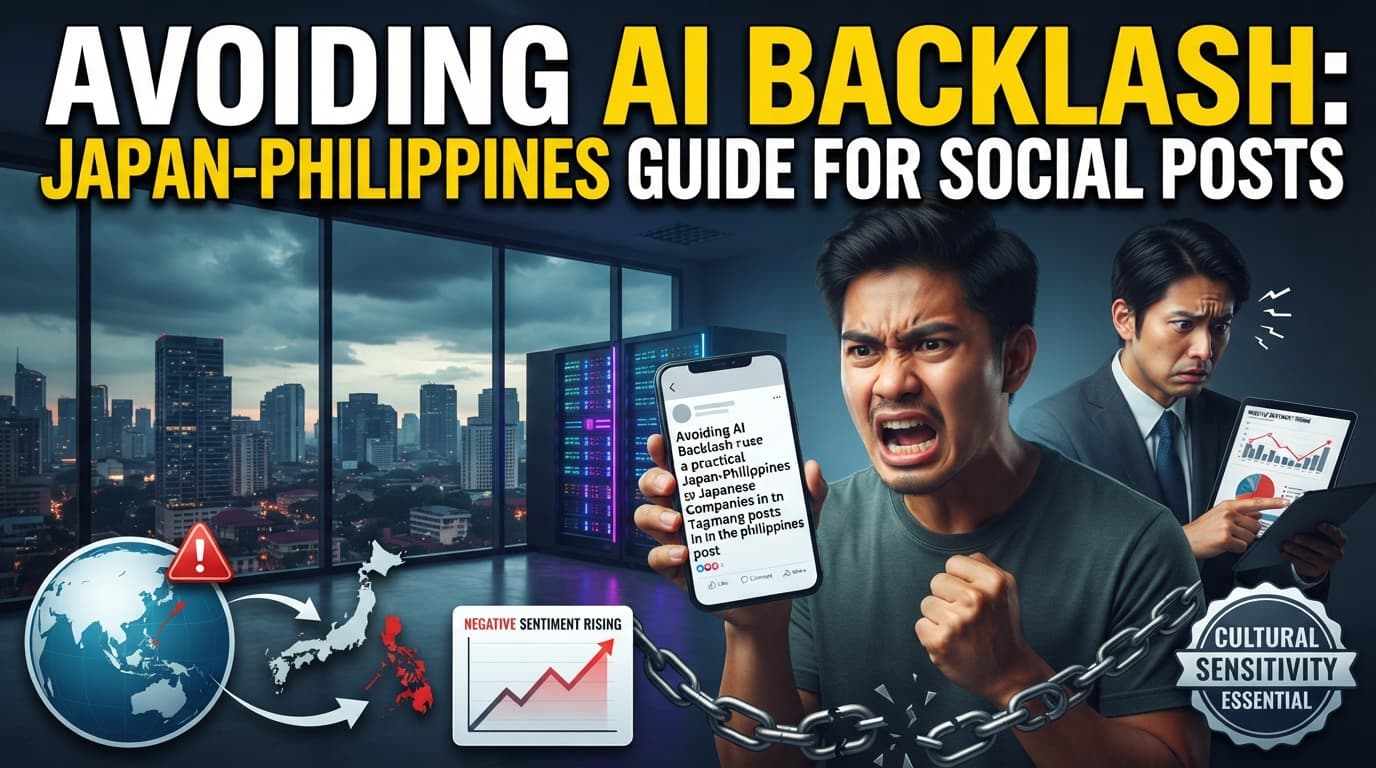
Using a U.S. bagel shop's AI backlash case, this material teaches the pitfalls and practical steps for Japanese companies using generative AI in social media marketing in the Philippines.
Part 1: Why This Matters
Step 1: The Philippine Business Context (3 min)
The Philippines is one of the world's heaviest users of social media. Facebook, Instagram, and TikTok have become indispensable not only as a means of personal communication but also as a way for restaurants, retailers, and service businesses to attract customers. For Japanese companies running Japanese restaurants, cafes, and variety stores in Manila and Cebu, posting on social media is an important activity that can determine sales.
At the same time, while editing images and writing posts with generative AI is convenient for the operator, it carries the risk of being taken by customers as "deception" or "dishonesty." Philippine consumers have a strong word-of-mouth culture, and Google reviews and comments on Facebook pages directly influence new customers' decisions. Rather than "bringing the Japanese way of doing things over as is," Japanese expatriates need to learn a way of using AI that matches local sensibilities.
[Scene setting] An office in Bonifacio Global City, Manila. An instruction came from the Japanese head office: "Let's use AI tools for social media operations to cut costs." Tanaka, the marketing lead, shares with a colleague an article about a Vermont bagel shop in the U.S. that did the same thing and faced backlash, and says, "Philippine customers value word of mouth, so let's decide carefully how we adopt it."
Step 2: Key Points from the Source Article (5 min)
| Item | Details |
|---|---|
| Shop name and location | Myer's Bagels (Burlington, Vermont, USA) |
| Owner | Adam Jones (age 53) |
| Business type | A Montreal-style bagel specialty shop with about 22 employees |
| Purpose of adopting AI | Support for creating social posts (Instagram). Had the AI generate post ideas for the graduation season, among others |
| The edits the AI made | Composited a wood-fire flame and a wooden cutting board that didn't exist onto a photo of the shop. Converted a comment by a real customer, "Sam," posted in a Google review into a handwritten-style note and composited it in |
| Customer reaction | More than 25–30 critical comments per post in the Instagram comments. Multiple one-star low ratings on Google reviews, citing not the food but the use of AI |
| Owner's response | Deleted the posts in question and apologized. However, he stated he is "not anti-AI" and intends to keep using it in other areas of the business |
| Publication date | May 16, 2026 |
This table was created for learning purposes based on facts in publicly available information. For details, please check the original article at the link above.
Step 3: Comprehension Check (5 min)
Q1. What is the regional style of bagel that Myer's Bagels offers, which differs from the New York style?
Hint: It's named after a Canadian city to the north. It's characterized by a short fermentation time and being baked over a wood fire.
Q2. On which platform did customers leave low ratings in response to the AI-composited posts?
Hint: It's a review service displayed alongside search results. Ratings use stars.
Q3. Where was the "Sam" comment that the AI used for compositing originally obtained from?
Hint: The source article lists three candidates (Google, Yelp, and an old Instagram comment).
Q4. How did the owner, Adam Jones, change his AI usage policy after facing criticism?
Hint: He didn't ban it outright. The tone is "be careful on social media."
Q5. What does Adam Jones cite as a problem with the people he had previously entrusted with social media operations?
Hint: The key points are the local characteristic of being a college town and the reason they don't stay long.
Related: Generative AI, Likeness, and Personal-Data Risk explains this in detail.
Part 2: Putting It into Practice
Step 4: Steps for Adoption in the Philippines (10 min)
If you're going to do social media operations or marketing using AI in the Philippines, here are the adoption steps for avoiding the same mistakes as the U.S. case.
| Step | Details | Philippine-specific note |
|---|---|---|
| 1. Separate by use | First draw the line between "areas where it's fine to create with AI" and "areas a human must always create." A safe division is AI for post drafts and analysis, and humans for images that handle customer voices. | Philippine customers value the shop's personality and story. Avoid AI generation for celebratory or religion-related posts. |
| 2. Establish disclosure rules | Create an internal rule that images and text generated or edited with AI are clearly labeled "AI assisted." | Under the guidelines of the NPC (National Privacy Commission, the government agency that administers personal information), reconstructing an individual's name or review with AI may require that person's consent. |
| 3. Set a monthly budget | AI marketing tools for small and medium-sized businesses typically run about 1,500–5,000 pesos a month. Treat the first three months as a trial run for your investment. | Because many cloud services aren't billed in pesos, build a 15% cushion into the budget to account for FX fluctuation. |
| 4. Brief Filipino staff | Hold a briefing for your local social media staff (often new graduates to people in their twenties) explaining not to use AI output as is. | In the Philippines, even when someone verbally replies "Yes, sir/ma'am," they may not actually understand. Confirm by showing concrete examples. |
| 5. Complaint-handling playbook | Prepare a first-response manual for when criticism appears in the comments. Decide in advance who has the authority to delete a post, and prepare draft wording for an apology. | Backlash in the Philippines spreads quickly through Facebook groups. Set up a structure that can respond within 24 hours. |
Step 5: Common Mistakes and How to Avoid Them (5 min)
Failure pattern 1: "Turning a real customer review into an AI image and posting it"
Bad example: Having the AI generate a customer's name and text from a Google review as a handwritten-style note image, and posting it on the shop's Facebook page without permission.
Good example: Before turning a real customer's name or review text into an image, always contact the person by message and obtain written permission, asking, "May we share your feedback?" Only when permission is obtained, present it in the form of the actual handwriting or a screenshot.
Failure pattern 2: "Embellishing the inside of the shop with AI"
Bad example: Even though you actually bake in a gas oven, you composite a wood-fire flame in the background with AI and post it as an atmospheric image. Customers who visit then write in reviews, "It's different from the photo."
Good example: Have your photographer take pictures in the actual kitchen and shop interior. Keep it to fine adjustments of lighting and color tone, and don't do edits that add equipment or materials that don't exist.
Failure pattern 3: "Using it without clearly stating it's AI-generated"
Bad example: You put out a post introducing AI-generated fictional staff illustrations as "this is our team," and customers press you, "Who are these people?"
Good example: When using AI-generated illustrations or images, clearly state "image for illustration (AI-generated)" in the caption. For introducing real staff, always use photos taken with the person's permission.
Related: Generative AI for Social Media in the Philippines explains this in detail.
Part 3: Going Deeper
Step 6: Related Technical Terms (5 min)
Generative AI is artificial intelligence that can create text, images, audio, and more from scratch. A Manila cafe chain uses it to quickly produce descriptions for new menu items and banner-image ideas for seasonal campaigns.
Prompt is the instruction text used to tell generative AI "I want you to produce output like this." At a Japanese-affiliated BPO (a company that takes on outsourced business work) in Cebu, prompt design for switching output between English and the local Tagalog when creating internal inquiry-response text is taught in employee training.
Deepfake is technology that uses AI to paste a real person's face or voice onto another video or audio clip. In the Philippines, it's treated as a term that in-house social media monitoring teams at banks and insurance companies should know, so they can quickly notice when fake videos impersonating their own executives circulate.
Image composition is processing where AI combines multiple photos or materials to add elements that weren't in the original image. Manila real estate companies are increasingly using it to create completed-look images of properties still under construction, but a practice of clearly labeling them "artist's rendering of the completed building" is spreading to avoid misunderstanding.
Social media monitoring is a mechanism for continuously tracking how your company's name or products are talked about in posts and comments. A Makati restaurant uses it to build a structure for detecting complaints written in Google reviews and comments within 24 hours, so the manager can reply directly.
Related: Generative AI Digital Marketing for Philippine SMEs explains this in detail.
Step 7: Thinking About How to Apply This at Your Company (10 min)
Create internal guidelines for AI-generated content
Prompt to consider: Among your social posts, separate and organize the scope you may create with AI (post drafts, seasonal-greeting illustrations, etc.) from the scope humans must always create (introducing customer reviews, introducing staff, real photos of food, etc.). Turning it into a single-page A4 checklist that local Philippine staff can refer to when they're unsure makes it easy to use on the ground.
Next action: Hold a one-hour meeting with your marketing lead next week and create a list in three categories: "AI use OK," "consult first," and "prohibited."
Re-confirm how you handle customer voices
Prompt to consider: Confirm whether your company has a permission-obtaining process for repurposing customer voices written in Google reviews or Facebook comments into promotional material. The Philippine NPC (the government agency that administers personal information) takes a strict stance on the commercial use of an individual's statements without their consent.
Next action: Have your local legal staff or a lawyer put together consent-obtaining wording (in Tagalog and English) for when you quote customer voices.
Prepare a first-response playbook for backlash
Prompt to consider: For when social media backlash occurs in the Philippines, decide in advance which staff member handles the first response, who reports to the Japanese head office, and at what timing posts are deleted. If this isn't decided, a delayed response invites further criticism.
Next action: Run one tabletop exercise based on Adam Jones's case with your Manila site's shop manager or marketing lead.
Part 4: FAQ
Q1. Is using AI for social media posts prohibited by law in the Philippines?
At present there is no law prohibiting the use of AI itself, but under notices from the NPC (National Privacy Commission), which administers personal information, using an individual's name or review text without their consent may run afoul of the Data Privacy Act of 2012. Always obtain consent before turning a real customer's name into an image.
Q2. Are Philippine customers harsher toward AI than Japanese customers?
It can't be said in a blanket way, but Philippine consumers have a strong word-of-mouth culture, and criticism tends to spread easily through Facebook comments. On the other hand, it's also a country with high interest in new technology. Many customers respond favorably to shops that are honest and don't hide their use of AI.
Q3. How should we indicate that an image is AI-generated?
It's best to note "AI assisted," "AI-generated image," or "image for illustration (AI-generated)" in both English and Tagalog at the end of the post. The younger generation in the Philippines understands an English label well enough, but for older audiences, having a local-language label is courteous.
Q4. The Japanese head office has instructed us to use AI, but there's pushback on the ground in the Philippines. How should we reconcile it?
Rather than an either-or of "full adoption" or "full ban," we recommend judging by use case. The division is to use AI for post drafts and analysis work, and have humans handle customer voices and real photos. Adam Jones, too, took the policy of being careful only on social media rather than a full ban.
Q5. What's the typical cost of AI marketing tools?
Social media management tools (with AI features) used by small and medium-sized businesses in the Philippines typically run about 20–100 US dollars a month (roughly 1,200–6,000 pesos). Factoring in FX fluctuation and the impact of VAT (12%), it's a good idea to build a 15–20% cushion into your annual budget.
Tips for Getting the Most Out of It (3 Tips)
1. Always ask yourself before posting, "How would I feel if it came out that this was made with AI?"
Put yourself in the customer's shoes and use as your benchmark whether they'd be disappointed to learn "oh, this was made with AI." In Adam Jones's case, trust collapsed the moment customers felt "this is different from how the shop really is." Honesty is decided not by whether you use AI, but by whether you can explain to customers how you use it.
2. Create the AI usage policy together with local staff
If the Japanese head office or Japanese expatriates decide the policy alone and impose it, the Filipino staff on the ground won't be on board with the operation. Involve your Manila or Cebu shop managers and social media staff and jointly create rules of "this is how our shop uses it," and it'll be easier to uphold on the ground.
3. Design your post-backlash response speed to be within 24 hours
Adam Jones deleted the posts and apologized immediately after facing criticism. This swift response kept the damage to a minimum. In the Philippines, too, social media backlash is a race against time. Decide in advance who has the authority to delete posts and who approves the apology text.
Bonus: How to Make Use of PH AI Works
PH AI Works provides AI-technology adoption support and consulting for Japanese companies doing business in the Philippines. Using AI in social media marketing and customer service is an area deeply tied to the theme of this material.
As a next step, you can consult us on things like the following.
- Support for creating use-case-based guidelines for bringing AI into your social media operations
- Putting in place a customer-data handling policy in line with the guidelines of the Philippine NPC (the personal-data-protection authority)
- Designing AI-use training programs for local staff
Please feel free to get in touch. The initial consultation is free.
References and Sources
About the author
Founder / AI Engineer (36+ years in IT)
- ●From Tokyo · based in Manila for 13+ years
- ●36+ years in IT (development, SEO, AI)
- ●IBM Certified Generative AI Engineer
- ●AI chatbots, RAG & AI agent development
A Japanese AI engineer with 36+ years in IT and 13+ years on the ground in the Philippines. I write from hands-on experience to help Japanese companies adopt AI that actually delivers results — chatbots, workflow automation, AI agents, and AI-driven marketing. Feel free to reach out in Japanese or English.
Free AI Consultation
Tell us your challenges and we'll propose the right AI adoption plan for your business.
Book a Free 30-Minute ConsultationRelated Articles
AI Model Vendors Now Sell Implementation Too
OpenAI and Anthropic now sell implementation as well as models. What a local subsidiary should decide about that.
8/18/2026
Contracting for AI While Prices Keep Falling
Write a model number into the contract and it is obsolete in six months. How to design for switching instead.
8/17/2026

Meta Cut 750,000 Under-16 Accounts in Australia
AI-assessed age checks removed 750,000 accounts overnight. What that says about depending on platforms for reach.
8/16/2026
When an AI Calls Your Shop to Ask About Stock
AI now phones shops on a buyer's behalf to check stock. What to decide on the receiving side before it reaches you.
8/15/2026

Handling News That Is Not Settled Yet
A reported $6 billion acquisition talk is not a completed deal. How to act on industry news before it is confirmed.
8/14/2026

What a 69-Page AI Report Does Not Show
Frontier firms are reported 8.3x ahead, yet a table on page 35 shows no statistically significant link to revenue.
8/13/2026