
Forward-Deployed Engineers at a Philippine Hub
How forward-deployed engineers drive AI adoption at a Philippine hub — what they do, and how the role is usually staffed.

AI Engineer · 36+ years in IT · Japanese, based in Manila for 13+ years
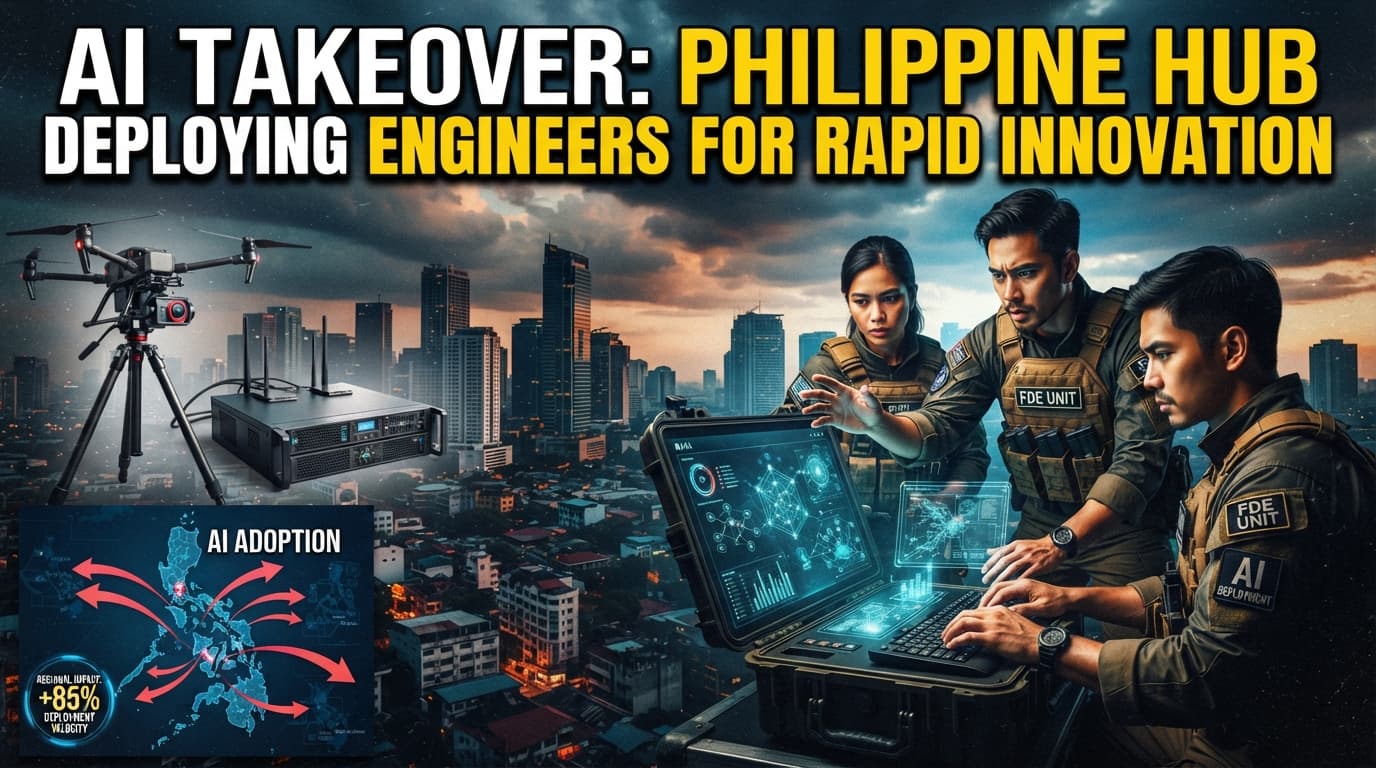
AI adoption stalling at the pilot stage is the problem the "FDE" role exists to solve. This piece looks at it from the position of a Japanese company in the Philippines: five concrete steps at a Manila hub, what it costs, and how to stay inside the data-protection law.
Part 1: Why This Matters
Step 1: The Philippine Business Context (3 min)
Many Japanese companies in the Philippines use Metro Manila and Cebu as BPO (business process outsourcing) hubs, shared-service centers (consolidated hubs for accounting and HR), and manufacturing bases. At these sites, AI adoption is emerging as a management issue, but you constantly hear that "we ran a PoC (pilot), but it never reached production."
The cause lies not in the AI model's performance but in the "adoption design" — how to build AI into the work. The reason major U.S. cloud providers are rushing to hire "forward-deployed engineers" (hereafter FDEs — engineers who embed at the customer to make AI adoption succeed) is precisely this challenge. For Japanese companies with Philippine hubs as well, whether to hold an FDE-type role in-house or source it externally becomes a deciding factor in the success of future AI use.
"Imagine a scene after the morning meeting at an office in Makati, where you consult the local IT head, Mr. Juan: 'Tokyo head office wants us to scale up AI adoption from next term. But last year's PoC ended in form only. This time I want to proceed with the FDE concept.' Mr. Juan tilts his head and asks, 'What's an FDE?' This material builds a foundation that lets you explain it to someone like Mr. Juan — and to Tokyo head office's management, too."
Step 2: Key Points from the Original Article (5 min)
We have organized the facts of the original article for business professionals at Philippine hubs.
| Item | Content |
|---|---|
| Definition of the term | Forward-deployed engineer (FDE). An engineer who embeds at a client company and supports AI adoption all the way to success |
| Google Cloud's move | In May 2026, CEO Thomas Kurian called for FDE hiring; the company had 1,513 job openings |
| OpenAI's move | Launched an organization called the "Deployment Company"; 31 FDE openings |
| Microsoft's move | In March 2026, announced a forward-deployment partnership with Accenture |
| Job growth rate | Per LinkedIn data, FDE-related openings grew 42-fold from 2023 to 2025 — standing out even against the 13-fold growth in AI engineer roles |
| Responsibilities | Strategic analysis, designing AI agents, model evaluation, building security and governance mechanisms, and collaborating with the customer's business experts |
| Underlying challenge | AI adoption failures at non-IT companies (lack of vision, lack of talent, lack of budget, underestimating complexity) |
| Future direction | A role accountable for outcomes rather than writing code; optimizing token costs also becomes a key duty |
This table was created for learning purposes based on facts from publicly available information. For details, please check the original article at the link above.
Step 3: Comprehension Check (5 min)
Q1. Is the main role of an FDE (forward-deployed engineer) to write code, or to make the customer's AI adoption succeed?
Hint: The original article explains that they "focus on the customer's successful outcomes rather than on writing code."
Q2. According to LinkedIn's data, by how many times did FDE-related job openings grow between 2023 and 2025?
Hint: It is a figure that greatly exceeds the 13-fold growth in AI engineer roles.
Q3. What does the original article cite as causes of AI adoption failing at non-IT companies? Name three or more.
Hint: Four factors are given — vision, talent, budget, and the complexity of adoption.
Q4. Which company did Microsoft form an FDE-related partnership with in March 2026?
Hint: It is a major global consulting and business-outsourcing firm.
Q5. What is one future role of FDEs suggested by the Gartner analyst in the original article?
Hint: It is work related to AI usage fees (the cost of processing units called tokens).
Related: OpenAI in the Philippines: An AI Adoption Strategy explains this in detail.
Part 2: Putting It Into Practice
Step 4: Adoption Steps in the Philippines (10 min)
We have organized the steps for driving AI adoption at a Philippine hub using an FDE-type role into five stages.
| Step | Content | Points specific to the Philippines |
|---|---|---|
| 1. Take stock of business challenges | Before using AI, narrow down to 3–5 business challenges you truly want to solve. Write them out by specific work name — BPO response quality, accounting invoice processing, HR applicant screening, etc. | Local staff have a deep-rooted culture of sharing challenges verbally, so carefully draw out undocumented complaints and operational workarounds |
| 2. Secure the FDE role | Decide whether to grow one in-house or commission an external support firm. The realistic approach at first is to combine an external FDE with a local manager | Monthly labor costs are trending up even in Metro Manila. For an experienced person, plan for a budget on the order of PHP 150,000–300,000 per month per person |
| 3. Build a small success case | Narrow to one department and one task and produce results in three months. Proceed with a clearly defined scope — for example, using AI for the initial triage of English inquiry emails | Under the Data Privacy Act of 2012 administered by the National Privacy Commission (NPC, the government agency in charge of data protection), be sure to confirm in-house consent-collection procedures when handling personal information |
| 4. Build governance | Decide who checks the results AI produces and who is responsible. Build in a mechanism to keep audit logs (records of operation history) at this stage too | Beyond head-office policy, we recommend recording it in the minutes of the local subsidiary's board. It serves as supporting material for later regulatory responses and audits |
| 5. Roll out and optimize costs | Spread success cases to other departments and tasks, and devise ways to hold down AI usage fees (token costs). Shortening prompts and choosing between lightweight models are key | Dollar-denominated AI usage fees fluctuate with exchange rates. Make peso-converted costs visible monthly and align them with head office's budget management |
Step 5: Common Mistakes and How to Avoid Them (5 min)
Mistake 1: "Passing Tokyo head office's instructions straight to the local site"
Bad example: You hand the AI adoption plan decided at the Japanese head office to the Manila team merely translated into English. Local work flows and language differences aren't reflected, the front line takes it as "this has nothing to do with us," and it becomes a dead letter.
Good example: Together with the local IT head, you create a version adapted to the Philippine work flow. In team meetings, you explain while showing concrete examples, and always make time for questions at the end.
Mistake 2: "Stuck at PoC (pilot), unable to move to production"
Bad example: You spend six months on an elaborate pilot, the demo succeeds, but because you hadn't decided the governance mechanisms and division of responsibility needed for production operation, it ends up shelved.
Good example: From the start, on the premise of production operation, you build something working in three months. Demand of the person in the FDE role, as the result, not a demo but "a state where it's built into actual work and can keep being used."
Mistake 3: "Putting data-protection considerations off until later"
Bad example: You input data containing customer information into an external AI service without checking. Later you become a target of an NPC investigation, and the local subsidiary's trust is damaged.
Good example: At the early adoption stage, you create criteria for judging, by type of data, "whether it may be input into AI." You set things so data isn't used for training, and ensure audit logs can be kept.
Related: Managing Agentic AI at a Development Hub explains this in detail.
Part 3: Going Deeper
Step 6: Related Technical Terms (5 min)
Forward-deployed engineer (FDE) is an engineer who embeds at the customer's site and sees AI adoption through to the end. When a Japanese insurance company adopts AI document review at a Manila BPO hub, the FDE plays the role of accompanying the project from designing the work flow to the start of operations.
Agent / agentic AI (AI that carries out work autonomously) is AI that, without being instructed one by one, carries out multiple steps on its own when simply given a goal. At a Cebu accounting shared-service center, it is beginning to be used as a mechanism that handles invoice reading, data entry, and sending approval requests in one continuous flow.
Token (the smallest unit by which AI processes text) is the unit into which AI divides text, and usage fees are also calculated by this token count. Because Japanese text tends to require more tokens than English, you need to be careful with cost estimates when using a mix of Japanese and English at a Manila hub.
Guardrails (mechanisms to prevent AI from running off the rails) are restrictions placed on both input and output so that AI doesn't give inappropriate answers. When using AI for customer service at a Manila call center, you'd set restrictions such as not including personal information in answers and not quoting figures without basis.
Outcome-based pricing is a mechanism where you pay for an AI service according to the results actually achieved, rather than usage time. In the Philippine BPO industry, performance-linked contracts have long been used in part, and this thinking is spreading in AI adoption support as well.
Related: Rising AI Prices: Cost Management for PH Operations explains this in detail.
Step 7: Applying It to Your Own Company (10 min)
Put into words why your AI adoption has stalled
Something to think about: If you have AI projects that ended at the PoC stage, try sorting their failure factors into the four categories of "vision," "talent," "budget," and "complexity." In many cases, multiple factors overlap.
Next action: List your AI-related initiatives over the past 24 months and create a one-page internal document that rates failure factors and restartability on a three-point scale.
Decide "who" plays the FDE role at the Manila hub
Something to think about: Who is best suited — a Japanese expatriate, the local IT head, or an external AI support firm? Comparing them along four axes — language, business understanding, technical skill, and cost — makes the decision easier.
Next action: For the three candidate patterns (expatriate-led / locally led / outsourced), summarize first-year costs and expected outcomes in a table, and propose it to the local subsidiary's management meeting.
Start making AI usage fees visible monthly
Something to think about: AI usage fees quietly balloon once you start using them. For a Philippine hub, dollar-denominated billing affects both pesos and yen, so you need a setup where head office and the local site can see the same figures.
Next action: Pull monthly usage fees (dollar-denominated and peso-converted) from the AI service's admin screen, and decide the format of a report shared between the local subsidiary and head office.
Part 4: FAQ
Q1. Which is better — growing an FDE in-house or sourcing one externally?
We recommend a two-stage approach: partner with an external support firm for the first one to two years and grow local staff in the meantime. In the Philippines, IT talent is highly mobile, and relying on a single in-house specialist tends to create a gap when they leave. Pairing an experienced external FDE with core staff who work locally for the long term makes knowledge more likely to stay in-house.
Q2. Will the time difference and language gap between the Manila and Japan teams be an obstacle to using FDEs?
The time difference is only one hour, and English is usable as a common language, so coordination is easier than with European or American hubs. However, if the Japanese head office keeps the habit of making decisions in Japanese documents, the translation burden falls disproportionately on the Manila side. Deciding a policy of creating the main FDE-related documents in English from the start speeds up local decision-making.
Q3. In relation to the data-protection law, how should we judge what data may be put into AI?
The Data Privacy Act of 2012, administered by the National Privacy Commission (NPC), sets procedures for obtaining consent when handing personal information to a third party and for cross-border data transfer. Because many AI services have servers overseas, be sure to create a procedure to consult your in-house data protection officer (DPO) before inputting customer information.
Q4. How much do the initial and operating costs of AI adoption come to in pesos?
It depends on the scope, but for a small-scale adoption targeting one department, many companies anticipate a first-year total on the order of PHP 3 million–8 million. External support costs make up more than half, followed by AI service usage fees (often dollar-denominated), in-house labor costs, and training costs. Factoring in exchange-rate swings, we recommend leaving about 10% of slack in the peso budget.
Q5. If local staff become anxious that AI will eliminate their jobs, how should we explain it?
In the Philippine BPO industry as it stands, the mainstream division of labor is that "AI takes over simple work and people concentrate on judgment and customer service." In an FDE-type approach, carefully explain in pre-adoption meetings that local staff's business knowledge is indispensable to AI design. In fact, the FDE's work itself is built on collaboration with the front line's business experts.
Tips for Making the Most of It (3 Tips)
Start with one task, three months, and one person in charge Starting broad and shallow means nothing reaches production anywhere. Choose just one task to tackle first at the Manila hub, and set the constraint up front of starting operations in three months. Narrow the person in charge to one, and building the result of AI adoption into that person's performance evaluation raises its priority in-house.
Always pair a local business expert with the FDE Neither the FDE alone nor local staff alone will succeed. The FDE brings knowledge of AI and adoption; local staff bring the realities of the work and the characteristics of the customers. Hold a weekly regular meeting without fail for at least the first three months, and tie the two sides' knowledge together.
Make AI usage fees visible every month, converted to pesos AI service fees are often dollar-denominated and subject to exchange-rate effects. Once you start adoption at the Manila hub, build a mechanism that shares both the dollar bill and the peso-converted amount with accounting monthly. When the cost picture is visible, head office and the local site can make decisions on the same premise.
Bonus: How to Make Use of PH AI Works
PH AI Works supports the use of AI and technology for Japanese companies expanding into the Philippines and for Japanese business professionals in the Philippines. Centered on FDE-style hands-on support, we help with AI adoption rooted in local work.
As a next step, you can consult us on things like the following:
- Re-examining AI-related initiatives that stalled in the past at the Manila hub and identifying work that can be restarted
- Working together to sort out which work to start AI adoption with at BPO and shared-service hubs for the most readily visible results
- Designing in-house study sessions to convey the concepts of AI and forward-deployed engineering to local staff
Please feel free to get in touch. The initial consultation is free.
References and Sources
About the author
Founder / AI Engineer (36+ years in IT)
- ●From Tokyo · based in Manila for 13+ years
- ●36+ years in IT (development, SEO, AI)
- ●IBM Certified Generative AI Engineer
- ●AI chatbots, RAG & AI agent development
A Japanese AI engineer with 36+ years in IT and 13+ years on the ground in the Philippines. I write from hands-on experience to help Japanese companies adopt AI that actually delivers results — chatbots, workflow automation, AI agents, and AI-driven marketing. Feel free to reach out in Japanese or English.
Free AI Consultation
Tell us your challenges and we'll propose the right AI adoption plan for your business.
Book a Free 30-Minute ConsultationRelated Articles
AI Model Vendors Now Sell Implementation Too
OpenAI and Anthropic now sell implementation as well as models. What a local subsidiary should decide about that.
8/18/2026
Contracting for AI While Prices Keep Falling
Write a model number into the contract and it is obsolete in six months. How to design for switching instead.
8/17/2026

Meta Cut 750,000 Under-16 Accounts in Australia
AI-assessed age checks removed 750,000 accounts overnight. What that says about depending on platforms for reach.
8/16/2026

When an AI Calls Your Shop to Ask About Stock
AI now phones shops on a buyer's behalf to check stock. What to decide on the receiving side before it reaches you.
8/15/2026

Handling News That Is Not Settled Yet
A reported $6 billion acquisition talk is not a completed deal. How to act on industry news before it is confirmed.
8/14/2026

What a 69-Page AI Report Does Not Show
Frontier firms are reported 8.3x ahead, yet a table on page 35 shows no statistically significant link to revenue.
8/13/2026