
Gemini Spark: Autonomous AI Agents for Philippine Work
How to put autonomous AI agents like Gemini Spark to work on business automation in Philippine operations, step by step.


AI Engineer · 36+ years in IT · Japanese, based in Manila for 13+ years
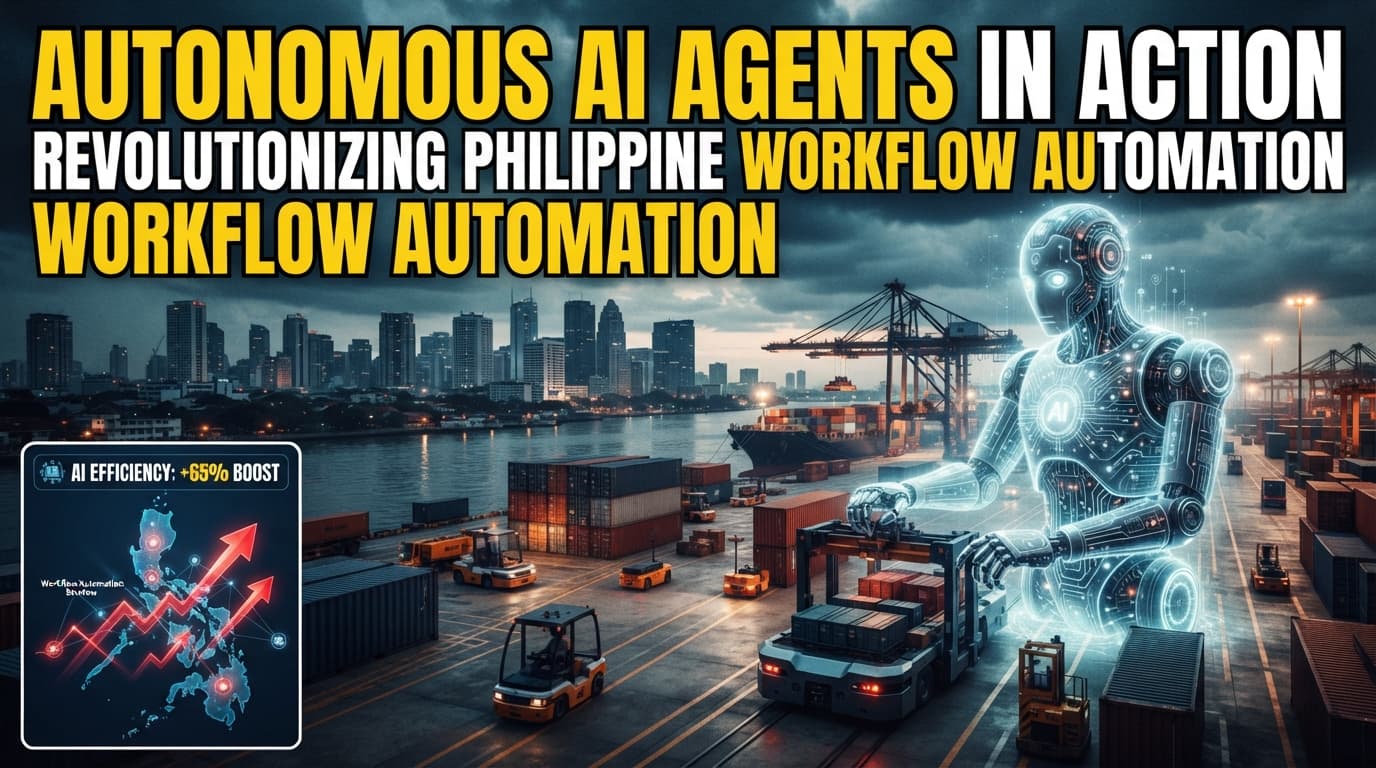
Centered on Google's newly announced Gemini Spark, we lay out, from a practical standpoint, the steps and cautions for safely adopting an AI agent that runs around the clock at your Philippine operation.
Part 1: Why This Matters
Step 1: The Philippine Business Context (3 min)
The set of updates Google announced at Gemini I/O 2026 shows AI evolving from an "assistant that answers questions" into an "agent that gets work done on your behalf." Gemini Spark, in particular, keeps running in the cloud even while you sleep or are in a meeting, handling email triage, document creation, and the automation of routine tasks. This carries major significance for Japanese companies doing business in the Philippines.
The Philippines has English as an official language, and BPO (business process outsourcing) industries such as call centers, accounting shared services, and IT help desks are among the country's main industries. Up to now, the Philippines' strength has been the ability to "hire English-speaking talent at a lower cost than in Japan." But once we enter an era where AI agents run in English around the clock, the premise of competition changes. Rather than "adding people" from the Japan head office to the Manila or Cebu operations, you'll need a mindset of "combining people and agents to raise productivity."
A Manila office, 9 a.m. on a Monday. Mr. Tanaka, a Japanese manager, speaks to Joy, a local staff member: "Joy, Google announced a new AI agent. From now on it'll apparently sort our email and draft daily reports overnight on our behalf. At next week's team meeting, I'd like us to think together about which task to try it on first." Joy thinks for a moment and replies: "Sounds interesting. But before we let the AI read emails that contain customer information, we'll also need to check our compliance with the Data Privacy Act."
This exchange distills the key points of this guide. You need to advance the decision to adopt a new technology and your attention to local Philippine regulations as two wheels of the same cart.
Step 2: Key Points from the Source Article (5 min)
We have laid out the main items announced in the source article, on a fact basis.
| Announced Item | Key Points |
|---|---|
| User scale | Monthly active users surpassed 900 million across 230 countries and more than 70 languages — a big jump from 400 million the prior year |
| Gemini 3.5 Flash | The first in the next generation of models, positioned to combine advanced reasoning with fast responses |
| Neural Expressive | A fully redesigned design language for the UI, featuring fluid animations, new typography, and haptic feedback |
| Gemini Omni | A model that takes text, images, and video as input and can generate cinema-quality video |
| Daily Brief | An agent that works across Gmail and Google Calendar to create a morning summary. Rolling out to Google AI Plus, Pro, and Ultra subscribers in the US |
| Gemini Spark | A personal AI agent that runs around the clock, powered by Gemini 3.5 and a mechanism called Antigravity. Offered in beta to Google AI Ultra subscribers in the US |
| MCP integrations | Newly announced connections to external services such as Canva, OpenTable, and Instacart |
| macOS app | Gemini Spark will also be integrated into the desktop version this summer, with expanded local file operations and voice features |
This table was created for educational purposes from facts in publicly available information. For details, please check the original article at the link above.
Related: ChatGPT vs Claude vs Gemini: Which for Philippine SMEs? explains this in detail.
Step 3: Comprehension Check (5 min)
Q1. By how much did Gemini's monthly active users grow year on year? Hint: At the top of the source article, the prior-year and this-year figures are presented side by side.
Q2. Why is Gemini Spark said to "keep running in the cloud"? Hint: Focus on what it does after you close your laptop or lock your phone.
Q3. Both Daily Brief and Gemini Spark are called "agents," but what is the difference in their roles? Hint: Daily Brief centers on "organizing" information, and Spark on "executing."
Q4. What does Gemini Spark always do before performing an important operation such as sending an email or making a payment? Hint: The source article says it does something "before a high-risk operation."
Q5. Name three external services newly announced for Gemini Spark's MCP integrations. Hint: One each from the fields of design, restaurant reservations, and grocery delivery.
Related: ChatGPT for Business Automation and Dashboards explains this in detail.
Part 2: Putting It Into Practice
Step 4: Implementation Steps in the Philippines (10 min)
When trialing an autonomous AI agent like Gemini Spark at a Philippine operation, attention to local regulations and culture is essential, not just technical validation. We recommend proceeding in the following five steps.
| Step | What to Do | Things to Watch For in the Philippines |
|---|---|---|
| Step 1 | Choose just one task to trial | Work that involves customers' personal information, such as first-line call-center response, is safest to avoid at first |
| Step 2 | Confirm compliance with the Data Privacy Act of 2012 | Because the Philippines' National Privacy Commission (NPC) takes a strict stance on the cross-border transfer of personal information, define in writing the scope of information you let the AI read |
| Step 3 | Hold a briefing for local staff | Some people feel anxious that "AI will take my job." Preparing supplementary materials in Tagalog deepens understanding |
| Step 4 | Run a small-scale, 2–4-week trial | A rough budget guide is a starting range of about 5,000–25,000 pesos a month (roughly 13,000–65,000 yen). Google AI Ultra pricing varies, so confirm the latest information at the time of contract |
| Step 5 | Record results and issues, then decide whether to adopt fully or stop | In the Philippines, verbal agreements can later turn into "he said, she said," so always keep your decision criteria and results in writing |
Step 5: Common Mistakes and How to Avoid Them (5 min)
Pitfall 1: "Applying it to large-scale work from the start"
What not to do: You set a policy of handing all customer-facing email over to the AI agent right away. When a data leak or misdelivery occurs, the scope of damage spreads and gets out of hand.
What to do instead: Start with internal routine work (for example, drafting minutes of internal meetings). Even if a problem occurs, the damage is small and points for improvement are easier to find.
Pitfall 2: "Adopting it without checking local Philippine regulations"
What not to do: You apply the operating rules decided at the Japan head office to the Manila operation as is, and let the cloud AI read customers' personal information. Neglecting the obligation to notify the NPC can expose you to penalties.
What to do instead: Before adoption, check the Philippine Data Privacy Act and the NPC's guidelines. If you handle customer information, spell out in the contract where the data is stored, how long it is kept, and whether it may be used for AI training.
Pitfall 3: "Skipping the explanation to local staff"
What not to do: The Japan head office decides on adoption unilaterally and tells local staff only "please use this starting next month." Staff push back, or are left without understanding how to use it, and the investment goes to waste.
What to do instead: Hold a briefing before adoption and show, with concrete examples, "what the AI agent does" and "what it does not do." Always set aside time to take questions from staff.
Related: No-Code AI Agents in the Philippines: A Practical Guide explains this in detail.
Part 3: Going Deeper
Step 6: Related Technical Terms (5 min)
An AI agent (autonomous AI assistant) is a program that takes instructions from a human and then figures out and carries out multiple steps on its own. At a Manila back office, you could entrust it with the task of automatically composing the morning sales-tally email and sending it to a superior.
MCP (Model Context Protocol) is a common standard for connecting AI models to external apps and services. When linking an in-house AI with restaurant-reservation or delivery apps in the Philippines, having this mechanism greatly reduces the individual connection work.
A cloud agent (an AI that runs in the cloud) is an AI that keeps running on a server on the internet, rather than on your own PC or phone. Picture the AI continuing to sort email at a Cebu operation even after employees have gone home — it can be used to cover overnight and weekend work.
Multimodal AI (an AI that can handle multiple input formats) is an AI that can understand not only text but also images, video, and audio together. At a Philippine construction site, you could imagine handing the AI photos along with progress notes and having it draft a report.
Trigger-based automation (automation that fires on a cue) is a mechanism where the AI starts working automatically when a specific condition is met. A Manila accounting clerk could, for example, hand the AI the credit card statement at each month-end and have it automatically find and flag any new recurring payments.
Step 7: Applying This to Your Own Company (10 min)
List three "tasks you'd want running 24/7"
Something to think about: There is only a one-hour time difference between a Philippine operation and the Japan head office, but there are surprisingly many tasks where "getting it processed outside business hours makes the next morning easier." Examples include sorting the prior day's inquiry emails, organizing social-media comments, and gathering competitors' pricing information.
Next action: Hold a 15-minute meeting within your department and have each member write down one "task it would help to have someone do overnight."
Draw a line between information you may entrust to AI and information you may not
Something to think about: The Philippine Data Privacy Act places strict limits on handling information that can identify an individual. Customers' names, addresses, phone numbers, and credit card information especially require caution. On the other hand, summaries of internal meetings and the organizing of publicly available market data can be entrusted relatively safely.
Next action: Create a one-page A4 "list of information that may be read by the AI" and share it with local staff.
Think about how to redesign local staff's work
Something to think about: As AI agents take on routine work, local Philippine staff's roles shift from "the person doing the actual work" to "the supervisor of the AI and the person responsible for handling exceptions." This can also be an opportunity for advancement, but mismatches occur if you don't confirm each person's wishes and strengths.
Next action: Hold a 30-minute interview with each local staff member to hear "the work they'd want to entrust to AI" and "the skills they'd want to develop."
Part 4: FAQ
Q1. Can I use Gemini Spark in the Philippines right now?
As of the source article's announcement, Gemini Spark is at the stage of beginning a beta offering to Google AI Ultra subscribers in the US. The timing of availability in the Philippines is undecided, so check Google's official announcements for the latest information. For the time being, the realistic move is to start with the basic features of the Gemini app, which is already available in the Philippines.
Q2. When using AI agents for work in the Philippines, what should I watch for under the Data Privacy Act?
The Data Privacy Act, set by the Philippines' National Privacy Commission (NPC), requires businesses that handle personal information to obtain the individual's consent, appoint a Data Protection Officer (DPO), and notify the authorities when an incident such as a data breach occurs, among other obligations. If you let an AI agent handle customer information, these obligations apply directly. Before adoption, check the guidelines with a Philippine law firm or on the NPC's official site.
Q3. Can I apply the same operating rules as the Japan head office to my Philippine operation?
Applying them as is would be risky. Japan's Act on the Protection of Personal Information and the Philippine Data Privacy Act overlap in some respects, but they differ in things like cross-border data transfer, the obligation to appoint a Data Protection Officer, and the severity of penalties. We recommend creating operating rules specific to the Philippine operation and having a local lawyer review them.
Q4. If local staff push back on adopting an AI agent, how should I respond?
In the Philippines, there is a culture of valuing relationships with family and colleagues, and the anxiety that "my job might disappear" tends to be felt even more acutely than in Japan. Clearly convey that the purpose of adoption is not "headcount reduction" but "entrusting routine work to AI so people can focus on more creative work." It is effective to discuss with each person, concretely, "which part of your work will be replaced by AI and which part will remain."
Q5. How much does the monthly fee cost in pesos?
The pricing for plans like Google AI Plus and Pro varies. Converting the US pricing as of the source article's writing into pesos gives a rough guide of around 1,000–5,000 pesos a month, but this changes with exchange rates and the plan offered. For the latest, accurate pricing, check the Philippine-market display on Google's official site. Note that if you adopt it as a company, a contract bundled with Google Workspace is also worth considering.
Tips for Getting the Most Out of This (3 Tips)
Narrow to a single task and begin a "two-week experiment"
The biggest tip for succeeding with AI-agent adoption is not aiming for perfection from the start. Choose just one task where failure does little damage — such as creating internal minutes or drafting a daily report — and try it for two weeks. Record the results and use them as material for deciding whether to continue or stop.
Develop local staff as "AI supervisors"
When you adopt an AI agent, local staff's roles change from doing the actual work to supervising. Present this change as a positive step up in their careers, and prepare training that builds their ability to check the AI's output and spot exceptions. Rather than a mere instruction from the Japan head office, it is important to make this something local staff can accept as part of their own careers.
Create a one-page A4 "list of information that may be read by the AI"
The most practical thing for Data Privacy Act compliance is to put the operating rules in a form anyone can see and understand. Summarize, in bullet points, the kinds of information that must not be given to the AI — customers' personal information, financial data, confidential strategic information — and distribute it to all local staff. It has a large preventive effect and also serves as evidence for audit response.
Bonus: How to Make Use of PH AI Works
PH AI Works provides practical support for the use of AI and technology, aimed at Japanese companies doing business in the Philippines and at Japanese business professionals based there. On this article's theme of AI-agent adoption, we take on three kinds of consultations in particular.
First, consultations to sort out, together, where in your operations you should begin trialing an autonomous AI agent. We help with taking stock of your work and setting priorities.
Second, consultations on building operating rules in line with the Philippine Data Privacy Act. We support the creation of realistic operating guidelines that reflect local legal requirements.
Third, consultations on designing briefings and training programs for local staff. We think through, together, how to ease staff anxiety at the time of AI-agent adoption and turn it into a positive effort.
Please feel free to get in touch. The initial consultation is free.
References and Sources
About the author
Founder / AI Engineer (36+ years in IT)
- ●From Tokyo · based in Manila for 13+ years
- ●36+ years in IT (development, SEO, AI)
- ●IBM Certified Generative AI Engineer
- ●AI chatbots, RAG & AI agent development
A Japanese AI engineer with 36+ years in IT and 13+ years on the ground in the Philippines. I write from hands-on experience to help Japanese companies adopt AI that actually delivers results — chatbots, workflow automation, AI agents, and AI-driven marketing. Feel free to reach out in Japanese or English.
Free AI Consultation
Tell us your challenges and we'll propose the right AI adoption plan for your business.
Book a Free 30-Minute ConsultationRelated Articles
AI Model Vendors Now Sell Implementation Too
OpenAI and Anthropic now sell implementation as well as models. What a local subsidiary should decide about that.
8/18/2026
Contracting for AI While Prices Keep Falling
Write a model number into the contract and it is obsolete in six months. How to design for switching instead.
8/17/2026

Meta Cut 750,000 Under-16 Accounts in Australia
AI-assessed age checks removed 750,000 accounts overnight. What that says about depending on platforms for reach.
8/16/2026

When an AI Calls Your Shop to Ask About Stock
AI now phones shops on a buyer's behalf to check stock. What to decide on the receiving side before it reaches you.
8/15/2026

Handling News That Is Not Settled Yet
A reported $6 billion acquisition talk is not a completed deal. How to act on industry news before it is confirmed.
8/14/2026

What a 69-Page AI Report Does Not Show
Frontier firms are reported 8.3x ahead, yet a table on page 35 shows no statistically significant link to revenue.
8/13/2026