
When AI Quietly Shrinks Entry-Level Hiring
Generative AI is shrinking entry-level roles. How a Philippine hub balances automation against developing its own talent.


AI Engineer · 36+ years in IT · Japanese, based in Manila for 13+ years
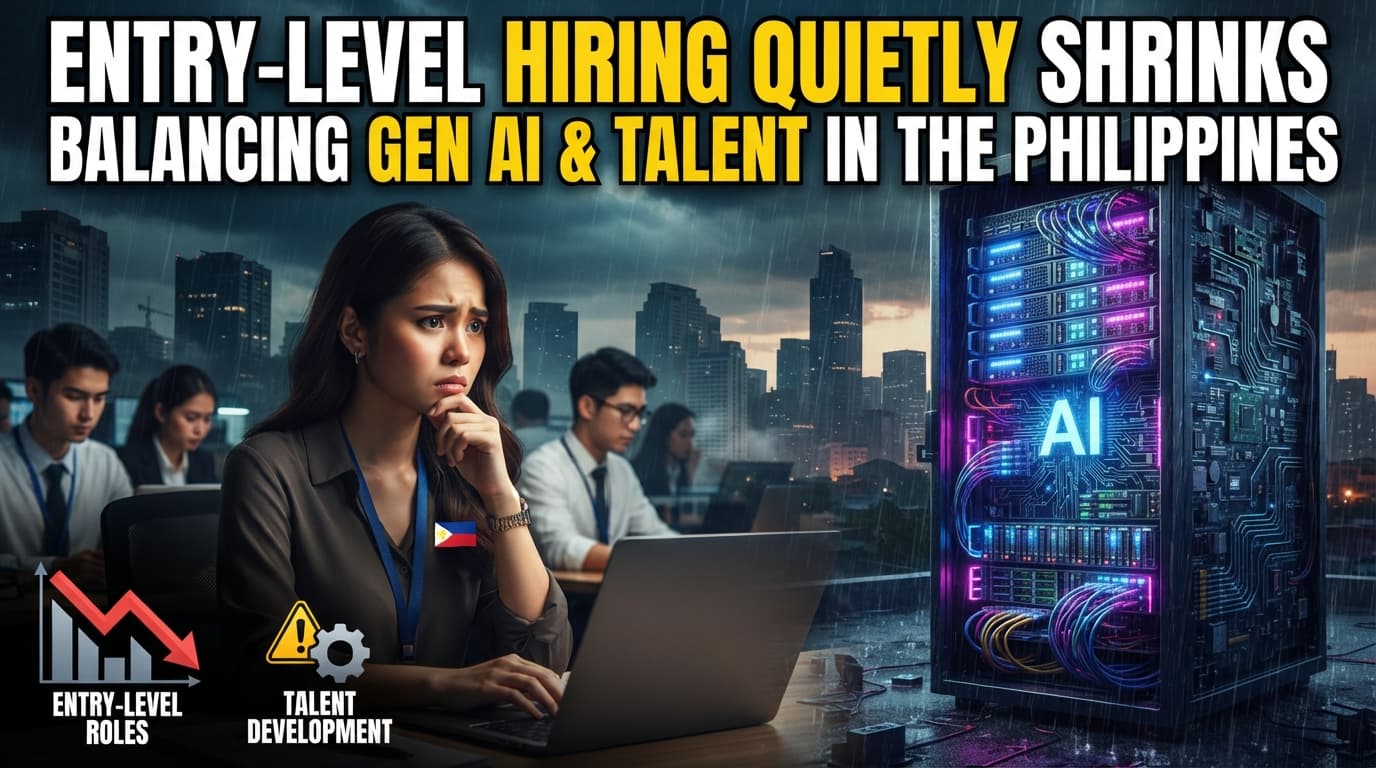
Now that generative AI is starting to take over junior work done by young employees, how should you design hiring and development at your Philippine hub? This guide explains the concrete steps and points to watch, for Japanese companies' on-the-ground managers.
Part 1: Why This Matters
Step 1: The Philippine Business Context (3 min)
The spread of generative AI has not shown up in the form of "dramatic unemployment," where employment overall plunges suddenly. However, studies by Stanford University and Anthropic in the United States have found that employment of young workers in AI-exposed jobs is quietly shrinking. This is not someone else's problem for Japanese companies operating in the Philippines, or for the Japanese professionals leading teams on the ground.
In the Philippines, BPO (business process outsourcing — the industry that handles call-center and back-office work on others' behalf) is a major employment base. On call-center floors, in accounting outsourcing, and at IT help desks, new graduates and early-career hires grow by gaining experience from "junior work." If generative AI comes to take over this junior work, the talent pool that should become the core of teams five and ten years from now could grow thin.
For Japanese companies, this is a management-judgment problem: how to strike the balance between cost optimization at the local hub and long-term talent development.
A morning stand-up at an office in Manila. A Japanese manager who has just received an email setting out head office's policy — halve new-engineer hiring and divert the budget to AI-tool adoption — turns to the local Filipino lead and says: "Short-term costs go down, but three years from now there'll be no one to grow into the seniors we need. Could you read through this article with me?"
Step 2: Key Points from the Original Article (5 min)
| Perspective | What the original article reported |
|---|---|
| Overall employment situation | Across developed economies as a whole, no sudden AI-driven drop in employment has been confirmed |
| Decline in young employment | In a November 2025 working paper from Stanford University's Digital Economy Lab, employment of 22–25-year-olds in AI-exposed occupations fell by a relative 16% |
| Occupations more easily affected | Occupations with high generative-AI use, such as software developers, customer-facing staff, programmers, and information-systems administrators |
| Impact on experienced workers | In the same occupations, employment of experienced workers has not declined. The drop is limited to young workers |
| U.S. new-graduate employment | The Federal Reserve Bank of New York reported, for Q4 2025, a 5.6% unemployment rate and a 42.5% underemployment rate for new college graduates (the highest since the pandemic) |
| Proposed responses | Revising university curricula, government tax incentives for youth employment, long-term talent-development policies at companies, and students acquiring AI skills |
Source: MIT Technology Review — "It's time to address the looming crisis in entry-level work" (May 26, 2026)
This table was created for learning purposes based on facts from publicly available information. For details, please check the original article at the link above.
Step 3: Comprehension Check (5 min)
Q1. What was the relative decline in employment among young workers (aged 22–25) in AI-exposed occupations, as shown by the Stanford University working paper?
Hint: Review the "decline in young employment" row of the table in Step 2.
Q2. Name three specific occupations from the original article where a decline in young employment was confirmed.
Hint: Recall jobs that AI can replace directly, such as software and call centers.
Q3. What were the Q4 2025 unemployment rate and underemployment rate for new college graduates reported by the Federal Reserve Bank of New York?
Hint: The unemployment rate is in the 5% range; the underemployment rate is in the 40% range.
Q4. How does the author of the original article assess the conventional advice to "learn to code"?
Hint: The work of translating from specs into code is becoming an area AI is good at.
Q5. Who does the author say is the real competitor for young workers going forward?
Hint: Not "humans vs. machines," but a more advanced framing one step beyond that.
Related: Redesigning a Development Team for the AI Era explains this in detail.
Part 2: Putting It Into Practice
Step 4: Adoption Steps in the Philippines (10 min)
When adopting AI at a Philippine hub, it is important to proceed in a way that does not take away young workers' development opportunities. Use the following steps as a reference.
| Step | Content | Points specific to the Philippines |
|---|---|---|
| 1. Take stock of current work | Classify the hub's work into "replaceable by AI," "made more efficient with AI support," and "requires human judgment" | Many sites run on verbal agreements, so interview local leads carefully |
| 2. Secure development slots | Don't cut junior hiring slots for cost reasons; separately design "AI-paired junior roles" that learn alongside AI | The monthly salary guideline is around PHP 20,000–30,000 for new graduates (with a range depending on the role); position it as an investment in development |
| 3. Train in using AI well | Learn how to verify outputs, how to handle confidential information, and how to spot hallucinations (the phenomenon where AI produces content that isn't true) | Rather than leaving materials in English, mixing in Tagalog and local work examples makes the learning stick |
| 4. Put data protection in order | Document compliance with the Data Privacy Act of 2012 and the scope of information given to AI | Some work carries a filing obligation with the NPC (National Privacy Commission, the Philippines' data-protection authority), so confirm in advance |
| 5. Measure effect and review | Every 3–6 months, review young workers' growth and AI's results together | Evaluate not by numbers alone; set up a forum to gather candid voices from local staff |
Step 5: Common Mistakes and How to Avoid Them (5 min)
Mistake 1: "Deciding on short-term cost alone"
This is the case where, when head office sends down an instruction to "halve junior hiring next term and shift the budget to AI-tool adoption," you simply carry it out. The talent pool that should have grown into seniors three years from now disappears.
Bad example: You freeze all of next term's junior hiring slots and put the freed-up budget toward AI-tool license fees.
Good example: You keep some of the junior hiring slots, and you entrust the young workers you hire with both training in using AI well and real work that requires judgment. The per-person cost rises, but you explain it as an investment that anticipates them becoming a fighting force three years out.
Mistake 2: "Leaving it to AI and not verifying the deliverables"
This is the case where you set up an operation that has young workers submit AI output as-is, losing the chance to develop their eye for quality.
Bad example: You have AI draft a customer-facing report, and the young worker forwards it to their superior as-is.
Good example: For the draft the AI produced, the young worker always checks three things — "the source of the figures," "leaps in logic," and "factual errors" — and submits it to their superior with a record of revisions. Build time to sharpen their verifying eye into the work.
Mistake 3: "Inputting work information into AI without data-protection arrangements"
This is the case where you input customer information or draft contracts into an external AI whose data handling is unclear, as-is. It may violate the Philippines' Data Privacy Act of 2012.
Bad example: You paste a document containing customers' names and account details into an external AI service to summarize, without reading the terms of use.
Good example: You make a rule on whether confidential information may be input, and anonymize it (mask information that could identify an individual) before inputting. You choose a service that can be set so data isn't used for training, and ensure audit logs can be kept.
Related: From Credentials to Capability: Hiring for the AI Era explains this in detail.
Part 3: Going Deeper
Step 6: Related Technical Terms (5 min)
Generative AI Refers to the type of AI that creates new things such as text, images, and code. On Philippine BPO floors, it is becoming common to have generative AI draft customer-response replies, which a staff member then checks and sends.
AI exposure A metric showing the degree to which an occupation's work can be replaced or supported by current AI. Occupations with many routine responses, such as a Manila IT help desk, have high exposure and feel the impact of AI adoption sooner.
AI literacy The ability to understand the basics of how AI works and to verify its output for use in your work. In hiring new Philippine university graduates, more companies are checking AI literacy in interviews in addition to English ability.
Prompt The text that tells the AI what you want it to do. At a Cebu-based accounting-outsourcing team, prompts for creating monthly reports have been standardized, building a system in which even a newcomer can produce drafts of the same quality.
School-to-work transition The process by which a new graduate leaves school, enters the workplace, and becomes fully capable. In the Philippines, a new graduate's first six months to a year are key to retention, and if junior-work opportunities shrink, this transition stops going smoothly.
Related: Philippine Talent Strategy After the SSW Freeze explains this in detail.
Step 7: Applying It to Your Own Company (10 min)
Make visible the "work you've handed to AI" at your Philippine hub
Something to think about: Try listing the work that has gone from "done by people" to "replaced by AI" over the past six months. Among the work you replaced, how much of it was a development opportunity for young workers?
Next action: Ask the hub head and HR to compile the work list and replacement status onto a single sheet.
Redesign the balance between young-worker development and short-term cost
Something to think about: From head office's view, you want to lower local costs; at the same time, you need to grow seniors who can be entrusted with the hub three and five years from now. Is there a design that achieves both, rather than one or the other?
Next action: When drawing up next term's budget, propose a separate "development-investment slot," and attach this article's figure (16% decline in young employment) as the basis.
Map a career path for young workers who use AI well
Something to think about: Have you mapped a roadmap in which "young workers who can use AI" don't stop at being mere operators but advance to judgment work in three years? Does the evaluation system support that?
Next action: Together with the local lead, map onto a single sheet the "abilities you want them to acquire" and the "work you'll entrust to them" for years one, two, and three.
Part 4: FAQ
Q1. Should new-graduate hiring in the Philippines be cut with AI the same way as at the Japanese head office?
We do not recommend cutting it across the board. In the Philippines, the flow of new graduates learning the basics of BPO and IT work in their first few years and growing into seniors supports corporate growth. Because the labor market's characteristics and wage levels differ between head office and the local site, applying head office's cut policy as-is risks leaving no one to be the core of hub operations three to five years out.
Q2. Local BPO companies are moving ahead with AI adoption — should we match competitors' speed?
You do need to match speed, but what you match is not the "surface of adoption" but the "substance of the results." Even if you lower short-term unit costs with AI adoption, a drop in quality leads to customer loss. The Philippines' major BPO firms have announced policies of maintaining their investment in talent development while using AI in parallel, so think on the premise of surviving over the long term.
Q3. If the Japanese head office decides to "raise work efficiency with AI and cut headcount," how should we negotiate locally?
It is effective to talk in numbers. As in the original article's Stanford study, present the fact of a 16% decline in young employment and an estimate of the risk of being unable to grow seniors three years out. If you also propose an alternative that keeps some junior slots on the premise of raising productivity by using AI, head office finds it easier to accept.
Q4. What legal points should we watch when inputting work data into AI in the Philippines?
The Data Privacy Act of 2012 (Republic Act No. 10173) is the basic rule for handling personal information. When inputting customer or employee information into AI, you may need the individual's consent and a clear statement of purpose. Industry-specific guidelines are published on the NPC's official site, so check the provisions relevant to your work in advance.
Q5. Are there training resources available locally for teaching young workers to use AI?
The DICT (Department of Information and Communications Technology) offers free digital-skills training, which includes basic AI courses. Combining this with in-house exercises using actual work data makes it more effective. Because most materials are in English, creating supplementary Japanese and Tagalog materials tied to the work, together with your local lead, helps the learning stick.
Tips for Making the Most of It (3 Tips)
1. Build the habit of evaluating the hub's work by its "development value"
Review each piece of work not just by cost but also through the lens of "what does a young worker learn here?" Before handing work to AI, confirming whose growth opportunity it was protects the hub's long-term strength.
2. Spell out the "way young workers and AI work together" in writing
Write into the work manual the division of labor in which AI makes the draft and the young worker verifies it and takes responsibility. Left vague, young workers default to dumping everything on AI, and their verifying ability doesn't grow. Making the roles clear in writing also aligns local staff's understanding.
3. Build your hiring plan by working backward from the senior profile you'll need in three years
Start your hiring plan not from "next term's labor costs" but from "what kind of seniors, and how many, do we need three years out?" Working backward, you'll see that this year's junior hiring slots can't be cut easily. It also serves directly as material for explaining things to head office.
Bonus: How to Make Use of PH AI Works
PH AI Works supports both the local AI use and the talent development of Japanese companies expanding into the Philippines. As a next step, you can consult us on things like the following:
- Taking stock of work at your Philippine hub and designing an AI adoption plan
- Planning and running training for young staff on using AI well
- Drawing up AI usage rules that take the Data Privacy Act of 2012 into account
Please feel free to get in touch. The initial consultation is free.
References and Sources
About the author
Founder / AI Engineer (36+ years in IT)
- ●From Tokyo · based in Manila for 13+ years
- ●36+ years in IT (development, SEO, AI)
- ●IBM Certified Generative AI Engineer
- ●AI chatbots, RAG & AI agent development
A Japanese AI engineer with 36+ years in IT and 13+ years on the ground in the Philippines. I write from hands-on experience to help Japanese companies adopt AI that actually delivers results — chatbots, workflow automation, AI agents, and AI-driven marketing. Feel free to reach out in Japanese or English.
Free AI Consultation
Tell us your challenges and we'll propose the right AI adoption plan for your business.
Book a Free 30-Minute ConsultationRelated Articles
AI Model Vendors Now Sell Implementation Too
OpenAI and Anthropic now sell implementation as well as models. What a local subsidiary should decide about that.
8/18/2026
Contracting for AI While Prices Keep Falling
Write a model number into the contract and it is obsolete in six months. How to design for switching instead.
8/17/2026

Meta Cut 750,000 Under-16 Accounts in Australia
AI-assessed age checks removed 750,000 accounts overnight. What that says about depending on platforms for reach.
8/16/2026

When an AI Calls Your Shop to Ask About Stock
AI now phones shops on a buyer's behalf to check stock. What to decide on the receiving side before it reaches you.
8/15/2026

Handling News That Is Not Settled Yet
A reported $6 billion acquisition talk is not a completed deal. How to act on industry news before it is confirmed.
8/14/2026

What a 69-Page AI Report Does Not Show
Frontier firms are reported 8.3x ahead, yet a table on page 35 shows no statistically significant link to revenue.
8/13/2026