
Meta's AI Restructuring: Redesigning Work on Site
What Meta's roughly 10,000-person AI restructuring suggests about taking stock of roles and redesigning work at a Philippine site.


AI Engineer · 36+ years in IT · Japanese, based in Manila for 13+ years
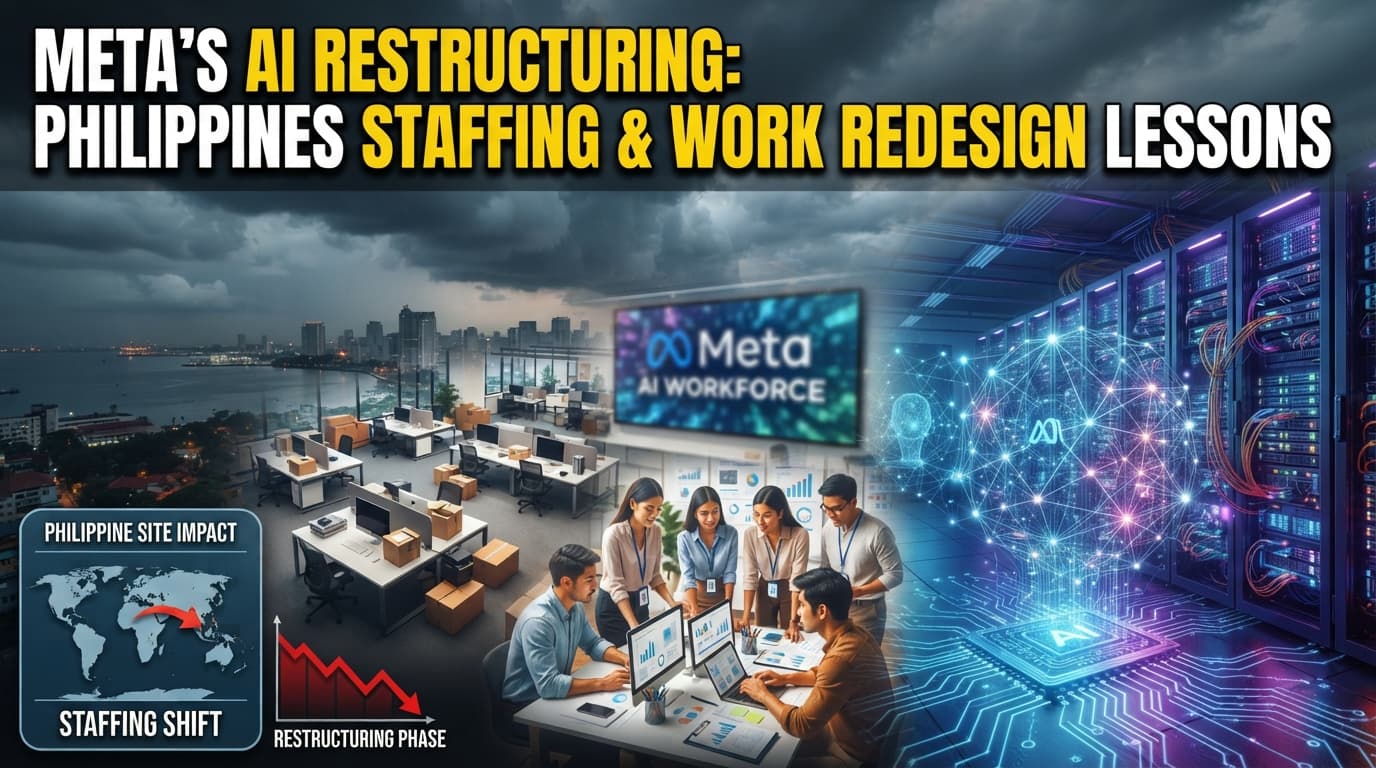
Meta's 10,000-person shift to AI turns on three things Japanese companies entering the Philippines have to get right as well: inventorying the work, designing the redeployment, and complying with local labour law.
Part 1: Why This Matters
Step 1: The Philippine Business Context (3 min)
The news that Meta cut 8,000 people — about 10% of its workforce — and separately redeployed 7,000 into AI-related roles is not someone else's problem for Japanese companies with operations in the Philippines. The Philippines is a global hub for what is known as BPO (business process outsourcing): call centers, accounting shared services, IT help desks, and the like. Cases of Japanese companies setting up back offices in Manila or Cebu are increasing rapidly as well.
The trend of major global tech companies sharply increasing AI investment and squeezing headcount to fund it affects the work outsourced to the Philippine side, too. In particular, repetitive clerical processing and simple customer handling are areas that are easy targets for replacement by generative AI. At the same time, demand rises, conversely, for talent who can master AI and create added value. As a trigger to review both the management decisions of the Japanese head office and the career design of local Philippine staff, this news is important.
At the head-office building in Manila, after the Monday morning meeting, IT director Jun-san (a Japanese expatriate) shows his smartphone to local HR manager Maria-san (a Filipina) and broaches the subject: "Maria-san, apparently Meta cut nearly 10,000 people again and redirected them to AI. We'd better review our headcount plan for next year, too. Shall we work through it together this week?" Maria-san, her expression clouding a little, replies, "Understood, Jun-san. Let's proceed carefully, with the staff's anxieties in mind."
Step 2: Key Points from the Original Article (5 min)
| Item | Content |
|---|---|
| Timing of the announcement | May 2026, notified by Mark Zuckerberg in a memo |
| Number cut | About 8,000 people (about 10% of all employees) |
| Redeployment | About 7,000 people into AI-related roles |
| Headcount after the cuts | An estimated ~71,000 (a calculation from the headcount as of December 2025) |
| AI-related capital expenditure | $125–145 billion planned for 2026 (up to about 2x the $72 billion of 2025) |
| Q1 2026 results | Revenue $56.3 billion (+33% year over year), net income $26.7 billion |
| Cumulative cuts since 2022 | More than 30,000 people |
| Industry-wide moves | Other companies, such as Cisco (4,000) and Cloudflare (20%), have also announced cuts tied to the shift to AI |
This table was created for study purposes based on facts from publicly available information. For details, please check the original article at the link above.
Step 3: Comprehension Check (5 min)
Q1. How many people did Meta cut in May 2026, and roughly what share of all employees did that represent?
Hint: Try to answer both the number and the proportion.
Q2. What was the other move Meta made at the same time as the cuts?
Hint: Recall the number of people redeployed and the area they were moved into.
Q3. Roughly how many times larger is Meta's planned 2026 AI-related capital expenditure compared with 2025?
Hint: Compare the upper figure ($145 billion) with the 2025 actual ($72 billion).
Q4. In a word, how did Zuckerberg's attitude differ between the first mass layoffs in 2022 and the May 2026 cuts?
Hint: In 2022 the tone included contrition; in 2026 the expression was more "matter-of-fact."
Q5. What companies besides Meta did the article cite as having cut staff citing the shift to AI?
Hint: A networking-equipment company and a CDN (content delivery acceleration) company appeared.
Related: AI Agents and Philippine IT/BPO Work: The Devin Effect explains this in detail.
Part 2: Putting It Into Practice
Step 4: Steps for Rollout in the Philippines (10 min)
Here we lay out a realistic procedure for advancing AI use and a review of staffing at your Philippine site. The Philippines has relatively strong worker protections, and dismissal procedures must strictly follow the rules of DOLE (the Department of Labor and Employment). Rather than easy cuts, it is important to make redeployment and retraining the central pillars.
| Step | Content | Philippine-specific notes |
|---|---|---|
| 1. Inventory the work | Classify current tasks as "routine," "semi-routine," or "requires judgment," and estimate the work hours that AI can replace | The minimum wage in the Philippines varies greatly by region; in Metro Manila a monthly salary of roughly PHP 18,000–25,000 is common. Use local peso-denominated labor costs when calculating cost-effectiveness |
| 2. Redeployment plan | Rather than starting from cuts, first design the destinations for redeployment (AI overseer, quality-check staff, English-writing staff, etc.) | A retrenchment notice to DOLE is, in principle, 30 days in advance. Even for redeployment, obtain written consent for changes to the job description |
| 3. Pilot rollout | Run a 2–3 month trial in one department, and measure processing time and quality before and after AI use | If data is passed to an external AI, confirm compliance with the Data Privacy Act of 2012, which is under the jurisdiction of the NPC (National Privacy Commission) |
| 4. Investment in training | Conduct 3–6 months of training for redeployment targets on writing prompts and checking outputs | If you build learning time into working hours, organize it in line with your work rules and DOLE's working-hours regulations |
| 5. Make results visible | Report monthly to the management meeting on "hours saved" and "new value-adding work created" | Filipino staff tend to value direct thanks and recognition from their superiors over evaluation by numbers. Use praise by name at meetings as well |
Step 5: Common Mistakes and How to Avoid Them (5 min)
Mistake pattern 1: Telling the team that "AI adoption = cutting people"
Bad example: A manager announces at the morning meeting, "We're bringing in AI, so we'll cut 10 people by year-end," leading only with the number to be cut. From that very day, staff motivation plummets, and the more capable ones leave for other companies.
Good example: Explain the redeployment policy first: "We want to use AI to reduce the time spent on routine work and move all of you to more specialized roles." Even when discussing cuts, present the scope and the support measures (retraining, internal job postings, severance pay, etc.) at the same time.
Mistake pattern 2: Carelessly entering data containing personal information into an external AI
Bad example: You paste an Excel file containing a customer list (names, mobile numbers, addresses) into a public version of a generative AI to summarize it, without checking the settings. This can escalate into an incident such as a data leak that becomes reportable to the NPC (National Privacy Commission).
Good example: Use it under a business plan, configured so that the data you enter is not used for training (set to be excluded from training). Mask names and contact details in advance, and document a simple set of usage rules internally.
Mistake pattern 3: Bringing the Japanese head office's way of doing things straight into the Philippines
Bad example: You distribute only the Japanese-language manual for the AI tool used in Japan, and dump it on the local site with "read it yourself from here." In reality it goes almost unused, and three months later you reach the mistaken conclusion that "AI won't take hold in the Philippines."
Good example: Work with your IT lead in Manila to create an English manual tailored to the local workflow. At team meetings, explain while showing concrete examples, and always set aside time for questions at the end.
Related: Philippine Talent Strategy After the SSW Freeze explains this in detail.
Part 3: Going Deeper
Step 6: Related Technical Terms (5 min)
Capital Expenditure (Capex) Money a company spends to buy things it will use for a long time — machines, buildings, servers — for the sake of future growth. It comes up when you write a "Capex request" to apply to the head office for a plan to buy new AI servers or high-performance computers at your Philippine site.
Restructuring Significantly rearranging the combination of departments within a company and the placement of people. It is used in situations like an announcement at the Manila office that "next term we will carry out a restructuring to merge accounting and IT into a shared service."
Hiring Freeze Temporarily stopping the hiring of new people. Because the Philippine talent market hires actively, when an instruction comes from the head office that "Q3 is a hiring freeze," local HR has to figure out how to handle candidates already in progress.
Personal Superintelligence A term referring to a very smart AI that helps each individual in line with their goals and life. When Japanese head-office executives visit the Philippine site and say "from now on it's the era of personal superintelligence," it is often a sign of a policy to give each employee an AI assistant.
Hyperscaler An operator with enormous data centers around the world that provides cloud services at massive scale. Hyperscaler regions are expanding one after another in the Philippines as well, and the term frequently comes up when the local systems department considers whether "data should be kept in Manila, or in a hyperscaler region in Singapore."
Related: Japan's Food-Service Visa Freeze: Hiring in the Philippines explains this in detail.
Step 7: Thinking About How This Applies to Your Company (10 min)
Inventory your Philippine site's work from an AI perspective
Discussion hint: Among the tasks your local staff perform daily, routine email replies, invoice data entry, and drafting internal documents in English are areas where generative AI could likely cut processing time by more than half. On the other hand, the "warm interactions with customers" that Filipino staff excel at, and "bridging between Japanese expatriates and the local team," are jobs hard to leave to AI. Look over your list of tasks and color-code which of the two each one falls under.
Next action: Within the next week, create a chart that rates the "AI-replaceability" of the five main tasks at your Philippine site on a three-level scale of high/medium/low, and set up time to review it together with your local managers.
Draw up a talent-development plan premised on redeployment
Discussion hint: Meta redeployed 7,000 people into AI-related roles at the same time as the cuts. If a Japanese company makes the same move in the Philippines, retraining is, in many cases, more advantageous than dismissal, both under labor law and in cost terms. Think about a path to develop local staff with strong English skills and logical thinking into "AI overseers."
Next action: Select three candidates, draft the outline of a 3-month AI-utilization training program (e.g., 2 hours/week × 12 weeks), and submit a proposal to the management meeting to fold it into the HR budget.
Align the differing "AI investment decision criteria" between the Japanese head office and the Philippine site
Discussion hint: At the head office, discussion happens in yen-denominated ROI (return on investment), but at the Philippine site, peso-denominated labor costs and dollar-denominated AI license fees are mixed together. Without accounting for exchange-rate fluctuations and local prices, an investment decision that looks "not worth it" from the local perspective can come down. Make sure both sites hold a common axis of evaluation.
Next action: Work with the accounting department to put in place, within one month, a template that displays AI-related investment decision documents side by side in three currencies: peso, yen, and dollar.
Part 4: FAQ
Q1. Can we carry out staff cuts through AI adoption in the Philippines, as we do in Japan?
It is legally possible, but the procedures are even stricter than in Japan. Retrenchment requires a 30-day advance notice to DOLE (the Department of Labor and Employment) and an advance notice of the same period to those affected. Separation pay is also calculated by statute. Cuts citing AI are no exception, so prepare documentary supporting materials (the adoption plan, the work-inventory results, etc.).
Q2. When Filipino staff say "AI will take our jobs," how should we respond?
It is effective to explain, with concrete examples, not that it will "take" jobs but that "it will do the simple work for you, so you'll be able to spend your time on more specialized work." Because Philippine workplace culture values human relationships, taking time for superiors to speak to people individually and hear out their anxieties makes the transition smoother.
Q3. The Japanese head office has approached us about whether "AI adoption could halve our Philippine site." How should we respond?
First, show the head office, in numbers, the laws on retrenchment in the Philippines, an estimate of separation pay, and the state of the hiring market. Laying out short-term cost savings alongside the costs of re-hiring when needed (recruiting expenses, the training period, the productivity loss until people get up to speed) enables a realistic discussion. It is also effective to propose replacing it with a plan premised on redeployment.
Q4. What Philippine-specific regulations should we watch out for when adopting AI?
Primarily the Data Privacy Act of 2012. It is under the jurisdiction of the NPC (National Privacy Commission), and businesses that handle personal information have obligations to register and to appoint a data protection officer (DPO). Before entering customer data into a generative AI, check the terms of use and choose a plan that allows you to set the data to be excluded from training and to specify the data storage region.
Q5. When applying to the head office for an AI-related investment amount, what should the Philippine side prepare to be more persuasive?
Presenting four things as a set — current labor costs in pesos, the dollar price of AI licenses, the estimated hours saved, and the new revenue opportunities created by redeployment — strengthens your case. In addition to large Capex examples like Meta's, adding the moves of peers within the Philippines (such as the AI adoption rate in the BPO industry) makes for persuasive material grounded in local realities.
Tips for Putting This to Use (3 Tips)
Tip 1: Start from "redeployment design," not from "cuts first" Meta also redeployed 7,000 people. Given Philippine labor law and workplace culture, retraining and redeployment ultimately cost less and preserve organizational trust. Simply starting your first internal announcement with the "redeployment policy" greatly reduces the turmoil on the ground.
Tip 2: Always make the "peso-denominated effect" visible in your pilot rollout Discussing things only in yen or dollars doesn't feel real to local staff. By expressing it in local currency — "saving ◯ hours per person per month = PHP ◯ of reinvestment capacity per month" — you make it easier for floor managers to act on it as their own concern.
Tip 3: Make the NPC standard the floor for your internal rules on handling personal information In the Philippines, the National Privacy Commission (NPC) operates relatively strictly. Rather than just referencing Japan's guidelines, compile onto a single page usage rules tailored to local regulations (the masking standard, the log retention period, making the exclude-from-training setting mandatory, etc.) and distribute it to all staff.
Bonus: How to Make Use of PH AI Works
PH AI Works supports AI adoption and operational transformation for Japanese companies expanding into the Philippines and Japanese business professionals based there. As a next step, you can consult us on things like the following:
- Support for inventorying your Philippine site's work and designing a redeployment plan through AI adoption
- Planning and running AI-utilization training for local staff (in English and Tagalog)
- Support for putting in place safe generative-AI usage rules aligned with the Data Privacy Act (the NPC standard)
We offer free consultations. If you have concerns about using AI or reviewing staffing in the Philippines, please feel free to get in touch.
References and Sources
- Fortune — "Meta laid off 10% of its workforce as Mark Zuckerberg warns that in the AI race 'success isn't a given'" (May 21, 2026)
- National Privacy Commission (NPC) — Official site of the Philippine National Privacy Commission
- Department of Labor and Employment (DOLE) — Official site of the Philippine Department of Labor and Employment
About the author
Founder / AI Engineer (36+ years in IT)
- ●From Tokyo · based in Manila for 13+ years
- ●36+ years in IT (development, SEO, AI)
- ●IBM Certified Generative AI Engineer
- ●AI chatbots, RAG & AI agent development
A Japanese AI engineer with 36+ years in IT and 13+ years on the ground in the Philippines. I write from hands-on experience to help Japanese companies adopt AI that actually delivers results — chatbots, workflow automation, AI agents, and AI-driven marketing. Feel free to reach out in Japanese or English.
Free AI Consultation
Tell us your challenges and we'll propose the right AI adoption plan for your business.
Book a Free 30-Minute ConsultationRelated Articles
AI Model Vendors Now Sell Implementation Too
OpenAI and Anthropic now sell implementation as well as models. What a local subsidiary should decide about that.
8/18/2026
Contracting for AI While Prices Keep Falling
Write a model number into the contract and it is obsolete in six months. How to design for switching instead.
8/17/2026

Meta Cut 750,000 Under-16 Accounts in Australia
AI-assessed age checks removed 750,000 accounts overnight. What that says about depending on platforms for reach.
8/16/2026

When an AI Calls Your Shop to Ask About Stock
AI now phones shops on a buyer's behalf to check stock. What to decide on the receiving side before it reaches you.
8/15/2026

Handling News That Is Not Settled Yet
A reported $6 billion acquisition talk is not a completed deal. How to act on industry news before it is confirmed.
8/14/2026

What a 69-Page AI Report Does Not Show
Frontier firms are reported 8.3x ahead, yet a table on page 35 shows no statistically significant link to revenue.
8/13/2026