OpenAI's Deployment Company: AI Adoption in the Philippines
What OpenAI's move into hands-on deployment means for companies operating in the Philippines, and how to plan AI adoption around it.

AI Engineer · 36+ years in IT · Japanese, based in Manila for 13+ years
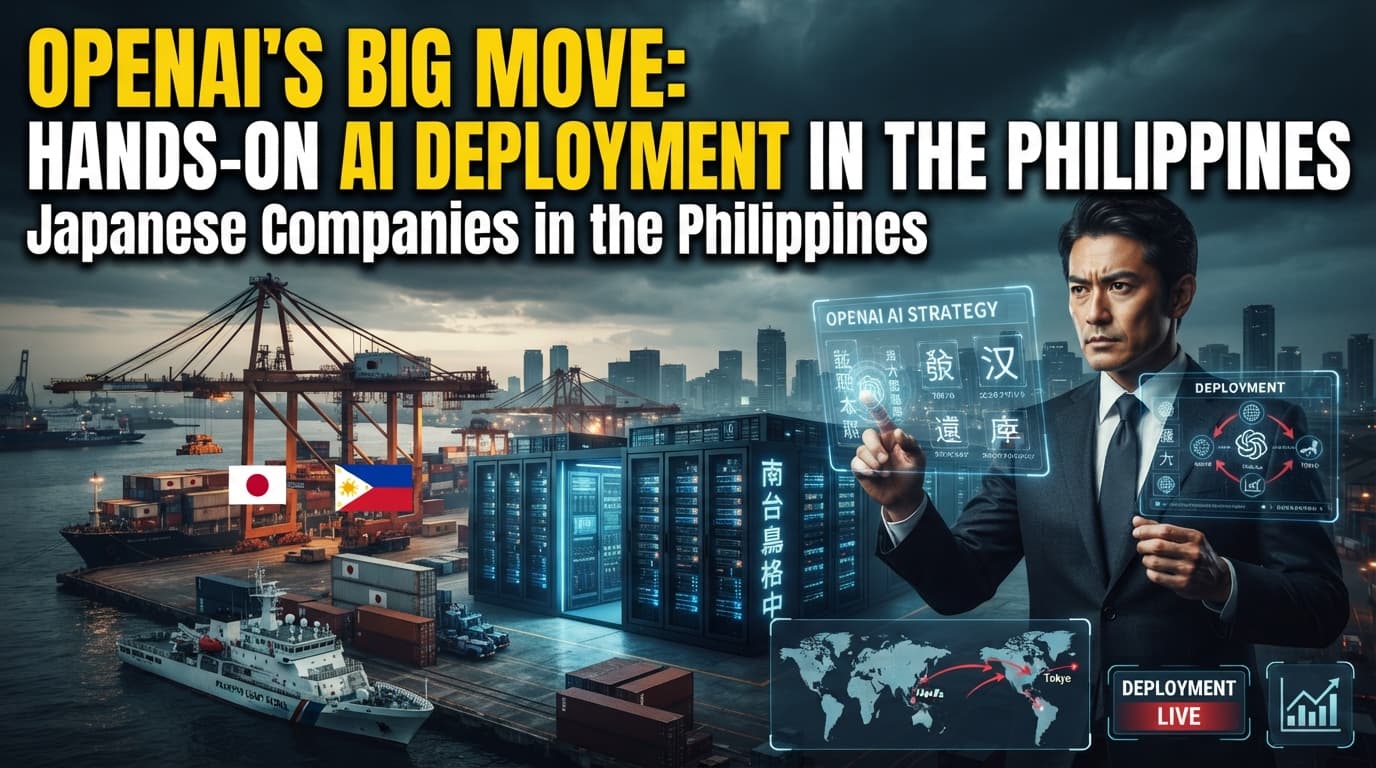
An era has arrived in which the providers of AI models take charge of hands-on deployment directly. For a Japanese company pushing AI adoption at a Philippine base, the useful thing is a set of criteria for deciding — and what to do once the decision is made.
Part 1: Why This Matters
Step 1: The Philippine Business Context (3 min)
The founding of "OpenAI Deployment Company," which OpenAI announced on May 11, 2026, is not someone else's problem for Japanese companies doing business in the Philippines. The work of deciding "which operations to embed AI into" and "how to connect it to production systems"—work that until now had been entrusted to local Philippine system-development firms or to the major systems integrators (SIers) contracted by Japanese headquarters—is shifting to the side that builds the AI models.
The Philippines, in particular, has an economic structure in which BPO (business process outsourcing: the industry that takes on the back-office work and customer service of overseas companies) supports roughly 9% of gross domestic product. Operations such as call centers, accounting shared services, and IT help desks are exactly the kinds of areas that are easy targets for being reshaped by AI. Japanese companies with bases in Manila or Cebu need to operate on the premise that the options for "who to ask to embed AI into operations" will change in a short span of time.
"Over morning coffee at the Manila office, finance director Mr. Tanaka says to local staff member Maria: 'About next year's system overhaul—it seems there's now an option where, in addition to the local vendor we've been using, the company that builds the AI models will work directly with us on improving operations too. How about we gather some information?'"
Cases in which Japanese headquarters thinks "we want to lead with AI adoption at our Philippine base to cut costs" are also increasing. Options that headquarters' IT department doesn't know about may take off first by local decision. That is precisely why it is important for those in decision-making positions on the ground to grasp the global shifts early.
Step 2: The Key Facts From the Original Article (5 min)
| Item | Details |
|---|---|
| Date of announcement | May 11, 2026 |
| New company name | OpenAI Deployment Company |
| Initial investment | Over $4 billion |
| Control structure | OpenAI owns and controls a majority |
| Number of participating firms | 19 investment firms, consultancies, and systems integrators |
| Lead investment firm | TPG |
| Co-lead founding partners | Advent International, Bain Capital, Brookfield |
| Main founding partners | Goldman Sachs, Warburg Pincus, BBVA, Emergence Capital, B Capital, Goanna, WCAS, SoftBank |
| Acquisition target | Tomoro (founded 2023, an applied-AI firm based in London and Edinburgh) |
| Personnel taken on | About 150 Forward Deployed Engineers and Deployment Specialists |
| Tomoro's track record | Tesco, Virgin Atlantic, Supercell |
| Acquisition completion timing | Within several months, after regulatory approval |
| OpenAI's customer scale | Over 1 million companies have adopted its products or API |
This table was created for study purposes based on facts from publicly available information. For details, please check the original article at the link above.
Step 3: Comprehension Check (5 min)
Q1. How much is OpenAI Deployment Company's initial investment?
Hint: The unit is dollars, and it's a figure in the billions.
Q2. Which country did the acquisition target, Tomoro, originate in? Also, name two of its main base cities.
Hint: An island nation in Europe, and one of the cities is in Scotland.
Q3. What kind of role does a "Forward Deployed Engineer (FDE)" play? Describe it in about 30 characters.
Hint: Think about what they do by embedding themselves inside the customer's company.
Q4. Of the 19 founding partners, which is named as a Japanese company?
Hint: A major Japanese group company with operations ranging from telecommunications to investment.
Q5. According to OpenAI, what determines the "next stage of enterprise AI"?
Hint: It's the other criterion, contrasted with "how smart the model is."
Related: Anthropic's $900B Valuation and AI Procurement explains this in detail.
Part 2: Putting It Into Practice
Step 4: Implementation Steps in the Philippines (10 min)
We have organized the approach to embedding AI into operations at a Philippine base into five stages. Working on the premise of an era in which AI-model providers move directly into deployment support, build your plan in light of local circumstances.
| Stage | Details | Philippine-specific points to watch |
|---|---|---|
| 1. Inventory your operations | Distinguish the operations you want to replace with AI from the ones humans should judge. Start your candidate list with repetitive operations such as call centers and accounting processing. | On the BPO front line, "how it sounds to the customer" matters most. Create operation descriptions that reflect the nature of handling a mix of English and Tagalog. |
| 2. Set the budget envelope | Secure a peso-denominated budget in two stages: pilot and production. | First-year pilots often run roughly 1.5 million to 5 million pesos. Account for exchange-rate swings and align with accounting in advance on the gap between dollar-denominated contracts and yen-denominated reporting. |
| 3. Select the provider | Evaluate the AI-model provider and the implementation partner that embeds it into operations separately. Also consider the pattern where the provider takes on hands-on deployment directly. | Take care not to abruptly cut ties with your local systems firm. The Philippines has a culture that values verbal agreements and human relationships, so explain things carefully to existing partners. |
| 4. Set up data protection | Create internal rules for handing personal information and transaction data to AI. | The Data Privacy Act (RA 10173), overseen by the NPC (National Privacy Commission: the government agency in charge of personal-data protection), applies. Use settings that keep your data out of training, and ensure you can retain audit logs. |
| 5. Embed it on the front line | Based on the pilot results, hold briefings and training for local staff. | Local staff have a culture of asking frank questions about new systems. Rather than unilaterally conveying headquarters' decisions, be sure to set aside ample time to take questions. |
Step 5: Common Mistakes and How to Avoid Them (5 min)
Failure pattern 1: "Adopting AI under headquarters' lead without listening to the local voice"
Bad example: The Tokyo headquarters' IT department decides on a globally common AI system and starts rolling it out at the Manila base by merely sending an email notice. Local staff are handed only an English operating manual and operation begins without their understanding why they're using this system.
Good example: You ask the Manila team which of their tasks the system is meant to replace before choosing it, and the manual is written against those tasks. The first month runs on one team, so problems surface while they are still small.
Failure pattern 2: "Starting out while leaving the handling of personal information vague"
Bad example: For verification, you feed operational data including customers' names and account information straight into the AI. Operation begins without any NPC filing or internal consent check, and problems surface later.
Good example: Before starting the pilot, you create a procedure for anonymizing the data. In line with NPC guidelines you choose the "keep our data out of training" setting, and you obtain confirmation from both your in-house legal team and a local lawyer.
Failure pattern 3: "Abruptly cutting ties with an existing local partner"
Bad example: Hearing that the AI-model provider takes on hands-on deployment directly, you switch contracts without even consulting the local systems firm you've dealt with for years. Your local reputation drops, which also hurts recruitment.
Good example: You convey your direction to existing partners early and propose a role they can fill in the new arrangement too. Because the Philippines is a culture that values the continuity of relationships, carefully reorganizing the relationship leads to long-term trust.
Related: Rising AI Prices: Cost Management for PH Operations explains this in detail.
Part 3: Going Deeper
Step 6: Related Technical Terms (5 min)
A Forward Deployed Engineer is an engineer who embeds themselves at the customer company's site to integrate AI into operations. For a Japanese company running a Manila call center, picture hiring someone who meets daily with the local operations lead and designs a system that uses AI to produce summaries of contact histories and drafts of customer responses.
Enterprise AI is AI built into and used within the operational systems of large and mid-sized companies. A typical example is introducing a system at a Philippine accounting shared-services center that has AI handle reading and entering invoices.
An API (a window that connects programs to each other) is the connection point through which your own system sends instructions to an external AI and receives its answers. A use case like having Manila's store-management system query the AI for inventory forecasts and display the results falls under this.
A systems integrator (SIer) is a business that combines software to fit the customer's operations and finishes it through to production go-live. In the Philippines, this is the local partner that, when a Japanese company sets up its local subsidiary, supplies a full set of accounting and attendance systems.
Deployment (finishing through to production go-live) refers not to merely running something as a trial but to getting it into a state where it can be used as part of daily operations. An example of deployment is building out an operation at a Cebu BPO base where AI-generated call summaries go into production use and quality-control staff check them every morning.
Related: AI Financial Advice After the ChatGPT-Plaid Tie-Up explains this in detail.
Step 7: Applying This to Your Own Company (10 min)
How to engage when the AI-model provider comes directly
A prompt to consider: If a company like OpenAI proposed to your Philippine base, "Why don't we work on improving your operations together?", how would you decide? Sort out whether the point of contact is headquarters or the local subsidiary, in whose name the contract is signed, and where the data is stored.
Next action: At next week's management meeting, put "internal procedures for contracting directly with an AI-model provider" on the agenda, and decide the initial division of roles among finance, legal, and the local subsidiary's representative.
Sorting out roles with existing local partners
A prompt to consider: If you've done business with a local systems firm or staffing agency for a long time, think about what they can take on within the new arrangement. Write out separately the parts the provider comes for directly and the parts only the local partner can handle.
Next action: Set up meetings with two or three of your main local partners and create a forum to talk frankly about "what we can do together over the next three years."
Creating internal rules for how to hand over operational data
A prompt to consider: When handing operational data to AI, you need to decide internally how far is permissible. For each of customer information, transaction information, and HR information, sort out whose approval is required and how the data is processed before being handed over.
Next action: Ask the Philippine subsidiary's information-security officer to draft, within one month, a "data-handling policy for AI use" that references the guidelines of the NPC (the government agency in charge of personal-data protection).
Part 4: FAQ
Q1. If Japanese headquarters signs a contract with an AI-model provider, can the Philippine subsidiary use it as is?
Not necessarily as is. The Philippines has its own Data Privacy Act (RA 10173), and personal information handled within the Philippines may require a filing with the NPC (National Privacy Commission: the government agency in charge of personal-data protection) and the appointment of an in-house privacy officer, even under the parent company's contract. Rather than reusing the headquarters contract as is, have a lawyer confirm its suitability for the local subsidiary.
Q2. I'd like a sense of the cost of adopting AI at a Philippine base.
It depends on the scope of operations, but for a pilot narrowed to a specific operation—such as summarizing call-center responses or processing accounting invoices—it is common to budget around 1.5 million to 5 million pesos in the first year. At the stage of scaling to production, monthly fees based on usage volume accumulate, so align with accounting in advance on the gap between dollar-denominated billing and yen-denominated reporting to headquarters. For specific figures, confirm by requesting quotes from the provider or implementation partner.
Q3. I'm worried local staff will push back against AI adoption.
The way you explain it—so that they don't feel "AI is taking my job"—is key. Philippine workplace culture tends to value the relationship with one's superior and the trust among colleagues. Hold an all-hands briefing early in the adoption process and convey the policy that "by leaving simple tasks to AI, we free up time for work only people can do," in both the local language and Japanese. Creating multiple opportunities to take questions is also effective.
Q4. Is it realistic to contract with both an AI-model provider and a local systems firm?
It is realistic, and during the transition period this arrangement is actually safer. A workable division of roles is: the provider handles the AI model itself and the core of the deployment, while the local systems firm handles connecting to existing operational systems, training local staff, and post-launch inquiries. In the contract, clearly separate the scope of responsibility and decide upfront who to contact when trouble arises.
Q5. Waiting on Japanese headquarters' decision delays our local adoption. What should we do?
Running completely on your own causes clashes with headquarters later, while waiting only on headquarters' decision means missing the moment. The realistic approach is to agree in advance, at the board level, on "the range the local subsidiary can advance at its own discretion through the pilot" and "the range where production requires headquarters' approval." In the Philippines, the speed of local decisions often determines the success or failure of a business, so explain this reality carefully to headquarters as well.
Tips for Putting This to Use (3 Tips)
1. Decide "who" the point of contact for AI adoption will be, first
We have entered an era in which AI-model providers take on hands-on deployment directly. Organize the four options: the local staffing agency, the local systems firm, the major systems integrator contracted by headquarters, and the AI-model provider's direct contact. Proceeding without deciding the point of contact leads to conflicting quotes and blurred lines of responsibility.
2. Create your data-handling rules before the contract
Before deciding which AI to use, create rules for "which of our data, processed how, and on whose approval, can be sent outside." Building on the guidelines of the NPC (the government agency in charge of personal-data protection) strengthens your hand in negotiations with the provider and smooths internal consensus-building.
3. Involve local staff from the very first discussion
Don't decide with only Japanese headquarters or Tokyo-based staff—bring the Philippine local operations lead into the very first review meeting. The fine local customs of operations and the linguistic characteristics of customer service are things only local staff can notice. Post-adoption uptake changes greatly depending on who was in the first discussion.
Bonus: How to Make Use of PH AI Works
PH AI Works provides support for embedding AI and technology into operations for Japanese companies doing business in the Philippines. Amid the trend of AI-model providers coming directly for hands-on deployment, we offer advice grounded in an understanding of both Japanese headquarters' and the local subsidiary's circumstances.
As a next step, you can consult us on things like the following:
- Inventorying your Philippine base's operations and identifying operations that are candidates for AI adoption
- Advice on dividing roles between the AI-model provider and local partners
- Considering a data-handling policy for AI use, informed by the guidelines of the NPC (the government agency in charge of personal-data protection)
Please feel free to get in touch. The initial consultation is free.
References and Sources
About the author
Founder / AI Engineer (36+ years in IT)
- ●From Tokyo · based in Manila for 13+ years
- ●36+ years in IT (development, SEO, AI)
- ●IBM Certified Generative AI Engineer
- ●AI chatbots, RAG & AI agent development
A Japanese AI engineer with 36+ years in IT and 13+ years on the ground in the Philippines. I write from hands-on experience to help Japanese companies adopt AI that actually delivers results — chatbots, workflow automation, AI agents, and AI-driven marketing. Feel free to reach out in Japanese or English.
Free AI Consultation
Tell us your challenges and we'll propose the right AI adoption plan for your business.
Book a Free 30-Minute ConsultationRelated Articles
AI Model Vendors Now Sell Implementation Too
OpenAI and Anthropic now sell implementation as well as models. What a local subsidiary should decide about that.
8/18/2026
Contracting for AI While Prices Keep Falling
Write a model number into the contract and it is obsolete in six months. How to design for switching instead.
8/17/2026

Meta Cut 750,000 Under-16 Accounts in Australia
AI-assessed age checks removed 750,000 accounts overnight. What that says about depending on platforms for reach.
8/16/2026
When an AI Calls Your Shop to Ask About Stock
AI now phones shops on a buyer's behalf to check stock. What to decide on the receiving side before it reaches you.
8/15/2026

Handling News That Is Not Settled Yet
A reported $6 billion acquisition talk is not a completed deal. How to act on industry news before it is confirmed.
8/14/2026

What a 69-Page AI Report Does Not Show
Frontier firms are reported 8.3x ahead, yet a table on page 35 shows no statistically significant link to revenue.
8/13/2026