
A Weak Peso and High Oil: Managing Cost With AI
Practical steps for FX scenario analysis and cost management when the peso is weak and fuel prices stay high.


AI Engineer · 36+ years in IT · Japanese, based in Manila for 13+ years
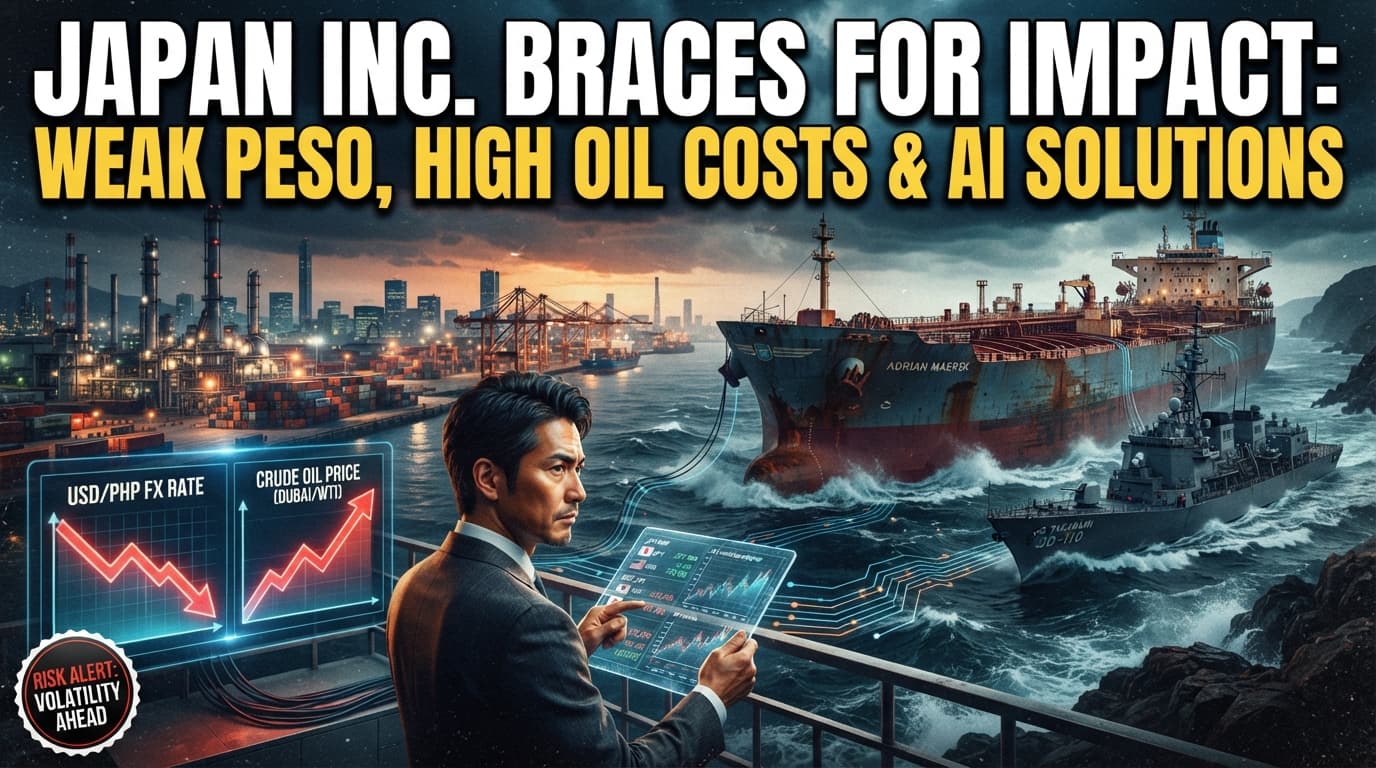
How should a local subsidiary brace for the twin pressures of a falling Philippine peso and high oil prices? We've laid out, for Japanese companies, the practical steps for AI-powered FX scenario analysis and procurement review.
Part 1: Why This Matters
Step 1: The Philippine Business Context (3 min)
There are indications that the Philippine peso may set new lows against the U.S. dollar. Normally, a rate hike by the central bank (the BSP: the Bangko Sentral ng Pilipinas) would be a factor supporting the currency, but rising import costs from high oil prices are squeezing growth and the trade balance, in a structure that cancels out the effect of the rate hike.
For Japanese companies expanding into the Philippines, a weak peso has two faces. For companies that are export-related or that pay salaries with funds from the Japanese head office, it is a tailwind; but for businesses that rely on local procurement of raw materials, fuel costs, and imported equipment, purchasing costs swell. Rising prices also lead to demands for wage increases from local staff, making labor-cost management more difficult.
In the Manila office, after finishing the monthly P&L report, the local finance officer says quietly to the Japanese manager, "The peso fell 2% from last month. The head-office remittance budget can't keep up with diesel costs. Shall we review next month's procurement plan?" The Japanese manager nods, sensing that this is not a one-off matter and that decisions need to be restructured on the assumption it will continue for half a year.
In situations like this, whether you have a mechanism to continuously track currency movements and quickly estimate the impact on costs greatly shapes the local subsidiary's earnings. AI tools turn this kind of scenario analysis of FX, costs, and procurement into something even a non-expert can handle.
Step 2: Key Points from the Original Article (5 min)
| Item | Content |
|---|---|
| Peso outlook | Indications that it may set new lows against the U.S. dollar |
| BSP policy outlook | Sumitomo Mitsui Banking Corporation's view assumes a rate hike of up to 100 basis points (1.00%) within the year |
| Why the rate hike is less effective | Higher import costs from rising oil prices are squeezing growth and the trade balance |
| Background to high oil prices | Rising energy prices stemming from a war between the U.S. and Iran |
| Financial institutions providing the analysis | Strategists at Sumitomo Mitsui Banking Corporation, BNY, and MUFG Bank |
This table was created for study purposes based on facts from publicly available information. For details, please check the original article at the link above.
Step 3: Comprehension Check (5 min)
Q1. Roughly how large is the rate hike the BSP is assumed to make within the year?
Hint: It is given in basis points. 100 basis points is 1.00%.
Q2. Why is the peso's weakness seen as hard to stop even if a rate hike is carried out?
Hint: Focus on the movement of energy prices and its connection to the trade balance.
Q3. Name three financial institutions cited in the original article as presenting a view on the weak peso.
Hint: They include Japanese megabanks and an American trust bank.
Q4. What event does the original article cite as the direct cause of rising oil prices?
Hint: It is a geopolitical conflict. The U.S. appears as a party to it.
Q5. Normally, what kind of effect is a central bank's rate hike thought to have on its own currency?
Hint: Recall the basic principle that high interest rates attract funds from overseas.
Related: The Philippine Central Bank's Rate Hike (4.75% Policy Rate), Explained for Japanese Companies: Cash-Flow Measures explains this in detail.
Part 2: Putting It Into Practice
Step 4: Steps for Rollout in the Philippines (10 min)
Here we lay out the procedure for introducing, at your local subsidiary, a mechanism to manage the impact of a weak peso and high oil prices with AI.
| Step | Content | Philippine-specific notes |
|---|---|---|
| 1. Identify the affected cost items | List out imported equipment, fuel costs, dollar-denominated rent, dollar-denominated software usage fees, and so on | On the premise of reconciling with the books submitted to the BIR (Bureau of Internal Revenue), record them in both pesos and dollars |
| 2. Create linked FX/oil scenarios | Have AI use a spreadsheet to estimate the impact on profit if the peso moves to 58, 60, and 62 to the dollar | Because the Philippines has high electricity rates even by Southeast Asian standards, calculate fuel-cost sensitivity separately |
| 3. Extract candidates for reviewing procurement and contracts | Feed past invoice data into the AI and have it propose contracts that can be switched to peso denomination | Because there are many verbal agreements with local vendors, always insert a step to put things in writing |
| 4. Build a dashboard for the management meeting | Have AI automatically summarize the weekly movements of FX, oil, and key cost items, and share them with the Japanese head office too | Reconcile with the financial information submitted to the SEC (Securities and Exchange Commission) and align your notation with the local auditor |
| 5. Hold a briefing for local staff | Using materials created with AI, explain how FX movements relate to their work | Prepare materials in both English and Tagalog, and always set aside time for questions |
Step 5: Common Mistakes and How to Avoid Them (5 min)
Mistake pattern 1: "Operating on the head office's budget rate as-is"
Bad example: You keep placing orders on the assumption of the 55-peso-to-the-dollar rate set in the head office's start-of-year budget, and even as the monthly deficit swells from the gap with the prevailing rate, you don't notice until the quarterly closing.
Good example: Have AI take in the prevailing rate weekly, and build a mechanism that notifies the procurement officer once the gap with the budget rate exceeds 3%. Consult the head office early and request a review of the budget rate.
Mistake pattern 2: "Treating the rise in fuel costs as a flat, uniform cost increase"
Bad example: You grasp the fuel-cost increase from high oil prices only as "up 5% overall," and enter price-increase negotiations without looking at the differences by delivery route or plant operating hours. As a result, customers won't accept it.
Good example: Have AI read delivery records and electricity usage logs, and show the cost increase by route and by time of day in numbers. In price-increase negotiations, explain in order of priority, starting with the parts where the impact is largest.
Mistake pattern 3: "Treating FX as a problem for accounting alone"
Bad example: You keep the impact of the weak peso confined to the accounting department and don't share it with sales, procurement, or HR. By the time you notice, you've missed the timing for wage-revision negotiations and price negotiations with customers.
Good example: Distribute the weekly report created with AI to the heads of sales, procurement, and HR as well. So that each department can think about how to act in its own work, briefly explain the meaning of the numbers, too.
Related: Reading the Weak Yen and FX Intervention with AI: An FX Risk Management Guide for Japanese Companies in the Philippines explains this in detail.
Part 3: Going Deeper
Step 6: Related Technical Terms (5 min)
A basis point (bp) is a unit expressing changes in interest rates or yields, with 1 basis point equal to 0.01%. In Philippine business, it appears frequently in BSP policy-rate announcements and in explanations of loan rates quoted by local banks, so when a finance officer can use this unit fluently in estimates and head-office reports, decision-making speeds up.
Sentiment analysis is a technology in which AI reads the text of news articles and social media and quantifies whether the market mood is "bullish" or "bearish." Among Japanese companies in Manila, cases are increasing where they have AI summarize, daily, English-language media and remarks by the BSP governor on the peso-dollar rate, and use it as material for FX-risk meetings.
Scenario analysis is a method of changing assumptions such as FX or oil prices and comparing, side by side, the impact on earnings and costs. Among Japanese manufacturers in the Philippines, having AI produce a table of profits if the peso moves in a range of 58 to 62 to the dollar, and bringing it to the head office's management meeting, is becoming common.
Energy cost sensitivity is an indicator showing how much your profit changes when oil or electricity rates move by 1%. Because the Philippines has high electricity rates even by Southeast Asian standards, Japanese BPO (business process outsourcing) companies that operate call centers have AI calculate this indicator monthly and use it as the basis for rate negotiations.
FX hedging is a mechanism that uses financial instruments such as forward contracts to limit losses from future currency fluctuations. Among Japanese trading houses and manufacturers that have entered Manila, cases are emerging of having AI read past transaction data to compare the terms when entering into forward contracts with local banks during a weak-peso phase.
Related: Yen at a 40-Year Low: An FX-Risk and AI Guide for Japanese Companies in the Philippines explains this in detail.
Step 7: Thinking About How This Applies to Your Company (10 min)
Do you have a pricing mechanism that's resilient to FX fluctuations?
Discussion hint: How frequently have you revised your local selling prices in the past? Check whether you have the structure to update your price list quickly when the peso falls 5%. With AI, an estimate of price revisions linked to FX movements can be done in a short time.
Next action: Have AI create a graph laying the FX trend of the past 12 months alongside the timing of your company's selling-price revisions.
Does visibility into fuel and electricity costs reach the front lines?
Discussion hint: Confirm whether the managers on the plant or logistics front lines see, in numbers, the fuel and electricity costs incurred in their own area each month. When only accounting holds the numbers, savings and efficiency improvements on the ground won't progress.
Next action: Have AI read the energy-related invoices of the past three months, and prototype a monthly report for each site.
Is information sharing between the head office and the local subsidiary lagging?
Discussion hint: How many days after the local subsidiary learns of movements in the peso-dollar rate or changes in oil prices does the head office's management learn of them? If it's more than a week behind, the divergence in judgment grows large.
Next action: For the head office's management, trial-run an AI summary report delivered every Monday on the movements of FX, oil, and key cost items.
Part 4: FAQ
Q1. In a phase of a persistently weak peso, how should we respond to local staff's demands for wage increases?
Wage-increase demands accompanying rising prices arise almost every year in the Philippines. To avoid strikes as well, it is important to engage in dialogue with well-grounded numbers. Have AI read past consumer price index (CPI) figures and your company's wage trend, create a comparison table against industry levels, and then discuss it with the HR lead. Considering a plan that sets tiers by job type, rather than a uniform increase, also makes it easier to preserve a buffer in your workforce.
Q2. The Japanese head office has told us "don't change the budget rate," so how should we act locally?
Changing the budget rate requires head-office approval, so it can't be moved arbitrarily on the ground. However, it is the local subsidiary's responsibility to make the gap with the prevailing rate visible weekly and share it with the head office. Regularly send the gap report created with AI to the head office's finance lead, and create an opening to start a conversation about a review.
Q3. Can we assume that a business booking revenue in pesos is unaffected by the weak peso?
Direct FX losses are unlikely to arise, but indirect impacts can't be avoided. Because rises in imported parts and fuel costs ride on top of your costs, your profit margin falls. Demands for wage increases from local staff also intensify. Even if your revenue is in pesos, break down the composition of your costs and have AI identify the proportion of dollar-denominated and imported items.
Q4. Is there a guideline for deciding whether to take out a forward contract?
The optimal answer differs by industry and cash flow, but if you have a fixed amount of dollar payments every month, it's worth considering a forward contract. Philippine banks offer forward products under BSP regulation. Get terms from several local banks and have AI create a comparison table, and your judgment will be faster. Because a forward contract is a mechanism that fixes both losses and gains, agree internally on the pros and cons before proceeding.
Q5. Tracking FX and oil movements daily on the ground in the Philippines is hard for want of staff. How should we start?
You don't need to aim for a perfect mechanism from the outset. First, start with an operation in which AI summarizes a trustworthy English-language media article each morning into a roughly three-line memo in Japanese. Once you're used to it, expand into a weekly report that combines it with your own cost-item data. One person is enough, and you can start with about 15 minutes a day.
Tips for Putting This to Use (3 Tips)
1. Translate FX movements into "the language of the front lines" Merely conveying the number — "the peso has passed 60 to the dollar" — won't move the front lines. Convey it in terms of the actual work and cost items: "diesel is expected to rise 3 pesos per liter," or "next month's parts imports will need an extra PHP 200,000." Having AI read your own cost-item data and translate it lets you produce this in a short time each week.
2. Align how the head office and the local site "read the numbers" When the head office's budget rate and the local prevailing rate diverge in perception, decisions are delayed. Deliver the movements of FX, oil, and key cost items to both sides in the same format every week, and create a state where you can hold meetings while looking at the same table. Generating it automatically with AI lets you avoid dependence on a single person.
3. Don't aim for perfection in one go; improve every week If you try to build a high-precision scenario analysis from the start, you'll never get it deployed. First start with a weekly FX memo, listen to the reactions from the relevant departments, and add tables and graphs little by little. Keep it up for three months, and a form that's meaningful for your company will come into view.
Bonus: How to Make Use of PH AI Works
PH AI Works supports operational improvements using AI and technology for Japanese companies expanding into the Philippines and Japanese business professionals running operations there. In phases where FX and cost fluctuations are large, it is especially effective to use AI to make efficient everything from gathering and summarizing data to producing the material for decisions.
As a next step, you can consult us on things like the following:
- Building a mechanism to turn macro indicators such as FX and oil into weekly reports combined with your own cost-item data
- An effort to have AI read past invoices and procurement data to extract candidates for cost reduction and contract review
- Designing a dashboard that lets the local subsidiary and the Japanese head office hold meetings while looking at the same numbers
Please feel free to get in touch. The initial consultation is free.
References and Sources
About the author
Founder / AI Engineer (36+ years in IT)
- ●From Tokyo · based in Manila for 13+ years
- ●36+ years in IT (development, SEO, AI)
- ●IBM Certified Generative AI Engineer
- ●AI chatbots, RAG & AI agent development
A Japanese AI engineer with 36+ years in IT and 13+ years on the ground in the Philippines. I write from hands-on experience to help Japanese companies adopt AI that actually delivers results — chatbots, workflow automation, AI agents, and AI-driven marketing. Feel free to reach out in Japanese or English.
Free AI Consultation
Tell us your challenges and we'll propose the right AI adoption plan for your business.
Book a Free 30-Minute ConsultationRelated Articles
AI Model Vendors Now Sell Implementation Too
OpenAI and Anthropic now sell implementation as well as models. What a local subsidiary should decide about that.
8/18/2026
Contracting for AI While Prices Keep Falling
Write a model number into the contract and it is obsolete in six months. How to design for switching instead.
8/17/2026

Meta Cut 750,000 Under-16 Accounts in Australia
AI-assessed age checks removed 750,000 accounts overnight. What that says about depending on platforms for reach.
8/16/2026

When an AI Calls Your Shop to Ask About Stock
AI now phones shops on a buyer's behalf to check stock. What to decide on the receiving side before it reaches you.
8/15/2026

Handling News That Is Not Settled Yet
A reported $6 billion acquisition talk is not a completed deal. How to act on industry news before it is confirmed.
8/14/2026

What a 69-Page AI Report Does Not Show
Frontier firms are reported 8.3x ahead, yet a table on page 35 shows no statistically significant link to revenue.
8/13/2026