
Rooftop Solar and Rising Electricity Costs
Why rising power costs are driving a rooftop solar boom in the Philippines, and what the numbers look like.


AI Engineer · 36+ years in IT · Japanese, based in Manila for 13+ years
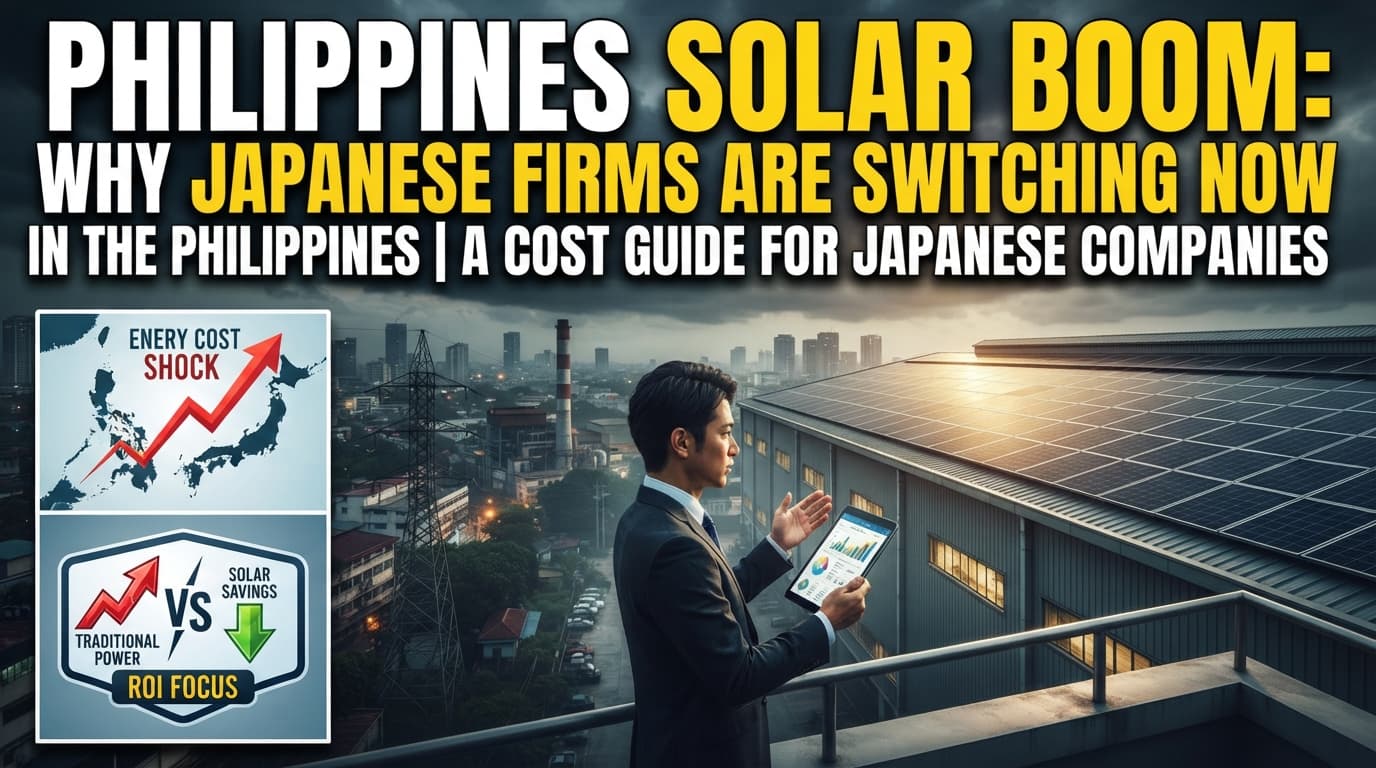
This guide explains the rapidly spreading rooftop solar movement in the Philippines from the perspective of Japanese companies operating there. From the background of rising electricity costs to installation steps and locally specific pitfalls, it covers the topic in practical, hands-on terms.
Part 1: Why This Matters
Step 1: The Philippine Business Context (3 min)
In the Philippines, the move to install solar panels on the roofs of homes and offices is spreading fast. The driver is the rising cost of electricity. Meralco, the country's largest electricity distributor, raised its rates by 10% after armed conflict broke out in the Middle East in late February. For the median household, the monthly electricity bill has come to account for roughly 12% of income.
The Philippines is one of the Southeast Asian countries with almost no electricity subsidies, and its residential rates are among the highest in the region. On top of that, because the Philippines relies on imports for the coal and gas used in power generation, a weaker peso tends to push electricity costs even higher.
This situation is not someone else's problem for Japanese companies with bases in the Philippines, or for Japanese nationals working there. Call centers, back-office operations, manufacturing sites, and the like consume a lot of power, so rising electricity costs translate directly into higher operating costs. That is exactly why it pays to understand the local shift toward solar power.
At your Manila office, a Filipino accounting staffer comes up and says: "This month's Meralco bill is up again. All the houses in my neighborhood are starting to put panels on their roofs." You recall the content of this guide and reply, "Let's take a proper look at the breakdown of our office's electricity costs. Let's check together whether solar is a realistic option for us." Sharing the numbers with your local colleagues is the first step toward a solution.
Step 2: Organizing the Key Points of the Source Article (5 min)
We have organized the facts stated in the source article into a table for study purposes.
| Point | Facts based on the source article |
|---|---|
| The world's largest solar panel market | Since armed conflict began in the Middle East, the Philippines has become the world's largest buyer of solar panels |
| Meralco's rate hike | Meralco, the largest electricity distributor, raised its rates by 10% after the Middle East situation worsened in late February |
| Household electricity burden | For the median household using 200 kilowatt-hours per month, electricity costs account for about 12% of monthly income |
| Panel import value | In the three months through May, $407 million worth of panels were imported, up 145% from the same period a year earlier |
| Inquiries to installers | Inquiries to Manila installer Philergy German Solar rose to about 2.5 times the previous year, reaching 3,000 a day at one point |
| Outlook for distributed solar | Research firm Ember projects that distributed solar, such as rooftop systems, could nearly triple to about 3,500 megawatts in two years |
| Shorter payback period | Because of rising electricity rates, the time to recoup installation costs has shortened from four years to 3.1 years |
| Government loans | The government offers loans of up to 500,000 pesos at 5% interest, but people employed in the private sector are not eligible |
| Solar's penetration | Solar still accounts for less than 4% of the country's total electricity consumption |
Reuters — "Philippines leads the world in rush to solar as power prices soar" (June 29, 2026)
This table was created for learning purposes based on facts from publicly available information. For details, please check the original article at the link above.
Related: Second-Life EV Batteries for Data-Centre Power explains this in detail.
Step 3: Comprehension Check (5 min)
Q1. By what percentage did Meralco raise its electricity rates after the Middle East situation worsened?
Hint: Look at the "Meralco's rate hike" row in the Step 2 table. It is a two-digit number.
Q2. In the three months through May, how much did the Philippines spend on imported solar panels, and by what percentage did that rise compared with the same period a year earlier?
Hint: The amount is in dollars, and the growth rate is a three-digit number.
Q3. How did the rise in electricity rates change the time it takes to recoup the cost of a solar installation?
Hint: State the two numbers — from how many years to how many years it shortened.
Q4. Some people cannot use the solar loans the government offers. Who are they?
Hint: It relates to employment type. The article mentions people who work in the private sector.
Q5. What share of the country's total electricity consumption does solar account for?
Hint: It is still a small number. The figure 4 is a clue.
Related: ADB's $70 Billion Plan for Philippine Infrastructure explains this in detail.
Part 2: Applying It in Practice
Step 4: Installation Steps in the Philippines (10 min)
We have laid out, step by step, how to proceed if you are considering adopting solar at a local base. Be sure to check the pitfalls specific to the Philippines as well.
| Step | What to do | Philippine-specific cautions |
|---|---|---|
| 1. Understand your current electricity costs | Gather several months of bills from Meralco and others, and check the unit price per kilowatt-hour and your usage | Rates keep rising. Looking at about six months of trends, not just the most recent bill, gives a more accurate picture |
| 2. Get quotes from multiple installers | Compare installed capacity, cost, and warranty terms across several companies | There are cases of delayed work due to parts hoarding and inadequate quality checks. Always confirm track record and warranty |
| 3. Estimate the budget and payback period in pesos | Calculate how many years it will take to recoup the cost from the upfront expense and the monthly savings | Government loans (up to 500,000 pesos at 5% interest) are not available to private-sector employees. Plan on the basis of your own funds or private financing |
| 4. Confirm regulations and procedures | Look into the procedures for grid connection and net metering (the mechanism for sending surplus power back to the utility) | Procedures with the Energy Regulatory Commission (ERC) and the utility are required. Conditions also change depending on whether you are within a PEZA (Philippine Economic Zone Authority) zone |
| 5. Consider whether you need battery storage | Decide whether to add battery storage as a hedge against power outages | Some areas in the Philippines are prone to outages. At bases where you do not want operations to stop, battery storage becomes more valuable |
For reference, the source article describes a Manila entrepreneur who installed a 12-kilowatt system with battery storage in January and cut their electricity bill to about one-fifth of the 21,000 pesos they paid the previous summer. Beyond the payback period, use real savings figures like these as decision criteria.
Related: Bracing for a Weak Peso and High Oil Prices: How Japanese Companies Strengthen FX and Cost Management with AI explains this in detail.
Step 5: Common Mistakes and Countermeasures (5 min)
Mistake 1: "Choosing an installer on price alone"
Bad example: You pick an installer simply because the quote is the cheapest, and only later notice delays and quality problems. The source article also points to parts hoarding and inadequate quality checks.
Good example: You choose after confirming past track record and warranty terms, comparing several installers. Treat price as just one factor, and look at delivery time and warranty too.
Mistake 2: "Planning on the assumption that you can use the government loan"
Bad example: You build your budget assuming you can use the 5% government loan, only to find out later that private-sector employees are not eligible, and your plan falls apart.
Good example: You run your estimates assuming the government loan is not available, using your own funds or private financing. Check whether you qualify for a program before you build your plan.
Mistake 3: "Looking only at the payback period and underestimating the weight of the upfront cost"
Bad example: You focus only on the payback period — "it pays for itself in 3.1 years" — and downplay the fact that a substantial upfront cost is required. The source article also notes that many households and companies cannot afford it because the upfront cost is too high, even if the payback is fast.
Good example: Alongside the payback period, you also check the impact of the upfront cost on your near-term cash flow. Decide based on both your available funds and the monthly savings.
Part 3: Going Deeper
Step 6: Related Technical Terms (5 min)
Rooftop solar is a setup that generates electricity by arraying solar panels on the roof of a house or building. Because electricity is expensive in the Philippines, the practice of installing panels on the roofs of Manila homes and offices to cut the power bought from Meralco is spreading.
Distributed solar is a method in which, rather than at a single large power plant, electricity is generated little by little across many buildings. According to the source article, this kind of distributed generating capacity could roughly triple in the Philippines within two years, making it an increasingly familiar option for local businesses as well.
Utility-scale solar refers to large solar power plants that generate electricity in bulk for the utility to sell. In the Philippines, the combined total of distributed systems such as rooftop installations is seen as potentially catching up to the scale of these large plants.
Battery storage is a device that stores generated electricity so it can be used when needed. Because some areas of the Philippines are prone to outages, some companies are adding battery storage to keep operations from stopping.
Payback time is the period that shows how many years it takes to recoup the installation cost through the electricity savings. In the Philippines, where electricity rates have risen, this period has shortened from four years to 3.1 years, encouraging adoption.
Step 7: Thinking About How to Apply It at Your Company (10 min)
Make your Manila base's electricity costs "visible"
Do you have a grasp of how much your local base pays for electricity each month and what it is mostly used for?
A thought-starter: Estimating the rough share by use — floor lighting, air conditioning, servers and PCs, and so on — reveals where there is room to cut.
Next action: Gather the last six months of Meralco bills and put the trends in unit price per kilowatt-hour and usage into a single table.
Evaluate solar adoption by payback period
From the electricity savings and the upfront cost, can you judge whether solar is a realistic investment for your company?
A thought-starter: Even if the payback period is short, it is important to check together whether the upfront cost will strain your near-term cash flow.
Next action: For the installed capacity you have in mind, get quotes from two installers and estimate the payback period in pesos.
Build outage-risk preparedness into your business plan
Do you have a clear picture of how much your operations would stop if a power outage occurred?
A thought-starter: At bases where you do not want operations to stop, the value of adding battery storage rises. Prioritize starting from the operations that cause the most trouble if they stop.
Next action: Identify the operations that would cause trouble if stopped by an outage, and confirm the amount of power those operations need together with your local staff.
Part 4: FAQ
Q1. Why is solar spreading so much in the Philippines?
The high cost of electricity is the biggest reason. The Philippines has almost no electricity subsidies, and residential rates are among the highest in Southeast Asia. According to the source article, Meralco raised rates by 10% after the Middle East situation worsened, and for the median household, electricity costs have reached about 12% of monthly income. Households and companies that want to cut their electricity bills are turning to rooftop solar.
Q2. How does the adoption environment in the Philippines differ from Japan?
In Japan, there is a degree of institutional support for electricity, but the Philippines has almost no subsidies, and rates fall directly on household and corporate costs. Because of that, the effect of cutting electricity costs on your own with solar feels larger. On the other hand, the upfront cost often exceeds the local average annual household income (353,200 pesos), so the financial hurdle needs to be kept in mind even more than in Japan.
Q3. Can employees of Japanese companies operating there use the government loans?
According to the source article, the government's 5% loans exclude people working in the private sector. Planning on the assumption that you can use them risks getting stuck later. Treat the loan as a bonus if it comes through, not as a line in the plan.
Q4. What pitfalls are there if you rush the installation?
The source article points out that supply cannot keep up with demand, leading to parts hoarding and inadequate quality checks. Choosing an installer on cheapness or speed alone can lead to delays and quality problems. Confirm track record and warranty, and decide after comparing several companies.
Q5. Does solar supply most of the Philippines' electricity?
Not yet to that extent. According to the source article, solar accounts for less than 4% of the country's total electricity consumption. Adoption is advancing, centered on rooftop systems, but for now it remains a small part of the whole. It is best to make your decision over the medium to long term, taking this level of penetration into account.
Tips for Putting This to Use (3 Tips)
First, pin down your base's electricity costs in numbers. The starting point for any countermeasure is knowing the current situation accurately. Gathering several months of Meralco bills and summarizing the trends in unit price and usage on a single page lets you judge calmly where there is room to cut and how much effect solar would have.
Always look at the payback period and upfront cost together. The "pays for itself in 3.1 years" figure is attractive, but you will misjudge if you overlook the impact a substantial upfront cost has on cash flow. Consider both the speed of recovery and your available funds.
Move forward by involving your local colleagues. Information such as the breakdown of electricity costs, installers' reputations, and the frequency of outages is well known to your local staff. Proceeding while checking the numbers together leads to decisions grounded in reality.
Bonus: How to Make Use of PH AI Works
PH AI Works supports Japanese companies expanding into the Philippines, and Japanese businesspeople working locally, in making use of AI and technology. You can consult with us in Japanese about reviewing operations in light of local energy circumstances and cost structures like the ones covered here.
As a next step, you can consult us for free on matters such as the following:
- How to organize data on your local base's electricity and operating costs and analyze it with AI to find room to cut
- Building a mechanism to clearly compare multiple quotes and payback periods when considering solar or battery storage
- An approach to sharing Philippine regulations and procedures internally so that local staff and Japanese headquarters can act on the same information
Please feel free to get in touch.
References & Sources
About the author
Founder / AI Engineer (36+ years in IT)
- ●From Tokyo · based in Manila for 13+ years
- ●36+ years in IT (development, SEO, AI)
- ●IBM Certified Generative AI Engineer
- ●AI chatbots, RAG & AI agent development
A Japanese AI engineer with 36+ years in IT and 13+ years on the ground in the Philippines. I write from hands-on experience to help Japanese companies adopt AI that actually delivers results — chatbots, workflow automation, AI agents, and AI-driven marketing. Feel free to reach out in Japanese or English.
Free AI Consultation
Tell us your challenges and we'll propose the right AI adoption plan for your business.
Book a Free 30-Minute ConsultationRelated Articles
AI Model Vendors Now Sell Implementation Too
OpenAI and Anthropic now sell implementation as well as models. What a local subsidiary should decide about that.
8/18/2026
Contracting for AI While Prices Keep Falling
Write a model number into the contract and it is obsolete in six months. How to design for switching instead.
8/17/2026
Meta Cut 750,000 Under-16 Accounts in Australia
AI-assessed age checks removed 750,000 accounts overnight. What that says about depending on platforms for reach.
8/16/2026

When an AI Calls Your Shop to Ask About Stock
AI now phones shops on a buyer's behalf to check stock. What to decide on the receiving side before it reaches you.
8/15/2026

Handling News That Is Not Settled Yet
A reported $6 billion acquisition talk is not a completed deal. How to act on industry news before it is confirmed.
8/14/2026

What a 69-Page AI Report Does Not Show
Frontier firms are reported 8.3x ahead, yet a table on page 35 shows no statistically significant link to revenue.
8/13/2026