Quantum Computing and the $2 Billion US Investment
The US is investing $2 billion in nine quantum firms. What companies in the Philippines should do now about encryption and compliance.

AI Engineer · 36+ years in IT · Japanese, based in Manila for 13+ years
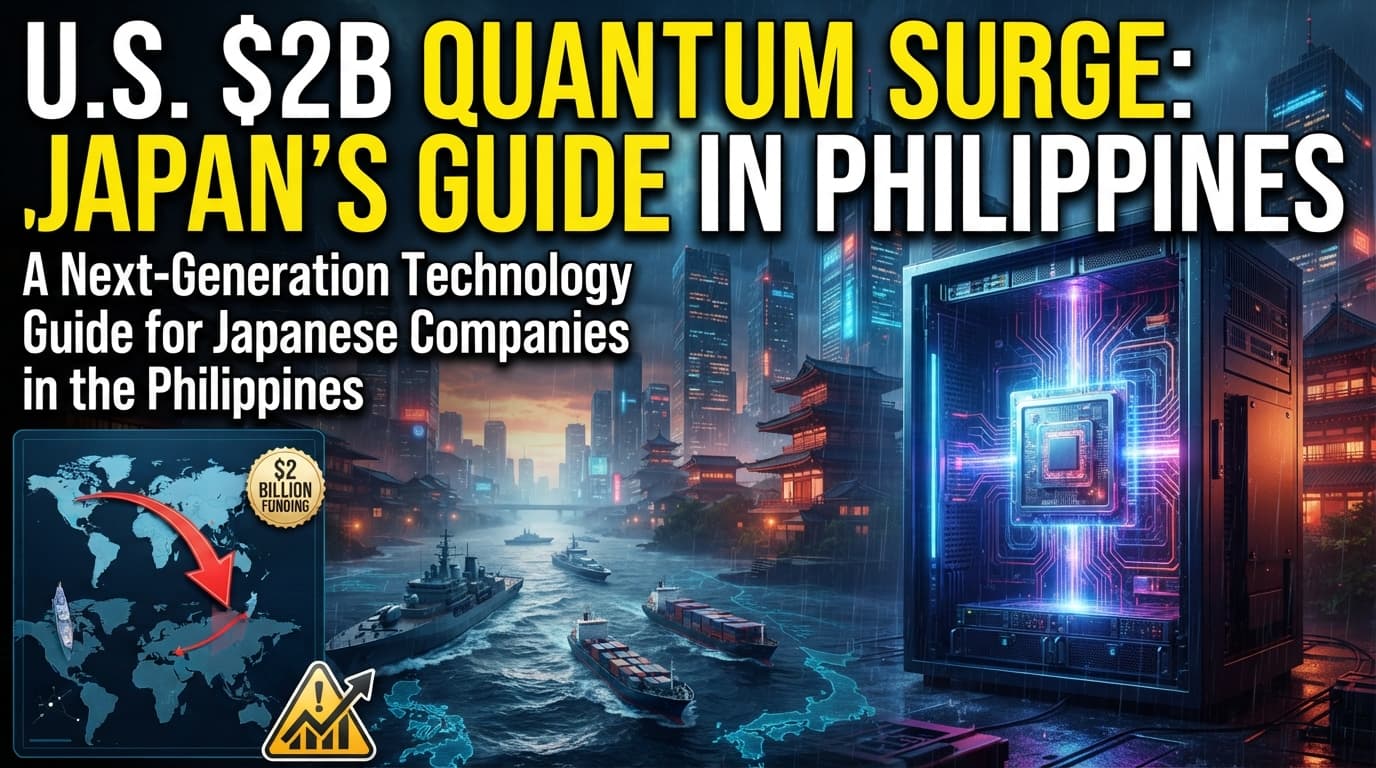
We take up the policy decision by the U.S. Department of Commerce to invest a total of $2 billion in nine quantum computing-related firms including IBM, and explain the encryption measures and the approach to information gathering that Japanese companies doing business in the Philippines should have in place.
Part 1: Why This Matters
Step 1: The Philippine Business Context (3 min)
The U.S. government's decision to invest a total of $2 billion (about ¥320 billion) in nine quantum computing-related companies is not merely U.S. industrial policy. For Japanese companies operating in the Philippines, too, it is an important move that affects medium- to long-term technology investment decisions.
The Philippines has grown as a BPO (business process outsourcing, an outsourcing destination) hub for Japanese companies, but going forward its role is expanding from a "mere outsourcing destination for tasks" to a "base that supports R&D and advanced data processing." Quantum computers are still in the early stages of practical use, but they will eventually touch on the shared services (a mechanism that consolidates the work of multiple sites in one place) of the Japanese companies gathered in the Philippines — in areas such as drug discovery, financial risk calculation, and logistics optimization.
The Asia regional headquarters of a Japanese manufacturer in BGC (Bonifacio Global City), Manila. At the Monday morning meeting, the CIO opens with this to a subordinate: "I hear the U.S. government has invested ¥320 billion in nine firms, starting with IBM. There's no impact on our operations right now, but looking ahead five or ten years, I want us to think about what we should prepare even at our Asia sites. Please organize it and report back to me by the end of this week."
In this way, creating the groundwork for local Philippine staff and Japanese managers to discuss future technology trends together helps with management decisions going forward.
Step 2: Organizing the Key Points of the Source Article (5 min)
Based on the facts in the source article, here are the main points in a table.
| Item | Details |
|---|---|
| Announcement date | May 21, 2026 |
| Announced by | U.S. Department of Commerce |
| Total investment | $2 billion (about ¥320 billion) |
| Number of target firms | Nine firms within the U.S. |
| Investment in IBM | $1 billion |
| IBM's use of funds | Establishing a subsidiary to manufacture wafers for quantum computing |
| Investment in GlobalFoundries | $375 million |
| Other firms mentioned | Atom Computing and others |
| Policy background | Support for the domestic technology industry by the Trump administration |
This table was compiled from publicly available facts for learning purposes. For details, please check the original article at the link above.
Related: Anthropic's $900B Valuation and AI Procurement explains this in detail.
Step 3: Comprehension Check (5 min)
Q1. On what date did the U.S. Department of Commerce announce the investment? Hint: The announcement date and the article's publication date may differ by one day.
Q2. What is the total investment in dollars, and roughly how much does it come to in Japanese yen? Hint: Check the "Total investment" row of the table.
Q3. For what purpose will the $1 billion that IBM receives be used? Hint: There is a mention of establishing a subsidiary.
Q4. What kind of company is GlobalFoundries, and how much does it receive in investment? Hint: It's in a semiconductor-related industry.
Q5. Under which administration's policy is this investment being carried out? Hint: The administration's name appears near the beginning of the source article.
Related: OpenAI in the Philippines: An AI Adoption Strategy explains this in detail.
Part 2: Putting It Into Practice
Step 4: Implementation Steps in the Philippines (10 min)
We've organized the steps for Japanese companies doing business in the Philippines to incorporate the trend of the next-generation technology of quantum computing into their operations.
| Step | Details | Points particular to the Philippines |
|---|---|---|
| 1. Build an information-gathering system | Designate a person to compile quantum computing trends once a month. | Leverage local staff's strength in reading primary English-language sources, and have them handle reporting to the Japanese head office for efficiency. |
| 2. Organize the relevance to your own operations | Identify where in your operations — finance, logistics, drug discovery, encryption, etc. — quantum may have future impact. | Think of it separately from the work handled at your Philippine BPO site (such as accounting shared services and data entry). |
| 3. Review the security of crypto assets and communications | Because the practical use of quantum computers may break current encryption methods, consider countermeasures. | Refer to the guidance of the NPC (National Privacy Commission), which administers the Philippine Data Privacy Act. |
| 4. Hold study sessions | Hold a quarterly study session where local staff and Japanese expatriates can learn together. | Prepare materials in both English and Japanese, and create an atmosphere where local staff feel free to ask questions. |
| 5. Secure a budget allocation | Set aside an annual budget for trial learning and attending external seminars. | A realistic guideline for local training costs is around PHP 5,000–15,000 per person. |
A supplementary note on the encryption measures in Step 3: it's said that once quantum computers come into practical use, some of the encryption methods now widely used become easier to crack. Because the protection of personal information is strictly overseen by the NPC in the Philippines, for work that handles customer data, draw up a forward-looking plan to update encryption methods early.
Related: IBM Bob and Enterprise AI: Rollout Lessons explains this in detail.
Step 5: Common Mistakes and How to Avoid Them (5 min)
Here are three commonly seen mistakes when advancing your response to next-generation technology in the Philippines.
Mistake 1: Stopping information gathering because "practical use is still far off"
Bad example: Judging that quantum computers are more than ten years away and ending up with no one in the company tracking the trends. Before you know it, a competitor has worked quantum-related topics into its proposals to clients, and only your company is behind.
Good example: Once a month, have local staff summarize English-language articles and share them at both the Japanese head office and the Philippine site. Even if practical use is still far off, it's important to keep your sensitivity to information sharp.
Mistake 2: Putting off updating encryption methods as "something to do someday"
Bad example: Even knowing you need to review the encryption method for customer data, you never get to it, swamped by the work in front of you, and several years pass.
Good example: Regularly check the NPC's latest guidelines and, while consulting with the IT department, draw up an encryption-method update plan as a roadmap spanning about three years. Make the responsible person and the deadline clear.
Mistake 3: Leaving local staff out of technology discussions
Bad example: Deciding "this is for the Japanese head office to decide" and leaving Philippine local staff out of the advanced technology discussions. As a result, major rework arises at the local implementation stage.
Good example: Bring Filipino engineers and IT managers into the discussion from the earliest stage. Local staff who are strong with primary English-language sources often raise points the Japanese side hadn't noticed.
Part 3: Going Deeper
Step 6: Related Technical Terms (5 min)
A quantum computer (a quantum computing machine) is a new kind of machine that computes on a different principle from the computers we use day to day. Its hallmark is that it can handle many calculations at once using the laws of physics of the extremely tiny world. At a Japanese pharmaceutical company in Manila, topics like "the calculations to narrow down candidate compounds for new drugs may someday speed up with quantum computers" are starting to come up in meetings.
A wafer (a semiconductor substrate) is a thin disk that serves as the foundation when making semiconductors or quantum chips. On a round plate made of silicon or the like, fine circuits are stacked in many layers. At Japanese electronic-component factories in Cebu and Batangas, components are assembled using chips cut from wafers, and if wafers for quantum computers become widespread, new work may be created.
A semiconductor foundry (contract semiconductor manufacturing) is the business of making semiconductors based on another company's blueprints rather than doing the design in-house. GlobalFoundries of the U.S. is a representative example. In the special economic zones (under PEZA jurisdiction) in Calamba and Laguna in the Philippines, Japanese semiconductor back-end factories are concentrated, and U.S. production trends affect orders at local factories as well.
The Trump administration (the administration of U.S. President Donald Trump) is the government over which Donald Trump of the U.S. presides as president. It has rolled out many support measures to strengthen domestic U.S. industry. At a Japanese trading company in Manila, "when U.S. industrial policy changes, it also affects import-export and procurement routes via the Philippines" is debated at the monthly management meeting.
The Department of Commerce (the U.S. Department of Commerce) is the U.S. government agency in charge of trade and industry, and it sometimes decides investments in technology companies and export controls. At Philippine IT firms and Japanese BPOs, regularly checking whether their business partners appear on the U.S. Department of Commerce's export-control lists is carried out as part of legal compliance.
Step 7: Thinking About How to Apply This to Your Own Company (10 min)
Build a system at your Philippine site for learning about "future technology"
Something to think about: At your company's Philippine site, who gathers information, and how, about technologies looking ten years ahead like quantum computers? Check whether information gathering has been left entirely to the Japanese head office, and whether there's an environment in which local staff can learn on their own initiative.
Next action: Starting next month, begin an in-house study session once a month where, for 15 minutes, local staff introduce technology news they've selected to one another.
Review your customer-data encryption policy three years ahead
Something to think about: With what encryption method is the customer data and transaction data you handle in the Philippines currently protected? Does the IT department have an update plan that anticipates the practical use of quantum computers? Check the NPC's latest guidelines together with this.
Next action: Within this quarter, create a one-page document comparing the current state of your encryption methods with the NPC's recommendations, and share it with management.
Organize how U.S. industrial policy affects your supply chain
Something to think about: When the U.S. makes large-scale investments in the semiconductor and quantum fields, it may affect routes that export components to the U.S. via the Philippines, and routes that procure technology from the U.S. Which countries is your Philippine site connected to?
Next action: Write out on a map the main import-export routes and business partners your Philippine site is involved with, and mark the places likely to be affected by changes in U.S. policy.
Part 4: FAQ
Q1. Do Japanese companies doing business in the Philippines need quantum computers right away?
There's no need to adopt them right away. Practical use is still in the early stages, and full-scale business use is seen as several years to about ten years off. That said, reviewing encryption methods and developing talent are worth starting early. For Japanese companies in the Philippines, a realistic place to start is by first designating one person responsible for information gathering.
Q2. Are there quantum computing-related talent in the Philippines?
Advanced research in physics and computer science is being conducted at institutions such as the University of the Philippines (UP) and De La Salle University, and excellent talent is emerging. If the Japanese head office conducts quantum-related research, organizing a research-support structure that leverages the Philippine site is also something that could be considered in the future. At present, however, specialists in the quantum field are scarce even in the Philippines, and salary levels tend to be higher than for general IT engineers.
Q3. How does the U.S. investment policy affect the Philippine semiconductor industry?
The U.S. investment emphasizes front-end processes such as wafer manufacturing, but the Philippines has many back-end (assembly and inspection) factories. If production increases in the U.S., orders may flow to Philippine back-end factories as well. On the other hand, if U.S. export controls tighten, caution is needed regarding China-bound transactions via the Philippines. We recommend that PEZA-jurisdiction factories check export-destination regulatory trends every month.
Q4. Is the Philippines' data protection law keeping pace with the quantum era?
The NPC, which administers the Philippine Data Privacy Act, is updating guidelines on data encryption and protection measures in stages. Direct guidance on the risk of encryption-cracking by quantum computers is still limited, but it may be updated going forward in light of international trends. For a Japanese company, it's reassuring to set up a system to check the NPC's official site every quarter.
Q5. How can we close the gap in technology awareness between the Japanese head office and the Philippine site?
The Japanese head office often has more information, but the Philippine site has the strength of being good with primary English-language sources. Dividing the roles — "the Japanese side covers cross-industry trends, the Philippine side does real-time summaries of English news" — lets them complement each other. It's important to hold a monthly online sharing session so both sites have the same information.
Tips for Making the Most of This (3 Tips)
Designate one person for information gathering and make it a monthly habit
For a long-term theme like quantum computers, the topic disappears from the company unless someone tracks the trends regularly. Designate someone at the Philippine site who can read primary English-language sources, and make a 15-minute in-house sharing once a month a habit. A shallow understanding is fine for the first year. Continuity matters above all.
Create a one-page document that makes the current state of your encryption methods visible
Surprisingly few people in a company accurately grasp which encryption method protects customer data and transaction data. Working with the IT department, create a one-page document listing the encryption methods used at your Philippine site. Comparing it with the NPC's latest guidelines reveals what to update next.
Involve local staff in technology discussions from the very start
With the approach of deciding policy at the Japanese head office alone and conveying it to the Philippine site afterward, rework inevitably arises at the local implementation stage. Bring Filipino engineers and IT managers into discussions of technology themes from the earliest stage. Their ability to read English-language materials and their perspective on local realities will surely help the Japanese side's judgment.
Bonus: How to Make Use of PH AI Works
PH AI Works specializes in supporting the use of AI and technology for Japanese companies doing business in the Philippines. Including responses to long-term technology trends like quantum computers, we provide adoption support in a form that connects to local operations.
The three themes you can consult us on as a next step are as follows.
First, building a technology information-gathering system at your Philippine site. You can consult us on how to create monthly trend reports and how to design study sessions that involve local staff.
Second, checking the current state of data protection and NPC compliance. We can help you verify whether the data-protection policy for the data handled at your Philippine site is consistent with current regulations.
Third, improving technology communication between the Philippine site and the Japanese head office. We support building a structure that reduces the information gap between the two sites and leverages the strengths of local staff.
Please feel free to get in touch. The initial consultation is free.
References and Sources
- Nikkei — "U.S. government invests ¥320 billion in quantum computing firms: IBM and eight others" (May 22, 2026)
- National Privacy Commission (NPC) — Official site of the Philippine National Privacy Commission
- Philippine Economic Zone Authority (PEZA) — Official site of the Philippine Economic Zone Authority
About the author
Founder / AI Engineer (36+ years in IT)
- ●From Tokyo · based in Manila for 13+ years
- ●36+ years in IT (development, SEO, AI)
- ●IBM Certified Generative AI Engineer
- ●AI chatbots, RAG & AI agent development
A Japanese AI engineer with 36+ years in IT and 13+ years on the ground in the Philippines. I write from hands-on experience to help Japanese companies adopt AI that actually delivers results — chatbots, workflow automation, AI agents, and AI-driven marketing. Feel free to reach out in Japanese or English.
Free AI Consultation
Tell us your challenges and we'll propose the right AI adoption plan for your business.
Book a Free 30-Minute ConsultationRelated Articles
AI Model Vendors Now Sell Implementation Too
OpenAI and Anthropic now sell implementation as well as models. What a local subsidiary should decide about that.
8/18/2026
Contracting for AI While Prices Keep Falling
Write a model number into the contract and it is obsolete in six months. How to design for switching instead.
8/17/2026

Meta Cut 750,000 Under-16 Accounts in Australia
AI-assessed age checks removed 750,000 accounts overnight. What that says about depending on platforms for reach.
8/16/2026

When an AI Calls Your Shop to Ask About Stock
AI now phones shops on a buyer's behalf to check stock. What to decide on the receiving side before it reaches you.
8/15/2026

Handling News That Is Not Settled Yet
A reported $6 billion acquisition talk is not a completed deal. How to act on industry news before it is confirmed.
8/14/2026

What a 69-Page AI Report Does Not Show
Frontier firms are reported 8.3x ahead, yet a table on page 35 shows no statistically significant link to revenue.
8/13/2026