
Philippine Talent Strategy After the SSW Freeze
With Specified Skilled Worker intake frozen in food service and a 2027 successor programme coming, how to plan hiring now.

AI Engineer · 36+ years in IT · Japanese, based in Manila for 13+ years
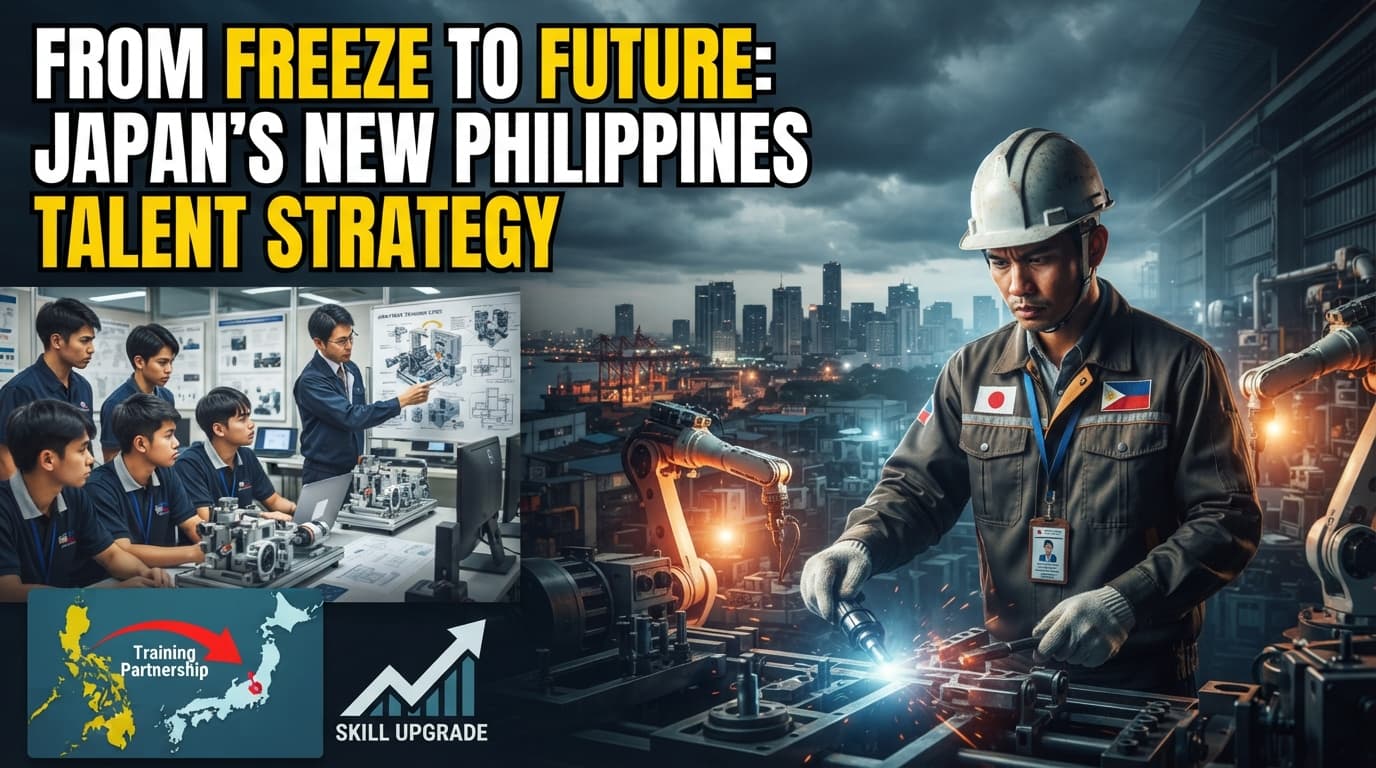
At a turning point in Japan's foreign-worker system, we lay out—together with practical steps—the hiring rethink and the approach to AI and operational automation that Philippine subsidiaries should take.
Part 1: Why This Matters
Step 1: The Philippine Business Context (3 min)
Foreign workers in Japan reached roughly 2.57 million as of the end of 2025, and among them Filipinos are known as vital talent supporting nursing care, food service, and manufacturing. With the Japanese government's freeze in April 2026 on new "Specified Skilled Worker (i)" intake in the food-service industry, changes are beginning to occur in the flow of labor from the Philippines to Japan. At the same time, for Japanese companies' Philippine subsidiaries and for Japanese-affiliated BPO (business process outsourcing) firms based in Manila and Cebu, there may be a growing opportunity to hire locally the talent that would otherwise have been sent to Japan.
For Japanese business professionals in the Philippines, this system change carries two meanings. One is the perspective of how the Japanese head office's talent-securing strategy affects the Philippine subsidiary. The other is the perspective that, when hiring Filipino staff, "candidates who had hoped to go to Japan" may now come onto the market. You need to consider, in parallel, the moves to make up for labor shortages by leveraging AI (artificial intelligence) and RPA (operational automation tools), and the moves to strengthen local hiring.
At the Philippine subsidiary of a Japanese-affiliated restaurant chain in Manila's BGC district, Ms. Tanaka (a pseudonym) from HR opens the morning meeting: "We heard from the head office in Japan. The Specified Skilled Worker quota for food service has been frozen for new intake. From next year, a new program called 'Employment for Skill Development' will begin. It looks like even here at our Manila site, we'll need to strengthen our training program for local staff and rethink our plan for developing talent to send to head office. Shall we think about a system, combined with operational efficiency through AI, that lets people work with us locally for the long term?"
Step 2: Key Points from the Original Article (5 min)
| Item | Content |
|---|---|
| Total foreign residents (end of 2025) | 4,125,392 |
| Number of foreign workers (end of 2025) | About 2.57 million (about 4% of the total workforce) |
| Specified Skilled Worker (i) cap for food service | 50,000 (about 46,000 reached as of the end of February 2026) |
| Date the intake freeze was announced | April 13, 2026 |
| Number of Technical Intern Trainees (end of 2024) | About 457,000 |
| Technical Intern Trainees in construction (end of 2024) | 107,000 |
| Technical Intern Trainees in food manufacturing (end of 2024) | 93,000 |
| Technical Intern Trainees in machinery and metals (end of 2024) | 61,000 |
| Technical Intern Trainees in agriculture and forestry (end of 2024) | 32,000 |
| Number of permanent residents | About 950,000 (23% of all foreign residents) |
| Engineer/Specialist in Humanities/International Services | A little under 480,000 (11.5%) |
| Holders of student-visa status | About 460,000 (allowed to work up to 28 hours per week with permission for activities outside their status) |
| Holders of Specified Skilled Worker status | About 390,000 |
| Start date of the new "Employment for Skill Development" program | From April 2027 (a new residency status replacing the Technical Intern Training Program) |
| Trend in the number of foreign workers | 2010: about 650,000 → 2025: about 2.57 million (about a fourfold increase) |
This table was created for study purposes based on facts from publicly available information. For details, please check the original article at the link above.
Step 3: Comprehension Check (5 min)
Q1. Which residency status did the Japanese government freeze for new intake on April 13, 2026? And which industry was affected?
Hint: Recall the industry that, of a cap of 50,000, had already reached about 46,000.
Q2. What is the name of the new residency status to be introduced from April 2027 in place of the Technical Intern Training Program?
Hint: The name itself contains the meanings of "to develop" and "to work."
Q3. As of the end of 2025, roughly how many foreign workers were there in Japan? And how many times higher is that compared with 2010?
Hint: In 2010 there were about 650,000. Try doing the division.
Q4. Among Technical Intern Trainees, which job category had the most people working in it (as of the end of 2024)?
Hint: The article also gave the example of the automobile industry in Ota City, Gunma Prefecture. Construction accounts for 107,000.
Q5. If a student obtains "comprehensive permission for activities outside their status," how many hours per week can they work at most?
Hint: A little fewer than 30 hours.
Related: Japan's Food-Service Visa Freeze: Hiring in the Philippines explains this in detail.
Part 2: Applying This in Practice
Step 4: Implementation Steps in the Philippines (10 min)
In light of the change in the Japanese head office's talent-securing strategy, here are the steps Philippine subsidiaries and Japanese-affiliated companies should work on.
| Step | Content | Considerations specific to the Philippines |
|---|---|---|
| 1. Re-examine the talent needs of the local subsidiary | Sort and organize the talent you had planned to send to Japan separately from the talent you need locally in the Philippines. For each of nursing care, food service, and manufacturing, check how the head office's policy change affects your local hiring plan. | You need to check the latest employment guidelines of DOLE (the Department of Labor and Employment) and understand the differences in procedures between local hiring and overseas deployment. |
| 2. Identify targets for operational automation with AI/RPA | Choose areas where AI or automation tools can supplement work that had relied on manpower—such as order taking, inventory management, and shift scheduling. This can ease talent shortages. | Under the Philippine Data Privacy Act (DPA), you need to register with the NPC (National Privacy Commission) and put internal rules in place for handling employee data. |
| 3. Redesign the training program for local staff | For Filipino talent who hope to "work in Japan," build a system that lets them build a career at the local subsidiary while learning Japanese and Japanese business culture. | Set pay levels based on the regional minimum wage (about PHP 600 per day in the NCR—Metro Manila—as a guide), and a design that adds a training allowance on top is realistic. Be mindful, too, of withholding obligations to the BIR (Bureau of Internal Revenue). |
| 4. Choose partners aligned with the Employment for Skill Development program | Looking ahead to the new program starting in April 2027, build a partnership framework early with local sending organizations and educational institutions. Also check the licensing status of the DMW (Department of Migrant Workers), renamed from the POEA. | In light of the Philippine business custom of frequently using verbal agreements, always put memoranda (MOUs) and contracts in writing. We recommend having a lawyer review them before signing. |
| 5. Estimate return on investment and explain it to stakeholders | Estimate the cost-effectiveness of automation investment and talent-development investment, and present it to the head office and local management. Thinking in terms of a medium-term plan of about three years is realistic. | When estimating investment amounts, present them in both pesos and dollars and note the foreign-exchange risk alongside; this makes it easier to gain the head office's understanding. |
Step 5: Common Mistakes and How to Avoid Them (5 min)
Mistake 1: "Being slow to relay the head office's policy change to the local side"
Bad example: Even after receiving word from the head office's HR department about the "freeze on the food-service Specified Skilled Worker quota," you don't share it within the local subsidiary, and three months later staff confront you—"I was supposed to be able to go to Japan; what's going on?"—causing confusion.
Good example: When you receive word of a policy change from head office, you consult with the local HR manager and, within one to two weeks, hold a briefing for the affected staff. Always secure time to take questions, and distribute the key points in writing as well.
Mistake 2: "Pushing ahead with AI adoption while leaving local staff's anxiety unaddressed"
Bad example: You bring in operational automation tools all at once and, thinking "this solves the labor shortage," put off explaining it to local staff. As a result, anxiety spreads that their jobs may disappear, and talented people leave.
Good example: Before adoption, you carefully explain the policy that AI and automation tools are "tools that take over routine work," and that staff will move to higher-value work. At the same time, prepare a training program for the new work.
Mistake 3: "Settling local hires' pay and contract terms with verbal agreements"
Bad example: When hiring Filipino staff, you explain the terms of pay and training period verbally and leave only a brief description in the contract. Later, a dispute arises over "what happened to the talk about going to Japan," and you carry litigation risk.
Good example: At the time of hiring, you spell out in the contract all of the pay, training content, the possibility of future deployment to Japan, and so on. You ask a local lawyer well versed in Philippine labor law to review it, and both parties read through it together before signing.
Related: When AI Quietly Shrinks Entry-Level Hiring explains this in detail.
Part 3: Going Deeper
Step 6: Related Technical Terms (5 min)
Specified Skilled Worker (tokutei ginou) is a residency status newly established by the Japanese government in 2019, created so that foreigners can work in industries facing severe labor shortages. At Japanese-affiliated companies partnering with sending organizations in the Philippines, a pattern has taken hold of providing Japanese-language and job training in Manila and Cebu and deploying those who pass to nursing-care facilities and food-service outlets in Japan.
The Technical Intern Training Program (ginou jisshu) is a system established in 2010, nominally so that foreigners learn skills in Japan and, after returning home, put those skills to use in their own country. Cases are seen where a candidate for a manufacturing management role in the Philippines spends three to five years gaining experience at a Japanese factory as a technical intern trainee, then, after returning home, takes on a mentoring role at an industrial park on the outskirts of Manila.
Employment for Skill Development (ikusei shuro) is a new residency status starting in April 2027 in place of the Technical Intern Training Program, with the aim of shifting to a system that develops talent while having them work for the long term. Programs such as developing young talent who graduated from Philippine universities for one year locally on the premise of employment in Japan may spread going forward.
BPO (Business Process Outsourcing) is a system of entrusting operations such as a company's accounting and call centers to outside specialist firms. Because the Philippines has abundant English-speaking talent, there are many cases of BPO firms based in Manila and Cebu taking on accounting and inquiry handling from Japanese companies.
The DPA (Data Privacy Act of 2012—the Philippine personal-information protection law) is a law that sets out the rules that organizations handling personal information within the Philippines must follow. When a Japanese-affiliated company manages HR data for both Japanese and Filipino staff at its Manila office, registration with the NPC (National Privacy Commission) and putting internal handling procedures in place are required.
Related: Meta's AI Restructuring: Redesigning Work on Site explains this in detail.
Step 7: Thinking About How to Apply This to Your Company (10 min)
Rethinking "hiring on the premise of deployment to Japan" at your Philippine subsidiary
A prompt for thinking: If you have talent you hired on the premise that "we'll deploy you to the Japanese head office in the future," the head office's policy change may leave that plan up in the air. Redesign a path where they can build a career locally, and be ready to explain it to them. It's important to make pay levels and promotion opportunities attractive regardless of whether deployment to Japan happens.
Next action: Together with your local subsidiary's HR manager, list the number of people hired over the past two years with the explanation of "on the premise of deployment to Japan," and set up one-on-one meetings with each of them.
Identifying work areas that AI and automation tools can supplement
A prompt for thinking: Identify work easily affected by labor shortages—order taking, inventory management, shift scheduling, accounting processing, and so on. Cloud-based AI tools and automation software are becoming easier to adopt in the Philippines too, with some you can try from around a few thousand pesos a month. A realistic approach is to try it small in one work area first, see the results, and then expand.
Next action: Within next week, interview department heads about the "top three most labor-intensive tasks" at the local subsidiary, and draw up a plan for a trial adoption of an AI or automation tool for one of them.
Rebuilding your talent-retention strategy locally in the Philippines
A prompt for thinking: The perspective of building a system for people to work with you for the long term locally in the Philippines—rather than on the premise of sending them to Japan—becomes important. Design comprehensive job satisfaction that includes cultural considerations—not only pay, but supplemental health insurance (PhilHealth), internal training, family-oriented events, and so on. Lowering turnover ultimately leads to reducing talent-securing costs.
Next action: Calculate your current turnover rate by department, and interview about five staff who left over the past year about their reasons for leaving. If you find common reasons, it's effective to start with measures that address them.
Part 4: FAQ
Q1. How does the freeze on Specified Skilled Worker intake in food service affect a Philippine subsidiary's hiring plan?
A1. The direct impact is limited to companies that had planned to send Filipino staff to the Japanese head office. However, because candidates within the Philippines who had hoped to "work in Japan" remain in the local labor market, the competitiveness of local hiring rises relatively. For Japanese-affiliated companies in Manila and Cebu, this can be called a good chance to secure talented people locally. We recommend reviewing pay levels and training content and clearly presenting a local career path.
Q2. Under the "Employment for Skill Development" program from April 2027, what will be required of companies?
A2. The details of the program await future government announcements, but based on the information published at present, the core will be the idea of "having people work while developing them." Cooperation with sending organizations on the Philippine side, the system for Japanese-language education, and the degree of freedom to transfer employers are being discussed as major changes from the Technical Intern Training Program. As a Philippine subsidiary, it's realistic to advance information gathering during 2026 and firm up your response policy by the start of 2027.
Q3. When hiring Filipino staff locally, how should I explain the gap in pay levels with Japan?
A3. Because the cost of living differs greatly between Japan and the Philippines, it's effective to convey thinking in terms of purchasing power rather than face-value comparison. The regional minimum wage in Metro Manila (NCR) is about PHP 600 per day as a guide, but for a candidate for a management role at a Japanese-affiliated company, a monthly salary of around PHP 40,000–60,000 is a common level. Presenting it comprehensively—including elements beyond pay such as health insurance, transportation allowance, and training opportunities—increases the sense of acceptance.
Q4. How should I deal with Filipino staff who feel anxious about job cuts due to AI adoption?
A4. In Philippine workplace culture, a relationship of trust with one's superior is the foundation for getting work done. It's important to position the adoption of AI and automation tools not as "to cut people" but as "to free people from routine work so they can do more creative work," and to take time to explain it before adoption. Set up a forum for dialogue with staff representatives and create opportunities for them to voice their anxieties and questions. Using in-person explanation alongside documents, not documents alone, is the key to building trust.
Q5. What should I be especially careful about in communication between the Japanese head office and the local subsidiary?
A5. The head office's decisions can change quickly based on figures and cap management, and the local subsidiary can be tossed about by them. When there is a policy change from head office, build a mechanism for the local subsidiary to feed back to head office from three perspectives: "the impact on local staff," "contractual responsibilities," and "ripple effects on the hiring plan." In the Philippines, verbal agreement is valued culturally, but always keeping important exchanges with head office in writing helps avoid trouble later.
Tips for Making the Most of This (3 Tips)
Re-examine your talent portfolio by splitting it into "premised on deployment to Japan" and "self-contained locally"
By managing separately the talent affected by Japan's system changes and the talent who will work locally in the Philippines over the long term, you can build a system where local operations don't stop even when the head office's policy changes. Make it a habit, together with your HR manager, to review this each quarter.
With AI and automation tools, start from "try small and measure the effect"
Rather than making a large investment all at once, trial-adopt a cloud-based tool you can start from around a few thousand pesos a month in one department, and measure the effect after three months. Sharing the success case internally before expanding to other departments is the approach that makes it easiest to win local staff's acceptance.
Set up a forum for dialogue with local staff at least once a month
Anxiety about labor shortages and system changes grows larger the fewer forums there are for dialogue. Create regular opportunities for dialogue in a form suited to Philippine culture, such as a small-group lunch or coffee time in the office. Connecting what you hear to your reports to head office turns you into a bridge that conveys local realities to head office.
Bonus: How to Make Use of PH AI Works
PH AI Works supports the adoption of AI and operational automation for Japanese companies expanding into the Philippines and for Japanese business professionals in the Philippines.As a next step, you can consult us on things like the following.
- How to bring AI into HR operations at a Philippine subsidiary (recruitment management, shift scheduling, payroll, and so on)
- Support for creating training content for local staff in response to the Japanese head office's system changes
- Selection of operational automation tools to make up for labor shortages, and drawing up an adoption plan
Please feel free to get in touch. The initial consultation is free.
References and Sources
About the author
Founder / AI Engineer (36+ years in IT)
- ●From Tokyo · based in Manila for 13+ years
- ●36+ years in IT (development, SEO, AI)
- ●IBM Certified Generative AI Engineer
- ●AI chatbots, RAG & AI agent development
A Japanese AI engineer with 36+ years in IT and 13+ years on the ground in the Philippines. I write from hands-on experience to help Japanese companies adopt AI that actually delivers results — chatbots, workflow automation, AI agents, and AI-driven marketing. Feel free to reach out in Japanese or English.
Free AI Consultation
Tell us your challenges and we'll propose the right AI adoption plan for your business.
Book a Free 30-Minute ConsultationRelated Articles
AI Model Vendors Now Sell Implementation Too
OpenAI and Anthropic now sell implementation as well as models. What a local subsidiary should decide about that.
8/18/2026
Contracting for AI While Prices Keep Falling
Write a model number into the contract and it is obsolete in six months. How to design for switching instead.
8/17/2026

Meta Cut 750,000 Under-16 Accounts in Australia
AI-assessed age checks removed 750,000 accounts overnight. What that says about depending on platforms for reach.
8/16/2026

When an AI Calls Your Shop to Ask About Stock
AI now phones shops on a buyer's behalf to check stock. What to decide on the receiving side before it reaches you.
8/15/2026

Handling News That Is Not Settled Yet
A reported $6 billion acquisition talk is not a completed deal. How to act on industry news before it is confirmed.
8/14/2026

What a 69-Page AI Report Does Not Show
Frontier firms are reported 8.3x ahead, yet a table on page 35 shows no statistically significant link to revenue.
8/13/2026