
How AI Helps Philippine SMEs Move Beyond Digital Transformation
A practical guide for Philippine SMEs on becoming an AI-first company, covering challenges, steps, costs in pesos, data privacy, and realistic ROI from AI and modern technology.


AI Engineer · 36+ years in IT · Japanese, based in Manila for 13+ years
Summary
- An AI-first company makes AI a default part of everyday workflows, not a single tool bolted on after the business has already gone digital.
- Nearly all Philippine companies already own computers and have internet access, yet only a small share use AI, so the real gap is in process design and skills, not basic equipment.
- A phased pilot with clear data rules and the right local partner reaches measurable savings faster and at lower risk than a full company-wide rollout.
Where Philippine Companies Get Stuck After Going Digital
| Challenge | What it looks like day to day |
|---|---|
| Disconnected tools | Sales, accounting, and inventory apps that do not share data |
| Heavy manual admin | Staff re-typing the same figures into different systems |
| Gut-feel decisions | Reports arrive late, so choices rely on memory, not numbers |
| Thin AI skills | No in-house staff who can plan or run AI projects |
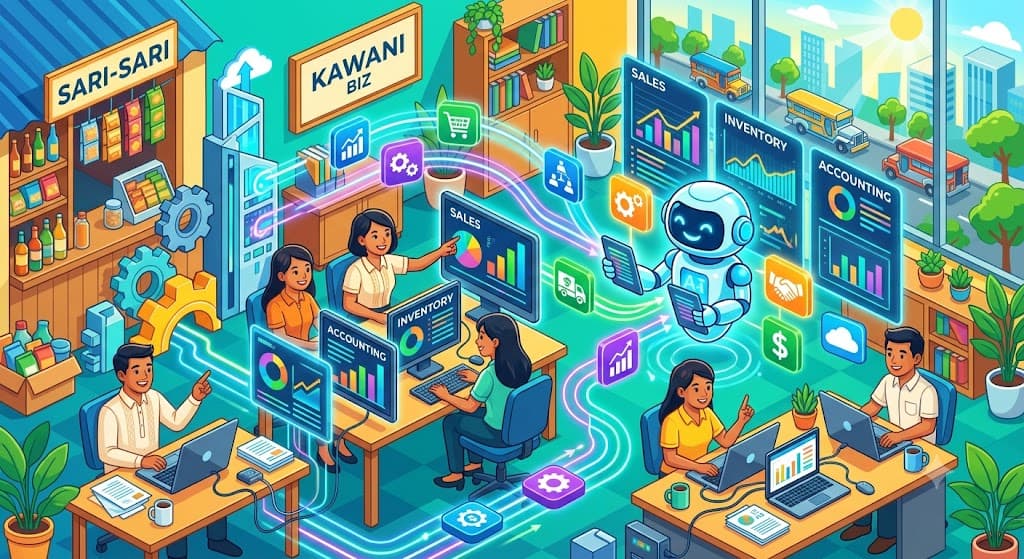
Many Philippine businesses spent the last few years buying software, moving to the cloud, and setting up online payments. This is digital transformation (DX), which means replacing paper and manual work with digital systems. The problem is that DX often stops at "we now have apps." The apps run, but they do not work together.
 After going digital, many Philippine SMEs still move data by hand between tools that do not connect.
The first common challenge is disconnected tools. A retailer in Cebu might use one app for the point of sale, another for accounting, and a chat group for supplier orders. None of them share data, so someone has to copy numbers by hand.
The second is heavy manual admin. Staff spend hours each week re-typing invoices, encoding receipts, or updating stock counts. This work is necessary, but it adds no real value and is easy to get wrong.
The third is gut-feel decisions. When reports take days to prepare, owners decide based on memory or instinct. By the time the data is ready, the moment to act has often passed.
The fourth is a skills gap. Nearly all registered businesses in the country are micro, small, or medium enterprises, and most do not have a data scientist or AI engineer on staff. Without that knowledge, even useful tools sit unused.
Related: How AI Helps Philippine SMEs Maximize Their Technology ROI explains this in detail.
Why Manual and One-Off Tools No Longer Keep Up
| Limit | Cost to the business |
|---|---|
| Manual work does not scale | More orders mean more hours and more mistakes |
| Spreadsheets break with growth | Files get too large, formulas fail, versions clash |
| Slow customer response | Buyers wait hours for replies and go elsewhere |
| Manual compliance is risky | Hard to track personal data under the Data Privacy Act |
The usual fix for a busy office is to "hire more people" or "build one more spreadsheet." These steps help for a while, but they reach a ceiling.
Manual work does not scale. If processing 100 orders takes one person a full day, then 1,000 orders need ten people or ten days. Costs rise in a straight line, and so does the chance of human error.
Spreadsheets break with growth. A single Excel file can run a small shop well. Once several staff edit it at the same time, or it holds tens of thousands of rows, formulas fail and versions get mixed up. The tool that once saved time starts to cause confusion.
Slow customer response quietly loses sales. Filipino buyers often message on Facebook, Viber, or Lazada and expect a quick reply. If a person has to answer every message by hand, nights and weekends become blind spots, and buyers move to a faster seller.
Manual compliance is risky. Under the Data Privacy Act of 2012 (RA 10173), businesses must protect the personal data they collect. Tracking consent, storage, and access by hand across many files makes mistakes likely, and the National Privacy Commission can act on breaches.
How an AI-First Setup Changes Daily Operations
| AI use | What it replaces |
|---|---|
| Automated admin | Manual encoding of invoices and receipts |
| AI customer support | Staff answering every basic message by hand |
| Real-time dashboards | Reports prepared days after the fact |
| Connected systems | Copying data between apps by hand |
Being AI-first does not mean replacing staff with robots. It means designing each process so that, where it makes sense, AI handles the repetitive part by default and people handle judgment, relationships, and exceptions.
 An AI-first setup lets owners see today's sales and stock at a glance instead of waiting for late reports.
Automated admin is usually the easiest starting point. AI technology is well-suited for reading invoices, sorting receipts, and pulling figures into accounting software with little human input. Staff then check the results instead of typing every line.
AI customer support can answer common questions any time of day. A well-set-up assistant handles "Is this in stock?" or "What are your store hours?" in English or Taglish, then passes harder cases to a human. Buyers get a fast first reply, and staff focus on real conversations.
Real-time dashboards turn raw data into a clear picture. Instead of waiting for a month-end report, an owner can see today's sales, slow-moving stock, or cash position on a phone. Modern forecasting tools can also estimate next month's demand from past patterns.
Connected systems remove the copy-paste step. When the point of sale, accounting, and inventory talk to each other, one sale updates every record at once. This is the quiet foundation that makes the other three uses reliable.
Related: How AI Strategy Helps Philippine SMEs Avoid Costly Adoption Failures explains this in detail.
Five Steps to Become an AI-First Company
| Step | Goal |
|---|---|
| 1. Audit processes and data | Know where time is lost and what data you hold |
| 2. Pick one high-impact pilot | Prove value on a single, clear problem |
| 3. Set data rules early | Stay compliant and keep customer trust |
| 4. Build or partner | Match the solution to real business complexity |
| 5. Measure and expand | Grow only what works |
Step 1: Audit processes and data. List the tasks that eat the most hours and the data you already collect. You cannot automate a process you do not understand. This step also shows whether your data is clean enough for AI to use.
 A phased pilot with a local IT partner keeps AI adoption focused, compliant, and low-risk.
Step 2: Pick one high-impact pilot. Choose a single problem with a clear cost, such as slow customer replies or hours lost to encoding. A focused pilot is cheaper to test and easier to judge than a company-wide change.
Step 3: Set data rules early. Decide what personal data the system may use, where it is stored, and who can see it, in line with the Data Privacy Act. Doing this at the start is far easier than fixing it after launch.
Step 4: Build or partner. Here I will share a lesson from my own work. As a client commissioning large web and system projects, I learned that template-based solutions have a low starting price but often fail to handle real business complexity. The setups that worked needed detailed analysis of the business up front, then a phased rollout. For most SMEs, working with a local IT partner who understands the Philippine market is faster and safer than building everything in-house.
Step 5: Measure and expand. Track the pilot against the goal you set in Step 2. On those same large projects, I held weekly progress meetings and required every specification change to be written down. That habit cut rework sharply, because nobody had to guess what was agreed. Expand only the parts that show clear results, and adjust the rest.
Related: How AI Strategy Helps Philippine SMEs Outperform Local Competitors explains this in detail.
What Results and ROI to Expect
| Area | Expected result |
|---|---|
| Staff time | Hours freed from repetitive admin for higher-value work |
| Accuracy | Fewer errors and less rework from manual encoding |
| Customer response | Faster replies, including outside office hours |
| Decisions | Choices based on current data instead of guesswork |
Honest expectations matter more than big promises. Results depend on the process you choose and the quality of your data, so the gains below are directions, not guarantees.
On staff time, automating admin work frees hours that staff can spend on customers, planning, or sales. The value is not just the saved hours but what those hours are used for instead.
On accuracy, moving encoding from people to AI checks reduces simple mistakes. Fewer errors mean less rework and fewer costly corrections later.
On customer response, a basic AI assistant can reply at night and on holidays, so fewer buyers leave for a faster competitor. Even partial coverage can recover sales that were quietly lost before.
On decisions, real-time dashboards let owners act on what is happening now. Over time, this is often where the largest value sits, because better timing affects pricing, stock, and cash.
On cost, a focused pilot can often start in the range of tens of thousands of pesos rather than millions, since many AI services are billed by usage. Significant savings can be expected when the pilot targets a process with a clear, repeated cost, and when you expand only what proves itself.
FAQ
Q: How much does it cost to start an AI project for a small business in the Philippines?
A: It depends on the process, but a single focused pilot is usually far cheaper than a full rollout. Many AI services charge by usage, so a small SME can often begin in the range of tens of thousands of pesos. The key is to start with one clear problem rather than buying a large platform on day one.
Q: Do we need to replace our staff with AI?
A: No. An AI-first setup is meant to remove repetitive admin work so staff can focus on customers, judgment, and tasks that need a human. The common pattern is fewer hours on encoding and more hours on work that adds real value.
Q: We are not technical. Can we still adopt AI?
A: Yes. Most SMEs do not have an AI engineer on staff, which is why partnering with a local IT provider is a practical route. A good partner audits your processes, runs a small pilot, and handles the technical setup, while you stay in control of the business decisions.
Q: How do we stay compliant with the Data Privacy Act when using AI?
A: Decide early what personal data the system may use, where it is stored, and who can access it, then write those rules down. Choose tools that let you control and delete data. Setting these rules before launch is far easier than fixing problems after a complaint or breach.
Q: How long before we see results?
A: A well-chosen pilot on a single process can show signs within a few weeks to a few months, since you are measuring one clear goal. Company-wide change takes longer. Expanding step by step, and only where results appear, keeps both risk and cost under control.
Moving Forward Without Overcommitting
Becoming an AI-first company is less about buying the newest tool and more about redesigning how daily work gets done. The businesses that gain the most start small: one process, clear data rules, a measurable goal, and a partner who understands the local market. From there, they grow only what works.
If your team is ready to take that first step, pick the one process that costs you the most time today and treat it as a pilot. PH AI Works can help you audit that process, plan a realistic pilot, and set it up in a way that respects your budget and the Data Privacy Act. Start with a single clear win, then expand with confidence.
Sources & References
- Philippine Institute for Development Studies (PIDS) — PH businesses lag in AI adoption despite digital access (2025) — Study on AI readiness and adoption rates among Philippine firms and MSMEs.
- Department of Information and Communications Technology (DICT) — State of the Nation in AI (SONAI) 2026 — Government direction on people-centric AI and digital transformation in the Philippines.
- Department of Science and Technology (DOST) — National AI Strategy for the Philippines (NAIS Ph) — National AI strategy, MSME support, and computing infrastructure plans through 2028.
- National Privacy Commission — Data Privacy Act of 2012 (RA 10173) — Full text and guidance on protecting personal data in the Philippines.
- ILO / Joint SDG Fund — Powering Digital Innovation in the Philippines (2025) — How AI training is being introduced into Philippine SME improvement programs.
About the author
Founder / AI Engineer (36+ years in IT)
- ●From Tokyo · based in Manila for 13+ years
- ●36+ years in IT (development, SEO, AI)
- ●IBM Certified Generative AI Engineer
- ●AI chatbots, RAG & AI agent development
A Japanese AI engineer with 36+ years in IT and 13+ years on the ground in the Philippines. I write from hands-on experience to help Japanese companies adopt AI that actually delivers results — chatbots, workflow automation, AI agents, and AI-driven marketing. Feel free to reach out in Japanese or English.
Your Competitors Are Already Using AI!
Is your business keeping up?
Related Articles

How AI Helps Philippine SMEs Maximize Their Technology ROI
A practical guide for Philippine SMEs on turning AI and technology investment into measurable ROI, with clear steps, cost expectations, and local business context.
6/23/2026
How AI Training Helps Philippine SMEs Build In-House AI Talent
A practical guide for Philippine SMEs on growing in-house AI talent through hands-on AI workshops and training, with steps, peso costs, and local context.
6/21/2026

How AI Development Partners Help Philippine SMEs Cut Costs and Build Faster
Why Philippine SMEs gain from a local AI development partner: peso-based pricing, strong English communication, and proven technical skill for real technology projects.
6/20/2026

How PEFT Helps Philippine SMEs Build Affordable Custom AI
A practical guide for Philippine businesses on using PEFT and RAG together to customize AI without heavy GPU costs, with local context and clear steps.
6/18/2026

How AI Strategy Helps Philippine SMEs Avoid Costly Adoption Failures
A practical guide for Philippine SMEs on why AI projects fail or succeed, with a strategy-to-operations roadmap, realistic ROI, and local compliance notes.
6/16/2026

How PEFT AI Fine-Tuning Helps Philippine SMEs Cut Development Costs
A practical guide for Philippine SMEs on PEFT, an AI fine-tuning technology that adapts large models for local business needs while keeping development costs low.
6/15/2026