
Adding AI to Legacy Systems in the Philippines
How Philippine businesses connect modern AI to legacy systems — integration practice, rollout steps, and what breaks.


AI Engineer · 36+ years in IT · Japanese, based in Manila for 13+ years

Summary
- Legacy systems can keep running while AI is added through an integration layer, so a full and costly replacement is often unnecessary.
- A phased path—audit first, then a small pilot, then gradual rollout—lowers risk and protects the money already spent on existing software.
- AI works best on top of clean, well-documented data, and weak documentation is the most common reason integration projects fail.
Why Legacy Systems Hold Philippine Companies Back
| Challenge | What It Means | Business Impact |
|---|---|---|
| Rising maintenance cost | Old software needs constant patching and special care | Budget goes to upkeep instead of growth |
| Shrinking talent pool | Few engineers still know older languages | Hard to hire, slow to fix problems |
| Poor connection to new tools | Old systems cannot easily share data | Manual copying between programs |
| Security and compliance gaps | Outdated software may miss modern protections | Risk under the Data Privacy Act |
Many established companies in the Philippines still run on software built years ago. Banks, manufacturers, logistics firms, and government offices often depend on a core system that "just works," so no one wants to touch it. The problem is that keeping an old system alive becomes more expensive every year. Patching, special hosting, and the few people who understand the code all add cost.
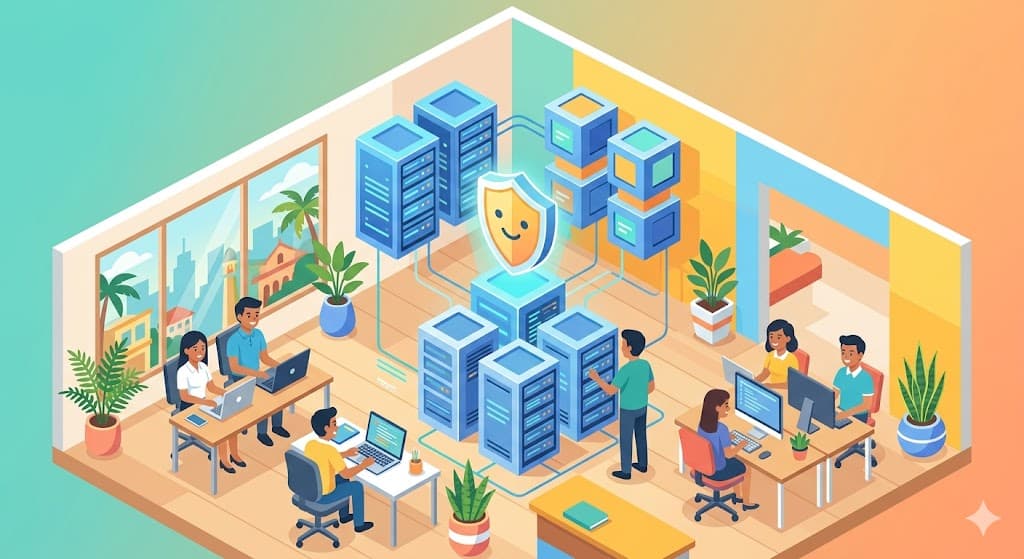
 Aging core systems keep many Philippine businesses running but grow more costly to maintain each year.
A second issue is talent. Older systems are often written in languages that new graduates rarely learn. When the original developer retires or leaves, the company is left with software that very few people can repair. This makes even small fixes slow and risky.
The third challenge is connection. A modern AI tool needs data to be available in a clean, structured form. An old system that stores data in its own closed format cannot easily pass that data to anything new, so staff end up copying numbers by hand from one screen to another.
Finally there is security. Software that no longer receives updates can fall behind on basic protections. For a business handling customer records, this is a real concern under Republic Act 10173, the Data Privacy Act of 2012, which the National Privacy Commission enforces.
Related: Custom AI Tool Integration for Philippine SMEs explains this in detail.
Where Manual Workarounds and "Rip and Replace" Fall Short
| Approach | Limitation | Why It Falls Short |
|---|---|---|
| Manual re-keying | Staff retype data between systems | Slow, error-prone, hard to scale |
| Full replacement | Build everything new at once | High cost and long downtime |
| Forced cut-over | Switch off the old system on one date | Operations stop if anything breaks |
| Ignoring staff knowledge | Replace without recording how work is done | Hidden business rules are lost |
When an old system cannot talk to new tools, the common reaction is to have people fill the gap. A team member exports a report, opens a spreadsheet, and types the figures into another program. This works for a while, but it does not scale. As volume grows, manual data entry becomes a bottleneck and a source of mistakes.
The opposite reaction is to throw everything out and build a brand-new system. This "rip and replace" plan sounds clean, but it is expensive and slow. While the new system is being built, the business still has to run on the old one, and the switch-over day carries real danger. If anything breaks during the cut-over, daily operations can stop completely.
There is also a quieter cost. Old systems usually contain years of business rules—how a discount is calculated, how a tax field is handled, how an exception is approved. Much of this lives only in the software and in the heads of long-serving staff. A full replacement that does not first record these rules tends to lose them, and the new system ends up working differently from how the business actually operates.
How AI and Modern Tools Connect Old and New Systems
| Method | What It Does | Best Fit |
|---|---|---|
| Integration layer (API) | A connector that lets two programs share data | Systems that must keep running |
| AI document extraction (OCR) | Reads text from scanned forms and invoices | Paper-heavy back offices |
| AI assistant over your data (RAG) | Answers questions using your own records | Support, search, internal Q&A |
| Automation (RPA with AI) | Software that repeats routine screen tasks | Repetitive data transfer work |
| Gradual migration | Replace one part at a time, not all at once | Large or critical core systems |
The most useful idea here is that you do not need to remove the old system to use AI. Instead, you place a thin software layer between the old system and the new tools. This layer is built around an API, which is simply a connector that lets two software programs send data to each other. The old system keeps running, and the API passes its data out to modern services when needed.
 An integration layer lets an old system keep running while AI services read and use its data.
Once that connection exists, several AI methods open up. One is OCR, short for optical character recognition, which reads text from scanned documents and images such as invoices, permits, and delivery receipts. For a back office that still handles a lot of paper, this removes a large share of manual typing.
Another method is an AI assistant built with RAG, or retrieval-augmented generation, which means the AI answers using your own company records instead of general internet knowledge. Staff can ask plain-language questions and get answers drawn from your real data, which is helpful for customer support and internal searches.
For repetitive transfer work, there is RPA, robotic process automation, which is software that copies the routine clicks and typing a person would do across screens. Paired with AI, it can handle steps that need a small judgment, such as sorting a document by type before filing it.
The fifth method is gradual migration, sometimes called the strangler approach, where you replace one piece of the old system at a time while the rest keeps working. This spreads risk over months instead of betting everything on a single launch day.
Related: AI Integration for Philippine SMEs: Cut Costs explains this in detail.
A Step-by-Step Plan to Add AI to Legacy Systems
| Step | Action | Result |
|---|---|---|
| 1. Audit and map | List what the system does and where data lives | Clear picture of the starting point |
| 2. Pick a priority use case | Choose one painful, high-value task | A focused, fundable first target |
| 3. Build the integration layer | Add an API so data can flow safely | Old and new systems can share data |
| 4. Run a small pilot | Test on one workflow with real users | Proof it works before spending more |
| 5. Roll out in phases | Expand step by step, not all at once | Lower risk and steady adjustment |
| 6. Monitor and improve | Track results and fix issues | The system keeps getting better |
The first step is to audit and map the existing system before writing any code. Document what each part does, where the data is stored, and which business rules are hidden inside. This step is often skipped, and that is exactly why many projects fail later.
 A phased plan with clear documentation and regular progress reviews reduces rework and risk.
Next, pick a single priority use case. Trying to automate everything at once spreads the budget too thin. Choose one task that is painful and valuable—for example, reading supplier invoices or answering common customer questions—so the first project has a clear and measurable goal.
The third step is to build the integration layer, the API connector described earlier, so data can move safely between the old system and the new AI service. With that in place, run a small pilot on one real workflow with a few actual users. A pilot shows whether the idea works in practice before a larger budget is committed.
This is where discipline matters more than any tool. With a legacy system, the cost of a misunderstanding is not a rewritten page but a corrupted record, so every change to the interface between old and new belongs in writing before anyone builds it.
After a successful pilot, roll out in phases, then keep monitoring results and improving. A legacy integration that is switched over all at once leaves you no working state to fall back to.
Related: Integrating GPT With Your Core Business Systems explains this in detail.
Results and ROI Philippine Businesses Can Expect
| Result Area | What Improves | Business Value |
|---|---|---|
| Less manual labor | Fewer hours spent re-typing data | Staff time moves to higher-value work |
| Faster turnaround | Documents and requests processed sooner | Better customer experience |
| Better data quality | Fewer typing errors, cleaner records | More reliable reports and decisions |
| Longer system life | Old investment keeps earning its value | Major replacement cost is delayed |
The clearest return comes from reduced manual labor. When AI handles document reading or routine data transfer, staff stop spending hours on repetitive typing and can focus on work that needs human judgment. For a growing Philippine SME, this often means handling more volume without hiring more people for the same task.
Speed is the next benefit. Requests, invoices, and applications that once waited in a queue can be processed much sooner. Faster turnaround tends to show up directly in customer satisfaction, which matters in competitive sectors such as retail, logistics, and financial services.
Data quality improves as well. Every manual re-typing step is a chance for error, and removing those steps makes records cleaner. Cleaner data leads to more reliable reports, which in turn support better business decisions.
It is fair to set expectations honestly. The costs of AI integration—cloud hosting, API usage, and development—are usually billed in pesos on a monthly basis and grow with usage, so they should be planned into the budget. There is no fixed percentage of savings that applies to every company. What can be said is that keeping a working system and adding AI on top of it is normally far cheaper than a full replacement, and significant savings can be expected over time when the project is scoped well.
FAQ
Q: Do we have to replace our old system completely to use AI?
A: No. In most cases you can keep the old system running and add an integration layer on top so AI tools can read and use its data. Full replacement is the most expensive and risky option, and it is rarely the first choice.
Q: How much does AI integration cost for a Philippine SME?
A: It depends heavily on the use case and data condition, so there is no single price. Costs usually include monthly cloud and API fees plus development work. Starting with one small pilot keeps the first cost low and gives you real numbers before committing to a larger budget.
Q: Is our data safe under the Data Privacy Act when adding AI?
A: It can be, if the project is designed for it. Republic Act 10173, the Data Privacy Act of 2012, and the National Privacy Commission set rules on handling personal data. Choose tools and hosting that support these rules, limit what data is shared, and document how data flows through the system.
Q: How long does a typical integration project take?
A: A focused pilot on one workflow can often be done in a matter of weeks, while a full phased rollout across several processes takes longer. Mapping the old system carefully at the start is what prevents delays later.
Q: We only have slow or unstable internet in our area. Can AI still work?
A: Yes, with the right design. Heavy tasks can be split into smaller batches and run during off-peak hours, and some processing can be handled on local servers. The integration should be planned around your real connection speed, not an ideal one.
Q: Do we need to hire a large foreign vendor for this?
A: Not necessarily. Local IT talent and AI engineers in the Philippines can handle integration work, and a local partner often understands the business context and regulations better. The key is clear documentation and steady communication, regardless of who you hire.
Starting Small, Building Toward Modernization
Modernizing a legacy system does not have to mean tearing everything down. The safer and more affordable path is to keep what already works, add an integration layer, and let AI handle the slow, repetitive parts—then expand step by step as results prove themselves. The companies that succeed treat this as a phased project with clear documentation, not a one-time switch.
If your business is weighing how to add AI to an existing system, a short audit of your current setup is a sensible first move. PH AI Works can help map your systems, find the highest-value first use case, and plan a phased integration that fits your budget and your local conditions.
Sources & References
- Philippine Digital Transformation Strategy 2022 — Overview of the DICT-led national strategy on government digital transformation and interoperability.
- DICT — Department of Information and Communications Technology — Official Philippine government body leading ICT policy, e-government services, and digital adoption programs.
- AWS Prescriptive Guidance: Strategy for modernizing applications — Vendor guidance on planning, milestones, and phased approaches for modernizing legacy applications.
- AWS Prescriptive Guidance: Mainframe Modernization — Explains replatforming and refactoring approaches that preserve existing business logic during migration.
- GovInsider: National and local initiatives driving digitalisation in the Philippines — Reporting on DICT MSME upskilling and local digital governance programs.
About the author
Founder / AI Engineer (36+ years in IT)
- ●From Tokyo · based in Manila for 13+ years
- ●36+ years in IT (development, SEO, AI)
- ●Google Certified AI Professional
- ●IBM Certified Generative AI Engineer
- ●AI chatbots, RAG & AI agent development
A Japanese AI engineer with 36+ years in IT and 13+ years on the ground in the Philippines. I write from hands-on experience to help Japanese companies adopt AI that actually delivers results — chatbots, workflow automation, AI agents, and AI-driven marketing. Feel free to reach out in Japanese or English.
Your Competitors Are Already Using AI!
Is your business keeping up?
Related Articles

What a Philippine Company Website Needs Now
Most company sites are built for a desktop visitor who no longer matters. The specs that serve phones and AI search.
8/14/2026

Adding AI to Existing Systems: A Retrofit Flow
Most Philippine companies cannot rebuild before adopting AI. How a retrofit works — find the seam, build beside it, cut over.
8/12/2026

AI and Customer Experience: The Whole Journey
Adding one AI feature rarely fixes CX. How to design AI across the journey rather than bolting it onto one step.
7/27/2026

Building AI Web Apps: The Design Choices That Matter Most
AI web app projects in the Philippines usually fail on design, not on the AI. Human checkpoints, loading feedback, and more.
7/25/2026

Core Web Vitals for Philippine Online Stores
Core Web Vitals measure how fast and stable a site feels. How Philippine stores pass Google's thresholds and rank better.
7/9/2026
Docker and Kubernetes: Preventing Downtime in the PH
How Docker and Kubernetes keep online systems stable for Philippine SMEs, reduce downtime, and support steady business growth.
6/10/2026