
Lean AI: Cutting Waste Before Adopting AI
What a logistics giant's Lean AI transformation suggests about removing waste before automating anything.


AI Engineer · 36+ years in IT · Japanese, based in Manila for 13+ years
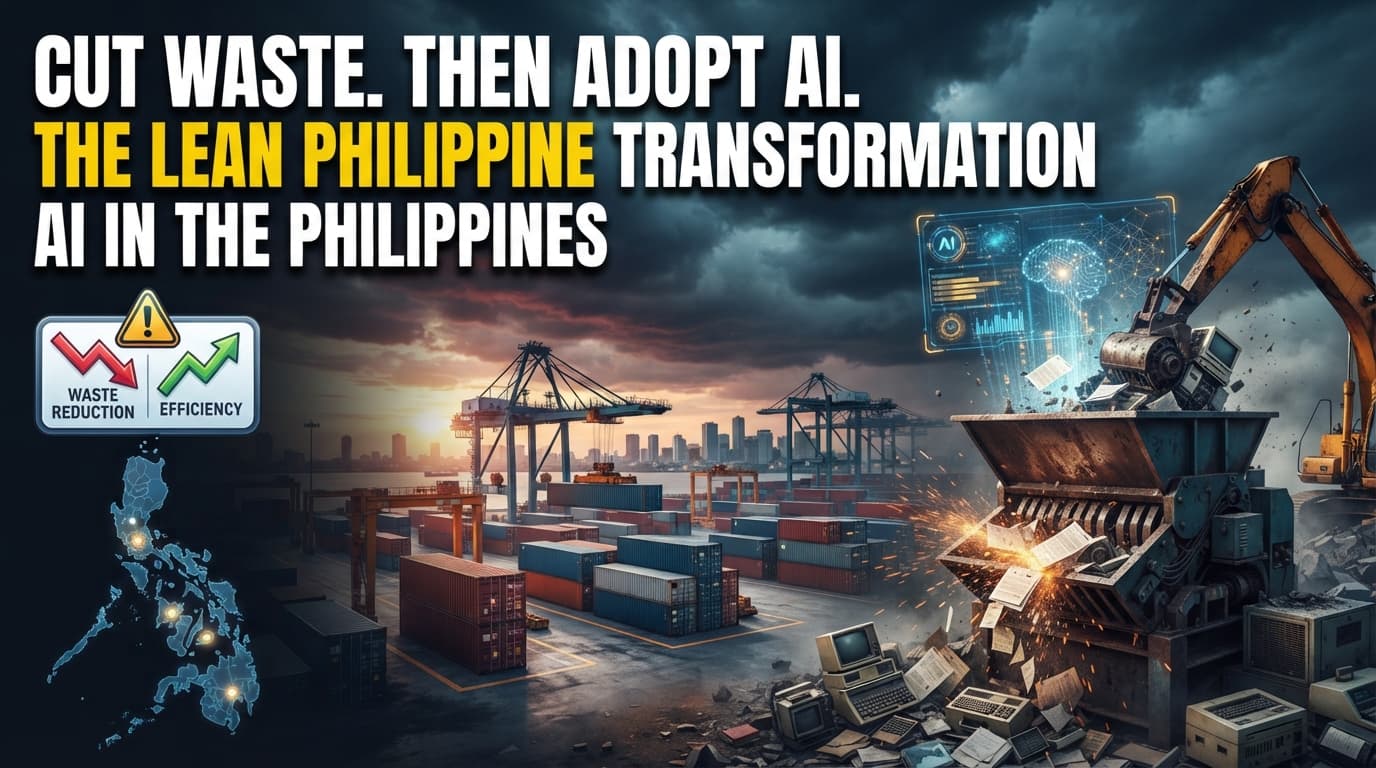
Lean AI Transformation: Lessons from C.H. Robinson's CEO on Starting with "Time, Not Tools"
Using logistics giant C.H. Robinson's "time-first" AI transformation as a case study, learn a mindset and practical steps for AI adoption that delivers results in the Philippines, adapted to local rules and culture.
Part 1: Why This Matters
Step 1: The Philippine Business Context (3 min)
When companies bring AI on board, many start by asking, "Which tool should we buy?" But Dave Bozeman, CEO of American logistics giant C.H. Robinson, says the starting point should be time, not tools. The company has been driving an internal overhaul it calls "Lean AI" (Lean is a manufacturing-born philosophy of stripping out waste to raise value), and over the past year its stock price has roughly doubled.
The Philippines is a major hub for business process outsourcing (BPO, the practice of handing work to an outside company), taking on operations for firms around the world. It is an environment full of repetitive, routine tasks — and one where wasted time can easily pile up. That is exactly why the sequence of "first rethink how you spend your time, then bring in AI" is such a practical hint for Japanese professionals working in the Philippines and for Japanese companies considering entry.
Before assembling a set of expensive tools, find where time is disappearing in the work right in front of you. Simply keeping this order makes it easier to get results even on a limited budget.
Picture yourself in a Manila office, opening a link to an article sent from your head office in Japan, and turning to your local team leader: "Before we bring in a new AI tool, why don't we look together at where our time disappears during the day?" The leader nods, a little surprised. The very idea of not starting with tool selection is different from how adoption has usually been approached.
Step 2: Key Points from the Source Article (5 min)
Based only on the facts stated in the source article, here are the main points in a table.
| Item | Details |
|---|---|
| Company | C.H. Robinson (ranked 277th on the Fortune 500) |
| Business | A company that handles freight and arranges transportation |
| CEO | Dave Bozeman |
| Name of the initiative | An internal overhaul called "Lean AI" |
| Change in stock price | Roughly doubled over the past year |
| How the CEO views the company | A technology company solving the world's logistics problems |
| Starting point of the transformation | Rethinking how time is used, not the tools |
This table was created for educational purposes based on facts from publicly available information. For details, please check the original article at the link above.
Related: Transforming Your Operating Model for AI explains this in detail.
Step 3: Comprehension Check (5 min)
Q1. What does Dave Bozeman use as the starting point for driving AI transformation? Hint: The article phrases it as "not tools, but ___."
Q2. Where does C.H. Robinson rank on the Fortune 500? Hint: It's a number in the high 200s.
Q3. How did the stock price change over the past year under Bozeman's reforms? Hint: The number "2" is the key.
Q4. How does Bozeman describe his own company? Hint: He calls it a "___ company" that handles logistics.
Q5. What idea does the "Lean" in "Lean AI" originally refer to? Hint: It's a way of thinking about "waste" that was born in manufacturing.
Related: West Shore Home's AI Strategy: 2x Revenue, 1,000 Fewer Hires explains this in detail.
Part 2: Applying It in Practice
Step 4: Adoption Steps for the Philippines (10 min)
Here is the "start with time" Lean AI mindset, organized into five steps for putting it into practice on the ground in the Philippines.
| Step | What to do | What to watch for in the Philippines |
|---|---|---|
| 1 | Find the wasted time | Work procedures are often not documented, so first write out the current state to make it visible |
| 2 | Narrow to one target and test | Start small — with a modest budget (a few tens of thousands of pesos) — focused on a single task |
| 3 | Decide how data will be handled first | If you use personal information, proceed in line with the rules of the National Privacy Commission (NPC) |
| 4 | Explain to the local team and get them involved | Because it can be culturally hard to disagree face-to-face, work to create an atmosphere where questions come easily |
| 5 | Measure the effect before scaling | Show the time saved in numbers, then expand to the next task in order |
In the first step, observe a day's work together with the local team. Write out which tasks take time — on paper or a spreadsheet — to make the true nature of the waste visible.
In the second step, choose one task from the waste you found that is high-impact and easy to tackle. Rather than rolling out company-wide at once, testing with a small budget keeps losses small even if it fails.
In the third step, decide in advance the scope of data you will feed into the AI. If you use customer personal information, choose settings that keep your data from being used for training, and proceed in line with the Philippines' data privacy rules.
In the fourth step, explain the purpose of the adoption and the benefits for the local team in a way that is easy to understand. Because the Philippines has a culture of showing deference to others, it is important to create a setting where questions come easily and to listen to voices from the field.
In the fifth step, confirm the time and workload saved in numbers. Once the effect is clear, expand the same approach to the next task in order.
Related: Vibe Coding: Building Business Tools Fast With AI explains this in detail.
Step 5: Common Mistakes and How to Avoid Them (5 min)
Here are three patterns that tend to trip people up when tackling this theme in the Philippines, along with countermeasures.
Mistake Pattern 1: "Starting with tool selection"
Bad example: You sign up for a bundle of trendy AI tools and simply tell the local team, "Please use these." Because it isn't clear which task's waste you want to reduce, the tools go unused while the costs pile up.
Good example: First look at a day's work together with the local team and pick the single most time-consuming task. Then test — on a small scale — only the tool that fits that task.
Mistake Pattern 2: "Starting without deciding how data will be handled"
Bad example: You feed customer personal information straight into an AI service, and only later realize you needed to handle National Privacy Commission (NPC) requirements and keep internal records. If an incident such as a data leak occurs, your response falls behind.
Good example: Before using personal information, decide which data you will use and how far. Choose settings that keep your data from being used for training, and make sure you can keep a record of who used it and when.
Mistake Pattern 3: "Deciding at head office alone and not explaining to the local team"
Bad example: AI adoption is decided at the Japan head office alone, and the Manila team is only notified of the outcome. The field has its work changed without understanding the purpose, and dissatisfaction and confusion spread.
Good example: Explain the purpose of the adoption and the benefits for the local team in advance. Set aside time to take questions, and reflect the field's opinions in the plan before moving forward.
Part 3: Learning More Deeply
Step 6: Related Technical Terms (5 min)
Lean (a way of thinking focused on eliminating waste) is an approach that removes unnecessary waiting and duplication from work so you can focus on valuable tasks. It was originally born on the automobile production floor. In Philippine outsourcing operations, it helps when you surface things like duplicate data entry in reports and time spent waiting for approvals, and then decide the order in which to automate them with AI.
AI transformation (reshaping a business with AI) means not just replacing some tasks with AI, but rethinking the way work itself is done to fit AI. One example is a Manila accounting team handing invoice processing over to AI while people concentrate on checking and judgment.
Productivity (output per unit of time or labor used) describes how much you can produce with the same number of people or hours. In the Philippines, labor costs are relatively easy to keep down, but if you can raise each person's output, your competitiveness rises further. The term comes up in situations where AI reduces simple tasks so employees can move on to higher-value work.
Logistics (managing the flow of goods) refers to the whole set of activities for delivering products and parts to the right place in the right quantity. In the Philippines, made up of many islands, transportation planning is complex, and predicting delivery routes and inventory with AI can reduce delays and waste.
Freight forwarder (a company that arranges transportation) is a company that takes on, on behalf of the cargo owner, the arrangement of ships, planes, and trucks as well as customs procedures. Japanese manufacturers bringing parts into the Philippines are increasingly partnering with local forwarders and using AI to efficiently handle import paperwork.
Step 7: Thinking About How to Apply It to Your Company (10 min)
Discuss the following three themes as a team.
Where is the "wasted time" in your company?
Prompt: Look back on a day's work and write out things like time spent waiting for approvals, re-entering the same content, and searching for things. The task that steals the most time is a candidate for where you first try AI.
Should you "test small" or "change all at once"?
Prompt: Rolling out company-wide all at once makes the loss from failure large. Compare the benefits and risks of first testing in one department versus proceeding across several departments at the same time.
How will you involve the local team?
Prompt: If the field's work changes without understanding the purpose, dissatisfaction arises. Discuss how you will convey the reason for the adoption and the benefits for the local team.
Next action: At next week's team meeting, have each member write out one task that takes the most time in their own work, and then choose together the first one to try AI on.
Part 4: FAQ
Q1. How much budget do you need to adopt AI? If you're just testing small, you don't need a large upfront cost. Many monthly subscription services are usable for a few tens of thousands of pesos, and you can start focused on a single task. A safe approach is to avoid signing a big contract right away and instead increase the budget after confirming the effect.
Q2. When using personal information, what should you watch for in the Philippines? The Philippines has a law to protect personal information, overseen by the National Privacy Commission (NPC). Before feeding customer or employee information into AI, decide the scope of use and choose settings that keep your data from being used for training. There are parts that resemble Japan's approach to data privacy, but the way filings and records are required can differ, so checking with a local expert brings peace of mind.
Q3. What should you do if local staff worry that "AI will take our jobs"? Explain that AI is a tool for reducing simple tasks so that people can concentrate on higher-value work. As in the C.H. Robinson example, it is important to carefully explain that the goal is to reduce wasted time, not to reduce headcount. Hearing out concerns early and reflecting them in the plan makes it easier to gain cooperation.
Q4. When the Japan head office and the Philippine site disagree on how to proceed, how should you coordinate? Because the head office often sets the policy while the local site handles the practical work, clarify each side's role first. In the Philippines, verbal agreement is emphasized in some situations, but to avoid later mismatches in understanding, we recommend also putting what you decide into writing.
Q5. Which tasks are easiest to see results from when starting with AI? You'll feel the effect most easily by starting with routine tasks that are highly repetitive and time-consuming. For example, invoice processing, first-line responses to inquiries, and document data entry are candidates. First confirm results on one task, then expand from there in order.
Tips for Putting This to Use (3 Tips)
First, write out "how time is spent" before tools Before looking for AI tools, observe a day's work together with the local team and write out where time disappears — on paper or a spreadsheet. When the waste becomes visible, the tools you truly need become clear, and it's easier to get results even on a limited budget.
Start by narrowing to one task and testing small Adopting company-wide all at once makes the loss large if it fails. Choose just one high-impact, easy-to-tackle task and test it with a small budget. After confirming the effect, expand the same approach to the next task — that's the safe way.
Decide how data will be handled before explaining to the local team If you use personal information, decide the scope of use and storage method first, and proceed in line with the Philippines' data privacy rules. Then explain the purpose of the adoption to the local team, and taking time to field questions helps them cooperate with peace of mind.
Bonus: How to Make Use of PH AI Works
PH AI Works is a company that supports the use of AI and technology in the Philippines. We can help Japanese companies and Japanese professionals in the Philippines who want to pursue this article's theme — "lean AI adoption that starts with time" — in a way adapted to Philippine rules and on-the-ground culture.
As a next step, you can consult us on things like the following.
- Help finding where the wasted time is in your operations and choosing the task to try AI on first
- Consultation on how to proceed with AI adoption in line with Philippine rules, including handling personal information
- Support with how to explain things to the local team and with planning for rolling it out across the organization
Please feel free to get in touch. The initial consultation is free.
References & Sources
About the author
Founder / AI Engineer (36+ years in IT)
- ●From Tokyo · based in Manila for 13+ years
- ●36+ years in IT (development, SEO, AI)
- ●IBM Certified Generative AI Engineer
- ●AI chatbots, RAG & AI agent development
A Japanese AI engineer with 36+ years in IT and 13+ years on the ground in the Philippines. I write from hands-on experience to help Japanese companies adopt AI that actually delivers results — chatbots, workflow automation, AI agents, and AI-driven marketing. Feel free to reach out in Japanese or English.
Your Competitors Are Already Using AI!
Is your business keeping up?
Related Articles
AI Model Vendors Now Sell Implementation Too
OpenAI and Anthropic now sell implementation as well as models. What a local subsidiary should decide about that.
8/18/2026
Contracting for AI While Prices Keep Falling
Write a model number into the contract and it is obsolete in six months. How to design for switching instead.
8/17/2026

Meta Cut 750,000 Under-16 Accounts in Australia
AI-assessed age checks removed 750,000 accounts overnight. What that says about depending on platforms for reach.
8/16/2026

When an AI Calls Your Shop to Ask About Stock
AI now phones shops on a buyer's behalf to check stock. What to decide on the receiving side before it reaches you.
8/15/2026

Handling News That Is Not Settled Yet
A reported $6 billion acquisition talk is not a completed deal. How to act on industry news before it is confirmed.
8/14/2026

What a 69-Page AI Report Does Not Show
Frontier firms are reported 8.3x ahead, yet a table on page 35 shows no statistically significant link to revenue.
8/13/2026