
AI Training and Workshops for Philippine SMEs
How a Philippine SME builds in-house AI skills — what to train, who to train, and how a first workshop is usually structured.


AI Engineer · 36+ years in IT · Japanese, based in Manila for 13+ years
Summary
- Growing AI skills inside your own team is more affordable and more durable for a Philippine SME than depending only on outside hires or a single seminar.
- Hands-on workshops built around a company's real tasks and real data produce stronger results than generic online courses.
- A phased plan — assess, run a pilot, build shared playbooks, appoint internal champions, then measure and adjust — turns scattered AI experiments into a lasting business capability.
The AI Skills Gap That Slows Down Philippine SMEs
| Challenge | What it looks like day to day |
|---|---|
| Costly specialists | Experienced AI staff ask for salaries an SME cannot match |
| Out-of-reach consultants | Large firms charge project fees beyond a typical SME budget |
| Fast-moving tools | New AI tools appear faster than formal courses can cover them |
| Key-person risk | AI know-how sits with one person who may resign |
Micro, small, and medium enterprises make up about 99% of all businesses in the Philippines, yet many still run on manual, repetitive work that AI could help with. The first barrier is people. Hiring a ready-made AI specialist is expensive, and the few skilled candidates are pulled toward large BPOs and tech firms that pay more than a small business in Quezon City or Cebu can offer.
 Many Philippine SMEs still rely on manual, repetitive work that in-house AI skills could ease.
The second barrier is the cost of outside help. Bringing in a big consulting firm for a custom project can run into figures that simply do not fit an SME budget, so the work never starts.
The third barrier is speed. AI tools change month to month, and a course recorded last year may already describe an older version of a tool. The fourth barrier is the quietest one: when only a single staff member understands the tools, the company carries real risk. If that person leaves, the knowledge leaves with them. The national AI strategy now treats upskilling and reskilling the workforce as a clear priority, which signals that building skills broadly, not in one person, is the safer path.
Related: AI Training That Builds Real Workforce Skills explains this in detail.
Why One-Off Courses and Single Hires Are Not Enough
| Common approach | Where it falls short |
|---|---|
| One weekend seminar | Skills fade quickly without regular practice |
| Hiring one AI specialist | Creates a bottleneck and key-person risk |
| Generic online courses | Not tied to the company's actual work |
| Buying tools, skipping training | Paid licenses sit unused and money is wasted |
A single weekend seminar feels productive, but most of what people hear is forgotten within weeks if they never use it on real work. The energy fades, and the team drifts back to old habits.
Hiring one specialist seems efficient, yet it simply moves the bottleneck. Every AI question now waits for that one person, and the rest of the team stays dependent. Generic online courses have the opposite problem: they teach AI in the abstract, using examples that have nothing to do with a sari-sari supply business, a clinic, or an accounting office. Staff finish the course but still cannot apply it to their own daily tasks.
The last mistake is buying tools and skipping the training. A company pays for several AI seats every month and assumes adoption will follow, but the licenses go unused.
AI training behaves like any other packaged product. A one-size package is cheap and tidy, but the lasting results come from a custom, phased approach shaped around how your company really works.
Building AI Capability Through Hands-On Workshops
| Element | Purpose |
|---|---|
| Role-based learning tracks | Match training to what each team actually does |
| Hands-on workshops | Practice on the company's real tasks and data |
| Internal AI champions | Spread skills and answer questions in-house |
| Shared playbooks and prompt library | Reuse what works and reduce key-person risk |
| Simple safe-use rules | Protect data and stay within local privacy law |
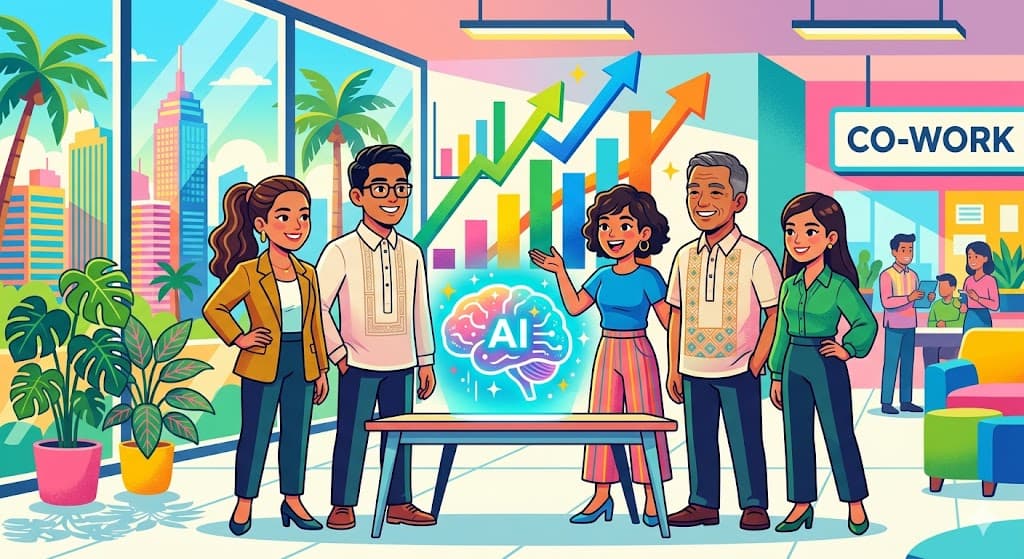
A workshop-led approach treats AI skill as something the whole team builds together, not a certificate one person collects. It starts with role-based tracks. The sales team learns to draft proposals and follow-ups; the finance team learns to summarise reports and clean data; customer support learns to draft replies in clear English and Filipino. Each group practices on work they recognise.
 Hands-on workshops using the company's own tasks and data make AI skills stick.
The core of the method is hands-on workshops using the company's own material. Instead of a sample prompt about a fictional company, staff work on a real quotation, a real customer email, or a real monthly report. The learning sticks because it is immediately useful.
To keep the skill alive, a few staff become internal AI champions. They do not need to be programmers; they are simply the people who enjoy the tools and help colleagues. Their work is captured in a shared playbook and prompt library — a simple document of prompts and steps that worked, so good results can be repeated by anyone. This also lowers key-person risk, because the knowledge lives in the company, not in one head.
Finally, a workshop program includes simple safe-use rules. Staff learn what data should never be pasted into a public AI tool, in line with the Data Privacy Act of 2012 and National Privacy Commission guidance. As an AI engineer who has earned professional certifications in generative AI and AI agent development, I find that a short, plain set of rules prevents far more trouble than a long policy nobody reads.
Related: AI Strategy Workshops for Philippine Executives explains this in detail.
A Step-by-Step Plan to Train Your Team
| Step | Action |
|---|---|
| 1. Assess | Map current skills and pick high-volume, repetitive tasks |
| 2. Choose tools | Select tools that fit your budget and data rules |
| 3. Pilot | Run a first workshop with one willing team |
| 4. Build playbooks | Document prompts and steps that worked |
| 5. Appoint champions | Name internal champions and set a regular schedule |
| 6. Measure and adjust | Track time saved, then improve the program |
Start by assessing where AI can help most. Look for tasks that are repetitive and high-volume — replying to common inquiries, drafting product descriptions, summarising meetings, or cleaning spreadsheets. These give the fastest, clearest wins.
 A phased plan moves a team from a pilot workshop to a lasting AI capability.
Next, choose tools that fit a real SME budget. Many business AI tools cost roughly ₱1,000 to ₱1,700 per user per month, so start with a small number of seats rather than buying for everyone. Government-linked programs through TESDA, DICT, and partner groups also offer free or low-cost training that can stretch a small budget further.
Then run a pilot with one willing team rather than the whole company. A focused first workshop builds confidence and produces examples you can show others. From that pilot, build your playbooks, appoint your champions, and set a regular rhythm — a short monthly session keeps skills fresh.
A short regular check-in and a written record of what worked will stop a programme from quietly stalling after the first burst of excitement. The final step is to measure simple results, then adjust the next round based on what you learn.
Related: Building a Lasting Workplace AI Culture explains this in detail.
What Results to Expect from In-House AI Training
| Outcome | What changes for the business |
|---|---|
| Faster routine work | Drafting, summarising, and data tasks take less time |
| Less outside spending | Fewer one-off jobs sent to outside vendors |
| Stronger retention | Staff feel invested in and tend to stay longer |
| Compounding capability | Skills and playbooks grow more valuable over time |
The clearest early result is time. Once staff can use AI for first drafts and summaries, routine work moves faster, and people spend more of their day on judgment and customer relationships. Significant time savings can be expected on repetitive tasks, though the exact gain depends on the work.
Over time, the company also spends less on outside vendors for small jobs it can now handle itself. The return on a training program is not only the hours saved this month; it is the work you no longer need to outsource.
Training also supports staff retention. When a business invests in its people's skills, those people tend to feel valued and stay longer — a real benefit in a market where good staff are often pulled toward larger firms. Best of all, the capability compounds. Every workshop adds to the playbook, every champion mentors the next, and the team you train this year becomes the foundation you build on next year. The analytics and AI sector is projected to create hundreds of thousands of new roles in the country in the coming years, so the skills your team gains now keep their value well beyond a single project.
FAQ
Q: We are a small company with no IT department. Can we still train staff in AI?
A: Yes. Practical AI training does not require coding or an IT team. It focuses on using ready-made tools for everyday tasks like writing, summarising, and organising data. Start with one or two willing staff, give them simple tasks, and grow from there.
Q: How much should an SME budget for AI tools and training?
A: Many business AI tools cost roughly ₱1,000 to ₱1,700 per user per month, so begin with a few seats instead of buying for everyone. Add free or low-cost government-linked training through TESDA, DICT, and partner programs, and you can keep the starting cost modest.
Q: Is it safer to hire one AI expert instead of training the whole team?
A: One hire creates a bottleneck and real key-person risk — if they leave, the knowledge leaves too. Spreading basic skills across several staff, supported by a shared playbook, keeps the capability inside the company and is usually the steadier choice.
Q: How do we keep company and customer data safe when using AI tools?
A: Set simple, written rules on what may never be pasted into a public AI tool, in line with the Data Privacy Act of 2012 and National Privacy Commission guidance. Short, clear rules that staff actually remember protect you better than a long policy nobody reads.
Q: How long before we see results from AI training?
A: Many teams notice faster drafting and summarising within the first few weeks of a hands-on workshop, because they practice on real work. Lasting results come from a regular rhythm — a short monthly session and an updated playbook — rather than a single seminar.
Make Your Team Your Strongest AI Asset
Building AI talent inside your company is steadier and more affordable than chasing scarce hires or expensive one-off projects. The path is practical: pick a few high-value tasks, run a hands-on workshop with real data, capture what works in a shared playbook, appoint internal champions, and keep a simple monthly rhythm. Done in phases, this turns AI from a side experiment into a skill your whole team owns.
If you would like help designing a workshop or training plan shaped around your business, PH AI Works can guide the assessment, run the sessions, and set up the playbooks and safe-use rules so your team can keep improving on its own.
Sources & References
- National AI Strategy Roadmap 2.0 (NAISR 2.0), Department of Trade and Industry, 2024 — sets workforce upskilling and reskilling as a national priority for AI adoption.
- National AI Strategy (NAIS-PH), Department of Science and Technology, 2025 — frames workforce development as one of five core strategies through 2028.
- Philippine Skills Framework for Analytics & AI (PSF-AAI), DICT and Analytics & AI Association of the Philippines — structured guidance on AI competencies for employers and professionals.
- Skills Map for Careers in Analytics and Artificial Intelligence Launched, Philippine Business for Education — notes the analytics and AI sector is projected to create around 500,000 jobs by 2028.
- Artificial intelligence gives Philippine entrepreneurs a competitive edge, BusinessWorld, 2025 — covers MSME share of businesses, low AI adoption, and the case for staff upskilling.
About the author
Founder / AI Engineer (36+ years in IT)
- ●From Tokyo · based in Manila for 13+ years
- ●36+ years in IT (development, SEO, AI)
- ●IBM Certified Generative AI Engineer
- ●AI chatbots, RAG & AI agent development
A Japanese AI engineer with 36+ years in IT and 13+ years on the ground in the Philippines. I write from hands-on experience to help Japanese companies adopt AI that actually delivers results — chatbots, workflow automation, AI agents, and AI-driven marketing. Feel free to reach out in Japanese or English.
Your Competitors Are Already Using AI!
Is your business keeping up?
Related Articles

Competitor Research With AI in One Hour a Week
A four-step weekly routine that collects and compares competitor information, so pricing decisions rest on current data.
8/10/2026

When Not to Use AI: Tasks to Keep Human
An honest look at the five tasks Philippine businesses should keep human — consequential decisions among them.
8/9/2026

Turning Full-Stack Developers Into Agent Specialists
Hiring an AI agent specialist in the Philippines is slow and costly. Retraining the developers you have is usually faster.
8/7/2026

What to Put in an AI Vendor Contract
AI vendor contracts in the Philippines often skip what matters: data return, audit logs, model changes, and exit protection.
8/6/2026
Keeping AI Running Through Brownouts and Typhoons
Cloud AI does not stop when the office loses power — your access does. A continuity plan for Philippine operations.
8/5/2026

Your AI Vendor's Legal Form Changes the Deal
SEC-registered corporation or DTI sole proprietor — in the Philippines the difference changes contracts, banking, and recourse.
8/3/2026