
TikTok Shop for Philippine Retail Owners: Setup and Tax
How retail owners in the Philippines set up TikTok Shop — registration, seller fees, BIR tax points, and what a 50-year-old store changed to win back sales.


AI Engineer · 36+ years in IT · Japanese, based in Manila for 13+ years
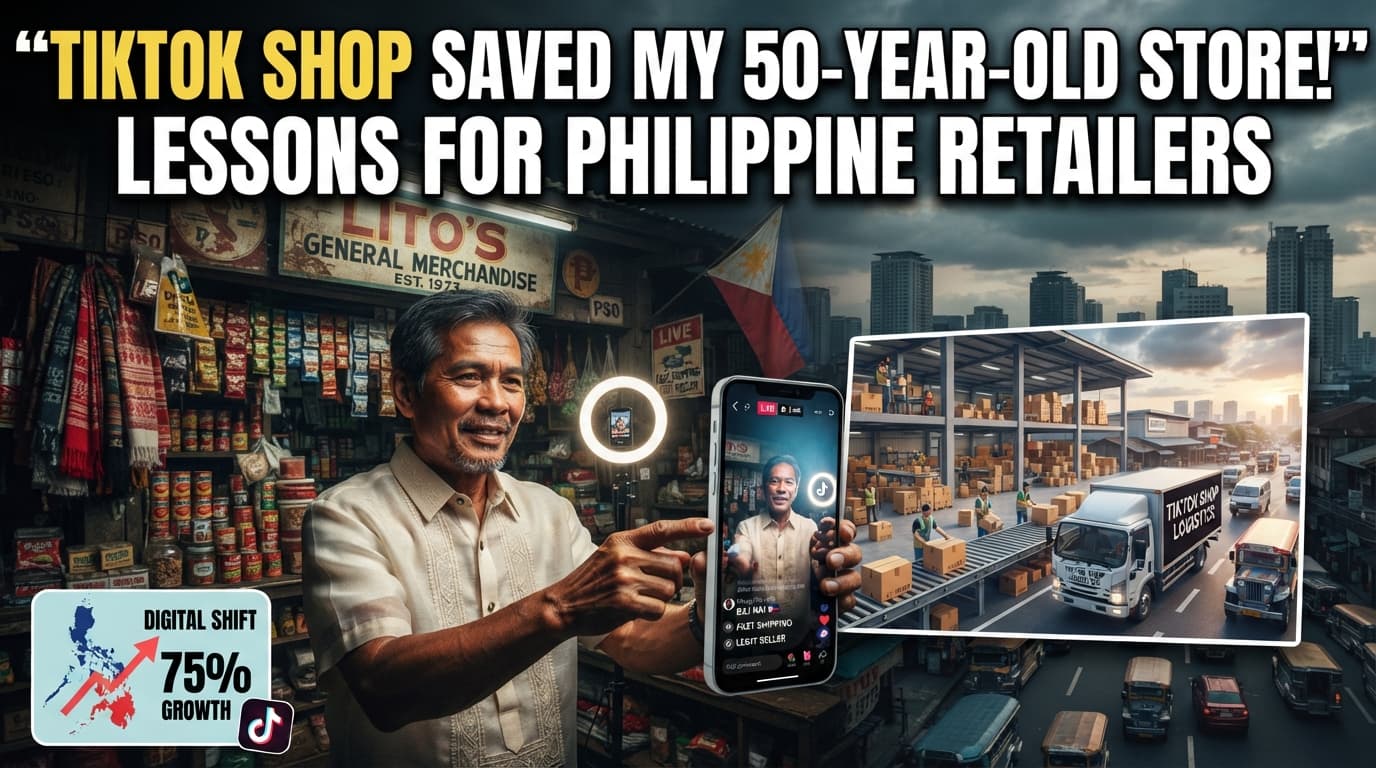
Learn concrete steps for digitizing a brick-and-mortar business in the Philippines from the story of a 50-year-old family snack shop that overcame falling foot traffic with online sales and social commerce.
Part 1: Why This Matters
Step 1: The Philippine Business Context (3 min)
"Nuts To You," a long-established snack shop in Center City, Philadelphia, is a 50-year-old family business — yet it hit a major wall in the form of declining foot traffic. In response, it has shifted the center of gravity of its sales toward its own online store and TikTok Shop (a feature that lets you sell products directly inside the social media app). This is not a story confined to the United States.
In the Philippines, a very large share of people use social media and video apps every day, and "social commerce" (online shopping that starts on social media) is spreading rapidly. A business that relies on a physical store alone tends to be vulnerable to swings in customer footfall. By contrast, if you combine online and social selling well, you can reach customers who never walk past your storefront.
For Japanese companies entering the Philippines — especially those in retail, food and beverage, or consumer goods — this idea of "expanding from a physical store into online channels" is essential. Local customers tend to gather information on their smartphones first and check a product's reputation on social media before they buy. Rather than importing a Japanese success story unchanged, you need a perspective that fits the local way of shopping.
This case is also close to home for Japanese business professionals based in the Philippines. It is a chance to review how dependent your business is on in-store visits, and to check whether you have built an online entry point.
"Picture this scene in your Manila office, where you turn to your Filipino marketing lead and say: 'Apparently a 50-year-old shop in Philadelphia is now selling on TikTok Shop. Why don't we run a small social-selling test for our store too, instead of relying only on foot traffic?' That single remark can be the doorway to thinking through digital sales with your local team."
Step 2: Organizing the Key Points of the Original Article (5 min)
Using only the facts stated in the original article, we have summarized the main points in a table.
| Item | Details |
|---|---|
| Company | Nuts To You (a long-established snack shop in Center City, Philadelphia, USA) |
| Founding & history | Founded in 1976, a family business spanning three generations, reaching 50 years in 2026 |
| Founder | Manny Radbill (who predicted in 1975 that nuts would become a health-food trend) |
| Change in store count | 6 stores in 2018, now reduced to 3 |
| In-store sales | In-person sales down 30–40% compared with before the pandemic |
| Growth of web sales | Launched in 2010; before the pandemic, $100–200 per day, rising to $3,000 per day within two days of the lockdown starting |
| Current web share | About 40% of sales now come through the website |
| TikTok Shop | About 1% of sales as of June 2026, but better than expected |
| Online customer trends | Sugar-free products and nostalgic candy (wax bottles, Sugar Daddies, and the like) |
| Challenges faced | An ADA (Americans with Disabilities Act) lawsuit, and a claim under California's Proposition 65 |
| Employees | 19 people, more than half of whom have been with the company over 10 years |
This table was created for educational purposes based on facts from publicly available information. For details, please check the original article at the link above.
Related: AI for Sari-Sari Stores: Smarter Micro-Retail explains this in detail.
Step 3: Comprehension Check (5 min)
Q1. In what year was Nuts To You founded, and what anniversary did it reach in 2026?
Hint: The founding year and the phrase "50th anniversary" are your clues.
Q2. Today, roughly what percentage of Nuts To You's sales comes through its website?
Hint: As in-store sales fell, online became a major pillar.
Q3. As of June 2026, roughly what share of sales did TikTok Shop account for?
Hint: It is still a small number, but it exceeded the owners' own expectations.
Q4. Within two days of the pandemic lockdown starting, how high did daily online sales climb?
Hint: Compare it with the pre-lockdown figure of "$100–200 per day."
Q5. What was the lawsuit that Nuts To You faced over its website about?
Hint: It relates to whether the site is usable by people who are visually impaired.
Related: Avoiding Backlash From AI-Generated Social Posts explains this in detail.
Part 2: Putting It Into Practice
Step 4: Implementation Steps in the Philippines (10 min)
Like Nuts To You, here are the steps for expanding a foot-traffic-dependent business into online and social selling, organized for the Philippine context.
| Step | What to do specifically | Philippine-specific points to watch |
|---|---|---|
| 1. Take stock of your sales channels | Use numbers to grasp how dependent current sales are on in-store visits | Note that the spread of hybrid work makes footfall hard to predict in some areas |
| 2. Set up an online store | Create an entry point where products can be bought online, with attention to ease of use on screen | Since most users are smartphone-first, prioritize readability on mobile screens first |
| 3. Test social selling on a small scale | List just a few popular products on TikTok Shop and watch the response | Start small (a few thousand pesos at first) and expand as you see growth |
| 4. Prepare for tax and payments | Complete tax registration for online sales and set up locally used payment methods | Confirm registration with the BIR (Bureau of Internal Revenue) and support for local payments such as GCash |
| 5. Design customer service | Split your assortment on the premise that in-store and online customers want different products | When handling customer information, comply with NPC (National Privacy Commission) guidelines |
For each step, the key is not to try to do everything perfectly at once. Nuts To You, too, first launched its website and later expanded gradually to TikTok Shop. Start small, watch the response, and increase your investment over time.
Related: AI E-Commerce for Philippine Retailers explains this in detail.
Step 5: Common Mistakes and How to Avoid Them (5 min)
Mistake 1: Thinking "Starting online will immediately solve the drop in foot traffic"
This is the mistake of expecting that, once you start selling online, you will quickly recover what you lost from falling foot traffic. In the Nuts To You case, the products that sold online (sugar-free items and nostalgic candy) were different from what in-store customers bought (nuts and oats).
Bad example: You start selling online and assume that this means you are safe even if foot traffic drops, so you leave your in-store assortment exactly as it is.
Good example: You understand that in-store and online customers buy different things, and you plan your assortment and presentation separately for each type of customer.
Mistake 2: Underrating website "ease of use"
This is the mistake of polishing only the appearance and forgetting consideration for people who are visually impaired or who use screen-reading software. Nuts To You was sued on the grounds that its website was not compatible with screen-reading software.
Bad example: You focus only on how the design looks and publish the site without checking whether it can be read by screen-reading software.
Good example: Before publishing, you check the page with a screen reader to hear how the text and image descriptions actually come through.
Mistake 3: Trying to compete with big chains on price alone
This is the mistake of trying to fight major chains on cheapness alone and wearing yourself out. In Nuts To You's area as well, Trader Joe's arrived in 2003 and Target in 2016, making it hard to beat the big players on price.
Bad example: You keep cutting prices to counter the big chains' low prices, eroding both your profit and your quality.
Good example: You accept that you cannot beat the big players on price, and aim to be chosen for your quality, expertise, and long-lasting customer relationships.
Part 3: Going Deeper
Step 6: Related Technical Terms (5 min)
TikTok Shop is a feature that lets you buy and sell products directly within the screen of the video app TikTok. In the Philippines, it is easier to get started by having local staff make short introductory videos and list just a small number of popular products to gauge the response.
Social commerce (online shopping via social media) is a selling approach in which a social media post or video becomes the trigger and carries the customer all the way through to a purchase. In the Philippines, because customers place great weight on word of mouth from friends and reputations on social media, partnering with trusted local creators to introduce products tends to be especially effective.
E-commerce (online shopping) is a system that lets people choose and buy products over the internet without going to a store. In the Philippines, since the majority of people order from their smartphones, getting mobile-screen readability and ease of purchase right before worrying about the PC view leads to better results.
A screen reader (screen-reading software) is software that reads aloud the text and descriptions shown on screen, helping people who are visually impaired use the internet. When you build your own site in the Philippines, confirming that product names and descriptions are read aloud properly lets you reach more customers.
Web accessibility (ensuring websites are usable by everyone) is the idea of making a website usable without trouble for everyone, regardless of age or disability. Before publishing a customer-facing site in the Philippines, checking text size and color contrast in advance prevents later rebuilds and complaints.
Step 7: Thinking About How to Apply This to Your Own Company (10 min)
How much do your sales rely on "in-store visits"?
Hint for thinking: Nuts To You's in-person sales fell 30–40%. Try estimating, with concrete numbers, what would happen to your sales if your foot traffic fell by the same amount.
Which of your products could sell well through social selling?
Hint for thinking: Online and in-store customers wanted different products. From your assortment, try picking out the products whose appeal comes across easily in a short social video.
What "quality" or "relationships" can you keep without fighting the big players?
Hint for thinking: Nuts To You survived not through a price war but through quality and long-standing customer relationships. Together with your local staff, write out the value that only your company can offer.
Next action: First, try tallying your sales for the most recent month split into "in-store" and "online." Once the ratio is clear, you will start to see where you should build your online sales entry point.
Part 4: FAQ
Q1. Is it realistic for a Japanese company in the Philippines to use social commerce such as TikTok Shop?
It is realistic. The Philippines has very heavy use of social media and video apps, and a culture of shopping triggered by social media is firmly rooted. However, rather than using videos made with a Japanese sensibility as-is, you will get a better response if you have Filipino staff create them in a form that fits the local language and tastes. Start by listing just a small number of popular products and testing on a small scale.
Q2. When starting online sales, is local tax preparation necessary?
Yes, it is. To sell online in the Philippines, you are also required to register your business with the BIR (Bureau of Internal Revenue) and issue proper receipts. Because the procedures differ from Japanese taxation, it is reassuring to consult a local accounting firm or expert early and confirm the flow of registration and tax payment.
Q3. What should you watch out for when handling data such as customers' names and addresses?
The Philippines has a law to protect personal information, and the NPC (National Privacy Commission) oversees its application. When collecting customer data, it is important to clearly explain what it will be used for and to obtain the person's consent. Including how data is handled when sending it to your head office in Japan, build a management system that follows local rules.
Q4. Once online sales grow, is it fine to close the physical store?
It cannot be said flatly that you should close it. When Nuts To You received an acquisition offer, it declined because the condition was to close all stores. A physical store is a place where customers can actually pick up the products and a place to nurture relationships with regular customers. In the Philippines, too, face-to-face trust is often the deciding factor in a purchase, so it helps to think of dividing the roles of online and physical store and making the most of both.
Q5. How can you avoid a price war with big chains?
Aim to be a store chosen not for price but for quality, expertise, and the quality of your customer service. Nuts To You accepted that beating the big players on cheapness was difficult, and set itself apart through long relationships with suppliers and through quality. In the Philippines as well, the secret to lasting is to hone the value only your company can offer — such as attentive service that addresses customers' concerns, or an assortment that is hard to find locally.
Tips for Putting This to Use (3 Tips)
Tally the most recent month's sales split into "in-store" and "online" You cannot see how dependent you are on foot traffic unless you put it into numbers. Once the ratio is clear, it becomes a basis for deciding where to build your online sales entry point. Simply splitting your past sales data into two is enough to start.
Pick just 3 popular products and test social selling on a small scale You do not need to put every product online from the start. Nuts To You, too, expanded in stages. Together with your local staff, pick about three products whose appeal seems to come across in a short video, watch the response, and increase them little by little.
Confirm "can anyone use it?" before publishing your site If you publish after polishing only the appearance, it can later lead to complaints or lawsuits. Checking text size and readability with screen-reading software before publishing lets you reach more customers and prevents needless rework.
Bonus: How to Make Use of PH AI Works
PH AI Works is an AI and technology solutions company that supports the launch of AI use and digital sales in the Philippines. For Japanese companies that want to expand a store-centered business into online and social selling, we provide practical support grounded in local conditions.
As a next step, you can consult us on things like the following:
- Making your degree of foot-traffic dependence visible and considering together where to build your online sales entry point
- Launching a small pilot of social commerce such as TikTok Shop with your local team
- Supporting the handling of customer data and website ease of use, set up in line with local rules
If you are unsure about the first step of online sales, please feel free to contact us first. The initial consultation is free.
References & Sources
About the author
Founder / AI Engineer (36+ years in IT)
- ●From Tokyo · based in Manila for 13+ years
- ●36+ years in IT (development, SEO, AI)
- ●IBM Certified Generative AI Engineer
- ●AI chatbots, RAG & AI agent development
A Japanese AI engineer with 36+ years in IT and 13+ years on the ground in the Philippines. I write from hands-on experience to help Japanese companies adopt AI that actually delivers results — chatbots, workflow automation, AI agents, and AI-driven marketing. Feel free to reach out in Japanese or English.
Free AI Consultation
Tell us your challenges and we'll propose the right AI adoption plan for your business.
Book a Free 30-Minute ConsultationRelated Articles
AI Model Vendors Now Sell Implementation Too
OpenAI and Anthropic now sell implementation as well as models. What a local subsidiary should decide about that.
8/18/2026
Contracting for AI While Prices Keep Falling
Write a model number into the contract and it is obsolete in six months. How to design for switching instead.
8/17/2026

Meta Cut 750,000 Under-16 Accounts in Australia
AI-assessed age checks removed 750,000 accounts overnight. What that says about depending on platforms for reach.
8/16/2026

When an AI Calls Your Shop to Ask About Stock
AI now phones shops on a buyer's behalf to check stock. What to decide on the receiving side before it reaches you.
8/15/2026

Handling News That Is Not Settled Yet
A reported $6 billion acquisition talk is not a completed deal. How to act on industry news before it is confirmed.
8/14/2026

What a 69-Page AI Report Does Not Show
Frontier firms are reported 8.3x ahead, yet a table on page 35 shows no statistically significant link to revenue.
8/13/2026