
When AI Chatbots Run the First-Round Interview
AI chatbots increasingly handle first-round job interviews. What that changes for hiring and for applying in the Philippines.


AI Engineer · 36+ years in IT · Japanese, based in Manila for 13+ years
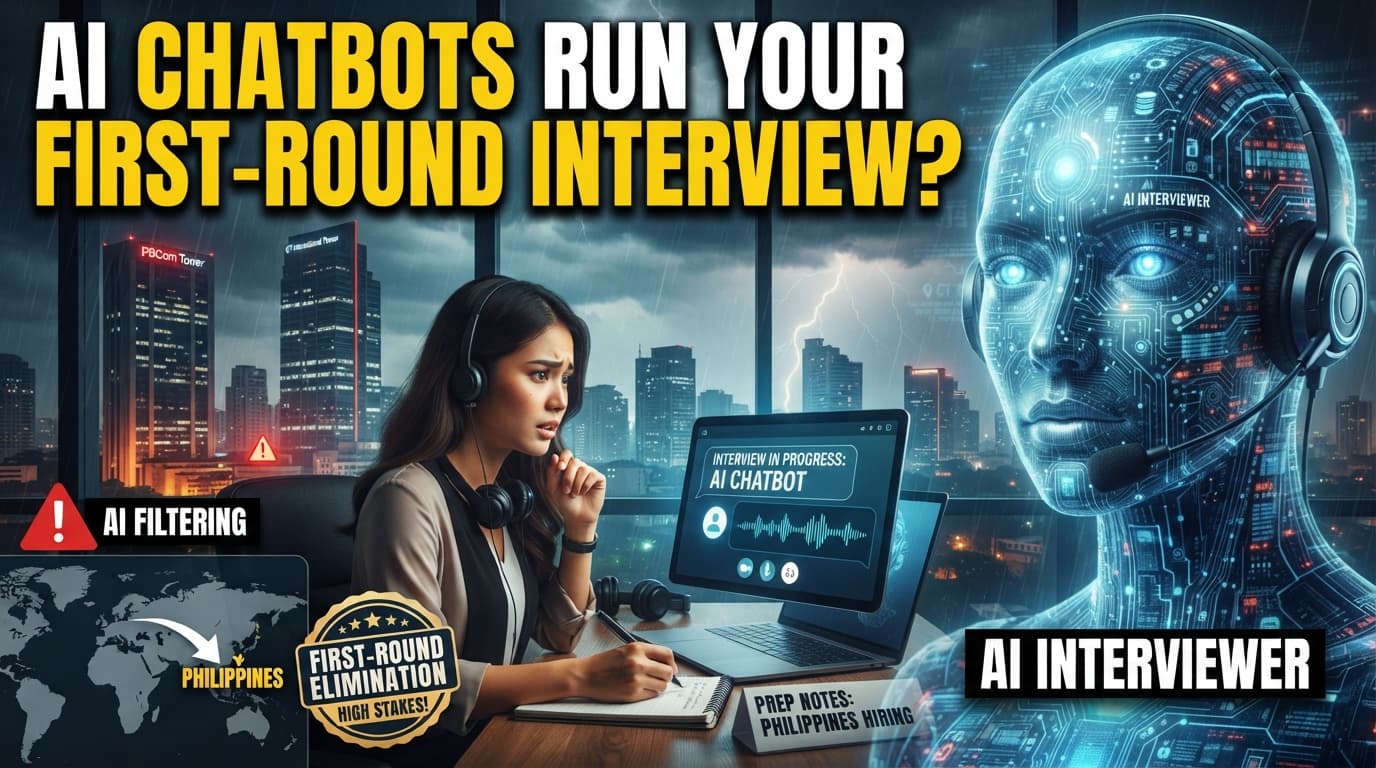
AI chatbots are increasingly conducting first-round job interviews around the world. This guide clearly lays out the practical points Japanese companies should know—both when hiring in the Philippines and when their own people end up on the receiving end of an AI interview.
Part 1: Why This Matters
Step 1: The Philippine Business Context (3 min)
For Japanese companies, the Philippines is a very large hiring market. It is not unusual for a single job opening to draw a huge number of applicants in a short time. As the source article describes, AI chatbots (automated conversational programs that talk with you on screen) taking over the first-round interview is spreading precisely as a response to this problem of "too many applicants for human recruiters to keep up with."
For Japanese companies expanding into the Philippines, and for the Japanese professionals involved in hiring there, this topic carries two meanings. One is the recruiter's view: how to process a flood of applications. The other is the candidate's view: your own employees and candidates are increasingly likely to be on the receiving end of an AI interview when applying to Japanese headquarters or to overseas roles.
According to the source article, AI interviews were originally used for high-volume hiring in retail and manufacturing. Now they have spread to white-collar roles below the director level. For Japanese companies hiring clerical and professional staff in the Philippines, this is no longer someone else's problem.
[A scene at a Manila office] At your Makati office, you turn to Maria, your local hiring lead: "Maria, take a look at this article. In the US, more than 60% of job seekers say they've already interviewed with an AI chatbot. For next month's high-volume hiring, shall we consider letting AI handle the first-round interview? Having a human meet every single applicant just isn't physically possible anymore, is it?" Maria leans toward the screen and replies, "It also says some applicants push back. If we roll this out, let's think through that consideration at the same time."
Step 2: Organizing the Key Facts from the Source Article (5 min)
Sticking only to the facts stated in the source article, here is the summary.
| Item | Fact as stated in the source article |
|---|---|
| Real example (Experis) | Vijo Thomas, 45, of Austin, Texas, interviewed this spring with an AI chatbot named Sophie for about 30 minutes. After two further interviews with humans, he joined as a Senior AI Solutions Architect in May |
| Widening scope of roles | Previously centered on hourly, high-volume hiring in retail and manufacturing. Now spreading to full-time white-collar roles below the director level |
| Greenhouse survey (April, ~3,000 people) | Share who had an AI interview in the past 12 months: US 63%, Germany 57%, Australia 54%, UK 47%, Ireland 36% |
| Coinbase case | Receives roughly 1.5 million applications a year. Introduced an AI interview named Milo in August 2025 and hired over 240 people who passed Milo's first-round screening |
| Zapier case | Piloted AI interviews last fall. Could screen up to five times the usual number of candidates, and about one-third of those who advanced to interviews would not have passed on their résumé alone |
| Applicant pushback | 38% of job seekers have dropped out of a selection process because of an AI interview, and 12% say they would decline if asked to do one in the future |
Source: Business Insider — "AI chatbots are coming for white-collar job interviews" (July 9, 2026)
This table was created for educational purposes based on facts from publicly available information. For details, please check the original article at the link above.
Step 3: Comprehension Check (5 min)
Q1. What is the name of the AI interview Coinbase introduced, and when did it start being used?
Hint: The name is spoken like a person's name. The timing is the latter half of 2025.
Q2. In the Greenhouse survey, which country had the highest share of people who had an AI interview in the past 12 months, and what was that percentage?
Hint: Of the five countries, the highest share is the country that is the main setting of the article.
Q3. How many applicants who passed Milo's first-round screening did Coinbase hire, at minimum?
Hint: A specific figure in the 200s appears in the article.
Q4. What does the Zapier representative call the people who advanced to interviews even though they would not have passed on their résumé alone?
Hint: It's a positive expression—"hidden ~".
Q5. What percentage of job seekers have dropped out of a selection process because an AI interview was involved?
Hint: A figure a little above 30%.
Related: From Credentials to Capability: Hiring for the AI Era explains this in detail.
Part 2: Putting It into Practice
Step 4: Rollout Steps in the Philippines (10 min)
If you want to bring AI interviews into the first round of your hiring in the Philippines, following the steps below will help you avoid mistakes. Each step includes a caveat specific to the Philippines.
| Step | What to do | Philippine-specific caveat |
|---|---|---|
| 1. Narrow the target roles | Start with the high-volume roles where applications concentrate | Starting with roles that draw many applicants, such as clerical or customer-facing jobs, makes the benefit easy to feel |
| 2. Decide how data is handled | Decide how candidates' video, audio, and answers are stored and when they are deleted | In line with the rules of the NPC (National Privacy Commission), which oversees the Data Privacy Act, make consent and retention periods clear |
| 3. Estimate the budget | Estimate the software's monthly fee and the initial setup cost separately | As a rule of thumb, an initial cost is often charged on top of the monthly fee; always get quotes from multiple vendors in pesos |
| 4. Keep humans involved | Treat the AI's score as reference only; a human always makes the final decision | Respecting a culture that values verbal commitments, share internally a practice of never rejecting someone on AI alone |
| 5. Prepare an explanation for applicants | Tell candidates in advance that you use an AI interview and why | As a consideration for pushback, also consider offering a switch to a human interview for those who want to decline |
As you work through each step, adjust to the actual flow of your operations together with your local hiring team. Data handling in particular is the part that most often becomes a problem later. Before rollout, check the NPC's rules and set up a mechanism to obtain consent from candidates. For labor and employment matters, keep DOLE's (Department of Labor and Employment) thinking in mind and take care to keep the selection fair.
Related: Job Scams in the Philippines: Protecting Staff and Hires explains this in detail.
Step 5: Common Mistakes and Fixes (5 min)
When working with AI interviews in the Philippines, the following mistakes often happen.
Mistake 1: "Using the AI score directly as the pass/fail decision"
Treating the numeric score the AI produces directly as your hiring decision is risky. The score can be influenced by features unrelated to job performance, such as speaking style and facial expression.
Bad: "Milo's score fell short of the cutoff, so I automatically rejected this applicant."
Good: "We look at the AI score as one reference. For candidates we're interested in, a human reviews the recording, and the hiring lead makes the final decision."
Mistake 2: "Starting an AI interview without explaining anything to the candidate"
Asking for an AI interview with no advance explanation can startle candidates into dropping out midway. The source article, too, shows that a certain share of people leave a process because of AI interviews.
Bad: "I applied, and suddenly an interview screen with a chatbot appeared. There was no explanation at all, so I got anxious and quit partway through."
Good: "First a human contacts them and explains why we use an AI interview and how it works. For those for whom it's inconvenient, we make other options available to discuss."
Mistake 3: "Hoarding candidates' personal data with no plan"
Continuing to store interview video, audio, and answers indefinitely, with no set deadline, is a problem. It risks running afoul of the Philippines' Data Privacy Act.
Bad: "It's convenient, so we keep every applicant's interview video on the server forever. Honestly, we didn't much care whether we'd obtained consent."
Good: "After obtaining consent from candidates in advance, we set a retention period and manage the data. Once the period passes, we reliably delete it in line with the NPC's rules."
Related: Redesigning a Development Team for the AI Era explains this in detail.
Part 3: Learning More Deeply
Step 6: Related Technical Terms (5 min)
An AI-led interview is an interview in which a computer program, instead of a human, converses with the applicant and conducts the first-round screening. At high-volume hiring sites in the Philippines, because applicants can take it at a convenient time even at night or on weekends, it is being considered as a way to reduce missed applications.
An avatar (the human-like figure shown on screen) is the character that looks like a person, displayed on screen when the AI talks with an applicant. It may appear as an upper-body figure like Sophie in the source article, or it may be voice only; when rolling it out in the Philippines, it is important to choose a design that does not make candidates uncomfortable.
Screening (sorting applicants) is the work of narrowing down, from many applicants, those who advance to the next round. At locations where applications tend to concentrate, such as Manila and Cebu, speeding up this first sort directly affects the speed of the whole hiring process.
Bias (skew in evaluation) refers to evaluation being skewed by factors unrelated to true ability. In the Philippines, bias based on age or origin can also be a problem; there are both the view that using AI reduces bias and the view that it creates a different bias, so you need to review the results periodically even after rollout.
Candidate experience (the impression an applicant receives) is the satisfaction and impression a candidate feels between applying and selection. Because the Philippines has a culture that values human connection, even when using an AI interview, having a human representative reach out partway—so candidates feel valued—is a key to hiring success.
Step 7: Thinking About Applying This to Your Own Company (10 min)
Rethink how you handle high application volume
Try to grasp, in numbers, how many applications a single opening draws at your Philippine location. Check whether humans alone can handle everyone, or whether applicants are slipping through the cracks.
Something to consider: Comparing the number of applications with the number who actually reached the first interview reveals how many candidates are being buried.
Next action: For each opening in the last three months, list the number of applications and the number of first interviews conducted, and share it with your local hiring team.
Draw the line between what to leave to AI and what humans keep
If you do bring in AI interviews, you need to decide how far to automate and where humans take over. On the premise that a human holds the final pass/fail decision, discuss where to draw the line.
Something to consider: Deciding the principle "AI up to a reference score, humans for pass/fail" at the outset keeps the front line from hesitating.
Next action: Write out the first-round flow on paper and color-code which parts the AI handles and which parts humans handle.
Think through how to tell candidates and how to prepare for withdrawals
Decide in advance how you will tell candidates that you use an AI interview. Given that some people push back and withdraw, also consider whether you can offer an alternative.
Something to consider: Preparing a short explanation of "why we use AI" in advance can ease candidates' anxiety.
Next action: Draft one candidate-facing notice, have local staff read it, and check whether anything is unclear.
Part 4: FAQ
Q1. We do high-volume hiring in the Philippines. Which roles should we try AI interviews on first?
Starting with roles that tend to draw concentrated applications is recommended. Clerical and customer-facing roles receive many applications and place a heavy burden on the first round, so you're likely to feel the benefit. The safe approach is to try one role first and, if it goes well, expand gradually.
Q2. Is it a problem to decide pass/fail on the AI's score alone?
Avoid deciding on the score alone. The source article, too, states that recruiters treat the score as reference and humans make the final call. Because the Philippines has a culture that values human connection, leaving room for human involvement also builds trust with candidates.
Q3. How should we handle candidates' interview videos and answer data?
The Philippines has a Data Privacy Act, and the NPC (National Privacy Commission) oversees its operation. Obtain consent from candidates in advance, set a retention period, and put in place a mechanism to reliably delete the data once the period passes. Hoarding it indefinitely, as you might by Japanese habit, risks violating the rules.
Q4. I'm worried about candidates who dislike AI interviews and withdraw. How does this compare with Japan?
A certain number of people withdrawing can happen in the Philippines as in Japan. In the source article's survey, over 30% of people had left a process because of an AI interview. As a countermeasure, carefully explaining the reason for using AI in advance and offering a switch to a human interview for those who want it can reduce withdrawals.
Q5. Could our own employees end up on the receiving end of an AI interview for roles outside the Philippines?
Very possibly. As in the source article, AI interviews are spreading even to white-collar roles below the director level. Tell your employees that in an AI interview, what matters is answering the questions precisely rather than reading expressions or making small talk. The very ability to use AI well will increasingly be evaluated going forward.
Tips for Getting the Most Out of This (3 Tips)
First confirm your own application numbers before deciding
Decide whether to bring in AI interviews with numbers, not gut feel. Lining up the number of applications and the number of first interviews for each recent opening shows at a glance whether human effort can keep up. With this fact in hand, your proposal to adopt it internally becomes more persuasive.
Decide the principle "AI is reference, humans decide pass/fail" first
Before rollout, decide that the AI's score is reference only and that humans hold the final decision. Sharing this line at the outset lets the front line operate without hesitation and reduces the risk of losing candidates to skewed evaluation.
Prepare a candidate notice and leave an escape route for withdrawals
Prepare in advance a notice that briefly explains why you use an AI interview. Allowing those who want it to switch to a human interview reduces withdrawals from pushback. The effort to make candidates feel valued makes the difference between hiring success and failure.
Bonus: How to Make Use of PH AI Works
PH AI Works is a company that supports the use of AI and technology in the Philippines. On today's theme—bringing AI into hiring—we can think through an approach tailored to local Philippine conditions together with you.
As a next step, you can consult us on things like the following.
- You want to organize your own application data and figure out together whether to bring in AI interviews
- You want to design your handling of candidate data in line with the Philippines' Data Privacy Act (the NPC's rules)
- You want to build, together, a framework for how to combine AI scores with human judgment
Please feel free to get in touch. The initial consultation is free.
References and Sources
About the author
Founder / AI Engineer (36+ years in IT)
- ●From Tokyo · based in Manila for 13+ years
- ●36+ years in IT (development, SEO, AI)
- ●IBM Certified Generative AI Engineer
- ●AI chatbots, RAG & AI agent development
A Japanese AI engineer with 36+ years in IT and 13+ years on the ground in the Philippines. I write from hands-on experience to help Japanese companies adopt AI that actually delivers results — chatbots, workflow automation, AI agents, and AI-driven marketing. Feel free to reach out in Japanese or English.
Free AI Consultation
Tell us your challenges and we'll propose the right AI adoption plan for your business.
Book a Free 30-Minute ConsultationRelated Articles
AI Model Vendors Now Sell Implementation Too
OpenAI and Anthropic now sell implementation as well as models. What a local subsidiary should decide about that.
8/18/2026
Contracting for AI While Prices Keep Falling
Write a model number into the contract and it is obsolete in six months. How to design for switching instead.
8/17/2026

Meta Cut 750,000 Under-16 Accounts in Australia
AI-assessed age checks removed 750,000 accounts overnight. What that says about depending on platforms for reach.
8/16/2026

When an AI Calls Your Shop to Ask About Stock
AI now phones shops on a buyer's behalf to check stock. What to decide on the receiving side before it reaches you.
8/15/2026

Handling News That Is Not Settled Yet
A reported $6 billion acquisition talk is not a completed deal. How to act on industry news before it is confirmed.
8/14/2026

What a 69-Page AI Report Does Not Show
Frontier firms are reported 8.3x ahead, yet a table on page 35 shows no statistically significant link to revenue.
8/13/2026